 Eurasia Press & News
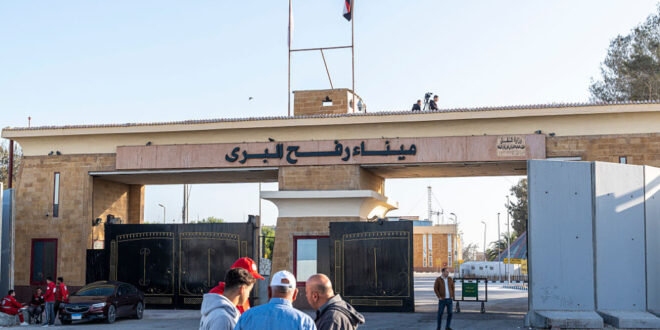
Cairo reaffirmed its adherence to the plan and UN Security Council Resolution 2803, including the right of return for Palestinians.
According to the Egyptian State Information Service, Egyptian authorities refuted on Wednesday afternoon reports that Israel claims it will open the Rafah crossing, the only lifeline for Gaza to the outside world, but only for those wishing to leave the besieged coastal enclave.
Citing an Egyptian official, the service stated that ”any agreement to open the crossing will cover both entry and exit, in line with US President Donald Trump’s plan for humanitarian and political arrangements following the ceasefire.”
Cairo reaffirmed its adherence to the plan and UN Security Council Resolution 2803, including the right of return for Palestinians and maintaining two-way operations at the crossing.
Earlier in the day, Israel’s Coordinator of Government Activities in the Territories (COGAT) announced that the Rafah crossing would reopen ”within the next few days,” marking the first such move since February 2025. According to the statement, departures would require prior Israeli security approval and would follow mechanisms previously implemented under EU supervision.
Notably, the statement made no mention of humanitarian aid entering through the Kerem Shalom crossing.
Moreover, a Palestinian official also echoed the Egyptian denial of Israel’s claim.
Speaking to The New Arab, the official, who preferred to remain anonymous due to the sensitivity of the issue, said, “Neither the Palestinian Authority nor the bodies authorised to manage the crossing have received any formal notification regarding reopening arrangements.”
“What Israel has announced bears no relation to reality, and there are no signs on the ground that the crossing will actually open in the near future,” he added. According to the official, the Israeli statement appears mainly symbolic, aimed at presenting a positive image to domestic or international audiences rather than addressing the urgent needs of Gaza’s residents.
“The citizens of the Strip continue to live under extreme hardship due to the ongoing siege. Any unilateral announcement, not coordinated officially and within international frameworks, will provide no tangible benefit,” the official stressed.
He also warned that Israel could be using such declarations as a form of psychological pressure, attempting to frame Egypt as obstructive, while Cairo maintains its commitment to international agreements.
”Egypt cannot accept unilateral steps that displace Palestinians or undermine their right of return,” the official said, emphasising that the Palestinian Authority is in continuous contact with the European Union and the United Nations to ensure any reopening is conducted safely and in accordance with prior agreements.
Meanwhile, various Palestinian factions, including Hamas, also affirmed the necessity of compelling Israel to implement its obligations under the ceasefire agreement signed on 10 October in Sharm el-Sheikh.
They stressed the need to prevent Israel from manipulating or evading these obligations, or restricting the opening of the crossing to one direction only—for departures from the Gaza Strip—as some Israeli sources have suggested.
A European Union official, who requested anonymity and is familiar with the matter, told TNA that the EU has received no official notification from Israel regarding new arrangements, stressing that “no changes exist beyond the January agreements, and we await Israel’s formal approval for crossing operations under the Trump plan.”
The announced agreements stress that no Palestinians will be forced to leave Gaza. Those who choose to travel will have the right to return, while humanitarian aid will continue through UN agencies, the International Red Cross and Crescent, and other independent organisations.
Reopening the crossing will follow mechanisms jointly supervised by the EU and the Palestinian Authority to ensure oversight and transparency, according to the EU official.
The to-and-fro of claims and denials occurs as Gaza faces a worsening humanitarian crisis, after two years of an Israeli genocide. UN agencies report persistent shortages of food, fuel, and medical supplies, compounding the suffering of thousands of Palestinian families living under an Israeli siege.
Concerns of forced displacement
For Palestinians in Gaza, their reaction to Israel’s claim was mixed.
Mohammed al-Ali, a 42-year-old father of five and market vendor, expressed cautious hope. ”We have lived for years under blockade, separated from family and friends […] My youngest son needs treatment outside Gaza, and my wife has long wanted to visit her family in Egypt,” he told TNA.
“Any chance to travel or receive medical care would be a lifeline. We follow every announcement closely, but delays only increase our suffering,” he said.
Conversely, Shaima Abu Hamad, a 29-year-old secondary school teacher, pointed out the overarching fear that Israel is pushing for the forced and final displacement of Gaza’s Palestinian community.
“We fear this could be a step toward emptying Gaza. We want to stay in our homes, teach, and rebuild our lives, not be forced to leave,” she said. “Any unilateral action that ignores the rights and needs of the population will deepen insecurity and fear for the future.”
Ahed Ferwana, a political analyst based in Gaza, underscored the importance of these concerns of displacement and the need to be wary of Israel’s statements.
“Netanyahu has repeatedly used announcements to deflect pressure to fulfil agreements,” he opined. “This portrays Egypt as an obstacle, while Cairo strictly follows international mechanisms. Israel may be trying to exploit the humanitarian crisis and limited oversight at Rafah to accelerate displacement.”
The ceasefire agreement reached in October, which was supposed to end Israel’s genocide, stipulated that the Rafah crossing would operate in both directions, enabling the return of stranded residents and the transport of patients requiring medical care.
However, Israel has kept the crossing largely sealed, citing Hamas’s alleged failure to meet obligations, including the handover of 48 captives, 20 living and 28 deceased. Israeli forces have also continued to kill Palestinians throughout the coastal enclave.
Recently, Amnesty International reported that Israel’s genocide on Gaza persists.
For Gaza residents, reopening Rafah is vital. The territory has endured over two years of severe restrictions on movement and imports, rising poverty and unemployment, and the near-collapse of basic services.
Both Palestinians and humanitarian organisations insist that two-way access is essential to enable travel for medical care, family reunification, and the delivery of crucial aid.
As Israel and Gaza’s authorities continue to navigate a complex political and humanitarian landscape, residents remain cautious, hoping for tangible relief but wary of announcements that may mask deeper agendas.