 Eurasia Press & News
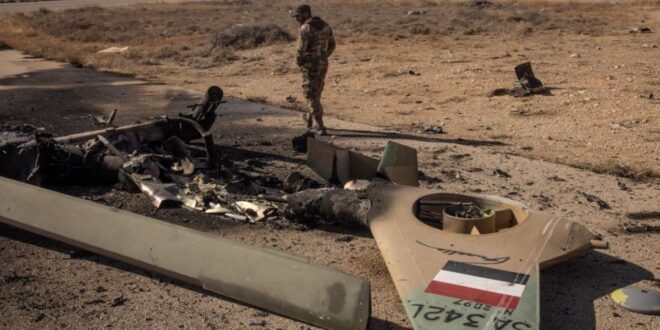
The commander of the Israeli Air Force, Lieutenant General Tomer Bar, has unveiled a strategic plan codenamed “Bashan Arrow”, which aimed to destroy what remained of the strategic military capabilities of the Syrian regime’s army just hours after its collapse and the fall of the Assad regime on 8 December 2024.
According to a report published by the Israeli newspaper Maariv on Monday evening, 8 December 2025, the operation was distinguished as one of the most significant military operations in modern history, paving the way for a later phase of strategic escalation in the region, including strikes on Iranian capabilities under an operation called “Am Klavi”.
The operation began on the night of 8 and 9 December, following meticulous preparation by the Israeli Air Intelligence Directorate, and continued for 72 hours with the participation of all air force wings, before the navy joined in to launch attacks on the Syrian fleet in Latakia port (on Syria’s Mediterranean coast).
Around 350 fighter jets took part in the operation, carrying out more than 350 airstrikes across Syria, targeting about 80% of the Syrian army’s firepower, including 90% of its strategic surface-to-surface missiles.
Targets included two squadrons at (T4) Airbase, as well as a strike on Blei Airbase, where fighter jets and helicopters, Scud missiles, drones, air defense missiles, anti-tank guided missiles, radars, and missile production sites were hit.
A source in the Israel Defense Forces confirmed that before the operation, when Israeli Air Force fighter jets took off from bases in the center or north of the country, they were immediately detected by the Syrian army’s radar systems.
This information could then be passed on to the Iranian air defense command, which led the Israeli Air Force to adopt an initial strike to destroy Syrian air defense systems in preparation for a later large-scale operation against Iranian capabilities.
A source in the Israeli Air Force said that destroying the Assad army’s air defense and radar capabilities was the opening blow that made possible the massive later attack on Iran and enabled rapid, complete air superiority in Iranian airspace. “In Operation Bashan Arrow, the air force decided the outcome of the war against Iran, and a few months later, it was the air force operation that opened the way into Iran, achieving air superiority from Syrian skies all the way to Iran,” the source added.
Israel continues targeting Syrian positions
Israel has carried out numerous strikes on different locations in Syria over the past year, most notably three raids on the General Staff headquarters building in Damascus on 16 July, in addition to a strike near the presidential palace in Damascus, according to monitoring by Enab Baladi.
At the time, a security source told Israel Army Radio that the air force had struck the headquarters of the Syrian General Staff in Damascus.
These repeated attacks have come against the backdrop of an Israeli pledge to protect the Druze community in Suwayda (southern Syria).
Israeli Defense Minister Israel Katz said that the period of warning messages to Damascus “is over, and now the painful blows will come.”
“We will continue to act forcefully in Suwayda to destroy the forces that attacked the Druze until they withdraw,” he added.
On 6 July, the Israeli army also announced that it had carried out a “preemptive” operation in Syria, destroying military positions belonging to the former Syrian regime in the Golan (southern Syria).
This came in a statement and video footage documenting the entry of elements from its 810th Brigade deep into Mount Hermon, which were published by the Israeli army spokesperson, Avichay Adraee, on X.
The spokesperson said that forces from the 810th Brigade, which is part of the 210th Division, continue to carry out operations inside Syrian territory, and that during one of these operations, a reserve battalion from the brigade, in cooperation with the Yahalom combat engineering unit, dismantled several former Syrian regime military positions in Syria.
These positions formed the forward line of contact with Syria near the summit of Mount Hermon and represented “a direct threat” to Israeli positions on Mount Hermon, according to the Israeli army.
The statement explained that the purpose of the operation was “to protect the citizens of the State of Israel, and in particular the residents of the Golan Heights.”