 Eurasia Press & News
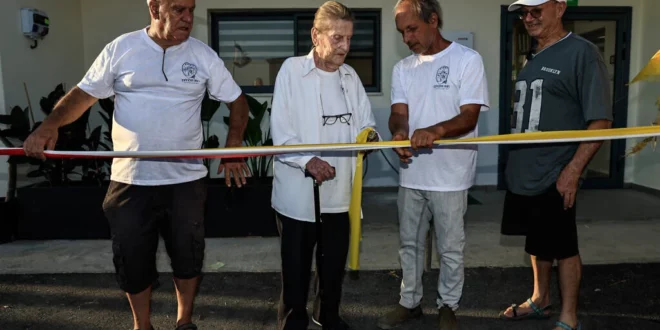
As demolition of damaged buildings continues, new construction is set to begin, with aim of resettling evacuees and absorbing dozens of new families – especially those with babies
KISSUFIM — Looking to build a brighter future, Kibbutz Kissufim, near the Gaza border, is planning to double its population and already has dozens of new families eager to settle in the war-torn community.
Since the devastation wreaked upon it on October 7, 2023, when Hamas gunmen slaughtered 14 out of 270 residents, plus six foreign workers, the community is residing in temporary accommodation in Omer, near the southern city of Beersheba. It hopes to go home next summer.
The kibbutz chairman, Lior Carmel, who resides in another kibbutz, Netzer Sereni, told The Times of Israel that 40 percent of Kissufim’s population was older than 60, and that the kibbutz had decided to add around 10 new members each year, focusing on young people and families.
“Dozens of families have already applied to live here,” he explained, “but we’ll start the process when we start to build, in around six months.”
Those who have already applied to join fall into three groups, he said: young singles, aged up to 30, who had fallen in love with Kissufim while volunteering in the fields, cleaning up, or helping with security duties after October 7; six families who had rented accommodation before the Hamas invasion, and decided to apply for membership; and others whom he had not yet met.
“A lot of young people want to feel part of the post-October 7 rehabilitation of Israel, and moving to the Gaza border area is a way of doing it,” he said.
The kibbutz plans to build 25 housing units over the next two to three years. The Tekuma Directorate, the state organization tasked with rehabilitating the Gaza border communities, will provide NIS 14 million ($4.3 million), to which the kibbutz will add NIS 6 million ($1.86 million) for the project.
“We’re looking for people who want a community life, with all the pros and cons,” Carmel said.
Kissufim’s communal way of life means members respect each other’s right to practice religion in their homes, and the pool is open on the Sabbath, with barbeques and community activities taking place.
“There’s solidarity and mutual commitment here, but you also have to respect group agreements, volunteer a lot, and contribute at least NIS 1,000 ($300) per month per household towards subsidies for services such as education, health, and community and cultural activities,” he said.
Rising from the ashes
On October 7, according to an IDF investigation, around 150 members of Hamas’s elite Nukhba force reached the Kissufim area. Around 40 attacked the IDF’s Kissufim post, located within the kibbutz, while some 60 rampaged through the area, murdering civilians.
According to the probe, some 25 terrorists were killed at the army post, 30 in the kibbutz, and around 50 in the surrounding area. Another 50 withdrew to Gaza, some of them wounded in the fighting with Israeli forces.
Twenty-nine soldiers fell trying to repel the terrorists, with more than 20 more slain on the IDF base.
Among the kibbutz dead was Shlomo Mantzur, 85, who was killed at the kibbutz on October 7. His body was taken to Gaza, and his remains were finally returned to Israel in March.
Also among those slain was Reuven Heinik, 56, a resident of Ashkelon and the longtime manager of the kibbutz dairy. On October 9, two days after the Hamas invasion, he drove to Kissufim to tend to the cows, only to be surprised and killed by terrorists still hiding inside the dairy. To eliminate the gunmen, IDF helicopters and tanks destroyed the building, with the cows inside.
Other physical wreckage includes the kibbutz supermarket and a structure housing artists’ workshops, where Mantzur produced his jewelry.
Carmel said that 97% of 140 residential and public buildings sustained damage during the terror attack, of which 28 were demolished. Another nine, including Mantzur’s house, are being pulled down at this time.
The dairy has been completely rebuilt, modernized, and named for slain manager Heinik, with NIS 17 million ($5.3 million) provided by property tax compensation and donations.
The construction of 20 new residential units for those returning from Omer will begin soon.
Carmel expects 90% to return home within the next two years, including young people.
‘The state has behaved fairly’
Kibbutz Kissufim is privatized and residents own their own homes. Given the need to involve and consult every family individually, there has been a time lapse between the announcement of the funds available and the commencement of the actual works, Carmel explained.
An ongoing shortage of Palestinian construction workers, together with a global rise in the cost of raw materials, has meant that the money residents initially believed they would get to renovate their homes has lost value, leading to frustration.
“We’re just farmers,” said Benny Hasson, who until recently headed the kibbutz poultry houses, and whose home was damaged on October 7. “Where are we supposed to get the difference from?” he asked.
Said Carmel, “It’s true that for private homes, some members won’t get what they thought they would get. They were given a sum, built a dream, and the money has lost value. They have to adapt their plans and are disappointed.”
Still, as a kibbutz with agriculture, solar power generation, and people working both on and outside of the community, the economic situation was relatively good, according to Carmel. It was people with private jobs who could not work remotely who were worst affected economically by October 7 and who would need to be reintegrated into the workforce.
“There is never enough, but the state has behaved fairly,” he said, budgeting NIS 76 million ($23.6 million) for the overhaul of public and residential buildings, and an additional NIS 16 million (just under $5 million), which the kibbutz will use to upgrade old and damaged infrastructure. The state is even paying the 12% overhead charged by the management company responsible for the physical works.
“What we are getting will more or less cover the actual cost of the physical rehabilitation,” said Carmel, adding that an additional $3 million in donations would be used to upgrade an educational building and undertake improvements that were needed for years.
What worried him was the emotional state of the community.
“In a community of 270, 50 people were murdered [kibbutz members and residents, foreign workers, and soldiers]. Around 80 terrorists came, with the last five holing up in the dairy and in the bushes until October 11. It’s crazy,” he said.
“People need to build trust again. One example of this is trust not in Arab people, but in the Arabic language. Many workers on Kissufim are Arab speakers. They have Israeli identity cards and are totally loyal to the state. But when people hear them speaking Arabic, it awakens memories of October 7.”
Carmel is among those voices in Israel pushing for a state commission of inquiry after all the hostages are returned. “People need to know that what happened is investigated in depth, that the truth comes to light, and that the prime minister takes responsibility and apologizes,” he said. “The fact that he and his government are not doing that is very weakening. People talk about this a lot.”
Prime Minister Benjamin Netanyahu is resisting calls for a state commission of inquiry, and has said his government wants to establish a commission of inquiry “with as broad public support as possible,” and not one rejected by what he claimed is “at least half the country.”
Some 25 people have already returned to live on the kibbutz, and, added Carmel with excitement, “We’ve opened a kindergarten with seven children, aged 0 to 6.”
The Eshkol Regional Council is building the kibbutz a new protected kindergarten.
Said Carmel, “It’s very important for us to hear the sounds of babies.”