 Eurasia Press & News
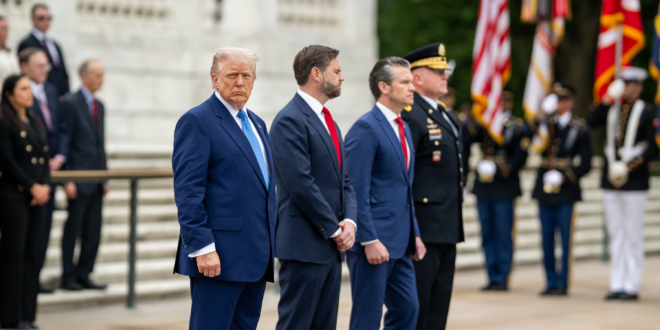
The Trump administration released a new National Security Strategy in recent days, articulating a conceptual break with many aspects of prior post-Cold War U.S. foreign policy.
In some places, the new NSS comes close to sounding like restraint: insisting on the need to prioritize among goals, advancing a narrower definition of core interests, calling for burden-shifting among allies and partners, and working toward regional balances of power rather than global U.S. primacy. [White House]
In other respects, however, the NSS advances misguided, contradictory, or fringe goals peculiar to the Trump administration. For example, even while stating that it will not seek to interfere with the sovereignty of other states, the document repeatedly calls out European governments for their domestic policies, even suggesting the U.S. should support opposition parties that promote “European civilization” and “identity.”
The NSS, despite some useful rhetoric, thus does not offer any real roadmap to a more restrained U.S. foreign policy, even in the Middle East or Europe. This is typical of U.S. strategy documents. [Benjamin Friedman and Justin Logan / War on the Rocks]
In fact, Congress’ current draft of the 2026 National Defense Authorization Act, far from advancing restraint, imposes restrictions on removing U.S. forces from Europe. This seems a better indication of the choices the U.S. government intends to make than the NSS. [Laura Kelly / The Hill]
Perhaps most notably, the NSS also declares a “Trump corollary” to the Monroe Doctrine. This not only aims to maintain U.S. hegemony and limit influence from rival powers in the Western Hemisphere, it claims the right to use force against drug cartels and the need to punish states in the region that seek outside support.
The Trump administration’s recent actions against Venezuela, its threats against Colombia, Mexico, Panama, Greenland, and Canada, and its intervention in support of President Javier Milei in Argentina can all be interpreted as instantiations of this “Donroe Doctrine.” [Gil Barndollar / National Security Journal]
Ironically, this heavy-handed approach may well have the opposite effect of what’s intended, instead pushing other states in the region closer to outside powers. [Daniel DePetris / Breaking Defense]
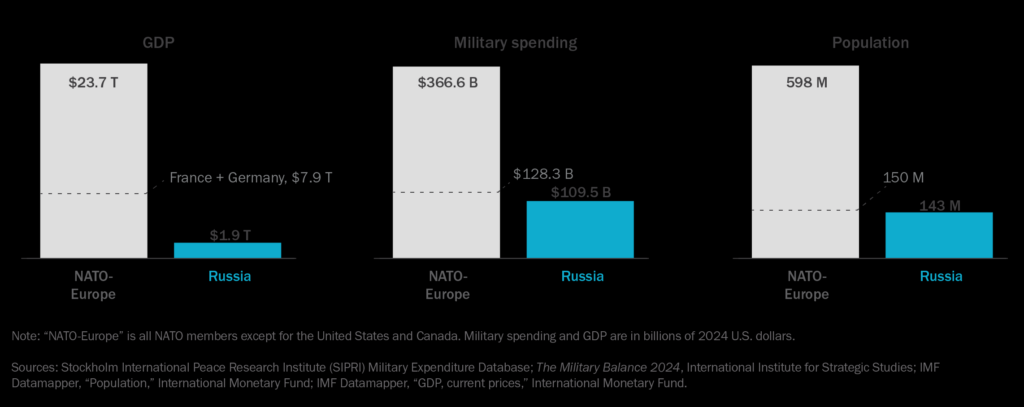
NATO-Europe has more than enough latent power to balance Russia and defend itself without U.S. assistance.
“Any deal that ends the war is going to be painful and unfair…. It still seems like we’re a long way from a set of terms that meets Russia’s minimum acceptable criteria and that is palatable enough to Ukraine that the United States can convince Kyiv to accept it.”
– DEFP Director of Military Analysis Jennifer Kavanagh in “His deadline for a peace deal blown, Trump faces choices on Russia-Ukraine talks” [David E. Sanger and Anton Troianovski / New York Times]