Eurasia Press & News
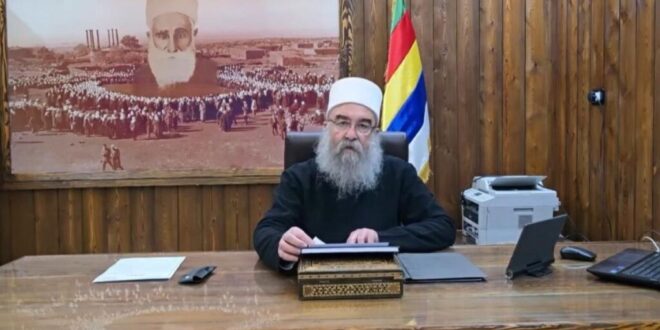
Hikmat al-Hijri, the spiritual leader of Syria’s Druze community, said that since the fall of the previous regime and the flight of its president “under international arrangements,” as he put it, it has been replaced by “a system of politicized factions alongside takfiri gangs.” He argued that the transitional phase has made little difference compared with the “woes and massacres” of the past, except in names and appearances.
In a statement published on the evening of Thursday, 18 December, al-Hijri said the past year was among the hardest for the people of “Jabal Bashan,” a Hebrew term he used for Jabal al-Arab. He stressed that efforts would continue to reach “safe harbor,” in line with what he described as legitimate demands.
He said that calls for Syrians’ rights were met with more “hatred” and attempts at “invasion and extermination,” culminating in what he called “the tragedies of Black July,” including massacres of civilians, the burning of homes, the theft of livelihoods, violations of honor and social customs, and the prevention of residents from returning to their villages “for security reasons and by international will.”
Al-Hijri said work was ongoing to regain villages and homes, adding that his men “rose up to defend the land, honor, and existence.” He announced a “request for independence” aimed at safeguarding dignity and civil peace, through “implementing the right to self determination in accordance with international law,” and said this option would not be abandoned as long as the will remained united.
He called for unified positions and mutual trust, and for faith in those bearing leadership responsibilities, amid continued kidnappings, enforced disappearances, shelling, and sieges.
He urged people to avoid “bickering,” revenge, and accusations of treason, rejecting what he described as “grandstanding” or claiming representation without authorization, while insisting that “the people of Bashan know their situation best.”
He condemned all unlawful acts and called for accountability for “traitors and terrorists,” in reference to those he said had planned a coup against him. He also called for prosecuting anyone who steals aid, trades in people’s basic sustenance, assaults public or private property, obstructs justice, or promotes ideas that fuel strife.
He emphasized that accountability falls under the jurisdiction of the competent authorities, saying that “weak souls” had tried, in his words, to break their own community. He said those individuals had been referred to the judiciary, stressing that there would be no tolerance for anyone implicated in the bloodshed of locals, and that they would remain “in defensive positions.”
Suwayda (southern Syria) saw security tensions after an arrest campaign targeting figures opposed to Sheikh al-Hijri, which led to the deaths of Maher Falhout and Raed al-Matni, one of the Druze sheikhs in Suwayda, who died as a result of torture during detention.
At the time, an Enab Baladi correspondent reported that the “National Guard,” backed by al-Hijri, carried out arrests on 28 November, targeting figures from the province, including the Druze sheikhs Raed al-Matni and Marwan Rizk, as well as Asim Abu Fakhr, Gandhi Abu Fakhr, and another person from the al-Safadi family.
Support for “minorities”
Al-Hijri denounced continued sectarian incitement and what he described as an insistence on exterminating minorities. He condemned sectarian attacks and massacres that targeted Alawites and Christians in Homs and Syria’s coastal region, as well as attacks on areas held by the Syrian Democratic Forces (SDF).
He called on international actors to intervene to stop violations, insisting on supporting Kurdish rights and standing with coastal communities in what he described as their “vigilance and rejection of injustice.”
He saluted the National Guard and Internal Security forces, Christians who he described as “steadfast,” and all minorities who remain attached to their roots and areas.
He said the spiritual leadership was monitoring “states’ efforts and intentions,” and was pursuing what he called a “historic right” through open countries concerned with implementing international resolutions and human rights. He referred to international positions on what he described as events in “Bashan,” and expressed thanks to those “seeking solutions,” including Israel.
Al-Hijri concluded by stressing continued efforts and calling for patience, discipline, and trust so that “Bashan becomes a point of stability” and “a shining pearl” in the region, as he put it.
He had previously sent a message on 11 October to the UN secretary general, members of the UN Security Council, the UN high commissioner for human rights, the Arab League, and Amnesty International, saying that “Jabal Bashan” suffers “for months from a comprehensive and harsh siege that threatens civilians’ lives.” He called on the international community to recognize what he described as “genocide” faced by the people of Suwayda.
Suwayda events
The events in Suwayda began on 12 July after reciprocal kidnappings between residents of the al-Maqous neighborhood in Suwayda, which has a Bedouin majority, and a number of Druze residents. The situation escalated the next day into mutual clashes.
The Syrian government intervened on 14 July to end the conflict, but the intervention was accompanied by violations against Druze civilians, prompting local factions to respond, including groups that had been cooperating with the Ministries of Defense and Interior.
On 16 July, government forces withdrew from Suwayda after coming under Israeli strikes. This was followed by violations and retaliatory acts against Bedouin residents in the province, leading to the dispatch of military convoys described as “tribal mobilizations” in their support.
Later, the Syrian government and Israel reached a US mediated agreement to halt military operations.