 Eurasia Press & News
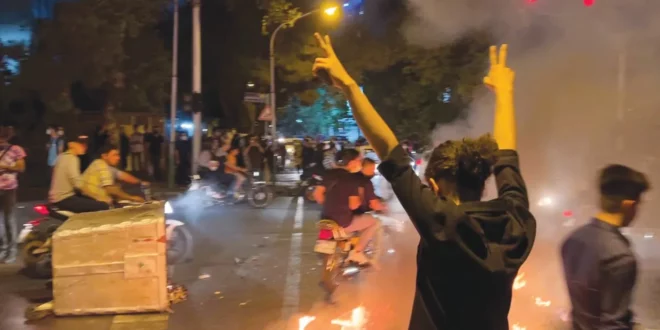
REGIONAL AFFAIRS: Any visible Israeli hand risks allowing the regime to reframe an organic uprising as a Zionist plot – but this does not mean that nothing should be done from the outside.
When reporters asked US President Donald Trump this week whether he supports the overthrow of Iran’s regime, his answer was striking less for what it said than for what it didn’t.
“I’m not going to talk about the overthrow of a regime,” Trump said during a photo-op on Monday with Prime Minister Benjamin Netanyahu at the entrance to Mar-a-Lago.
Instead, he spoke about Iranian inflation, an economy gone “bust,” economic collapse, and a people ground down by hardship – before offering a bleakly realistic observation drawn from years of watching Iran: whenever protests reach a critical mass, the regime shoots, people are killed, and the streets empty.
With this characteristically blunt description, Trump was acknowledging a truth that Western policy-makers have struggled with for decades: wanting the Iranian people to succeed, while knowing that openly supporting their efforts for regime change may actually help ensure they fail.
That tension – between solidarity and sabotage, between moral clarity and strategic restraint – sits at the heart of the moment Iran is now entering, once again.
Beyond economics: Iran’s 2026 uprising and the West
TENS OF thousands of Iranians have taken to the streets since Sunday across the country, first over the collapse of the rial and soaring inflation, but then quickly voicing demands – signaled by chants like “Death to the dictator” – that go well beyond economics.
It has happened repeatedly over the last 25 years. Student protests in 1999-2000. The Green Movement in 2009-2010. Nationwide economic protests in 2017-2018. The fuel-price uprising of November 2019. Water and bread protests in 2021. And most dramatically, the “Woman, Life, Freedom” movement in 2022-2023, following the death of Mahsa Amini in custody.
The same question arises in Washington, Jerusalem, and European capitals each time – how to help without hindering.
The dilemma has its roots deep in Iran’s collective memory: the 1953 CIA-backed overthrow of Prime Minister Mohammad Mossadegh. For Iranians, this is not some obscure event that happened nearly 75 years ago. Instead, it is a trauma that resonates through the years. It is also the prism through which Tehran frames every Western gesture of support for internal dissent.
When Iranian leaders accuse the US and Israel of instigating protests, they are not inventing a narrative out of thin air. They are invoking a real episode that continues to reverberate. That incident lends the regime’s claims of foreign interference a sense of plausibility – a “been there, done that” credibility that might otherwise not exist.
Likewise, that episode has strongly influenced every American response to Iranian unrest since.
In 2009, President Barack Obama, facing the Green Movement, opted for extreme caution. Seeking to avoid giving Tehran an excuse to brand the protests as foreign-backed, and very keen on preserving the possibility of nuclear diplomacy, which was a top administration priority, Washington kept its distance.
With time, that restraint – especially considering Obama’s support for protesters in Egypt during the “Arab Spring” – has come to look like a badly missed moment. America’s silence did not spare the protesters from repression, and the regime – which at the time seemed to be teetering – survived to consolidate its power.
Trump, in his first term, chose the opposite tack. During the 2017-2018 protests and again in 2019, he openly voiced support for the demonstrators and cast their anger as evidence of regime corruption and misrule. Tehran seized on those statements as proof of foreign interference, and the protesters themselves were divided over whether Trump’s words helped or hurt.
Joe Biden, faced with the 2022 protests, decided on a more vocal response than that of the Obama administration. The White House paired clear public support for Iranian women with targeted sanctions and steps to expand Internet access. The shift reflected lessons Biden drew from 2009, as well as changed realities that included stalled nuclear talks and less concern about diplomatic fallout from showing support.
Tehran predictably blamed Washington for stirring up the unrest and brutally put down the protests. This reinforced the conclusion that, regardless of how the US responds, the regime will pin the protests on “foreign agitators.”
FOR ISRAEL, the dilemma is even sharper.
Jerusalem would obviously be thrilled by a different regime in Tehran – one not pouring resources into Hezbollah, Hamas, and ballistic missiles aimed at Israeli cities. But Israel’s very involvement is radioactive.
Netanyahu put it carefully this week in an interview with Newsmax. Change in Iran, he said, “will come from within.” Israelis, he stressed, understand what the Iranian people are going through and are sympathetic, but it is not for outsiders to decide Iran’s future.
That restraint is deliberate. Any visible Israeli hand risks allowing the regime to reframe an organic uprising as a Zionist plot.
This does not mean that nothing from the outside should be done, or that the West and Israel are helpless and must abandon the Iranian protesters to their fate.
Rather, the conclusion is that the tools that actually work and are effective are unglamorous, indirect, and often invisible.
Economic pressure matters – a lot.
The current protests did not erupt in a vacuum. They were triggered by inflation, a collapsing currency, and the siphoning off of hundreds of billions of dollars to fund a grandiose nuclear program and regional proxies created to form a “ring of fire” around Israel. All the while, ordinary Iranian citizens were left without reliable electricity or water.
Sanctions imposed in response to these Iranian policies contributed mightily to Iran’s economic vulnerability, and tightening them now in targeted ways can place further pressure on the regime and limit its ability to buy loyalty.
Economic sanctions on Iran are not enough
SANCTIONS ALONE, however, are not enough; they should be augmented by technical support for the protesters. One way of doing this is to ensure Internet access by providing censorship-circumventing tools such as Psiphon and satellite connectivity kits such as Starlink. This allows the protesters to directly counter the regime’s ability to isolate them, coordinate crackdowns, and control the narrative.
The Biden administration did this to some degree during the Mahsa Amini protests, allowing the protesters to document abuses, organize strikes, and sustain momentum.
Targeting the machinery of repression also matters. Sanctions on surveillance technology providers, on telecommunications firms enforcing censorship, and on Islamic Revolutionary Guard Corps units directly involved in crackdowns would affect the regime’s capacity to put down the protests.
Targeting IRGC units does not necessarily mean military action against them, but, rather, pinpoint sanctions: naming the provincial IRGC and Basij commanders who order the shooting of protesters or make mass arrests, freezing their assets abroad, and restricting their travel. The aim is to erode the regime’s capacity to repress by raising the personal and institutional cost for those who carry out the crackdowns.
Another way the West can help is by supporting Iranian diaspora organizations that operate at arm’s length from governments. These groups can provide financial, legal, and moral assistance without tainting the protesters as foreign proxies.
THERE IS, however, another possibility hovering in the background – direct military action.
In recent days, there has been increased talk about the possibility that Iran could try to deflect domestic pressure outward by attacking Israel. This is not something unheard of in the region.
But here the calculus cuts both ways.
As Netanyahu warned this week in an interview on Fox News, any ballistic missile attack on Israel would bring devastating consequences to Iran.
Nevertheless, if Iran were to strike Israel now, it would hand Jerusalem a clear justification to hit IRGC bases and personnel inside Iran – precisely those forces responsible for violently suppressing protests. Such strikes would not be framed as support for demonstrators, but as self-defense.
Tehran obviously understands this, which is one reason it may reconsider whether this is really the time to launch an attack against Israel. While Jerusalem is very unlikely to act preemptively on behalf of protesters, if hit by Iran, it has made clear that it will not hesitate to respond with full force – and that response would inevitably have an impact on Iran’s internal repression apparatus.
ONE OF the most striking aspects of this moment is what has not happened.
During the Israel-Hamas War, massive anti-Israel demonstrations – often openly sympathetic to Hamas – swept capitals and campuses around the world. Hamas saw those protests and concluded that much of the world was with it.
For Iran’s protesters, there has been no such echo. Why?
Part of the answer lies in framing. The anti-Israel protests were cast, however, tendentiously, as anti-colonial and anti-imperialist. Iran, which brands itself as being at the anti-imperialist vanguard, does not fit that mold. The radical Left and the Islamists – the red-green coalition that coalesced in full force after October 7 against Israel – are not going to go out to demonstrate against the ayatollahs.
But forget about protests. Tellingly, The New York Times did not have a single article about the protests on its front page this week. Not only was there no article, but there was also not even a blurb at the bottom of the front page where articles on the inside pages are promoted.
The absence of global demonstrations of solidarity with the Iranian protesters, and the lack of front-page attention, matters and has consequences for those demonstrating in Iran.
Authoritarian regimes do factor international reaction into their responses. When internal unrest dominates headlines and triggers demonstrations abroad, repression becomes costlier.
When it does not spark much of a response, the regime’s calculus shifts. Silence lowers the perceived price of repressing these protests, and Iran’s leadership can conclude that it has room to crack down without triggering sustained external pressure.
Global reaction also has an effect on the staying power of the protesters. The Gaza demonstrations around the world signaled to Hamas that it was not isolated, and this informed some of its decisions.
A lack of global outrage now sends Iranian protesters the opposite message: they are on their own, their struggle did not capture the world’s attention. That matters in terms of morale, endurance, and the demonstrators’ willingness to keep returning to the streets even as the risks mount.
OVER A quarter-century of protest waves in Iran, the West – led by the United States and including Israel – has oscillated between caution and moral support, but has never crossed into overt sponsorship of regime change.
That restraint reflects neither cowardice nor indifference, but history: an understanding that in Iran, visible foreign support can become a liability. The task now is not for the West or Israel to lead Iran’s revolution, but to avoid getting in its way – and to quietly, patiently make it harder for the regime to crush those who are risking everything to challenge it.