 Eurasia Press & News
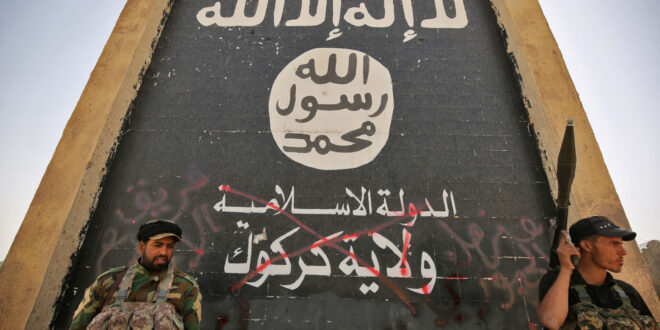
In the most fatal attack against US troops in Syria so far this decade, an Islamic State (IS) gunman shot dead two US soldiers and a civilian American interpreter on 13 December.
The deadly attack transpired amidst expanding US-Syrian military cooperation and Syria joining the US-led anti-IS coalition. It raises questions concerning IS’s potential to destabilise Syria amidst the delicate ongoing post-Assad political transition.
The attacker had infiltrated Syria’s security forces, getting himself into a position where he could shoot the Americans and some of his fellow Syrians before getting himself killed. The US military retaliated by launching Operation Hawkeye, which saw US warplanes bomb 70 targets with 100 precision-guided munitions, on Friday.
“IS’s ‘success’ in killing US troops in Syria might well be an opportunistic one-off – it is certainly possible the jihadists would see the propaganda value in such a thing,” Kyle Orton, an independent Middle East analyst, told The New Arab.
“However, IS’s general practice is to acquire influence through infiltration and intimidation, and only reveal itself once it is able to withstand the backlash of its presence being known,” Orton said. “Which could suggest this is a signal that IS assesses its position as powerful enough to engage in a more overt confrontation,” he added.
“The simultaneous escalation in IS strikes in government-controlled areas this past week would appear to be data pointing in the latter direction.”
Century International fellow and Swedish Defence Research Agency (FOI) senior analyst Aron Lund cautioned that the “absence of reliable details” makes it hard to speculate on how exactly the 13 December attack happened.
“The Islamic State clearly has some degree of presence and support in Syria,” Lund told TNA. “It may be concealing the true extent of that presence, in order to quietly build up its position.”
Recent events in Syria “may have given them another shot at reorganising, but it’s a complex picture – it creates opportunities but also new obstacles,” Lund added.
Vetting vexations
The assailant in the attack, which took place near the iconic ancient city of Palmyra, had recently joined the new Syrian security forces two months earlier. He was one of 5,000 members recruited for a new division established in the Badiya desert region. IS remnants have long used this large, barren area as a sanctuary.
“The incident highlights the continued permissive environment in the Syrian Badiya, a vast and weakly governed area that the Islamic State continues to exploit for movement, planning, and attacks,” Freddy Khoueiry, a global security analyst for the Middle East and North Africa at the risk intelligence company RANE, told TNA.
The 13 December attack occurred only a month after Syria officially joined the anti-IS coalition. The US and Syrian militaries had previously cooperated on a limited basis against IS, but the US military still distrusts its new partner.
“In terms of countering IS, the US can help Damascus up to a point,” Orton said. “The government’s military apparatus does suffer all kinds of deficiencies in training, discipline, and resources that the US can assist in providing technical fixes.”
Syrian President Ahmed Al-Sharaa previously led the armed Islamist group Hayat Tahrir al-Sham (HTS), which spearheaded the overthrow of his predecessor, Bashar Al-Assad, in December 2024. HTS officially disbanded, and many of its fighters joined the new military.
The group previously controlled Syria’s northwestern Idlib province and didn’t have the manpower required for building a national army. Consequently, it sought more recruits, and at least some IS militants or sympathisers have managed to infiltrate.
Orton highlighted a “fundamental problem” for which there isn’t any “technical fix” when it comes to building Syria’s new army.
“HTS is an Islamist outfit emerging from the jihadi-Salafist camp, and whatever modulations the leadership has made in its thinking, the evolution of the rank-and-file is distinctly less complete,” he said.
“Unlike a Western military, where signs of Islamism are a red flag that often lead to dismissal, HTS is having to try to detect when one of its soldiers has crossed from what some call the ‘political jihadism’ to the ‘extremist’ jihadism of the Islamic State,” he added.
“That is difficult even for HTS and impossible for the US.”
Constructive cooperation
Lund of FOI sees grounds for some cautious optimism. Noting that the US has good reason for its “serious counterterrorism concerns,” he underlined how Al-Sharaa is a reliable partner against IS.
“Al-Sharaa’s government has positioned itself as a partner in the struggle to root out the Islamic State, and there’s no reason to doubt his commitment to doing exactly that,” Lund said.
“Al-Sharaa’s rebel faction has very problematic jihadist roots – very, very problematic – but it started fighting the Islamic State more than ten years ago. They were determined and ruthless about it, and they were pretty effective.”
Furthermore, as Syria’s president, Al-Sharaa has shown he is no less determined to fight IS. He now has “added incentives” to do so.
“He needs to move away from his jihadist legacy, and counterterrorism cooperation has emerged as a way to build a positive security relationship with the US, Europe, and Arab nations,” Lund said.
“Al-Sharaa used to be a US-designated terrorist, but he’s now a US-backed counterterrorism leader. He’s a smart guy, and he knows that this is a good card to play – and frankly, he’d be doing it anyway.”
Nevertheless, some factors could complicate, if not undermine, otherwise constructive cooperation.
“Syria is fragile and dysfunctional,” Lund said. “Al-Sharaa’s government is weak, and it is made up of Islamists, many of whom have a significant degree of sympathy for the Islamic State’s anti-Western message,” he added.
“Al-Sharaa’s pro-Western turn and public courting of minorities and secularists is deeply off-putting to some of his armed supporters,” he added. “They wanted Sharia law and Islamic governance, not whatever this is.”
And while many will comply despite their reservations, some won’t, potentially creating space for “more intransigent Islamists,” such as al-Qaeda loyalists or IS supporters. As the 13 December attack showed, there doesn’t need to be many of them to cause trouble.
“Even though Trump didn’t flinch and just reassured Al-Sharaa of his support, it was a serious incident,” Lund said of 13 December.
“More incidents like this could strain US trust in Al-Sharaa’s government, and with Trump being infamously fickle, who knows how he’ll react if this keeps happening.”
Orton similarly believes that attacks like 13 December could strengthen “Trump’s tendency to think that the US is better washing its hands of Syria entirely rather than being drawn into a complicated nation-building (or at least state-building) enterprise”.
The attack was the first time IS had killed American soldiers since a suicide bomb attack in Manbij in January 2019. Editorials promptly appeared in American media in its aftermath, calling for an immediate withdrawal of US troops from Syria.
“Bureaucratic inertia and Trump’s limited attention span might prevent any precipitate US withdrawal from Syria, even as that continues to be the goal Trump is pushing towards, but all bets are off if ‘green-on-blue’ attacks become routine,” Orton said.
While RANE’s Khoueiry believes the attack will “inevitably renew calls” for a complete US withdrawal, he anticipates that any ultimate drawdown will “remain gradual” as US policymakers fear a rapid withdrawal could create “further security vacuums” and “embolden” IS.
“The US is unlikely to suspend cooperation with Syria in the near term and may instead deepen it, particularly if Syrian security forces under the Al-Sharaa government continue to demonstrate a credible commitment to targeting IS cells and addressing extremist elements within their own ranks,” he told TNA.
“Al-Sharaa will no doubt continue to police jihadist dissenters and suppress the Islamic State,” he said. “There’s no reason to doubt his commitment to stamping out the Islamic State and groups of that nature – and his forces will be more effective at it than the former regime was, in some ways,” he added.
“But even so, Al-Sharaa’s government is vulnerable to Islamic State infiltration in ways that Assad’s government was not. And institutionally and in terms of material capacity, it’s still very weak.”
Despite all of this, Washington calculates that it’s much better to keep Al-Sharaa onside, since there are far more precarious possible alternatives.
“For the US, Al-Sharaa will remain the best thing on offer unless Syria starts falling apart completely or unless some internal crisis were to force him to shift gears and return to his jihadist roots,” Lund said. “Washington will want to prevent that,” the analyst added.
“The United States is likely to keep showering him with praise and support, to reinforce his position and keep him on a positive ideological trajectory.”