 Eurasia Press & News
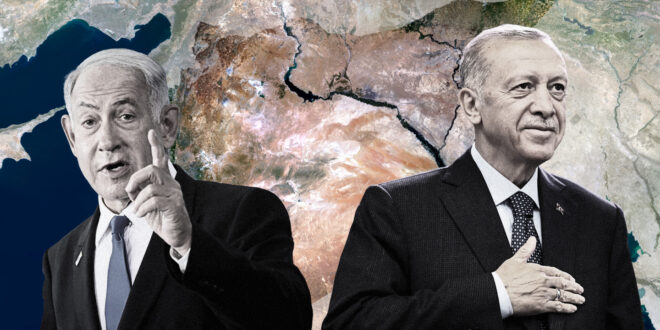
Since the collapse of Bashar Al-Assad’s government just over a year ago, Syria has become an arena for an increasingly stark contest between Turkey and Israel.
Ankara and Tel Aviv’s strategic visions for Syria are fundamentally irreconcilable. Turkey seeks a unified state anchored by an Ankara-friendly central authority and preserved territorial integrity.
Israel, by contrast, favours a weakened and fragmented Syria incapable of projecting power or resisting external aggression.
With Iran largely pushed to the margins, Turkey has emerged as the principal counterweight to Israel’s expansionist and destabilising designs in the war-ravaged country.
Nearly ten months after Damascus and the Syrian Democratic Forces (SDF) signed the 10 March agreement, which envisaged integrating the People’s Protection Units (YPG)-dominated force into the Syrian state, the process has stalled.
This paralysis has sharpened Ankara’s anxieties, particularly as Israel’s links with the SDF/YPG increasingly shape Turkey’s threat perceptions of the US-backed group in northeastern Syria.
The SDF and the limits of state authority
The 10 March agreement was designed to facilitate the integration of the SDF/YPG into the Syrian armed forces by the end of 2025. Yet progress has stalled, with disagreements over the mechanics of integration proving intractable.
At the core of the impasse is a fundamental divergence: the US-backed force seeks to preserve its existing battalion structures and a measure of autonomy, while Damascus insists on the individual absorption of SDF fighters into the national military.
Having secured unprecedented autonomy during the civil war, the SDF/YPG is deeply reluctant to relinquish the authority it has exercised since 2012. The Kurdish-majority force also assumed control of key Islamic State detention facilities, as well as large portions of Syria’s hydrocarbon resources, which are strategic assets that further reinforce its leverage and resistance to central control.
Whether Damascus and the SDF/YPG can ultimately reach a compromise capable of averting a full-scale confrontation remains uncertain. The United States is attempting to facilitate additional dialogue in an effort to sustain momentum toward some form of integration.
An extension of the deadline into 2026 may offer both sides a face-saving off-ramp and reduce the risk of a deeper national rupture. Still, clashes between SDF/YPG and Syrian government forces in Aleppo on 22 December underscored the fragility of the process and the depth of mutual mistrust.
Meanwhile, Turkey’s patience is rapidly eroding. Ankara has made clear that, absent tangible progress on integration, a renewed round of Turkish military operations against the SDF/YPG cannot be ruled out.
Tel Aviv’s hand in northeastern Syria
Speaking alongside his Syrian counterpart, Asaad Hassan al-Shaibani, at a joint press conference in Damascus on the day of the Aleppo clashes, Turkish Foreign Minister Hakan Fidan declared the SDF/YPG had “no real intention of making significant progress in the negotiations on integration with the Damascus administration”.
He further accused the group of conducting “some of its activities in coordination with Israel,” and described that as a “major obstacle” to integration. Fidan’s visit to Damascus carried added weight, as he was accompanied by Turkey’s defence minister and intelligence chief.
Available reporting suggests that Prime Minister Benjamin Netanyahu’s government has developed indirect but substantive links with the SDF/YPG as part of Tel Aviv’s post-Assad Syria strategy, using the group as a means of constraining the consolidation of power by the relatively new central authorities in Damascus.
Nonetheless, Israel’s relations with the SDF/YPG are far less direct than Tel Aviv’s ties to Israel-backed Druze factions in southern Syria. Geography is certainly a huge factor.
“The Druze live in areas close to Israel and within what Israel considers its immediate sphere of influence. Northern Syria is far removed from that context,” Dr Salim Çevik, a Visiting Fellow at the German Institute for International and Security Affairs (SWP), explained to The New Arab.
Israel’s ties with the SDF/YPG need to be understood within the context of the United States’ role as a backer of the Kurdish-dominant group, he added.
“There is no realistic scenario in which Israel would militarily shield or actively defend the SDF against a Turkish operation. More importantly, the decisive external actor regarding the SDF is the United States, not Israel,” Dr Çevik said.
“Washington treats the SDF as part of its own security framework in Syria. Israel cannot meaningfully support the SDF independently of US policy.”
Ankara’s red lines and the risk of escalation
Ankara’s message is unequivocal: it will not remain passive if the SDF/YPG fails to integrate into the Syrian armed forces.
Ankara regards the YPG as an offshoot of the Kurdistan Workers’ Party (PKK) and has designated the US-backed group a terrorist organisation.
Although both the United States and the European Union similarly classify the PKK as a terrorist entity, they stop short of extending that designation to the YPG.
Viewing a PKK-affiliated proto-state, particularly one coordinating with Israel along its borders, as a grave national security threat, Turkey has made clear that it will not tolerate such an entity consolidating its position.
Since August 2016, Turkey has launched multiple military operations against the group inside Syria, with growing media speculation that Ankara may soon undertake another.
“An Apoist Kurdish state hostile to Turkey has always been seen by most Turkish nationalists as a part of the Greater Israel Project, which aims to occupy areas from Turkey’s Southeast, where the PKK mostly operated, to the Nile. Netanyahu’s overt support for the YPG has exacerbated this notion,” noted Dr Ali Demirdas, a US-based analyst who specialises in Turkish politics, in a TNA interview.
“With Assad gone and a Turkish-backed government established in Damascus, many Turks are of the opinion that Turkey is now de facto bordered by Israel at the Golan Heights. Therefore, both Turkey and Israel’s push for regional dominance will likely result in indirect if not direct clashes,” he added.
Enter Saudi Arabia
Saudi Arabia and other Gulf Cooperation Council (GCC) members are playing increasingly prominent roles in post-Assad Syria, not only as economic investors but also as political and diplomatic partners of Damascus.
With Riyadh now closely aligned with the Turkish-Qatari axis on the Syrian file, Saudi Arabia and Turkey stand unified in their opposition to Israeli efforts to fragment and weaken the country.
“It’s becoming increasingly clear that Turkey is the only regional power that has the ability and arguably the willingness to counterweigh the new Israeli hegemony in the region, and specifically in Syria,” Dr Karim Emile Bitar, a lecturer in Middle East Studies at Sciences Po Paris, told TNA.
“Also, in a context where there are increasing rivalries between Saudi Arabia and the UAE in Yemen, Sudan, and elsewhere, Turkey has something in common with Saudi Arabia notwithstanding the rivalry within Sunni Islam,” he added.
“What they do have in common is that they are both determined to do their best to preserve Syria’s unity and territorial integrity at a time when Israel is increasingly trying to court and use the existential angst of minorities, and this could lead to fragmentation in the region.”
Saudi officials, like their Turkish counterparts, are calling on the international community to pressure Israel to halt its aggression against post-regime-change Syria, while simultaneously backing the Trump administration’s lifting of US sanctions on Damascus – a move that both Ankara and Riyadh successfully lobbied for earlier this year.
In this regard, Saudi Arabia and Turkey share a vision of a strong, unified Syrian state. This stands in direct contrast to Israel’s preferred outcome.
“Turkey is not acting alone in this effort. Saudi Arabia is at least as important an actor as Turkey in trying to influence Washington’s Syria policy, and both invest significant diplomatic effort in pushing the US toward stabilisation, state functionality, and territorial coherence. Israel pushes in the opposite direction, emphasising containment and the prevention of Syrian state reconstruction,” commented Dr Çevik.
The battle for Syria is far from over
Nearly 13 months after Assad’s fall, Syria is no longer merely emerging from civil war. It is being reconstituted amid an intensifying struggle between competing regional visions.
At the core of this contest lies a stark choice between the consolidation of power in President Ahmed Al-Sharaa’s government and fragmentation. Turkey, aligned with Saudi Arabia, Qatar, and other Gulf monarchies, is investing diplomatic and political capital in the restoration of a unified Syrian state capable of exercising sovereign authority across its territory.
Israel, by contrast, is fully committed to preventing precisely such an outcome, favouring a Syria too fractured to challenge Tel Aviv’s borderless aggression and quest for regional hegemony.
The SDF/YPG’s unresolved status has become a pressure point in this rivalry. As integration stalls and mutual distrust deepens, the risk of miscalculation grows, particularly as Ankara’s patience wears out.
Although Washington constrains Israel’s indirect leverage over the SDF/YPG, Tel Aviv’s ties to the group have nevertheless sharpened Turkish threat perceptions and increased the risks of an increasingly direct Turkish–Israeli confrontation over post-Assad Syria.
Looking toward 2026, a critical variable is how the Trump administration handles rising tensions between Turkey and Israel.
Whether the White House honours its stated commitment to working closely with Turkey and Syria or allows Netanyahu free rein to pursue the “Greater Israel” agenda will be decisive in determining whether post-Assad Syria achieves greater stability and unity under its Ankara-aligned government, or fragments into separate entities, reminiscent of Yugoslavia in the 1990s.