 Eurasia Press & News
IRAN AFFAIRS: A slogan once considered politically unutterable has returned, and sounds of crowds chanting it fill the air as Iranian protests continue to call for the end of the Islamic Republic.
As protesters took to the streets of Iran this week, amid chants of anger against Supreme Leader Ayatollah Ali Khamenei and fury over an economy in free fall, a slogan once considered politically unutterable returned, and the sounds of crowds chanting it filled the air.
“Javid Shah” – Long Live the Shah.
Videos sent from inside Iran showed demonstrators chanting openly in support of the Pahlavi dynasty, in exile since the fall of the last shah, Mohammad Reza Pahlavi, alongside calls for the downfall of the Islamic Republic. For a regime built on the overthrow of the monarchy and the erasure of the Pahlavi legacy, the chant is existentially threatening. It is a sign that anger has moved beyond dissatisfaction with economic policies or personalities and toward rejection of the Islamic Republic itself.
The demonstrations erupted last Sunday after Tehran’s powerful bazaari merchant class shuttered its shops in protest at Iran’s deepening financial crisis. The collapse of the rial, which briefly saw the open-market value of $1 reach 1.4 million rials, compared to the official rate of 42,000, transformed long-simmering economic despair into open unrest. From Tehran to Isfahan, Mashhad, Ahvaz, and Hamadan, protests spread rapidly, and the slogans soon moved beyond bread-and-butter grievances.
Crowds were heard chanting, “This is the final battle! Pahlavi will return,” and “The shah will return to the homeland, and Zahhak (despot) will be overthrown,” invoking the mythological tyrant of Persian lore. Chants calling for the death of Khamenei and rejecting Iran’s regional spending – “No to Gaza, no to Lebanon, I give my life for Iran” – have shown that it is not merely financial disaster but the continuous funneling of billions of dollars to proxy groups that the people are sick of.
So far, Iran’s security forces have relied largely on tear gas, water cannons, and rubber bullets to disperse crowds, although Wednesday night saw the first death of the protests when, according to reports, a member of the paramilitary Basij militia which is regularly deployed to suppress unrest, was killed. The regime appears wary of deploying its security forces too harshly, attempting at first to placate demonstrators with political fixes and messages of “dialogue,” aware that such a move could push the unrest into uncontrollable territory. But the slogans echoing through the streets suggest that something deeper has already begun.
To outside observers, chants of “Javid Shah” may sound like a literal call for the restoration of monarchy. Inside Iran, their meaning is more complex.
For a regime that has invested enormous energy in trying to subdue the idea of Iran’s monarchical past, the return of such chants is deeply unsettling. The Islamic Republic, after all, represents only a fleeting moment in Iran’s long history. If the Islamic Republic survived to reach 50 years in 2029, it would represent less than 2% of Iran’s history. For most of that history, Iran was ruled not by clerics but by kings, shahs, and emperors.
The chant of “Javid Shah” represents on one level the Iranian people’s desire for something it has enjoyed (or endured, depending on how one feels about monarchy) for the majority of its history. Iranians look upon the ayatollahs, with their obsession of the ummah (global Muslim community) and their support for the Palestinians and proxy groups such as Hezbollah, as intruders upon Persian history.
For more than four decades, the regime has portrayed the Pahlavi era as uniquely corrupt, illegitimate, and anti-Iranian. Invoking the shah today is therefore not just nostalgia alone, but a direct assault on the regime’s founding narrative.
Political upheavals often begin with the destruction of taboos, such as the Woman, Life, Freedom protests of 2022 over the issue of women’s hijab. When protesters stop speaking within the language imposed by the state and instead reach for forbidden symbols, the regime’s authority begins to erode. “Javid Shah” is precisely such a symbol.
When the bazaar and the students speak together
For centuries, Iran’s bazaari merchant class has played an outsized political role, acting as both an economic backbone and a mobilizing force during moments of national crisis.
Rooted in the traditional bazaars of cities such as Tehran, Isfahan, Tabriz, and Mashhad, bazaaris were closely tied to clerical networks through religious endowments, giving them both financial leverage and moral authority.
That influence has repeatedly altered the country’s trajectory. Bazaar closures helped force the cancellation of the Tobacco Concession in the 1890s, fueled the Constitutional Revolution of the early 20th century, and underpinned the nationalization movement led by prime minister Mohammad Mossadegh in the 1950s. Most decisively, sustained bazaar strikes in 1978-79 deprived the Pahlavi state of revenue and logistical stability, accelerating the monarchy’s collapse.
Even under the Islamic Republic, which initially emerged from this clerical-bazaar alliance, bazaaris have periodically reasserted their power through strikes and protests, particularly during periods of economic hardship or currency collapse.
So the bazaar is much more than just a marketplace. It has the precedence of being a historical engine pushing Iran in one direction or the other.
The question posed at the beginning of the week was, “Are the bazaaris striking purely out of financial unhappiness, or are they also against the regime?” The sound of Pahlavi’s name passing their lips seems to indicate an answer.
What makes the current unrest more volatile, however, is that the bazaar is no longer acting alone.
Alongside merchants, students have begun to reemerge as an active force. Reports from Tehran indicated earlier in the week that students from multiple universities joined demonstrations, chanting not only against Khamenei but also openly in support of Crown Prince Reza Pahlavi. Videos have shown students being arrested, as more and more throughout the country have joined in the protests.
Students played a central role in overthrowing the shah in 1979. University campuses in the 1960s and 1970s were hotbeds of Islamist and secular-left activism, producing many of the figures who helped dismantle the monarchy. The student movement of that era was overwhelmingly anti-monarchist.
That the same demographic is now chanting pro-Pahlavi slogans proves how deeply Iran’s political reference points shifted under the surface and unnoticed.
For today’s students, most of whom were born decades after the revolution, the shah is a symbolic figure from history and not one they can draw on memory to identify with. In contrast to the Islamic Republic they have known all their lives, the Pahlavi era represents an Iran without clerical domination, without enforced ideology over everyday life, and, for those who wish the fruits of Iranian labor to be enjoyed within the country, without the diversion of national wealth into regional proxy wars.
This convergence of bazaaris and students is historically rare and politically combustible. When these two forces have moved together, Iranian regimes have struggled to survive. In 1979, their alignment helped bring down the monarchy. In 2025, they are again converging. And this time against the very system that they helped sweep to power.
Pahlavi steps forward – and sets limits
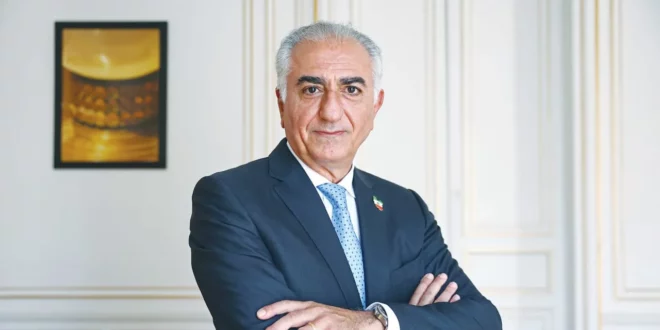
It is against this backdrop that Crown Prince Reza Pahlavi has emerged as the main focal point for Iran’s fragmented opposition.
On Monday night, as protests intensified, Pahlavi issued a public message, stating, “Today is a time for greater solidarity.
“I call on all segments of society to join your fellow citizens in the streets and raise your voices demanding the downfall of this system.”
This message followed months of increasingly political positioning.
At a press conference in Paris in June, Pahlavi called openly for regime change and announced plans to form a broad opposition front. He condemned the Islamic Republic’s repression and warned Western governments against providing the regime with economic or diplomatic lifelines. Crucially, he laid out core principles for a post-Islamic Republic Iran: territorial integrity, equality of all citizens, individual liberties, and the separation of religion and state.
At that Paris appearance, Pahlavi directly addressed Khamenei, urging him to step down and promising due process – “more than you have ever given any Iranian.” He described the moment as Iran’s “Berlin Wall moment,” signaling a psychological break rather than an imminent seizure of power.
The message was reinforced at a major opposition convention in Munich in July, where Pahlavi convened more than 500 Iranian dissidents from across the ideological spectrum. Monarchists and republicans, secular activists, ethnic leaders, artists, athletes, and former political prisoners gathered in what organizers described as the broadest opposition coalition in decades.
There, Pahlavi outlined a five-pillar strategy for change: maximum international pressure on the regime, maximum support for the Iranian people, encouragement of defections from within the system, mass mobilization and organization, and detailed planning for Iran’s economic and political recovery. He also presented elements of an emergency transitional framework, emphasizing that any future system, including the question of monarchy, must be decided by a national referendum.
Repeatedly, in Paris, Munich, and subsequent statements, Pahlavi stressed that he does not seek political office and would not accept the throne unless chosen through a democratic vote. It is important to remember that. Pahlavi is not waiting to swoop in and sweep Iranians off their feet – he is willing to let them choose their own future. But the voices emanating from the streets suggest he has a large amount of popular support among the protesters.
“It is crystal clear that the population accepts the leadership of Prince Reza Pahlavi,” one member of the Iranian opposition now in exile told The Jerusalem Post this week. “Now it is up to the prince to expand his circle and show that his professional cadres can take over the government. In that case, the military could join the people. This is a scenario if the protests continue.”
Whether Iran’s current protests will sustain momentum remains uncertain. The regime may yet escalate repression, testing the resolve of demonstrators.
But something irreversible has already occurred on the streets of the Islamic Republic. The people are calling for the return of their king.