 Eurasia Press & News
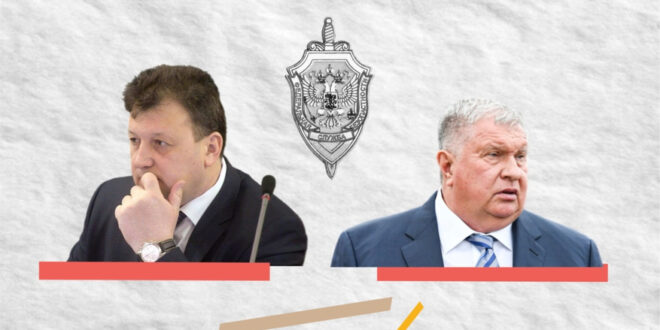
Rosneft CEO Igor Sechin has once again emerged victorious from a behind-the-scenes battle for key positions in the FSB leadership. His close associate, General Ivan Tkachev, previously reported on by The Insider, has been appointed head of the FSB’s Military Counterintelligence Department (MCD). In the mid-2000s, Sechin virtually dominated the FSB’s Internal Security Directorate (ISD), and high-profile arrests of undesirable governors, deputies, and generals were carried out under his orders. He then took control of the FSB’s Economic Security Directorate “K,” which oversees the country’s entire financial system. Now, the top oil executive has acquired the Ministry of Defense. The Insider publishes previously unknown biography of the new head of the MCD, General Tkachev, whose phone records revealed the names of Prime Minister Mikhail Mishustin’s brother-in-law, a criminal banker, and a prosecutor who served as the state prosecutor in high-profile trials.
Battle for the chair
A fierce battle for the post of head of the FSB’s Far Eastern Military-Defensive Combat Team erupted in December 2024 following the resignation of the previous head, Nikolai Yuryev, previously reported by The Insider. Colonel General Yuryev was dismissed following the assassination of Igor Kirillov, the head of the NBC Protection Troops, in Moscow. The chief military chemist and his driver-bodyguard were killed on December 17, 2024, in Moscow in an explosion near a building on Ryazansky Prospekt. Putin called Kirillov’s death a grave blunder by the intelligence services and demanded that those responsible be punished.
Kirillov himself, during his lifetime, became infamous for his fake news about biological weapons allegedly being developed by the United States in laboratories in Ukraine. Two days before his assassination, the SBU charged Kirillov in absentia with ordering the use of K-1 combat grenades filled with toxic agents. Later, some media outlets reported that the Ukrainian Main Intelligence Directorate (GUR) was involved in Kirillov’s assassination.
Initially, it was expected that military counterintelligence would be headed by the First Deputy Chief of the Far Eastern Military District, Vice Admiral Pavel Boyko, who previously held the position of Chief of the FSB Directorate for the Pacific Fleet, or Alexander Vasiliev from the “Ural clan” in the FSB.
But while their candidacies were being finalized in high offices, Rosneft CEO Igor Sechin intervened, and Lieutenant General Ivan Tkachev emerged as the only candidate. Previously, he headed the 6th Service of the FSB’s Internal Security Directorate, nicknamed “Sechin’s special forces,” and then moved to the post of head of the FSB’s Economic Security Directorate “K.”
A year and a half ago, Sechin already scored a major victory in the administration when Andrey Belousov was appointed Defense Minister in place of Sergei Shoigu. Unlike Shoigu, Belousov, an economist, is far from a stranger to Sechin and chaired the board of directors of Rosneft from 2015 to 2018.
Under Shoigu, the Ministry of Defense’s unofficial overseer was oligarch Gennady Timchenko, who made his billions in oil trading and government contracts. It was Timchenko, who had a joint business with the Shoigu-Vorobyov clan, who convinced Putin in 2012 to appoint the Ministry of Emergency Situations’ chief rescuer as Minister of Defense.
A source for The Insider reported that not a single key appointment in the military department was made without the oligarch’s approval, and that at generals’ corporate parties, the Timchenko couple always sat at the same table with Shoigu and his associates.
The same place, as a rule, was frequented by the head of the Far Eastern District of the Russian Federation, Yuryev; Putin’s “successor,” Alexei Dyumin; the governor of the Moscow region, Andrei Vorobyov; a major construction contractor for the Ministry of Defense, Anton Abdurakhmanov; and the “glamorous general,” Timur Ivanov, who is currently on the federal wanted list and serving a 13-year prison sentence.
The FSB’s 1st Service, to which Tkachev, a Sechin man, was appointed, oversees the central apparatus of the Ministry of Defense, the General Staff, and the commanders of the various branches of the armed forces. Military counterintelligence representatives are stationed in each military district and are assigned to Russian military bases in Abkhazia, Armenia, Kyrgyzstan, Tajikistan, Transnistria, and Syria. Furthermore, the 1st Service of …
Military counterintelligence has an extensive network of agents within the Ministry of Defense and handles operational support for criminal cases of embezzlement within the military, at military facilities, and within Rosoboronexport and the National Guard. This allows for close monitoring of the entire army and navy, which is important for Putin, who distrusts the military.
The network of agents in the Ministry of Defense makes it possible to keep the entire army and navy under constant control, which is important for Putin.
Since the onset of aggression against Ukraine, special agents from the Far Eastern Military District (DVKR) have been joining joint task forces in the occupied territories. “There’s a lot of work to do, embezzlement at all levels, from soldiers and warrant officers stealing gasoline and diesel fuel to district, fleet, and army commanders who accept kickbacks for government contracts or inflate procurement prices and pocket the difference. Since the launch of the Joint Military District (JMD), investigations have been launched into the theft of weapons and ammunition, desertions, surrenders, self-inflicted wounds to obtain monetary compensation, criminal offenses motivated by drunkenness, drug addiction, and much more. Furthermore, the leadership has instructed them to focus on patriotic education of schoolchildren and students, and people are being pulled away from their work,” a source in the Far Eastern Military District (DVKR) described the situation to The Insider.
Belgorod Kolkhoznik
The new head of the FSB DVKR, Ivan Tkachev, comes from the village of Borisovka, Belgorod region. Most of his relatives were born in western Ukraine. For example, Valentina Tkachenko’s mother lived almost her entire life in Borisovka, but never learned to speak Russian. “This is the news of my regalia. Golovne, so that you will be alive and healthy. To be honest, Moscow isn’t playing around? “He’s a nice guy,” the pensioner asked the correspondent.
The “handsome guy” found his way into the central office at Lubyanka Square thanks to his connections with the once-powerful FSB general Oleg Feoktistov, nicknamed “General Fix.” They served together in a border detachment in Karelia, and when Sechin instructed Fix to create a 6th service within the FSB’s Internal Security Directorate, he called on Tkachev.
As a source in the “six” recounted, Tkachev was initially ridiculed and nicknamed “the Belgorod collective farmer” behind his back: “No one took Ivan Ivanovich seriously. He was mostly involved in organizational matters, and his duties included making excuses for our idiots after drunken car races around the capital and fights in restaurants. Then jokes started about him playing hockey in an amateur league and the guys being afraid to cut him. Now, as you can imagine, the jokes have ended, and his name is spoken in whispers.”
Incidentally, The Insider recently published a story about Tkachev playing captain for the Buran hockey club alongside Putin’s adjutant, a Rosneft auditor, and FSB and GRU officers. His wife, who has made a meteoric rise in the Odintsovo district administration in the Moscow region, leads the Buran support group. In Odintsovo, Olga Anatolyevna oversees all schools and heads the commission for the protection of minors’ rights. On December 16, at the Odintsovo school in Gorki-2, a 15-year-old Nazi stabbed fourth-grader Kobiljon Aliyev to death, forcing Putin to offer condolences to the president of Tajikistan. However, no news has been released regarding Tkacheva’s resignation.
The couple spends their vacations at Gazprom’s Polyana resort near Sochi or in Karelia with Tkachev’s younger brother, Vitaly. He serves there as a border guard, while his son, Denis, joined the marines and is based in the secret settlement of Sputnik near Murmansk.
Since the aggression against Ukraine, the marine brigade has been on the front lines and has suffered enormous losses. A source from Borisovka reported that Denis’s nephew had some troubles in the service a couple of years ago and was summoned to an FSB investigator, but apparently his uncle resolved the issue.
The general’s daughter, Anna, married a young security officer, Vladislav Konev, who was also born in Borisovka. The wedding was held at Barvikha Luxury Village, a popular destination for millionaires and showbiz stars.
Tkachev’s name first surfaced in the media in 2013, when the 6th Service raided the apartment of Yevgenia Vasilyeva, the secret wife of Defense Minister Anatoly Serdyukov. The “masked show” was part of a high-profile criminal case involving large-scale fraud at Oboronservis, the company Vasilyeva had previously headed.
In fact, the reason was not the theft at Oboronservis, but a conflict between Sechin and Serdyukov over a billion-dollar contract to build two helicopter carriers for the Russian Navy. Sechin, then chairman of the board of directors of the United Shipbuilding Corporation (USC), intended to sign a contract with South Korea’s Dokdo, while Serdyukov and his supporter, Dmitry Medvedev, bypassed him and entered into an agreement with France’s Mistral.
According to sources, Sechin was furious and demanded that incriminating evidence be collected against the “furniture maker” Serdyukov, even though Putin had approved the deal with the French. Information about the “wealth” of Serdyukov and Vasilyeva was skillfully leaked to the press from Tkachev’s office on Kolpachny Lane, with inexpensive costume jewelry being passed off as diamonds.
At the same time, Prosecutor General Yuri Chaika, who had initiated an investigation into the USC, also came under fire: his youngest son was even considered for imprisonment. The entire country sat watching, eagerly awaiting the moment when the “sweet couple” would end up in the dock and receive real prison sentences.
But Minister Serdyukov, accused of negligence, was granted amnesty, while Vasilyeva was kept on the hook until the very end. Instead of a suspended sentence, as her defense claimed, she was sentenced to five years in prison. However, she only served 34 days in prison and was released on parole. Five people were imprisoned in the Oboronservis case, but the whole affair with arrests and trials was in vain: due to the annexation of Crimea, France refused to provide helicopter carriers to Russia, and they were sold to Egypt.
Interestingly, General Tkachev’s phone records included the number of Prosecutor Vera Pashkovskaya, who serves as the state prosecutor in many high-profile trials, including the Vasilyeva case. Rumors had previously circulated that orders were being issued to judges and state prosecutors from the “six” office on Kolpachny Lane. A year after the end of Vasilyeva’s trial, Pashkovskaya was awarded a certificate of honor as the best employee of the Prosecutor General’s Office.
Taran Sechin, Mishustin’s brother-in-law and the “king of cashing out”
Subsequently, on Sechin’s orders, Tkachev oversaw the arrests of the governors of Kirov Oblast, Nikita Belykh; Sakhalin Oblast, Alexander Khoroshavin, who was playing on Gazprom’s side; Komi Republic, Vyacheslav Geyzer, who was said to be close to billionaire Viktor Vekselberg; and the head of the Main Directorate for Economic Security and Combating Corruption of the Ministry of Internal Affairs, Lieutenant General Denis Sugrobov, who attempted to recruit an employee of the “six.”
Meanwhile, Sugrobov’s deputy, General Boris Kolesnikov, committed suicide during interrogation, and no one was punished. And after moving to the head of the FSB’s “K” banking department in 2016, Tkachev “shut down” Alexey Ulyukayev, the head of the Ministry of Economic Development, who allegedly hinted to Sechin about a $2 million bonus for a positive decision on the purchase of Bashneft.
Also caught in the crossfire of “Sechin’s special forces” were the head of customs, Andrei Belyaninov, who once served with Putin in the KGB, Minister Mikhail Abyzov, who is close to Medvedev, the Magomedov brothers, owners of the Summa Group, Senator Rauf Arashukov, and the American investor Michael Calvey.
However, the general gained widespread notoriety when he persuaded the head of the Serpukhov district, Alexander Shestun, to bow to Moscow Region Governor Andrei Vorobyov and resign voluntarily. Otherwise, as he put it, “they’ll bury you before the elections,” “they’ll dig you up and put you in jail,” and “Don’t you want to live?”
Shestun had previously helped Tkachev gather incriminating evidence against corrupt officials and security forces in the Moscow region, and naively counted on the FSB officer’s support. Instead, he himself was ultimately sentenced to 15 years in prison. Even before his imprisonment, Shestun told The Insider that Tkachev had everything under control at every level, and that he only had to snap his fingers and everything would be delivered to him.
Shestun naively counted on the FSB officer’s support, but in the end he himself was sent to prison for 15 years.
His statements are confirmed by the FSB officer’s phone records, obtained by the editorial office. In addition to Prosecutor Pashkovskaya, the general’s records include the numbers of senior officers from other FSB services, investigators, government officials, top managers of major Russian state corporations, and successful businessmen involved in the supply of oil, medicine, and medical equipment. Among the numbers found were contacts of businessman Alexander Udodov, brother-in-law of Prime Minister Mikhail Mishustin.
According to media reports, Udodov was actively involved in VAT fraud when Mishustin headed the Tax Service. For example, in 2011, Udodov’s name figured in a high-profile criminal case involving the theft of 2 billion rubles under the guise of a VAT refund; his home was searched. Investigators suspected that Mishustin’s brother-in-law was the mastermind behind the fraudulent scheme, but he was soon demoted to the status of a witness, and other accomplices in the scheme received real prison sentences.
In his investigation, Alexei Navalny reported that Udodov often acted as a front man, registering prime land in Rublyovka worth hundreds of millions of rubles in his own name and then gifting it to Mishustin. What Tkachev and Udodov discussed is unknown, but Sechin apparently did not give the go-ahead. Udodov is now known as the “mushroom king,” as he has become the head of the largest holding company, Agrogrib, and has achieved a leading position in this market.
Of particular interest is another phone number in Tkachev’s billing records, belonging to shadow banker Yevgeny Dvoskin. A native of Odessa, he moved to Brighton Beach with his family in 1977 and previously went by the name Slusker. Slusker had been arrested several times in the US and served time for car theft, death threats, document forgery, and fraud involving diesel fuel and securities. At the request of the FBI, Slusker was detained in Monaco and faced 25 years in prison. However, hired lawyers found legal loopholes, and he was released.
The American immediately moved to Russia, changed his last name, and settled in Moscow with a Rostov-on-Don passport. In the capital, Dvoskin-Slusker took control of several small banks and, using shell companies, cashed out over 500 billion rubles. According to investigators , some recalcitrant bank owners were brutally beaten. The Investigative Committee of the Ministry of Internal Affairs opened a criminal case, but Dvoskin fled the country. The fugitive was discovered near the office of the thief-in-law Ded Khasan in the Writers’ House on Pirogovskaya Street, where police surveillance was stationed. However, Tkachev’s subordinates from the 6th Service guarding him prevented the shady banker from being apprehended. However, Dvoskin claimed that he himself had become a victim of extortion by the Ministry of Internal Affairs, which is why he was assigned state protection.
Dvoskin later resurfaced in Crimea as a shareholder in Genbank and founder of the Crimean Revival Fund. He even had a personal handler from the FSB’s Crimean Security Service, Alexey Bragin, whose phone number appears in Tkachev’s phone records. Besides his handler, the banker’s phone numbers included high-ranking Crimean officials, Rosgvardia generals, and businessmen close to Ramzan Kadyrov.
These days, Dvoskin’s Bentley is seen more often in Moscow; he is a regular at private parties attended by major bankers and still travels with security.
Apparently, Minister Andrei Belousov and his team of accountants conducted a thorough audit of the military department and discovered where the shadow financial flows went under Timchenko and Shoigu, which units were the most prone to theft, and where the 30% of Rosneft’s fuel and lubricants supplied to the army were being diverted. It’s possible that new arrests and incarcerations will begin very soon, as the scenario has long been tried and tested: Tkachev’s visit to Sechin with a folder, media leaks, searches, and operational footage broadcast on all federal television channels. Purge operations could also take place within the Russian National Guard—the Far Eastern Defense Ministry includes Military Unit 3600, which directly oversees this law enforcement agency. Three Russian National Guard generals are currently under investigation for accepting bribes for government contracts. The Insider reported how the unit’s commander, Lieutenant General Vyacheslav Ryazansky, evaded bailiffs for 20 years, and how his replacement, Gleb Kurbatsky, narrowly escaped prison for losing classified documents. However, some difficulties are expected: according to The Insider’s source, Putin’s former bodyguard, Viktor Zolotov, who heads the Russian National Guard, throws fits when confronted by military investigators and security officers from the Far Eastern Military District.
It should be noted that after Tkachev’s transfer to the Far Eastern District, Sechin retained control of the FSB’s Economic Security Service’s “K” Directorate, which oversees the country’s entire financial system. The directorate’s chair was taken over by Alexey Trukhachev, a member of the “Voronezh clan” who previously held the position of deputy head of the FSB’s “M” Directorate. His older brother, Sergey, is the vice governor of the Voronezh Region and is implementing 6.1 billion rubles allocated for road construction under the national project.
Meanwhile, two more clan representatives took up key positions at Lubyanka: Alexei Komkov became the head of the FSB’s 5th Service and oversees spy stations abroad, while Albert Stepygin, a former member of the Internal Security Directorate, was appointed his deputy.
Both began their service in the FSB Directorate for the Voronezh Region and later moved to Moscow. General Komkov, like Tkachev, plays amateur hockey, and Stepygin’s wife, as The Insider reported , mines sand and gravel in the Vladimir Region with a Lithuanian citizen.
The clan is overseen by Voronezh native Alexander Kupryazhkin, FSB State Secretary, who assumed this position in the mid-1990s thanks to his close connections to Sechin. The Insider was unable to contact Tkachev, as his phone number was blocked.
While this article was being prepared, a car carrying Lieutenant General Fanil Sarvarov, the head of the General Staff’s Operational Training Directorate, was blown up on Yasenevaya Street in Moscow. He died at the scene from his injuries. The head of the FSB’s military counterintelligence is personally responsible for the safety of the Ministry of Defense’s leadership. There have been no reports that General Tkachev has been dismissed.