 Eurasia Press & News
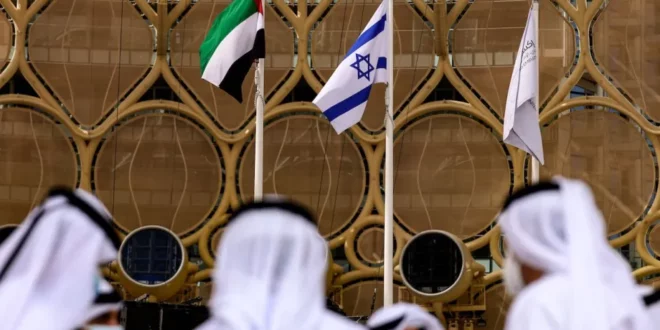
Israel is behind a secret pact with the United Arab Emirates to destroy Saudi Arabia’s role as the Gulf’s regional powerbroker. The astonishing claim is just one of a series of sensational statements made by a senior Arab royal whistle blower to Middle East Monitor on Tuesday evening.
The news will come as a particular blow to the increasingly unpopular Emir of Kuwait, Sheikh Mishal Al-Ahmad Al-Jaber Al-Sabah, who is planning to mark the second anniversary of his accession to power with a series of extravagant celebrations this weekend.
According to a Kuwaiti royal insider, two assassination teams have been sent to Canada and the UK to eliminate anti-Mishal regime dissidents who have sought refuge in those countries.
“There are no rules any more — there are no consequences any more. Gulf unity is a myth and all those carefully manicured media images you see of crown princes and emirs standing together in harmony is a load of rubbish,” claimed the Arab royal who is hiding his identity for fear of reprisals. “Behind the scenes there is bitter rivalry and lots of back-stabbing.”
He added that it is widely recognised that Israel is grooming the UAE to oust Saudi Arabia as the main source of power in the region. “After the UAE signed the Abraham Accords with Bahrain in 2020, Kuwait began to move its allegiance from Saudi to Abu Dhabi. The Saudis have been too slow to support Israel and sign the Abraham Accords, so the Israelis are now keen to change the power dynamics in the Middle East.”
To show its closeness to Kuwait, Israel has even offered to help eliminate dissidents overseas who are undermining the Emir’s rule with their constant allegations, added the Gulf royal. “It is like a game of musical chairs. Saudi will cosy up to Qatar again and the UAE is gathering its friends over the normalisation of ties with Israel. Yemen is also challenging relations between Saudi and the UAE.”
When the 86-year-old Emir suspended Kuwait’s constitutional democracy on the evening of 10 May 2024 — which many argue was an illegal action — one of the first congratulatory phone calls he received the next day was from UAE President Mohammed Bin Zayed Al-Nahyan. Up until 10 May, Kuwait was the only Arab state in the region with an elected parliamentary system of government and where elections, with public counting of votes on Kuwait TV, were rumoured to cause unease in neighbouring autocratic regimes.
Since then, Kuwait and the UAE have signed more than a dozen memorandums of understanding across critical sectors with the two countries collaborating over security, energy and infrastructure, social development, economic growth, crime, transport, education and healthcare.
The increasing closeness of the two states was reflected recently when Kuwait revoked the citizenship of Sheikh Tariq Al-Suwaidan, one of the region’s most influential Islamic preachers, who is followed by millions on social media across the Arab world. He is a known member of the Kuwaiti Muslim Brotherhood and offered vocal support to the movement’s political efforts in Egypt. In 2013, he was fired from his role with a Saudi religious TV channel by billionaire Prince Alwaleed Bin Talal, who declared that there was no place for the Brotherhood in his business.
The revocation of the Sheikh’s citizenship was rumoured strongly to have been pushed through after a request from the UAE. Officially, though, Kuwait is saying the formal decree was “based on the recommendation of the first deputy prime minister and minister of interior, and with the approval of the Cabinet.” Nevertheless, no specific reason was given for the move.
Canadian dissident Samih Maurice Bowles, who was imprisoned in Kuwait 11 times without charge between 2010 and 2017 for refusing to collude in covering up corruption between large private business and government officials. The 50-year-old is now on at least 20 medications a day and officially disabled as a result, it is said, of the torture and brutality he suffered at the hands of his Kuwaiti jailers. He has stated publicly on X that he is targeted for kidnapping or assassination by a hit squad that he says arrived from the UAE in Toronto less than two weeks ago. He also runs a controversial blog which names and shames a number of Kuwaiti officials who he alleges are corrupt.
The United Nations Working Group on Arbitrary Detention, part of the UN commission on Human Rights, published a report in 2023 describing what happened to Bowles and requesting the government of Kuwait to undertake necessary reforms to its justice system, as well as provide Bowles with suitable compensation. To date, however, the Kuwait government has not complied with any of the report’s recommendations and letters from lawyers acting for Bowles sent to Kuwaiti diplomatic missions in Paris, Geneva and Ottawa have gone unanswered.
“It appears that they decided that they would rather have me killed or kidnapped [and taken] to Kuwait, than accept the recommendations of the UN report,” says the vocal critic of the latest version of the Al-Sabah regime.
Sources have also made further revelations about how the former Emir of Kuwait, Sheikh Saad Abdullah Al-Sabah, was deposed in 2006, just days after assuming office. While the official narrative is that he abdicated voluntarily due to ill health, Middle East Monitor revealed in September how he was detained by force and prevented from leaving his home at the Shaab Palace to swear the oath of office at the National Assembly.
The background to Sheikh Saad’s removal was narrated by Ahmad Mohammad Ahmad Yusuf, the son of Sheikha Hessa Saad Al-Abdullah Al-Sabah. Ahmad was stripped of his nationality after a verbal dispute with the interior minister, the emir’s powerful second-in-command. Forced into exile in Lebanon for his own safety, Ahmad now endures hardship, cut off from his mother — his only parent — and from his grandmother, Sheikha Latifa, whom he calls his spiritual refuge. He declined to comment on the latest developments in the tiny kingdom.
Sheikh Mishal, the current head of state who was at the time a senior figure in the Kuwait National Guard, is said to have led a contingent of troops to Shaab Palace to enforce the coup, and one eyewitness described how Mishal “personally assaulted Sheikh Saad’s wife, Sheikha Latifa, to forcibly take from her the seal of state.”
The seal of state was worn as a ring on her hand at the time, said an eyewitness, another royal insider who also fears for his safety if his identity is disclosed. A letter of abdication from Sheikh Saad, now said to have been forged, was then sent to the National Assembly, which voted to accept Sheikh Sabah Ahmed Al-Sabah as head of State. He was an older brother of Mishal.
Sheikh Saad, a hugely popular figure in Kuwait, lived out the remainder of his life in a state of depression under virtual house arrest until he died in 2008.
Today, a general atmosphere of repression intensifies over what was once the sole constitutional democracy in the Arabian Gulf, with lèse-majesté laws used by Mishal, the world’s oldest Crown Prince when he came to power, to prosecute and imprison critics, including so far, several members of the shuttered National Assembly.
Meanwhile, dissidents who have sought refuge in other countries now face the threat of violence, kidnap and even assassination, aided and abetted, it is claimed, by the UAE. If, as Samih Maurice Bowles claims, the Canadian authorities are aware of this threat then, surely, they should act accordingly against the states involved. Given that Israel is said to be operating deep behind the scenes, though, this is quite possibly, and shamefully, unlikely.