 Eurasia Press & News
Palestinians stranded by newly drawn boundary question when they can return home
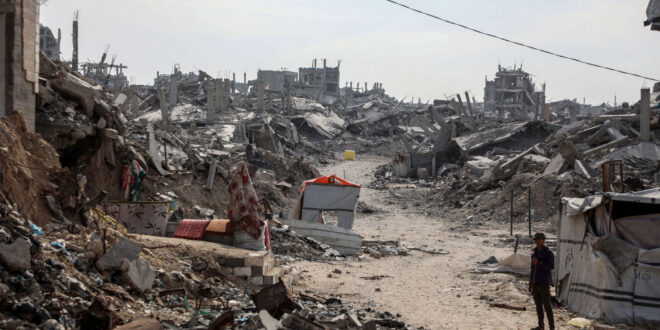
Despite the declared end of the war on the Gaza Strip under the agreement signed in October 2025, thousands of Palestinians continue to live in a state of forced displacement.
They are unable to return to homes or land which now lie beyond what is known as the “Yellow Line”.
This line, which has swallowed more than half of Gaza’s territory, has become a symbol of a new phase of war, one that continues silently, away from cameras.
Meanwhile, British troops are supposed to be monitoring the ceasefire from a “coordination centre” in Israel, where they have not spoken publicly about Benjamin Netanyahu’s repeated violations of the truce.
There has even been a report suggesting British military personnel are involved in designing a housing scheme inside the Yellow Line where only suitably vetted Gazans will be allowed to live.
A forbidden zone behind a fragile agreement
The term “Yellow Line” is used to refer to the boundary to which Israeli forces withdrew following the agreement. However, for many Palestinians, this withdrawal has not translated into calm.
They are prohibited from entering the residential and agricultural areas beyond the line, where Israeli forces continue to operate, designating them as “dangerous combat zones”.
In Al-Mawasi, southern Gaza, 55-year-old Haj Abu Imad, as he prefers to be called, lives in a tent with his family after being displaced by Israeli forces from their home in Jabalia camp, located beyond the Yellow Line.
With a voice full of sorrow, he says: “We don’t feel that the war has ended. They haven’t allowed us to return to our areas or even check on our homes. We are still living through another war, the war of displacement and suffering, especially with the arrival of winter.”
He adds that his family is waiting for the second phase of the agreement to begin, hoping they will be allowed to return to the ruins of their home and set up a tent over it.
“We are strangers here… life is harsh, and with each passing day, we feel more and more like we’re stuck with no way forward.”
Although the line was originally a virtual demarcation, the Israeli army installed large yellow concrete blocks to mark it on the ground, making it impossible for Palestinians to cross without facing the risk of direct targeting.
Daily explosions and deception
The Abadla family is experiencing similar suffering, displaced from eastern Khan Younis to the west after their area fell within the Yellow Line.
Khaled Abadla, a 41-year-old father-of-two, insists that what he hears every night completely contradicts the Israeli claims that the war has ended.
He says, “Israel is deceiving the world. Every day we hear explosions and blasts in the eastern Khan Younis area, and their echoes reach us. Some nights we don’t know the taste of sleep because of those sounds.”
He points out that several people have been killed in the area over the past weeks as a result of approaching the line or attempting to return to their homes.
Nightlife resembling a curfew
In the northern Gaza Strip, just two streets away from the Yellow Line in the Beit Lahia project, 28-year-old Zeina Kalab lives with her family in a cracked house that barely protects them from the winter cold.
She describes the situation, saying: “By five in the evening, no one dares to leave the house. It feels like an unofficial curfew.”
She continues: “At night, quadcopter drones fly over the area, and the sounds of explosions and blasts continue nonstop. We feel that the war is still ongoing, but we have no other options… We returned to our home despite its danger because it is the only place where we can take shelter.”
The Yellow Line stretches from Northern Gaza, through the central area, and reaches the outskirts of Rafah, encircling densely populated regions.
Beyond this line, the Israeli army is deployed in areas including the neighborhoods of Shuja’iyya, Tuffah, and Zeitoun in eastern Gaza City, as well as Beit Lahia and Beit Hanoun in the north, and the surroundings of Rafah and eastern Khan Younis in the south.
In the shelters: illness, cold, and tension
In a shelter in western Deir al-Balah, Mohammed Abu Shamala (69), displaced from Rafah, is enduring difficult health conditions. He suffers from a persistent cough due to the overcrowding and poor ventilation inside the hall where he stays with hundreds of others.
In a weary voice, he says: “Since the war ended, I’ve been waiting to return to Rafah. I can no longer bear these conditions… the weather is cold, diseases are spreading, and the crowd is overwhelming.”
He points out that the news he hears daily only adds to his anxiety: “Every day we hear about new plans by the [Israeli] occupation… one time they say they’ll turn Rafah into a humanitarian city, another time they talk about moving all of Gaza’s population there. We don’t know what awaits us.”