 Eurasia Press & News
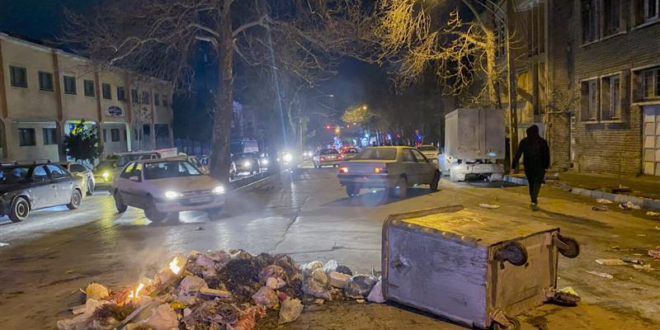
On Sunday, December 28, Iran’s latest wave of unrest began not on a university campus or in a symbolic political square but in the very heart of the country’s economic sphere: the Grand Bazaar commercial center in downtown Tehran. As 2025 was drawing to a close, Iran’s currency, the rial, suddenly plunged to historic lows of around 1.45 million per US dollar, after months of mounting pressure driven by chronic inflation, a large budget deficit, banking-sector fragility, and renewed geopolitical shocks following the 12-day war with Israel and the United States. The Iranian currency lost around half of its value in the six months after June 2025, falling roughly twice as fast as it had over the previous 11 months, since President Masoud Pezeshkian took office in July 2024. What turned the rial’s long-running decline into an abrupt collapse was a sharp loss of confidence in the government’s ability to stabilize the currency.
In Tehran and several provincial cities, merchants pulled down their shutters as the rial’s sharp depreciation made it impossible to operate, according to the business community, and the government’s latest budget signaled higher taxes, rising energy costs, and fewer protections for households already under severe strain. But what initially looked like a familiar economic protest quickly revealed something more consequential. For many shopkeepers, closing their stores seemed safer than remaining open. With exchange rates fluctuating hour by hour, merchants could neither price goods nor be confident they could replace inventory after a sale. Selling any of their inventory risked immediate losses if the dollar rose again before restocking, while holding onto goods exposed them to inspections, accusations of hoarding, or pressure to sell at unofficial or controlled rates. At the same time, the government’s new budget reinforced expectations that conditions would worsen rather than stabilize going forward; while the fast loss in spending power has curtailed consumer hoarding behavior that could have been expected in economic crisis situations such as this.
The most recent draft budget presented by the Pezeshkian government to the Majlis (parliament) made clear that the state intended to shift its chronic deficits directly onto society. It was a budget that many Iranians interpreted less as a recovery plan than as a statement of priorities. On the household side, it rolled back long-standing protections — such as financial subsidies for basic goods — that had cushioned economic shocks. Wages were set to rise far below inflation; taxes were slated to increase sharply on an already strained and narrow base; and indirect supports, from energy subsidies to preferential exchange rates and insurance coverage for essential medicines, were trimmed or restructured in ways that pushed costs directly onto families, patients, and small businesses. The message from the state was blunt: With government revenues exhausted, society would have to bear the brunt of adjustment.
At the same time, this call for sacrifice clashed with the budget’s treatment of regime-facing institutions. Even as officials insisted there was no fiscal space to ease household pain, spending on ideological bodies continued to grow, most visibly when it came to financing the national broadcaster. Funding for state television has more than quadrupled in less than three years, despite declining audiences and persistent questions about effectiveness and accountability. To many Iranians, the contrast was unmistakable: scarcity for daily life, security for institutions tasked with projecting the Islamist regime’s narrative. It is this asymmetry, more than any single tax or price hike, that has turned economic frustration into political anger. Thus, the shopkeepers’ strike quickly spread and transformed into large street protests in more than 70 Iranian cities and towns across the country. The authorities cracked down hard, arresting hundreds; and, as of the ninth day, nearly 20 protesters have been killed by security services responding to the rallies.
The past week of street demonstrations represents not simply an eruption of anger over inflation or taxes. These protests — the largest in years and having quickly adopted political, anti-regime sloganeering — are a public acknowledgment that the Islamic Republic’s governing model has failed the Iranian people. Cosmetic fixes, including the replacement of officials, no longer command credibility. In effect, what collapsed first was not the rial but public trust.
At the center of this impasse stands Supreme Leader Ayatollah Ali Khamenei, who has dominated Iran’s political system since 1989. Iran’s problems, as these protests underscore, are not primarily economic. They stem from political decisions made over decades by the supreme leader and his inner circle: the concentration of power; the creation of a rentier, increasingly militarized, economy; the narrowing of political participation; and a foreign policy that prioritizes ideological confrontation over economic sustainability. Even the most capable technocratic government would struggle to deliver recovery under sanctions and deep structural constraints, especially given that decisive authority does not reside with the cabinet.
Meaningful change would require a rebalancing of authority by empowering President Pezeshkian’s elected government while curtailing the vast unelected institutions whose influence flows from proximity to the supreme leader and control over resources. That is the one step Khamenei has so far shown no inclination to take.
This is now the fifth nationwide protest cycle Iran has witnessed in nine years. Each previous round was met with repression, tactical concessions, and promises of reform; and each time, the system absorbed the shock and remained fundamentally unchanged. What distinguishes the current moment is not simply the intractability of the unrest but its emotional register. Iranian commentary increasingly describes not just hardship but a collapse of expectations of a better future: a society trapped in chronic uncertainty, where time stops and life is suspended.
In this condition, the immediate issue is no longer only income or prices but the loss of the ability to plan at all, what local analysts describe as existential instability and the erosion of hope. That despair has deepened because economic mismanagement now coincides with a strategic dead end: For the first time since Iran’s nuclear program triggered sanctions pressure more than two decades ago, there is little belief inside the country that diplomacy offers a credible exit, particularly under a Trump administration committed to maximal pressure on Tehran. Hence, protesters today are not only angrier, they are more hopeless. To paraphrase a common sentiment in Iranian media, these protests are not driven by hope or ideology; they are driven by exhaustion — the moment when coping finally stopped working.
Khamenei still has options. He could open the political system, redistribute authority, and give the Islamic Republic a chance to reinvent itself under new domestic and international conditions. But he almost certainly will not. He views the current unrest primarily through the prism of hostile Western designs to topple the Islamist regime he has captained for more than three decades. In that worldview, protest is not a mirror held up to systemic failures but a weapon wielded by adversaries. This perception, more than any specific policy, now shapes Iran’s political deadlock.
A very predictable crisis
In July 2025, a group of 180 leading Iranian economists and university professors issued a stark warning that Iran was approaching a decisive crossroads and that continuing with the existing model of governance risked deeper instability rather than security. While praising national unity during the 12-day war with Israel and affirming that security is the state’s first duty, they cautioned that military resilience could not compensate for chronic inefficiency, collapsing public trust, a frozen foreign policy, entrenched corruption, and widening injustice. Their message was explicit: Without a fundamental paradigm shift, including diplomatic de-escalation, an end to economic rent-seeking, the withdrawal of military (namely, the Islamic Revolutionary Guard Corps, or IRGC) forces from business, restoration of free expression, media reform, and the release of political prisoners, Iran would remain dangerously vulnerable to both domestic and foreign pressures despite battlefield cohesion.
Six months later, their warning looks less like foresight than inevitability. The protests that erupted in late December were not an unforeseen shock but the delayed consequence of prolonged political indecision. For years, Iran’s leadership postponed hard choices, opting instead for tactical improvisation. The regime has managed crises without resolving them, suppressing symptoms without addressing causes. Over time, this strategy transformed indecision into policy and paralysis into structure. As one senior reformist figure put it, “We are facing indecision at the top, and the country urgently needs tough and vital decisions.” Another was even more blunt: “Continuing the current situation is not possible.”
The result is a political environment in which calls for fundamental change are no longer confined to dissidents abroad or activists on the margins. Inside Iran, the language of reform has expanded dramatically. Discussions of referendums on the future of the political system — once unthinkable — now appear openly in Iranian commentary. The line between economic protest and political protest has effectively disappeared. The protesters themselves are using radical slogans such as “Mullahs have to go,” “Khamenei the dictator,” and “Death to the dictators.” This does not mean Iranian society has suddenly embraced revolution. It means gradualism has exhausted its credibility.
The erosion of gradualism does not point in only one direction. Change in Iran now looks inevitable, but its form remains contested. One possibility is regime collapse, driven by cumulative protest cycles that eventually overwhelm the system’s capacity for control. A more immediate — and in some ways more plausible — outcome is regime hardening marked by a shift toward greater reliance on coercion, with the IRGC and its political allies exercising even greater authority as civilian institutions recede further into irrelevance. Yet a third path still exists, at least in theory. The leadership could choose to listen to society, rein in ideological purists at home and abroad, and recalibrate state priorities toward the basic economic and social needs of the population, accepting political reform as a means of preserving the system rather than surrendering it. As a former senior IRGC commander who now backs internal reform has put it, Iran ultimately faces three paths to change: Khamenei accepts it; foreign intervention imposes it; or people come out into the streets and force political change.
This is why the current protests feel different. Although triggered by economic shocks, they are at their root not about prices, wages, or subsidies as such. They are about the political system that has produced — and sustained — economic collapse, social repression, environmental breakdown, and international isolation. The animating force is not hope or ideological mobilization, but exhaustion. Bazaar merchants, long among the most conservative and system-adjacent social groups, have joined the unrest not to challenge authority in the abstract, but because normal economic life has ceased to function. Markets no longer respond to official promises or threats; after years of unmet assurances, they have learned to discount both.
After the war, a missed opening
The timing of the protests matters. After the 12-day war, many Iranians hoped the shock of confrontation would prompt a strategic reassessment at home. The logic was straightforward: External pressure had peaked, and national unity had been demonstrated, so perhaps now was the moment for internal recalibration, which would involve greater political openness, accountability, and a renewed focus on domestic survival. To paraphrase the economists’ July letter, military resilience cannot compensate for collapsing public trust.
Instead, the system reverted to familiar habits. Khamenei returned to an old script: Repress dissent, deny the political nature of grievances, and frame unrest as the product of foreign incitement. Officially aligned media outlets reinforced this framing, insisting that a clear boundary must be drawn between protest and riot. At the same time, continuity in foreign policy was reaffirmed, even as its economic costs fell squarely on Iranian society. Across Iran’s political spectrum, however, there is little dispute about the local roots of the protests. Analysts acknowledge that sanctions and geopolitical tensions have intensified pain, but they also recognize that mismanagement, corruption, and strategic rigidity turned pressure into collapse.
Last summer’s 12-day war additionally exposed the limits of Iran’s reliance on external patrons, leaving Iranians, if not the regime, feeling increasingly isolated and vulnerable. Despite years of strategic alignment with Russia and China, neither offered meaningful support or protection when tensions escalated. This failure resonates deeply at home. After all, so-called “resistance” without economic capacity is not strategy; it is attrition. This captures the growing skepticism toward the regime’s foreign policy narrative.
Khamenei’s instincts are shaped by history, specifically, by his reading of the shah’s downfall in 1979. In his telling, Mohammad Reza Shah Pahlavi’s fatal mistake was loosening political control in the face of protests, opening a door that could not be closed. Concession, in this worldview, is a slippery slope.
This logic explains the carefully managed ascent of Masoud Pezeshkian in 2024. His presidential victory was not simply allowed; it was engineered as a pressure-release mechanism rather than an endorsement of reform. The system cleared his path knowing his electoral appeal but also cognizant of the limits it would impose afterward. Pezeshkian was encouraged to speak the language of change but denied the authority required to carry it out.
Since taking office, Pezeshkian has faced structural constraints at every turn. There has been no meaningful domestic political reform, no reassessment of Iran’s militant foreign policy, and no challenge to entrenched power centers. Even technocratic steps, such as the recent replacement of the central bank governor, have been dismissed by analysts as insufficient. Iranians are no longer persuaded by this choreography. Years of managed token reform have trained society to distinguish between tactical adjustment and genuine transformation. The perception that Pezeshkian is a token president kept on a short leash is now widespread, and corrosive.
The political reality ahead
Iran is also undergoing a generational reckoning. The first generation of Islamist revolutionaries from 1979 is aging out of power. Their language and priorities resonate poorly with a younger population shaped by sanctions, digital exposure, and blocked futures. For years now, the political system has not been able to speak the language of its society. At 86, Khamenei does not have much time left to spearhead genuine transformation and, so far, shows no inclination to do so. If he will not, the regime’s future may be decided not by a single uprising but by the cumulative force of repeated protest cycles — the first of the three aforementioned scenarios that now lay before the Islamic Republic of Iran. The debate is no longer about why people are protesting. It is about what comes next.
Iran today is defined by a stark asymmetry. On one side stands a deep state that understands its challenges and knows they will intensify but remains politically paralyzed, even as Washington signals its determination to force a reckoning over Iran’s nuclear and missile programs and its regional posture. On the other stands a society whose only realistic avenue for political pressure increasingly runs from the street upward.
Khamenei can still choose to accept major political change, despite knowing it would come at his own expense. Doing so might give the Islamic Republic a chance to survive by reinventing itself. If he does not, the decision may be made for him, by this protest movement, or the next, or the one after. That is the basic political reality of Iran today.