 Eurasia Press & News
Two things can be said about Poland at the beginning of 2026: it is doing well and doing badly at the same time.
The Polish economy is growing faster than almost anywhere else in Europe, EU funds are arriving in record amounts, and defence spending is set to reach nearly 5 per cent of GDP – among the highest in NATO. Few European capitals enjoy such momentum, or project such confidence. And yet the country’s political institutions are grinding against each other: the president and prime minister hardly cooperate, the far right is polling in double digits, presidential vetoes are piling up, nominations are being blocked, and coalitions barely hold. The question for 2026 is how long Poland can sustain both realities.
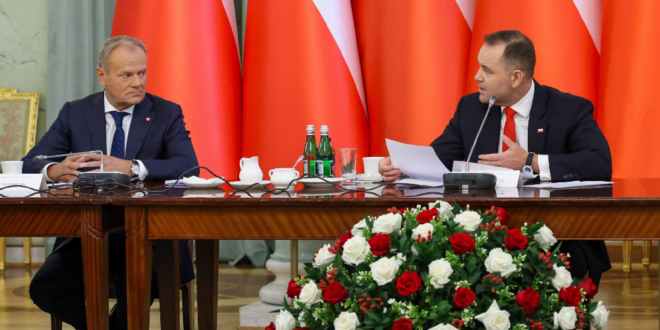
The presidential election ended in June 2025 – by July, the permanent campaign was already underway. What followed was not renewal but a new level of cohabitation: a liberal government and a right-wing president locked into an uneasy stalemate. Governing has become an exercise in endurance, with both camps positioning themselves for the 2027 parliamentary vote. The result: paralysis in some areas, quiet acceleration in others.
If 2025 was about choosing direction, 2026 will be about living with the consequences. Institutional gridlock, rising security costs, mounting public debt and unfinished democratic repairs are beginning to intersect. Trade-offs long postponed are becoming harder to avoid.
Living with the enemy
In domestic politics, the upcoming year will be shaped by two overlapping forces: cohabitation as a political setup, and next year’s general election as the governing horizon.
Cohabitation between a Civic Platform-led government and a president aligned with Law and Justice (PiS) is not new. This time, however, it is proving more confrontational. President Karol Nawrocki has made unusually assertive use of his veto powers: in just five months, he has vetoed more legislation than his predecessor managed in a decade.
But the vetoes are only part of it. Nawrocki has also blocked military promotions, refused ambassadorial appointments and stalled judicial nominations. Poland still does not have an ambassador in Washington. This is creating genuine gaps in how the state functions.
At the same time, the axis of political polarisation is shifting. For years, Polish politics revolved around Donald Tusk versus Jaroslaw Kaczynski. In 2026, the main rivalry increasingly runs between Tusk and Nawrocki. The change suits both men. Nawrocki is positioning himself as the dominant figure on the right, while Tusk benefits from a new adversary who helps consolidate his own centrist camp.
Nawrocki ended 2025 as Poland’s highest-rated politician, likely the predictable honeymoon bounce. Openly aligned with the MAGA wing of Western conservatism, he is seeking to move beyond blocking legislation and emerge as the political leader of a future right-wing majority. This ambition matters in the context of 2027, when a governing coalition between PiS and the far right is no longer a distant scenario.
Tusk appears energised by the renewed confrontation. His government – a broad and often uneasy coalition of liberals, centrists and the left – has regained some of its old momentum. Recent polling places Civic Platform and its allies in the low-to-mid 30 per cent range, ahead of PiS, stuck in the high 20s. Analysts attribute this recovery mostly to the unfreezing of EU funds, relative government stability and continued fragmentation on the right.
Yet the arithmetic of 2027 remains unforgiving. The challenge for the liberal camp will not be just about defeating PiS. While Civic Platform has strengthened its position, the far right has grown in parallel. That space now belongs to two separate populist formations – both with Confederation in their name, confusingly enough – which together attract a more radical electorate. By late 2025, the combined support of PiS and both Confederation parties – Konfederacja and Confederation of the Polish Crown (KPP) – was sufficient, on paper, to form a governing majority.
Paradoxically, the presidential campaign strengthened the far right more than PiS itself. While PiS retains organisational depth and an older base, it is losing ground among younger voters, particularly men drawn to Konfederacja’s blend of economic libertarianism, cultural backlash and anti-establishment posturing. Unless PiS renews its appeal, it risks entering 2027 as the largest party on the right – but dependent on Konfederacja as a coalition partner, despite the latter’s repeated declarations that such cooperation would never happen.
The rise of Grzegorz Braun’s KPP faction deserves particular attention. Braun, whose political brand mixes explicit antisemitism with pro-Russian framing and anti-establishment theatrics, was once a fringe figure. Now his party polls in double digits. Whether this represents a durable shift or temporary protest will become clearer in 2026.
What would a further swing to the right mean? It is likely to translate less into immediate policy change than into a coarsening of political language: sharper euroscepticism, harsher rhetoric on migration and culture, and persistent questioning of liberal democratic norms. Talk of leaving the EU remains largely rhetorical, but polling shows growing openness to the idea.
The real question for 2026 is whether Poland’s liberal and pro-democratic forces can move beyond defensive positioning and articulate a convincing political project of their own – before the permanent campaign consumes what remains of the governing middle ground.
Borrowed time
The economy is where Poland’s contradictions become most visible. In 2026, the state is attempting an ambitious balancing act: funding one of the largest military buildups in Europe while preserving generous social programmes and increasing spending on healthcare. For now, the numbers add up. The question is how long that can last.
Growth is forecast to remain strong in 2026, at around 3.5 to 4 per cent, supported primarily by EU-funded investment. Only Lithuania and Estonia are expected to grow at a similar pace. Growth is being carried by household consumption and investment, defence spending and corporate transformation. Inflation is expected to fall to around 2.5 per cent, meaning Poland would meet the central bank’s inflation target for the first time since 2019.
But the real story is happening just offstage. EU funds are doing almost all of the heavy lifting. In 2026, Poland is set to receive a record 180 billion zloty in EU funding – including roughly 120 billion zloty from the EU’s pandemic National Recovery Plan (KPO) – the largest annual inflow of such funds since accession. That money is going into energy transformation, healthcare modernisation, transport infrastructure and defence. It is strengthening the zloty, and allowing the government to avoid making hard fiscal choices.
The problem is what happens next. When EU funds taper off after 2026, investment growth is expected to slow sharply in 2027. At that point, the gap between what Poland is spending and what it can afford will become impossible to ignore.
Public debt is expected to rise sharply, from about 55 per cent of GDP in 2024 to nearly 70 per cent by 2027, according to the European Commission. The budget deficit remains large, driven by higher spending on defence, social benefits, public-sector wages, healthcare and debt servicing.
For now, Poland can afford to have it all. The harder test will come once it has to choose.
Security as the priority
The central issue in Poland’s foreign policy remains the war in next-door Ukraine. How it ends – or fails to end – will shape Poland’s strategic position for years to come.
With developments in Ukraine unfolding rapidly and unpredictably, it is difficult to assess which scenario is most likely. What once seemed unthinkable is now openly discussed: the prospect of a direct confrontation between NATO and Russia no longer belongs solely to the realm of speculation.
Against this backdrop, security will remain Poland’s top priority in 2026, and its least contested policy choice. It is also by far the most expensive one. The 2026 budget allocates roughly a quarter of total public spending to defence – around 200 billion zloty – making Poland among the largest defence spender in NATO in proportional terms.
The political logic is stark. In a recent interview with BIRN, Deputy Defence Minister Cezary Tomczyk argued that failing to invest heavily now could lead to far higher costs later. “If war reached Europe and affected Poland, we would move overnight from spending 5 per cent of GDP on defence to 40 per cent,” he said. “That is the alternative we face today – either you have your own army or a foreign one.”
Beyond conventional military spending, Poland remains on the frontline of a broader hybrid confrontation. Sabotage, disinformation and covert pressure have become persistent features of the security landscape. Reports of attempted attacks on infrastructure, drone provocations and disrupted plots are routine. For Poland, security is no longer a contingency plan, but a permanent condition.
Cohabitation at home has weakened Poland’s external posture in Ukraine peace talks. The uneasy relationship between Tusk and Nawrocki has reduced Warsaw’s ability to speak with one voice, costing it visibility in high-level discussions about the war’s future.
What seems certain, however, is that if the war of attrition continues, Poland’s role as NATO’s eastern anchor will deepen. That would reinforce its strategic importance, but also lock the country into the long-term costs of frontline status: sustained defence spending, persistent security risks and growing political fatigue, with no clear off-ramp.
A negotiated settlement, however, would not necessarily bring relief. An agreement that allows Kyiv to preserve statehood while enabling Moscow to claim victory domestically could free up Russian military capacity and shift its focus westwards. In such a scenario, Poland and NATO would face a more ambiguous – and potentially more volatile – security environment in the late 2020s.
For Warsaw, the dilemma is stark. Whether the war drags on or freezes, Poland remains exposed either as a frontline state without an endpoint, or as a neighbour to an emboldened and reconstituting Russia.
Further down the list of concerns
It is no accident that democracy and human rights come at the end of this analysis. They also sit low on the list of political priorities for the current government. In 2026, no major breakthrough is expected. What is unfolding instead is repair without closure.
The judiciary remains the formal focus. “Looking ahead to 2026, observers should watch how Poland actually implements Court of Justice of the European Union [ECJ] and European Court of Human Rights [EHCR] rulings on judicial independence – a key test of restoring democratic standards,” Paulina Milewska, constitutional law researcher at the European University Institute in Florence, told BIRN. Recent rulings have found Poland’s Constitutional Tribunal lacked independence under EU law. Implementation will serve as a credibility test, though results so far have been mixed.
But Milewska warns the more consequential risks may lie elsewhere: “Over the next year, democratic damage in Poland could emerge outside the courts,” particularly where legal uncertainty has become entrenched.
Reproductive rights remain the clearest example. The near-total abortion ban is still largely in force despite an ECHR ruling that found the uncertainty itself violated fundamental rights. LGBTQ+ rights present a similar test: Poland will need to implement a recent EU court ruling on recognising same-sex marriages from other member states, even though Poland itself does not allow such marriages. Asylum procedures at the Belarus border remain another flashpoint, where the suspension of standard procedures has raised concerns about violations.
The cohabitation setup and the government’s desire to play it safe – while courting right-leaning voters – have left election promises on human rights largely unfulfilled. An example: in late 2025, the government proposed legislation allowing couples to formalise their relationships through agreements granting limited legal recognition – a watered-down substitute for civil partnerships or same-sex marriage, what Prime Minister Tusk called “the civilisational minimum that Poland must be capable of meeting.” The phrase captures the mood. Whether Poland becomes more democratic or just looks better in Brussels will depend on implementing what has already been promised.
Beyond human rights, the same dynamic applies. Poland has bought itself time – with borrowed money, deferred choices and strong growth. What it does with that time will determine whether 2026 marks a consolidation or the beginning of a reckoning.