 Eurasia Press & News
In Gaza, lethal hostilities continued to subside, while Israel consolidated and expanded its control; protests rocked Iran; and Gulf proxy rivalries fuelled a political storm in southern Yemen.
Gaza: Lethal hostilities continue to subside, while Israel consolidates and expands control
Since taking effect on 10 October, the ceasefire in Gaza has largely held, enabling the return of all but one deceased hostage, halting the intense fighting, and increasing the flow of aid. But the second phase of the ceasefire has yet to materialize. Israel maintains territorial control over more than half of Gaza and full operational freedom across the territory, and its forces continue to conduct attacks — although at much reduced rates compared to the pre-ceasefire period. Over 320 incidents of Israel Defense Forces (IDF) shelling, as well as air- and drone strikes, were recorded in December, slightly more than in the preceding month. However, the lethality of attacks declined significantly, with fatalities dropping to less than half the number recorded for the previous month.
The IDF has continued sporadic attacks and targeted killings inside Hamas-controlled areas — including the killing of senior commander Raed Saad on 13 December — in an attempt to constrain Hamas’ ability to reconstitute. But the majority of Israeli operations have shifted to the Yellow Zone under its control, where the focus is on consolidating territorial control. Demolitions of residential properties have continued unabated, and areas such as Bani Suhaila in Khan Younis, which had not been fully cleared during the war, have been targeted with airstrikes and shelling. Israeli forces have also used live fire, tank fire, and drone strikes against militants crossing over or approaching Israeli troops along the Yellow Line during what appeared to be Hamas patrols or infiltration attempts. Civilians, including children collecting firewood, have also been killed in these areas near a line that in some places is poorly demarcated and in other places has continued to expand westward since the ceasefire.1 Several instances of territorial expansion were reported in December, including further into Gaza City’s al-Tuffah neighborhood.2
Iran: Protests break out amid economic strain and heightened external pressure
In Iran, 2025 ended with a new wave of nationwide demonstrations. The protests began in late December as bazaar merchants in Tehran went on strike after the Iranian currency hit record lows. The protests expanded to all 31 Iranian provinces, with slogans shifting from economic grievances to anti-regime opposition. On 8 January, the situation escalated further as violent confrontations erupted between demonstrators and security forces. Amid an internet and international communication blackout, an independent assessment of the scale of violence remains difficult. But initial reports suggest significant levels of violence in the past few days of the protests, with human rights organizations so far confirming almost 550 deaths, including nearly 50 security forces.3 Actual numbers are expected to increase as information trickles in. Over 10,000 people have been reportedly arrested since the start of the protests.4 The situation had quieted down by 11 January; however, it is unclear whether this marks the end of the unrest or only a temporary lull.
The protests reflect continuing and widespread discontent among Iranians. The Iranian state, however, retains extensive coercive capacity and shows a continued willingness to use force against the demonstrators, while the mobilization has so far lacked the scale, organizational cohesion, and domestic leadership required to pose an immediate challenge to regime survival. No fractures among the political elites or security forces have so far emerged, at least none that are visible externally. Yet, the unrest is unfolding at a moment of exceptional strain for the Islamic Republic — amid sustained Israeli pressure and explicit warnings from Donald Trump that raise the prospect of renewed US intervention — underscoring a regime facing mounting challenges on multiple fronts.
Lebanon: Disarmament efforts continue under dual diplomatic and military pressure
Although reports suggested that Israel was considering a new large-scale offensive against Hezbollah in early December5 — following the killing of Hezbollah’s chief of staff on 23 November — the deadliness of Israeli operations in Lebanon declined over the course of December. Thirteen fatalities were reported, down from around 40 in November, marking the lowest monthly total since the ceasefire took effect in late November 2024.
This apparent de-escalation came alongside increased diplomatic efforts and followed reports that Saudi Arabia, Egypt, and Qatar had urged Washington to pressure Israel to de-escalate and engage the Lebanese government.6 On 3 December, civilian representatives from Lebanon and Israel engaged in direct meetings for the first time since 1983,7 with a second session on 19 December, reportedly to explore economic cooperation. In December, Israel also coordinated with the Lebanese Army on two searches of sites suspected of being Hezbollah facilities. Notably, the first inspection prevented an imminent strike on a residential building that Israel had publicly threatened to target.
Although the Lebanese Army announced in early January that it had effectively taken over security in the south and largely completed the first phase of disarmament south of the Litani, Israeli officials have characterized these steps as insufficient, pointing to continued Hezbollah rearmament and warning that the ceasefire’s security provisions remain unmet,8 leaving the risk of renewed escalation intact. Subsequent phases of disarmament, beginning with areas north of the Litani toward the Awali River, are expected to be slower and more complex as Hezbollah continues to refuse full disarmament across the rest of the country and has warned that forced disarmament could trigger internal conflict.
Syria and Turkey: Counter-IS operations intensify as the threat of insurgency persists
In December, US and partner forces, including Syrian security forces and units of Turkish security services, redoubled operations against the Islamic State (IS) on the back of a deadly attack on US soldiers in Syria and amid fears of renewed attacks in Turkey.
On 13 December, a gunman who was a member of Syria’s security forces — set to be dismissed due to his extremist views9 — killed two US soldiers and a civilian interpreter near Tadmor. Both Syrian and American officials blamed the IS for the attack. This precipitated a retaliatory US campaign, Operation Hawkeye Strike, on more than 70 targets in central Syria, including IS weapons storage sites and infrastructure, with help from the Royal Jordanian Air Force. In January, the operation continued with additional strikes by French and United Kingdom forces on 3 January and large-scale US strikes on underground IS positions and arms storage sites on 10 January.
In Turkey, authorities arrested 115 suspected IS members based on intelligence about planned attacks on New Year’s celebrations on 25 December.10 Days later, deadly clashes in Yalova between security forces and suspected IS cells left three Turkish officers and six IS militants dead. These events highlight ongoing concerns about Turkey’s role as a transit point and support base for IS financing, recruitment, and logistics, even though successful attacks in Turkey are still rare.
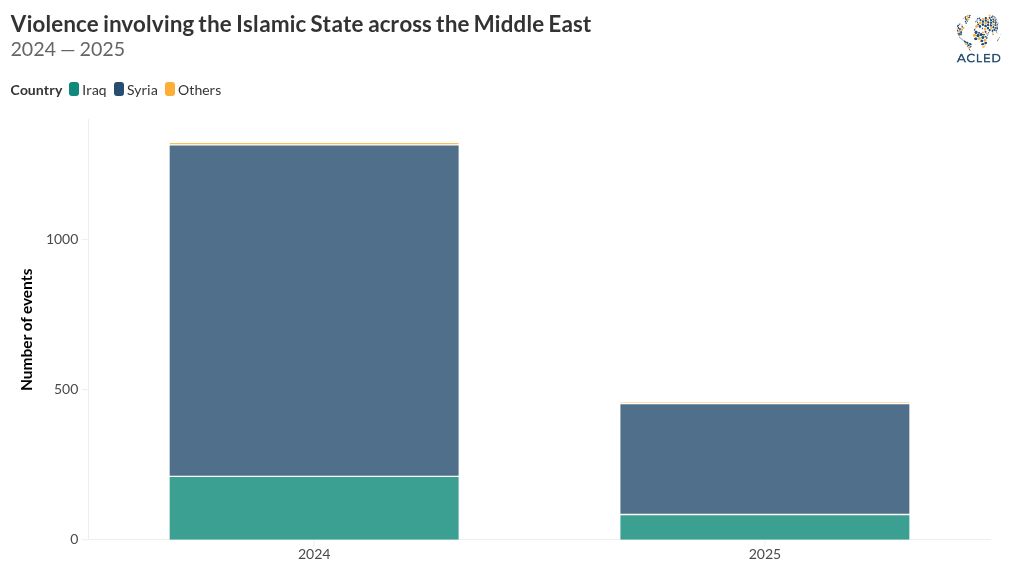
The scale of operations, however, points to an enduring risk of IS sleeper cells in the region that remain capable of mobilizing despite a drop in activity. The resurgence of anti-IS operations in December occurred despite a significant decline in IS-related incidents from 1,300 incidents in 2024 to 460 in 2025. Instead of responding to more violence, these actions signify that governments are worried IS could regroup by moving weapons, keeping up supply routes, and taking advantage of security gaps caused by political changes and shifting territorial control, especially in central and southern Syria.
Syria: A deadly attack on an Alawite mosque in Homs triggers further inter-religious violence
On 26 December, a militant, reportedly from Saraya Ansar al-Sunna, detonated explosives at an Alawite mosque in Homs city, killing at least eight people and injuring several others. The explosion renewed mobilization among the Alawite community, which demanded decentralization and the right to self-determination in protests against the Syrian government. These demonstrations were met with counter-demonstrations in support of the new transitional administration, mainly in the coastal town of Lattakia, which led to several confrontations between the demonstrators from both sides.
The protests were also accompanied by direct attacks against the security forces by anti-government militants who managed to infiltrate through the Alawite demonstrators, leaving one security member dead. State forces responded with the use of firepower to disperse the Alawite protesters, killing two. Triggered by the attacks on the security forces, young men from several pro-government neighborhoods in Lattakia conducted organized attacks on critical locations and facilities in the city, including shops; civilian vehicles; and properties of Alawite Muslims in al-Ziraa, Laa-Azhari, al-Raml al-Janoubi (Raml al Shamali), and Dator neighborhoods, which injured three individuals. During the unrest, the young men used sectarian chants and insults.
Against this backdrop of escalating violence, the Lattakia governorate imposed a curfew on 28 December to prevent further deterioration of security. Despite an overall decrease in the number of violent events in Lattakia since the fall of Assad in December 2024, civilian targeting has skyrocketed, with over 200 events recorded in 2025, compared to just 16 the year prior.
Yemen: Gulf proxy rivalries fuel a political earthquake in southern Yemen
Long-simmering tensions within the Presidential Leadership Council (PLC) escalated in the last months of 2025, as the regional competition between Saudi Arabia and the United Arab Emirates trickled down to southern Yemen. In early December, the UAE-linked Southern Transitional Council (STC) capitalized on local disputes in the eastern governorate of Hadhramawt to seize positions held by Saudi-backed tribes and the Nation’s Shield Forces (NSF) before advancing further east into Mahra, meeting little military resistance. By 7 December, this blitz-style advance, dubbed “Promising Future,” had concluded, resulting in at least 50 deaths — the highest monthly toll in Hadhramawt since April 2016, when al-Mukalla was re-taken from al-Qaeda.
As the STC consolidated control amid widespread civilian repression, Saudi Arabia initially exercised restraint through diplomacy, with little effect.11 This changed dramatically after Riyadh struck al-Mukalla port on 30 December, accusing Abu Dhabi of backing the STC, and PLC President Rashad al-Alimi called for the withdrawal of UAE troops and a state of emergency.12 Between 2 and 4 January 2026, NSF forces — supported by seven waves of airstrikes in Hadramawt and al-Mahra, especially around Sayun and its airport — retook Hadhramawt and al-Mahra. Cornered, the STC — which had issued a constitutional declaration on 3 January13 — agreed to join peace talks in Riyadh.14 In a final twist, STC chairman Aydarus al-Zubaydi withdrew from the talks and went into hiding on 7 January.15 This triggered Saudi airstrikes on his home area, on camps, military trucks, and weapons depots in al-Dali governorate and the final takeover of Aden by Saudi-backed forces.16
Overall, the crisis was triggered by long-simmering political tensions within the PLC, Yemen’s governing body. On the eve of the escalation, month-long disputes over reforming the PLC underscored the body’s growing ineffectiveness. The STC held a relative majority in the eight-member council with three seats, yet came under mounting pressure — unable to deliver basic services, riven by internal leadership rivalries, and increasingly challenged by self-rule claims in Hadhramawt. Eventually, in October 2025, the Israel-Hamas ceasefire marked a tipping point, reviving Houthi-Saudi peace talks and pushing the STC to seek advantage ahead of a possible settlement.17
The situation in southern Yemen remains highly volatile. On 9 January, an STC delegation announced the dissolution of the secessionist body from Riyadh, after Aydarus al-Zubaydi was dismissed from the PLC and referred to a penal court on charges of high treason.18 However, several senior figures rejected the dissolution,19 while a large pro-STC demonstration took place in Aden on 10 January. Meanwhile, Saudi Arabia launched the Comprehensive Southern Dialogue Conference20 — an initiative supported by the STC delegation in Riyadh and attended by other major UAE-backed Yemeni forces21 — as part of a broader effort to expand southern representation, reform the PLC, and stabilize southern Yemen.