 Eurasia Press & News
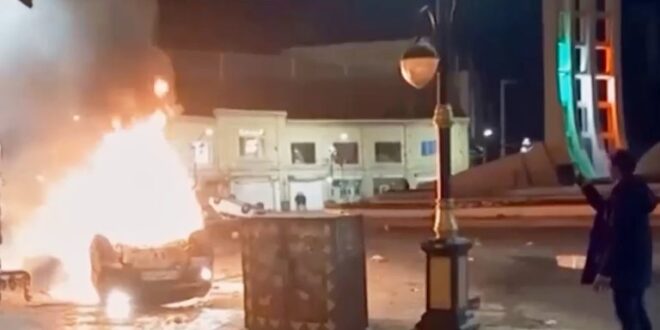
Anti-government demonstrations in nearly 200 Iranian cities continue to expand and intensify despite the increasing use of force by regime security forces.
The failure of the security forces to quell the unrest indicates that the opposition is highly motivated and that security personnel might be hesitant to carry out orders to use massive force.
Government leaders, including Supreme Leader Ayatollah Ali Khamene’i, are seeking to stiffen the resolve of regime supporters and the security forces by characterizing the demonstrators as “terrorists.”
President Trump is threatening to use force against Iran if the government employs massive force against protesters, but it remains unclear how U.S. intervention, if ordered, would help topple the regime.
As protests against Iran’s Islamic regime have expanded over the course of the past two weeks, U.S. and other intelligence agencies are struggling to assess whether the current uprising will topple the 47-year-old Islamic Republic, led by Supreme Leader Ayatollah Ali Khamenei. The protests have grown in size and intensity, and drawn in additional socio-economic and ethnic groups, despite escalating use of violence by Iranian security forces. In recent days, the protests have turned increasingly violent, including attacking security personnel and setting fire to regime symbols, mosques used by security forces, and some government buildings. The regime has mismanaged the economy and also the country’s natural resources, with drastic water shortages in the capital city of Tehran. Meanwhile, the Iranian government spends hundreds of millions of dollars each year propping up various proxy groups across the Middle East.
The unrest began on December 28 as strikes and demonstrations by merchants restive over the collapse of Iran’s currency, but quickly drew in youths and other groups calling for the Islamic Republic’s ouster. After its first week, the uprising was reportedly dismissed by U.S. intelligence as the latest in a decades-long string of uprisings destined to be easily crushed by regime suppression. However, as the uprising’s size and intensity expanded, defying government suppression, U.S. intelligence reportedly began to reassess its earlier estimates, according to Axios media. Late last week, a senior U.S. official told journalists: “The protests are serious, and we will continue to monitor them.” On Friday, President Trump seemed to reveal the latest judgment of U.S. intelligence, telling reporters: “Iran’s in big trouble…It looks to me that the people are taking over certain cities that nobody thought were really possible just a few weeks ago.” His statement corroborated videos and other social media reports that some cities, and large parts of major cities, were falling out of the regime’s consistent control. After three consecutive days of large protests in Tehran and other major cities, which began Friday, some experts assessed the unrest as a revolution that would significantly reshape Iranian policy, if not perhaps topple the regime outright.
U.S. and global leaders, as well as international and Iranian human rights organizations, are closely monitoring Iran’s response to what senior Iranian leaders increasingly imply is a threat to the regime’s grip on power. Last week, the government shut down the Internet and cut telephone lines off to the world, actions that most experts suggested were an attempt to hide an anticipated major escalation in the use of force against protesters. Iranians were able, in part by accessing the Starlink network, to broadcast videos of security forces using live ammunition against protesters. Hospitals were reporting significant streams of wounded patients seeking treatment. According to the Washington D.C.-based Human Rights Activists News Agency, which was founded by anti-regime activists, as of Friday, the 13th day of unrest in Iran, at least 65 people had been killed, including at least 14 members of the security forces. More than 2,300 people had been arrested. However, other reports put the death toll from unrest much higher, with TIME citing a doctor in Tehran as saying at least 217 people had been killed. Sources thought to be supportive of the protests cited much higher figures, reporting more than 2,000 protesters killed as of Sunday. The real number is likely even much higher.
Sensing the ineffectiveness of its measures to date, senior Iranian leaders have begun to express growing alarm at the potential of the uprising to displace them. In response, the leadership is relying on the familiar playbook it has used to suppress major uprisings in the past — threats to use massive suppressive force and to execute protesters. On Friday, addressing an audience of supporters, Supreme Leader Khamenei stated a clear intent to escalate a crackdown, saying: “Everyone knows the Islamic Republic came to power with the blood of hundreds of thousands of honorable people; it will not back down in the face of saboteurs.” The Supreme Leader also sought to paint demonstrators as tools of outside powers, stating they were “troublemakers” who are trying “to please the president of the U.S.” On Saturday, Iran’s attorney general warned that anyone taking part in the protests would be considered an “enemy of God” — a charge that carries a death penalty. Elected President Masoud Pezeshkian has called for dialogue with protest leaders, but neither he nor any other senior leader has suggested the regime would dramatically change its policies to address the underlying causes of the uprising.
Senior leaders also sought to motivate the security forces amid reports that some security personnel, including in the historically pro-regime Islamic Revolutionary Guard Corps (IRGC), were balking at carrying out an order to use massive force against demonstrators. The IRGC Intelligence Organization seemed to corroborate the reports in a January 10 statement that it is “dealing with possible acts of abandonment” in IRGC ranks. Cascading defections by the security forces could spell the beginning of the end for the regime. As of Friday, state media had begun calling the demonstrators “terrorists” — a label intended to rally security commanders’ enthusiasm for the crackdown. Iran’s leadership also sought to expand its available force by enlisting help from the regular army (Artesh), the national force that existed during the reign of the former Shah and remains heavily armed. The Artesh had steadfastly refused to participate in suppressing past uprisings, arguing its sole function is to protect the nation, not any particular regime. Departing from its past neutrality, the Artesh stated last week: “The Army, under the command of the Supreme Commander-in-Chief (Khamenei), together with other armed forces, in addition to monitoring enemy movements in the region, will resolutely protect and safeguard national interests, the country’s strategic infrastructure, and public property.” However, the Artesh, consistent with its national rather than ideological mission, did not indicate that it would be willing to use its heavy weaponry to clear the streets of protesters, leaving the effect of its announcement on the course of the uprising uncertain. Research organizations such as the Institute for the Study of War (ISW) assessed that the regime’s attempts to deploy the Artesh to counter protest reflected its desperation in the face of the determined uprising.
As the unrest marked its second full week, questions increasingly centered on the effect of outside actors, particularly the U.S., on both the protests and the Iranian government. Many of the questions focused on the threat by President Trump, shortly after the uprising began, to use force against the Iranian regime if it killed protesters. On Friday, he clarified an earlier warning, saying that any possible American air strike in support of protesters wouldn’t “mean boots on the ground but that means hitting them very, very hard where it hurts.” He added, “I tell the Iranian leaders you better not start shooting (at protesters) because we’ll start shooting too.” On Saturday, he issued a message of support to protestors, posting on his Truth Social media account: “Iran is looking at FREEDOM, perhaps like never before. The USA stands ready to help!!! President DONALD J. TRUMP.” Advocates of U.S. intervention nonetheless criticized his failure to implement his threat, despite compelling evidence that the regime has used significant force against protesters. Some experts, however, argued the Trump threat — even without implementing action — had caused the regime to restrain its use of force and had energized protesters by persuading them they had major outside support.
Perhaps acknowledging the criticism, reports appeared on Saturday that senior Trump officials had begun discussing how to carry out an attack on Iran, if needed to implement Trump’s threats. The discussions reportedly included potential targets, U.S. officials told the Wall Street Journal. However, many experts assessed that U.S. strikes on Iranian military assets would not substantially affect the regime’s ability to respond to the unrest, and might enable the regime to use the attack to rally its supporters. Nonetheless, senior Iranian leaders sought to deter Trump from taking action. The speaker of Iran’s parliament, Mohammad Bagher Qalibaf, warned Sunday that the U.S. military and Israel would be “legitimate targets” if the U.S. strikes the Islamic Republic over the ongoing protests. If the United States does act, it could be in a non-kinetic manner, at least initially, with cyberattacks targeting critical infrastructure of the regime. Covert action, including actions in and through the information environment, is another strong possibility.
Trump’s posture on the unrest also suggested the scale of the uprising might have convinced him to pivot from seeking a new nuclear agreement with Iran to supporting regime change. Alternatively, Trump might be positioning himself to take credit if the uprising succeeds. Trump’s stance prompted additional questions about whether the U.S. might openly support an alternative leadership, including Reza Pahlavi, the son of the former Shah, who has been in exile in the U.S. since 1979. He has been seen by many analysts as a galvanizing force behind the momentum of this round of protests. Others argue there is no broad support for Pahlavi and the return of a monarchy to Iran, even if temporary, and that his role in stoking demonstrations has been exaggerated by unverified social media accounts. However, signaling reluctance to throw the U.S. weight behind a specific post-regime leader, Trump said on Thursday he had rejected Pahlavi’s overtures to meet. He told right-leaning commentator Hugh Hewitt: “I think that we should let everybody go out there, and we’ll see who emerges,” adding that it wouldn’t necessarily be “appropriate” for him to support Pahlavi.