 Eurasia Press & News
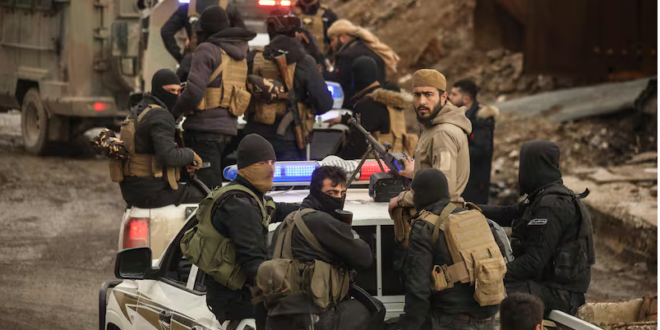
Syrian government forces entered the ethnically mixed city of Hasakah on Monday and prepared to do the same in Kobani and Qamishli, under the first phase of a deal to integrate areas held by the Syrian Democratic Forces.
The National witnessed about 15 armoured vehicles and police cars carrying roughly 100 Syrian internal security personnel driving into the outskirts of Kobani on Monday morning, mirroring similar troop movements in Hasakah. As of early Monday evening, troops were still preparing to enter Kobani city.
Entry into the Kurdish stronghold of Qamishli by government troops is expected to take place on Tuesday.
The Kurdish-led SDF continued to operate checkpoints as government troops arrived in the Kurdish-held areas.
State media circulated an image showing government troops posing with newly appointed Hasakah security chief Marwan Al Ali at the city’s traffic department headquarters. A Syrian flag was hanging in the background. Mr Al Ali was later seen meeting with officials from Hasaka’s Asayish, the SDF’s internal security force.
Official media also published “instructions” from Mr Al Ali for personnel to “adhere to laws and regulations, and ensure discipline while maintaining public order”.
Both the SDF and the Syrian government have taken steps to ensure the smooth implementation of the ceasefire agreement. On Sunday, the SDF announced a precautionary curfew across areas under its control to “maintain security, stability and the safety of residents” as government forces prepared to move in.
Under the terms of the agreement, a limited number of internal security forces will enter Kobani, Hasakah and Qamishli as part of a phased process aimed at integrating security and administrative institutions in the semi-autonomous Kurdish-held areas. Some SDF brigades are to become part of the Syrian army.
But it remains to be seen whether the fragile agreement will hold, with more than a decade of civil war in Syria entrenching bad blood between Kurdish and Arab communities in the north.
In the village of Sirreen, Abrahim Alush, who watched as Syrian government troops rolled into a previously SDF-held stretch of Arab-majority villages on the outskirts of Kobani, expressed doubt the truce would hold.
“The SDF has both a political arm and a military arm. The political side reached the agreement, but I doubt the military branch will abide by it,” he told The National as Syrian troops prepared to enter Kobani.
He added that he was displaced from his home in Sabt, in northwestern Syria, during the war and his house was destroyed by the SDF.
“There’s a major fissure between Arabs and Kurds. It will take a lot of time for full integration to happen.”
Another Arab resident of Sirreen, Ismail Khalil, was more optimistic, saying he hoped the arrival of security forces in Kurdish areas would be “the beginning of good tidings for us all”.
Political uncertainty remains over the future of north-eastern Syria as the tentative ceasefire follows weeks of fighting between government forces and the SDF. Since mid-January, the Syrian army and affiliated groups have launched an offensive on SDF-held areas, making rapid territorial gains across the north-east and retaking key oilfields previously controlled by the SDF, significantly shrinking Kurdish-held areas.
On Sunday, Aleppo’s head of internal security, Mohammad Abdul Ghani, met Kurdish officials and said preparations were under way for security troops to enter Kobani. He said efforts were being made to develop “the appropriate plan for deployment, activating police stations and integrating them into the general system of the Ministry of Interior”.
“We are not a nation of revenge or force. We are a nation built on the application of the rule of law,” he added.
Government and SDF officials said it would take about a month to fully implement the agreement, beginning with security postings before expanding to the integration of state and civil administrative structures.