 Eurasia Press & News
Toplines
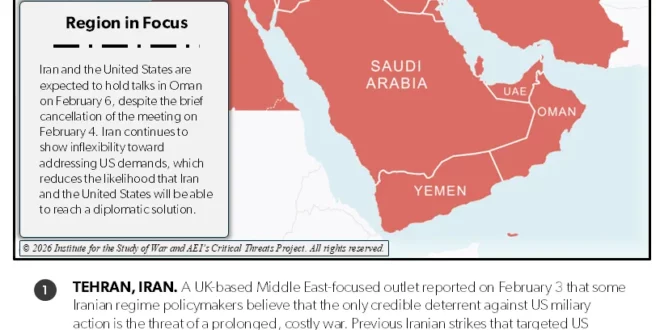
Iran and the United States are expected to hold talks in Oman on February 6, despite the brief cancellation of the meeting on February 4.[1] Iran continues to show inflexibility toward addressing US demands, which reduces the likelihood that Iran and the United States will be able to reach a diplomatic solution.[2] The United States and Iran had previously agreed to hold talks in Istanbul, Turkey, on February 6, with other regional states participating.[3] Iran’s refusal to show flexibility over the location and format of the talks prompted a brief cancellation of the planned US-Iran talks on February 4, according to two unspecified US officials.[4] The Iranian regime also pushed for bilateral US-Iran talks and restrictions that would limit the talks to the Iranian nuclear program, instead of broader negotiations desired by the United States that would address the ballistic missile program and Iran’s support for regional proxies.[5] Unspecified officials separately told Axios on February 4 that at least nine regional countries urged the United States not to cancel the talks in ”high-level” messages, which led to a US decision to hold the February 6 talks despite the earlier cancellation.[6] The sources added that the Trump administration remains “very skeptical” that negotiations will proceed.[7]
The administration’s skepticism is in response to Iran’s efforts to limit the scope of the negotiations. The Trump administration seeks to discuss Iran’s nuclear program, ballistic missiles, and support for its proxy network. Iran has signaled that it intends to limit US-Iranian discussions to nuclear issues, almost certainly because it is unwilling to make concessions on either of those two priorities.[8] Iranian officials have repeatedly insisted that Iran will not negotiate on its ballistic missile program or support for its proxy and partner network, which constitute the main pillars of Iran’s deterrence and defense strategies.[9] Supreme Leader Representative to the Supreme National Security Council’s Defense Council Ali Shamkhani told a Lebanese Hezbollah-affiliated outlet on February 2 that Iran will “definitely continue” to support the Axis of Resistance.[10]
A UK-based Middle East-focused outlet reported on February 3 that some Iranian regime policymakers believe that the only credible deterrent against US military action is the threat of a prolonged, costly war. The outlet reported that Iranian regime members have concluded that limited retaliatory Iranian military action can no longer deter the United States from taking military action against Iran.[11] Previous Iranian strikes that targeted US assets in the region failed to deter US military action, such as Iran‘s strikes targeting Ain al Assad airbase in Iraq in 2020 (in response to the United States’ targeted killing of former IRGC-QF commander Qassem Soleimani) and al Udeid Airbase in Qatar in June 2025 (in retaliation for the US strikes on the Iranian nuclear program).[12] Iran now finds itself under threat of potential US military action once again, despite its strike on al Udeid in June 2025. Iranian officials appear to be reckoning with the concept that threatening similarly limited retaliatory strikes targeting US assets will not deter the US from striking Iran again.
This report about the beliefs of some Iranian policymakers corroborates CTP-ISW’s previous assessment that Iran is attempting to deter US military action against Iran by forecasting that it will escalate into a prolonged regional war.[13] Iranian policymakers have almost certainly seen and internalized the ongoing discussion in Western media about the Trump administration’s fears about a broader war. Supreme Leader Ali Khamenei warned on February 1 that a US attack on Iran would lead to a regional war.[14] Foreign Affairs Minister Abbas Araghchi also warned on February 1 that Iran would target US bases and that the ensuing conflict would extend to the region if the United States attacks Iran.[15]
Iranian senior political insiders also confirmed to the same outlet that Araghchi is overseeing Iranian nuclear negotiations with the United States, and Supreme National Security Council (SNSC) Larijani is supervising Iran’s coordination with Russia.[16] Araghchi, who has served as foreign affairs minister since August 2024, has been the main point of contact with the United States, specifically US Special Envoy to the Middle East Steve Witkoff, throughout the US-Iran negotiations process since 2025.[17] Araghchi also led the Iranian nuclear negotiating team as deputy foreign minister under the Hassan Rouhani administration between 2017 and 2021.[18] Senior political insiders told the outlet that Araghchi has won “internal battles” within the Iranian regime regarding Iran’s nuclear negotiations at ”key junctures” over the past year.[19] Araghchi has also coordinated with Larijani, who oversees Iran’s relationship with Russia, according to the insiders.[20] Araghchi attended Larijani’s ”frank and fruitful” meeting with Qatari officials in Doha on January 31, according to a senior Iranian political insider with knowledge of the meeting.[21] Larijani has held several meetings with Russian officials over the past year as the Supreme Leader‘s advisor on international affairs and during his second tenure as SNSC Secretary since August 2025.[22] Larijani also spent nearly 20 years working on Iran’s nuclear file, as SNSC Secretary between 2005 and 2007 and particularly as parliament speaker between 2008 and 2020, when he oversaw the passage of the 2015 Joint Comprehensive Plan of Action.[23]
A senior People’s Protection Units (YPG) commander who reportedly opposed previous efforts to integrate the Syrian Democratic Forces (SDF) into the Syrian state publicly endorsed the SDF’s integration under the January 30 agreement. YPG founder and SDF General Command member Sipan Hamo said that the January 30 SDF-Syrian government agreement satisfied many of the SDF’s objectives for its integration into the Syrian state in a February 3 interview with pro-Kurdish Turkish media.[24] The 14-point January 30 agreement outlines the SDF’s gradual integration into the Syrian state.[25] Hamo said that it was essential for Syrian Kurds to ”correctly interpret” the gains of the January 30 agreement, which he characterized as the ability of Syrian Kurds to “now live in Syria as citizens with their own existence and identity.”[26] Hamo echoed other Kurdish leaders, including moderate and SDF commander Mazloum Abdi, by commenting that the agreement shifts the SDF’s struggle from a military struggle to a political one.[27] Hamo added that Kurds will achieve these goals through their involvement in the drafting of the new Syrian constitution.[28] Syria currently operates under an interim constitution, which President Ahmed al Shara ratified in March 2025, that establishes a five-year transition period that will last until 2030, when the Syrian People’s Assembly (parliament) will have drafted an official constitution.[29] Hamo clarified that the January 30 agreement must grant the same rights to Kurds in areas that faced Turkish-backed offensives in 2018 and 2019, such as Afrin, Aleppo Province, and Ras al Ain, Hasakah Province.[30]
Hamo’s public support for the SDF’s integration indicates that moderates within the SDF may be successfully convincing hardliners to support the agreement, which reduces some of the risks of an organized, large-scale YPG-led insurgency in northeastern Syria. Hamo’s support for the agreement is consistent with CTP-ISW’s current most likely course of action, which is a low-grade, relatively unorganized insurgency organized by individual hardline holdouts and not senior YPG or Kurdish leaders. Hamo’s support for the January 30 agreement represents a significant shift in his rhetoric and views on SDF integration. Syrian government sources previously accused Hamo of being an SDF hardliner whose maximalist demands prevented an agreement during government-SDF negotiations in early January 2026.[31] President Shara accused Hamo of taking direct orders from Kurdistan Workers Party (PKK) officials and of living for seven years in the Iraqi Qandil Mountains, the PKK’s stronghold, before returning to Syria in 2025.[32] Hamo’s comments in his February 3 interview also suggest that he may have supported the SDF internal security forces’ (known as Asayish) decision to ignore a ceasefire[33] with the Syrian army in Kurdish neighborhoods of Aleppo City on January 9.[34] Hamo’s notable shift in perspective towards supporting the January 30 agreement suggests that moderate voices within the SDF may have successfully persuaded “hardliners” such as Hamo to accept the agreement. Hamo’s public support, combined with his status as a senior YPG commander, reduces the likelihood that hardline YPG fighters will organize themselves at-scale and resume attacks or launch an insurgency against the Syrian government. Some YPG, SDF-affiliated, and unaffiliated Kurdish fighters who reject the January 30 agreement could still decide to launch an independent low-grade insurgency, however.
The Syrian government and SDF have continued to implement the January 30 agreement.[35] The 14-point January 30 agreement stipulates four distinct implementation phases before the end of February, followed by a fifth phase establishing permanent commitments between the SDF and the Syrian government.[36] An Asayish commander, Siamand Afrin, told Kurdish media on February 4 that the Syrian government and SDF had completed the first two phases of the January 30 agreement, which include a comprehensive ceasefire and the deployment of Interior Ministry forces to Hasakah City and Qamishli, respectively.[37] Afrin said that the agreement has entered its third phase, which stipulates a government-SDF prisoner exchange, the end of the government’s “siege” on Kobani, Aleppo Province, and the withdrawal of all military forces from either side.[38] A Syrian source said that prisoner exchange and SDF military withdrawal from urban areas were still under discussion on February 4.[39]
Key Takeaways
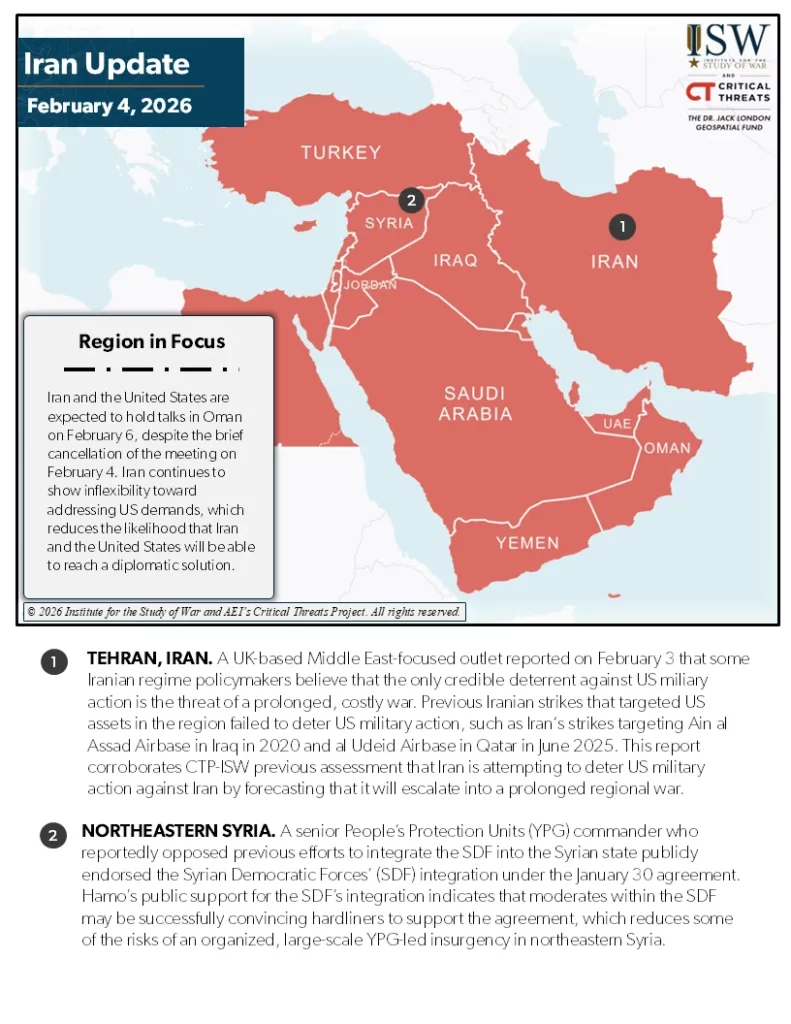
US-Iran Talks: Iran and the United States are expected to hold talks in Oman on February 6, despite the brief cancellation of the meeting on February 4. The Trump administration seeks to discuss Iran’s nuclear program, ballistic missiles, and support for its proxy network. Iran continues to show inflexibility toward addressing US demands, which reduces the likelihood that Iran and the United States will be able to reach a diplomatic solution.
Iranian Deterrence: A UK-based Middle East-focused outlet reported on February 3 that some Iranian regime policymakers believe that the only credible deterrent against US military action is the threat of a prolonged, costly war. Previous Iranian strikes that targeted US assets in the region failed to deter US military action, such as Iran’s strikes targeting Ain al-Assad Airbase in Iraq in 2020 and al Udeid Airbase in Qatar in June 2025. This report corroborates CTP-ISW’s previous assessment that Iran is attempting to deter US military action against Iran by forecasting that it will escalate into a prolonged regional war.
SDF Integration: A senior People’s Protection Units (YPG) commander who reportedly opposed previous efforts to integrate the Syrian Democratic Forces (SDF) into the Syrian state publicly endorsed the SDF’s integration under the January 30 agreement. Hamo’s public support for the SDF’s integration indicates that moderates within the SDF may be successfully convincing hardliners to support the agreement, which reduces some of the risks of an organized, large-scale YPG-led insurgency in northeastern Syria.
Iran
An IRGC-affiliated Telegram channel reported that Iran operated a Russian Mil Mi-28 attack helicopter in Tehran on February 4.[40] Iran received at least one Mi-28 on January 28 as part of a November 2023 Iranian-Russian military agreement.[41] Russian Mil Mi-28 attack helicopters are unlikely to be useful to Iran in conventional aerial warfare against adversaries like the United States and Israel, given that US and Israeli long-range missiles and aircraft can target the helicopters long before the helicopters can attack US or Israeli aircraft. CTP-ISW assessed on January 13 that Iran likely acquired these systems for use against internal disturbances and threats, including protests.[42] Low-flying helicopters can have a deterrent effect against protesters even if the helicopters do not attack the protesters with their weapon systems.
Iraq
The United States continues to oppose State of Law Coalition head and former Prime Minister Nouri al Maliki’s assumption of the Iraqi premiership. Several unidentified people told Bloomberg on February 3 that the United States warned Iraqi officials that the United States would reduce Iraq’s access to oil-export revenues if Maliki became prime minister.[43] The United States reportedly issued this warning during a recent meeting between senior US officials and Iraqi Central Bank Governor Ali al Alaq in Turkey.[44] The US State Department said in response to the Bloomberg report that the United States would use a “full range of tools” to ensure that Maliki does not become prime minister.[45] Alaq denied that US officials warned him that a Maliki premiership would impact Iraq’s access to its oil revenue.[46] The Bloomberg report follows the United States reportedly threatening senior Iraqi officials with US sanctions, including sanctions targeting Iraq’s oil revenue account at the New York Federal Reserve, if Iranian-backed Iraqi militias are included in the next government.[47] The Central Bank of Iraq has managed an account at the New York Federal Reserve on behalf of the Iraqi Finance Ministry since 2003 that holds the Iraqi federal government’s revenue from oil exports in US dollars.[48] Oil revenue accounts for about 90 percent of the Iraqi state’s budget.[49] Curtailing the Iraqi government’s access to its oil revenue account would very likely hinder the Iraqi government’s ability to fund domestic spending and provide liquidity for Iraqi banks.
Maliki’s admission of “close ties” with Iranian-backed Iraqi militias during an interview on February 3 demonstrates why the United States would consider a Maliki premiership synonymous with the inclusion of Iranian-backed Iraqi militias in the next government.[50] An unidentified US State Department official also told Iraqi media on February 4 that the United States will halt US aid to Iraq if Maliki assumes the premiership.[51] US President Donald Trump similarly said that the United States “will no longer help Iraq” if Maliki becomes prime minister.[52] Maliki pursued authoritarian and sectarian policies between the US withdrawal from Iraq in 2011 and 2014, which contributed to the rise of the Islamic State of Iraq and Syria (ISIS) in Iraq.[53] The United States ultimately conditioned its support for Iraq against ISIS in 2014 on Maliki’s removal from power due to his direct role in destabilizing Iraq.[54] Iran backs Maliki’s candidacy.[55]
It remains unclear if the Shia Coordination Framework will continue to insist on Maliki’s nomination or pick an alternative candidate for prime minister due to US and domestic pressure. Maliki is still likely attempting to secure the premiership, however. The framework announced on January 31 that it still supports Maliki, but is expected to discuss Maliki’s nomination in a meeting on February 4.[56] Maliki told Iraqi media on February 3 that he is willing to forgo the premiership if the framework votes to select another candidate by a two-thirds majority, but is likely still aiming for the position.[57] An unspecified “leading” framework source told Asharq al Awsat on February 4 that Maliki’s current insistence on the premiership is designed to prevent current Iraqi Prime Minister Mohammad Shia al Sudani from becoming prime minister and to allow Maliki to have an “influential say” in choosing the alternative candidate, rather than to actually return Maliki to the premiership.[58] The framework source added that Sudani withdrew from the premiership race on January 13 on the condition that he would receive the premiership with the framework’s support if Maliki failed to form a government.[59] The framework member’s comments are consistent with Kurdish reporting about Sudani’s conditional withdrawal, although Maliki denied in the February 3 interview that Sudani asked for any guarantees in order to support Maliki.[60]
Syria
A group of Suwaydawi representatives is promoting a pathway for Suwayda Province’s reconciliation with the Syrian state.[61] A group of 26 civil society representatives and local notables from Suwayda Province identified themselves as the “Third Movement” in a social media statement on February 1.[62] The Third Movement presented itself as a middle ground between recent failed Syrian government initiatives to promote reconciliation and the lack of any “integrated, viable project” from Druze Sheikh Hikmat al Hijri and his followers.[63] Hijri and his coalition of anti-government Druze groups have refused to negotiate with the Syrian government, and domestic and international efforts to reconcile his camp with the Syrian transitional government have largely remained stalled since September 2025.[64] Hijri said in a January 2026 interview that the people of Suwayda demand “not only self-administration but an independent Druze region.”[65] The Third Movement affirmed that Suwayda is ”an integral part of the Syrian state,” but did not explicitly call for Suwayda Province to formally re-integrate into state civil and security services.[66] The movement instead calls for a ”genuine partnership in managing local affairs,” noting that Suwaydawis have ”legitimate local demands” that do not interfere with the Syrian government’s authority.[67] The group announced a roadmap for Suwayda Province to open dialogue with and cooperate with the Syrian transitional government on building accountability mechanisms, returning internally displaced persons (IDPs), and ensuring basic resources and opportunities for the province.[68]
The Third Movement’s initiative proposed a new, locally-staffed civil body to address instability within Suwayda Province.[69] Members of the Third Movement cited ongoing insecurity within the province and other reasons, including Hijri’s reliance upon Israel and his followers’ repression of political opposition, as justification for their opposition to Hijri and his movement.[70] The Third Movement proposed the establishment of a “Civil Rescue Committee” as an unarmed civil framework to address the province’s humanitarian needs and social issues.[71] The group said that the committee would be committed to the ”Syrian national identity” but ”non-partisan.”[72] The group said that the conception of the committee is ”open to development” and asserted that it is not a ”governance project.”
The Syrian government may be willing to support this Suwaydawi-led push for reconciliation to ensure full control over Syria by undermining Hijri and ultimately integrating Suwayda Province. Some Suwaydawi representatives behind the Third Movement have expressed support for the Syrian government’s efforts to reconcile with Suwayda or even reportedly assisted government forces in July 2025.[73] Hikmat al Hijri’s Supreme Legal Committee has taken a relatively hardline position that calls for self-administration and self-determination, which is irreconcilable with Damascus’s position that Syria must be united and centralized.[74] Damascus is hesitant to forcibly integrate Suwayda, however, due in part to Israeli diplomatic support for the Druze and Israeli military airstrikes against the government in support of the Druze in July 2025.[75] The Syrian government has employed a relatively light-handed strategy toward the Druze-majority Suwayda Province since the violence in July 2025, which has primarily focused on raising money for and rebuilding villages in government-controlled areas of northwestern Suwayda Province.[76] These efforts have not appeared to make any meaningful headway with the current anti-government Druze authorities in Suwayda Province.
The Third Movement‘s call for “consensual administrative decentralization” and a “genuine partnership to manage local affairs” with the Syrian transitional government could possibly entice anti-government Druze who have sided with Hijri due to his championship of Druze self-determination. The Third Movement’s position is somewhat consistent with Syrian Law No. 107, which dictates local administration in theory. Law No. 107 is an Assad-era law that devolves important economic and community support authorities to local leaders but places them under a centrally appointed governor.[77] This system, implemented under Assad, gave significant authority to the governor and comparatively less to local leaders.[78]
A third-party effort that advocates for basic services and rights for Suwaydawis may also garner the support of anti-government Druze who have supported Hijri since July 2025. Suwayda Province continues to face significant resource shortages that are contributing to insecurity and armed conflict in the province.[79] The Suwayda National Guard has conducted several politically motivated arrests and killings of prominent Druze individuals in Suwayda Province, likely as part of an effort to discourage dissent and to consolidate political control. Several members of the Third Movement have also accused Hijri’s followers or the National Guard of political repression and other violations.[80] One Third Movement member pointed out that Hijri’s political efforts are built entirely on ”external support” without an economic base.[81] A services- and rights-focused initiative could undermine Hijri’s political legitimacy by building support among other Suwaydawi Druze who previously supported him.
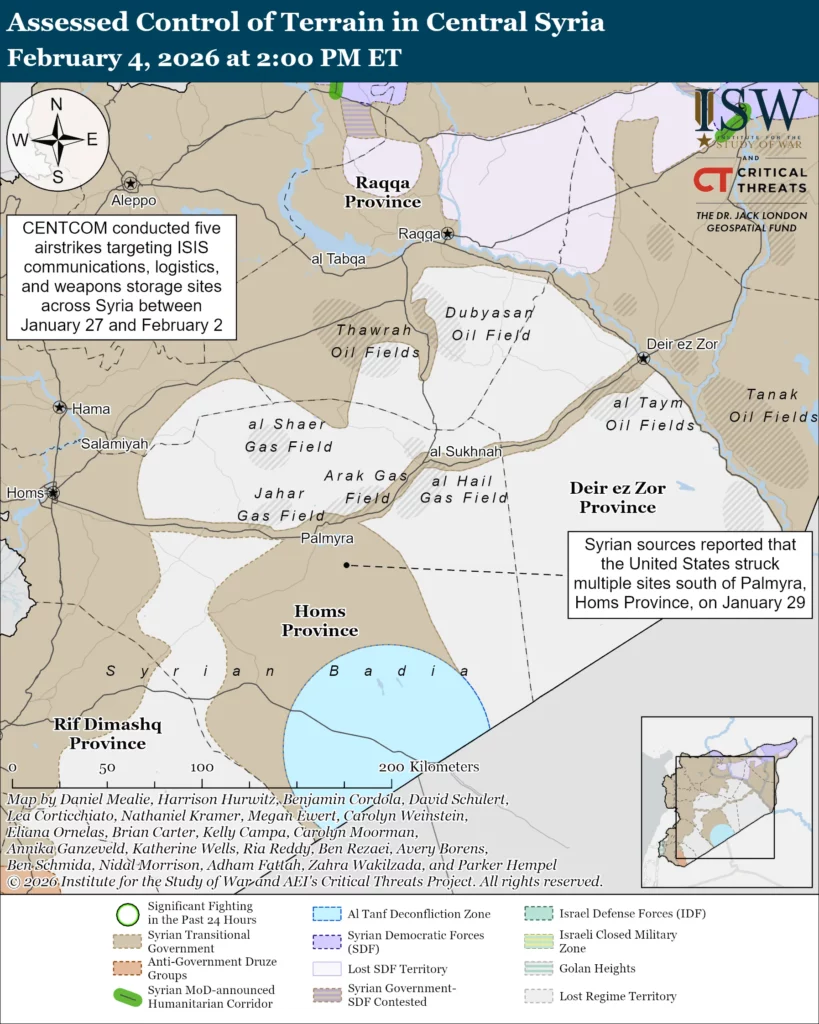
The United States has continued to conduct drone strikes targeting Islamic State in Iraq and al Sham (ISIS)-affiliated targets in Syria. US Central Command (CENTCOM) announced on February 4 that it conducted five airstrikes targeting ISIS-affiliated communications, logistics, and weapons storage sites across Syria between January 27 and February 2.[82] Syrian sources reported that the United States struck multiple sites south of Palmyra, Homs Province, on January 29.[83] CENTCOM also reported that the United States and partner forces, including Syria, have killed or captured 50 ISIS operatives in Syria over the last two months.[84] Syrian Ministry of Interior forces, with support from the US-led Global Coalition to Defeat ISIS, arrested and killed multiple ISIS ”governors” in late December 2025, for example.[85]
CENTCOM conducted a drone strike that killed former Al Qaeda (AQ)-aligned Hurras al Din leader Bilal Hasan al Jasim in Aleppo Province on January 17.[86] CENTCOM reported that Jasim had “direct ties“ to the ISIS-aligned Syrian security forces member who conducted an insider attack that killed two US servicemembers, a US civilian interpreter, and a Syrian internal security officer in Palmyra, Homs Province, on December 13.[87] Hurras al Din is a Syrian AQ affiliate comprised of former Jabhat al Nusra fighters who opposed the group’s split from AQ in 2016 and defected to form Hurras al Din.[88] US CENTCOM has repeatedly targeted members of designated terrorist organizations in Syria since the fall of Assad, including Hurras al Din.[89]
Arabian Peninsula
CTP-ISW has temporarily suspended its coverage of Yemen beginning on January 9.
Palestinian Territories & Lebanon
Nothing significant to report.