 Eurasia Press & News
Toplines
US, Ukrainian, and Russian delegations continued trilateral talks in Abu Dhabi, United Arab Emirates (UAE) on February 4. Ukrainian National Security and Defense Council Secretary Rustem Umerov stated on February 4 that the trilateral talks were “meaningful and productive” and that the parties continued to work in separate groups before resuming trilateral negotiations.[1] White House officials noted that US Special Envoy to the Middle East Steve Witkoff and former Senior Advisor to the US President Jared Kushner traveled to Abu Dhabi to participate in negotiations.[2] Umerov added that US Secretary of the Army Dan Driscoll and Supreme Allied Commander Europe and Commander of US European Command General Alexus Grynkewich participated in the consultations.[3] US Secretary of State Marco Rubio cautioned that there will likely be no information about the progress of the talks until there is a “breakthrough,” even through leaks, and noted that the remaining unresolved issues are the “most difficult.”[4]
Senior Kremlin officials and mouthpieces reiterated Russia’s commitments to its war goals and explicitly rejected Western-backed security guarantees for Ukraine, likely to set information conditions to reject any peace deal that does not concede to Russian demands. Russian Ministry of Foreign Affairs (MFA) Spokesperson Maria Zakharova reiterated the Kremlin’s characterization of any deployment of Western troops to postwar Ukraine, including through the Coalition of the Willing, as “categorically unacceptable” for Russia.[5] Zakharova claimed that such a deployment would threaten Russia’s security and threatened that Russia would consider such troops as legitimate military targets. Zakharova stated that a resolution to the war is impossible unless it addresses Russia’s so-called “root causes,” which Russia aims to resolve through “military or political means.” Kremlin officials use “root causes” as shorthand to refer to Russia’s demands for the rollback of the North Atlantic Treaty Organization (NATO) to its 1997 borders, the destruction of the Ukrainian military, and the replacement of the current democratically elected Ukrainian government with a pro-Russian regime.[6] Kremlin Spokesperson Dmitry Peskov reiterated on February 4 that Russia will continue its war in Ukraine until the Ukrainian government “makes the appropriate decisions,“ likely meaning until Ukraine capitulates to Russian absolutist demands.[7] Kremlin-affiliated former Ukrainian Verkhovna Rada Deputy Viktor Medvedchuk — a close personal ally of Russian President Vladimir Putin whom Putin initially wanted to install in place of Ukrainian President Volodymyr Zelensky following Russia’s full-scale invasion — claimed on February 4 that statements about Western troop deployment to Ukraine make negotiations a “dead end” as Russia will “never allow“ the Coalition of the Willing to deploy forces in Ukraine.[8] Russian State Duma deputies, who often act as bullhorns for the Kremlin’s rhetorical lines, also reiterated the Kremlin’s explicit rejection of postwar security guarantees for Ukraine.[9]
The United States concluded a deal to transport liquified natural gas (LNG) to Ukraine through the Vertical Gas Corridor. Reuters reported on February 2 that the United States concluded a deal with Greek joint venture Atlantic-See LNG Trade to transport US LNG to Ukraine through a pipeline that passes through Bulgaria, Romania, and Moldova, likely referring to the Vertical Gas Corridor pipeline.[10] The Atlantic-See LNG Trade S.A. stated that it will deliver the first shipment of LNG to Ukraine in March 2026.[11] The US Embassy in Kyiv confirmed on February 4 the deal to transport LNG through the Vertical Gas Corridor and noted that this deal marks a new route for US energy exports to replace Russian exports in Europe and demonstrates US business support for Ukrainian energy security.[12]
Russian forces are intensifying their battlefield air interdiction (BAI) campaign in the Kostyantynivka-Druzhkivka tactical area, setting conditions for a future offensive operations against Kostyantynivka using lessons learned from Pokrovsk. The commander of a Ukrainian brigade operating in the Kostyantynivka direction reported on February 4 that Russian forces have recently focused efforts on interdicting Ukrainian logistics rather than conducting combat operations, in part due to freezing temperatures.[13] The commander stated that Russian interdiction efforts are forcing Ukrainian forces to rely more heavily on unmanned ground vehicles (UGVs) to supply troops and positions within Kostyantynivka. The commander noted that the brigade’s use of UGVs in January 2026 increased twofold and that Ukrainian forces need to procure more UGVs at a cheaper rate to sustain logistics. The commander stated that Russian forces also interdict Ukrainian logistics by surveilling, striking, and remotely mining Ukrainian ground lines of communication (GLOCs) with first-person view (FPV) and sleeper drones; conducting drone ambushes; and destroying Ukrainian UGVs. The commander reported that it is difficult to rotate Ukrainian drone operators out of Kostyantynivka because Russian forces prioritize targeting Ukrainian drone operators, particularly with glide bombs, Molniya fixed-wing drones, and other FPV unmanned aerial vehicles (UAVs). The spokesperson of another Ukrainian brigade operating in the Kostyantynivka-Druzhkivka tactical area reported on January 8 that Russian drone ranges significantly increased in 2025, making it difficult for Ukrainian forces to travel into Kostyantynivka.[14] Russian forces began infiltration missions into Kostyantynivka in mid-October 2025 but have thus far not prioritized the seizure of Kostyantynivka in favor of completing the seizure of Pokrovsk.[15]
Russian forces are likely trying to replicate a new campaign design that Russia has successfully employed in Pokrovsk and later in eastern Zaporizhia Oblast. Russian forces in the Pokrovsk direction have been striking various targets in Ukraine’s near rear at an operational depth of about 25 to 100 or more kilometers. These targets include roads, railways, and bridges that support Ukrainian GLOCs, ahead of subsequent intensified ground operations. Russian forces also targeted Ukrainian drone operators to create exploitable gaps in Ukraine’s “wall of drones” defensive line.[16] Russian forces spent months conducting BAI campaigns to set conditions for intensified offensive operations in the Pokrovsk and Hulyaipole directions, which ultimately enabled Russian advances in these directions in fall 2025.[17]
The Russian Unmanned Systems Forces (USF) have already reportedly formed seven regiments, 25 battalions, one division, and three detachments separate from the Russian Rubikon Center for Advanced Unmanned Technologies and the BARS-Sarmat Unmanned Systems Special Purpose Center.[18] Former Deputy Head of the Ukrainian Main Military Intelligence Directorate (GUR) Major General Ilya Pavlenko stated on February 3 that the Russian USF consists of 87,000 troops and plans to raise one brigade, four regiments, 96 battalions, two divisions, and 82 companies in 2026. Pavlenko stated that Russia also plans to reorganize the BARS-Sarmat Unmanned Systems Special Purpose Center (formerly BARS-Sarmat Detachment, subordinated to Airborne Forces [VDV]) and the existing five USF regiments into six USF brigades.[19] Pavlenko noted that Russia appears to be reorganizing the BARS Center and existing USF units to improve decision-making and alleviate fragmentation between forces. It is unclear if Russia is planning to integrate Rubikon into the USF or is undertaking efforts to improve cohesion between Rubikon and USF units. Russia has been attempting to build out its USF since mid-2024 and presented its first USF regiment during the May 2025 Victory Day Parade in Moscow.[20]
Ukrainian President Volodymyr Zelensky appointed Major General Oleh Luhovskyi as the acting head of the Ukrainian Foreign Intelligence Service on February 4.[21]
Key Takeaways
US, Ukrainian, and Russian delegations continued trilateral talks in Abu Dhabi, United Arab Emirates (UAE) on February 4.
Senior Kremlin officials and mouthpieces reiterated Russia’s commitments to its war goals and explicitly rejected Western-backed security guarantees for Ukraine, likely to set information conditions to reject any peace deal that does not concede to Russian demands.
The United States concluded a deal to transport liquified natural gas (LNG) to Ukraine through the Vertical Gas Corridor.
Russian forces are intensifying their battlefield air interdiction (BAI) campaign in the Kostyantynivka-Druzhkivka tactical area, setting conditions for future offensive operations against Kostyantynivka using lessons learned from Pokrovsk.
The Russian Unmanned Systems Forces (USF) have already reportedly formed seven regiments, 25 battalions, one division, and three detachments separate of the Russian Rubikon Center for Advanced Unmanned Technologies and the BARS-Sarmat Unmanned Systems Special Purpose Center.
Ukrainian President Volodymyr Zelensky appointed Major General Oleh Luhovskyi as the acting head of the Ukrainian Foreign Intelligence Service on February 4.
Ukrainian forces recently advanced near Slovyansk and Hulyaipole and in the Kostyantynivka-Druzhkivka tactical area. Russian forces recently advanced near Slovyansk, Pokrovsk, Hulyaipole and in the Kostyantynivka-Druzhkivka tactical area.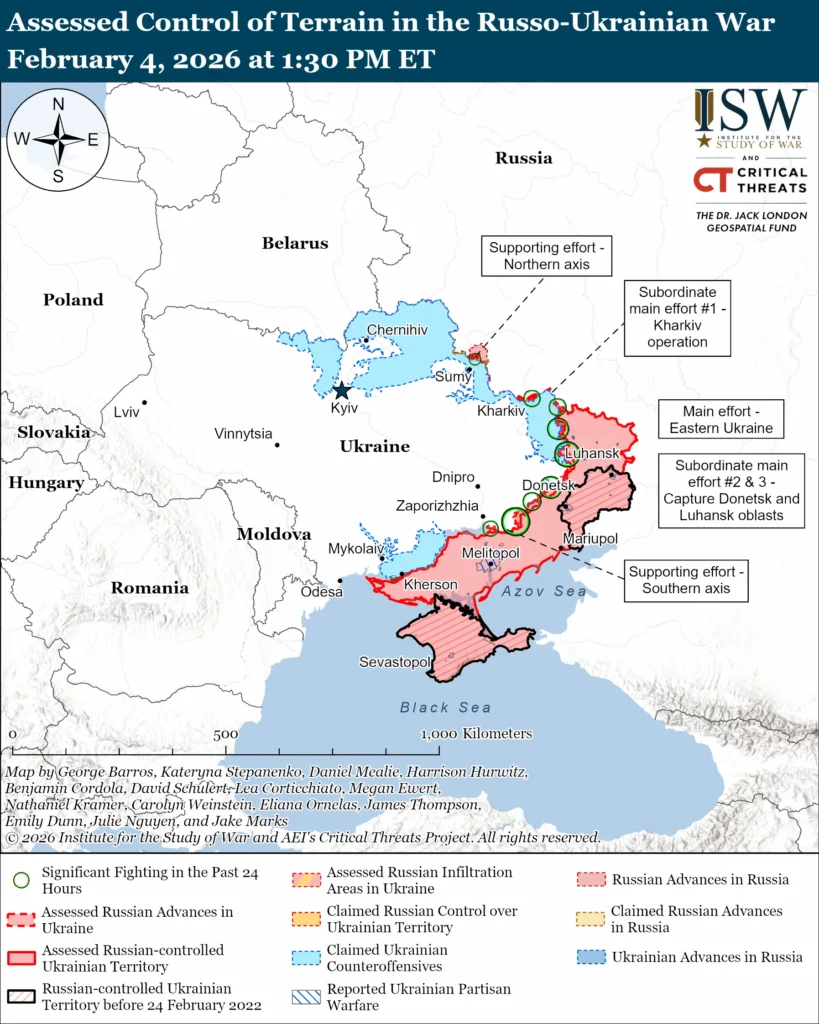
We do not report in detail on Russian war crimes because these activities are well-covered in Western media and do not directly affect the military operations we are assessing and forecasting. We will continue to evaluate and report on the effects of these criminal activities on the Ukrainian military and the Ukrainian population and specifically on combat in Ukrainian urban areas. We utterly condemn Russian violations of the laws of armed conflict and the Geneva Conventions and crimes against humanity even though we do not describe them in these reports.
Ukrainian Operations in the Russian Federation
Ukrainian forces continue their frontline strike campaign against military assets in Russia. Geolocated footage published on February 3 shows Ukrainian forces striking a Russian 2S19 Msta-S self-propelled gun near Murom, Belgorod Oblast (roughly 10 kilometers from the international border).[22]
Russian Supporting Effort: Northern Axis
Russian objective: Create defensible buffer zones in Sumy Oblast along the international border
Russian forces continued offensive operations in northern Sumy Oblast on February 4 but did not advance.
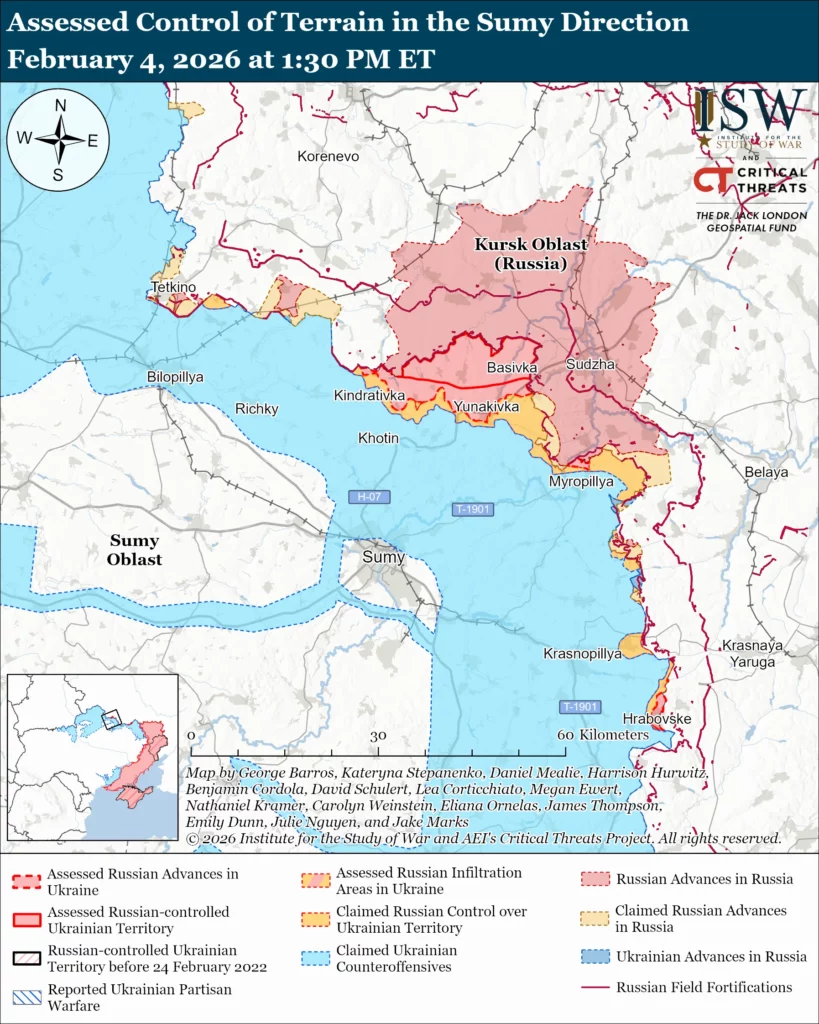
Russian forces attacked in Kursk and Sumy oblasts, including north of Sumy City near Oleksiivka and Kindrativka and toward Nova Sich; northeast of Sumy City near Yablunivka and Yunakivka; east of Sumy City near Marine; and southeast of Sumy City near Pokrovka, on February 3 and 4.[23]
A Kremlin-affiliated Russian milblogger claimed on February 4 that Russian offensive potential in northern Sumy Oblast remains limited as Russian forces transferred most reserves from this area to Donetsk Oblast.[24] The milblogger assessed that Russian forces are unlikely to conduct a major offensive operation in the area in the near future, which is in line with ISW’s ongoing assessments.[25]
Order of Battle: Drone operators and other elements of the Russian Rubikon Center for Advanced Unmanned Technologies, the Smuglyanka Detachment, and the 106th Airborne (VDV) Division, including its 119th VDV Regiment, reportedly continue to operate in the Sumy direction.[26]
Russian Main Effort: Eastern Ukraine
Russian Subordinate Main Effort #1 – Kharkiv Oblast
Russian objective: Push Ukrainian forces back from the international border to create a defensible buffer zone with Belgorod Oblast and approach to within tube artillery range of Kharkiv City
Russian forces continued offensive operations in northern Kharkiv Oblast on February 4 but did not advance.
Russian forces attacked northeast of Kharkiv City near Hrafske, Prylipka, Vovchansk, Starytsya, and Vovchanski Khutory, and toward Neskuchne on February 3 and 4.[27] A Russian milblogger claimed that Ukrainian forces counterattacked near Symynivka (northeast of Kharkiv City).[28]
Order of Battle: Drone operators of the Russian 83rd Motorized Rifle Regiment (69th Motorized Rifle Division, 6th Combined Arms Army [CAA], Leningrad Military District [LMD]) are reportedly operating in the Kharkiv direction.[29]
Russian forces continued offensive operations northeast of Velykyi Burluk near Khatnie on February 3 and 4 but did not advance.[30]
Russian Subordinate Main Effort #2 – Oskil River
Russian objective: Cross the Oskil River in Kharkiv Oblast and push westward into eastern Kharkiv Oblast and northern Donetsk Oblast
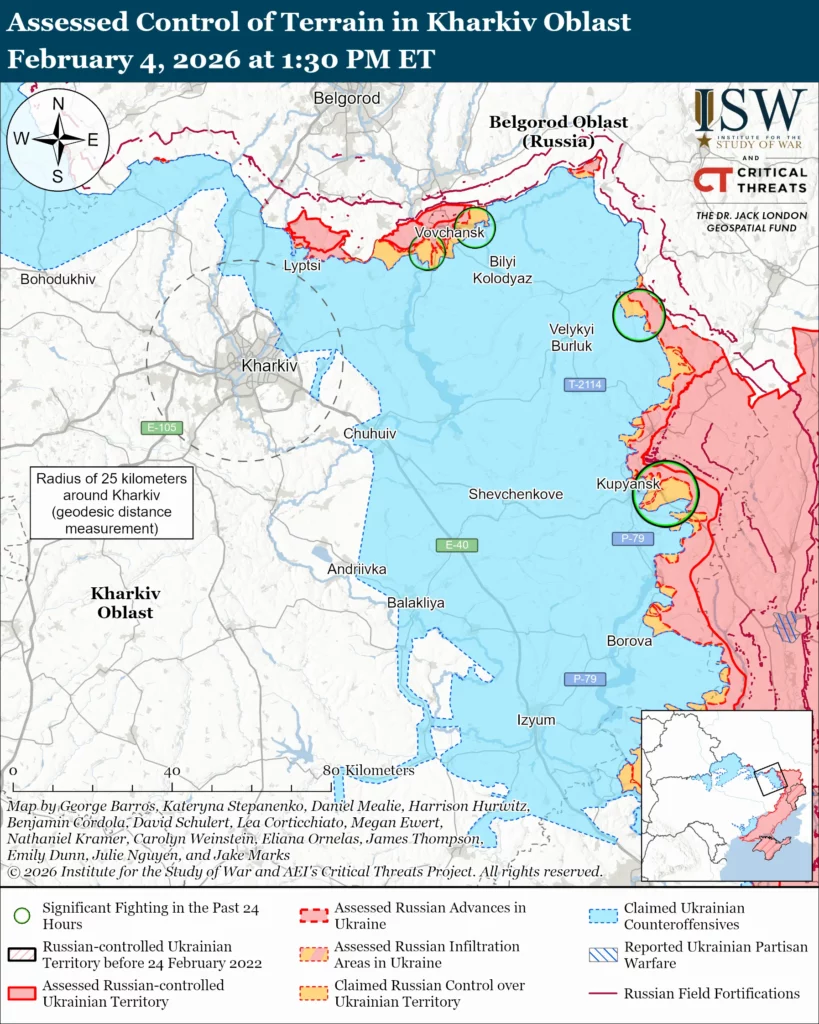
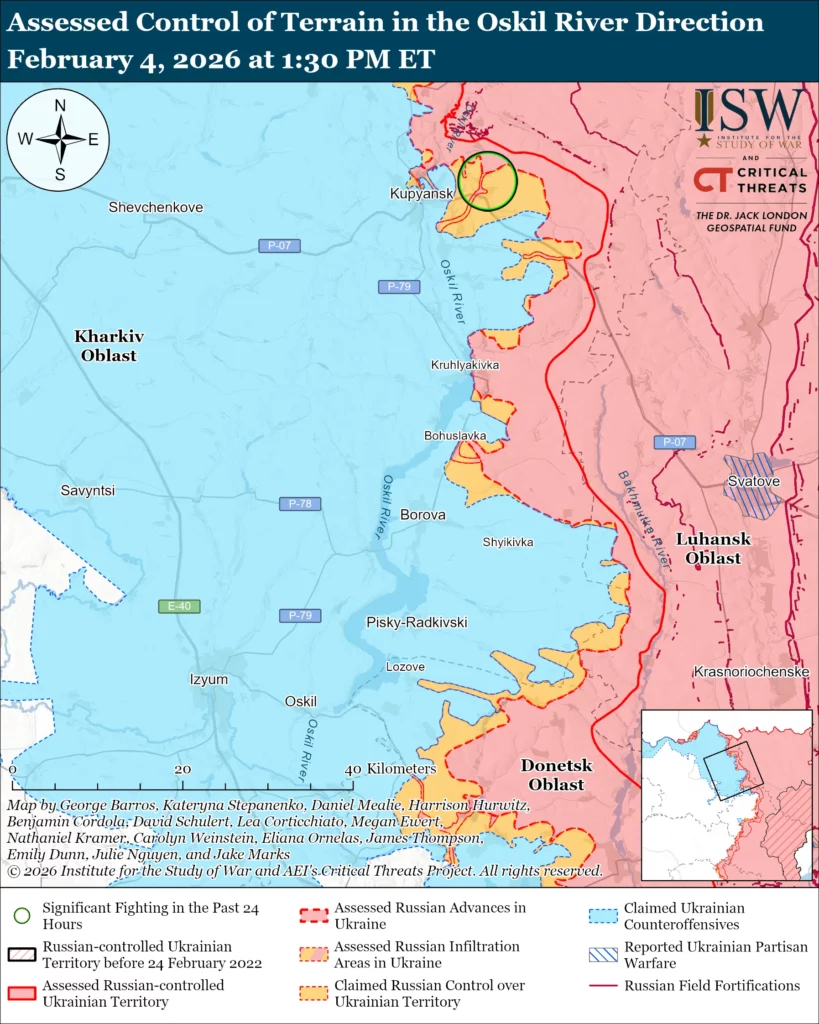
Russian forces continued offensive operations in the Kupyansk direction on February 4 but did not make confirmed advances.
Unconfirmed claims: A Kremlin-affiliated Russian milblogger claimed on February 4 that Russian forces seized Petropavlivka (east of Kupyansk).[31] The milblogger claimed on February 4 that Russian forces had only recently seized Petropavlivka, which contradicts previous Russian Ministry of Defense (MoD) claims about the seizure of the settlement.[32]
Russian forces attacked near and within Kupyansk itself; east of Kupyansk near Petropavlivka and Podoly; southeast of Kupyansk near Pishchane and toward Kurylivka; southeast of Kupyansk near Novoosynove and Hlushkivka; and south of Kupyansk toward Kupyansk-Vuzlovyi and Kivsharivka on February 3 and 4.[33]
The Kremlin-affiliated milblogger criticized the Russian military command for conducting infiltration missions to generate footage and falsely claiming that such footage demonstrates Russian control over settlements that Russian forces do not actually control.[34] The milblogger argued that Russian efforts to exaggerate advances in the Kupyansk direction are creating the impression that Russian forces are prioritizing generating informational effects instead of focusing on correcting tactical errors that exaggerated reports cause.
The Ukrainian Joint Forces Task Force reported on February 4 that an isolated group of Russian forces remains in Kupyansk.[35]
Order of Battle: Drone operators of the 3rd Battalion of the Russian 352nd Motorized Rifle Regiment (11th Army Corps [AC], Leningrad Military District [LMD]) reportedly continue to operate in the Kupyansk direction.[36]
Russian forces continued offensive operations in the Borova direction on February 4 but did not make confirmed advances.
Unconfirmed claims: A Russian milblogger claimed that Russian forces advanced east of Kolisnykivka (northeast of Borova).[37]
Russian forces attacked south of Borova near Korovii Yar and Oleksandrivka and toward Krymky on February 3 and 4.[38]
Russian Subordinate Main Effort #3 – Donetsk Oblast
Russian objective: Capture the entirety of Donetsk Oblast, the claimed territory of Russia’s proxies in Donbas, and advance into Dnipropetrovsk Oblast
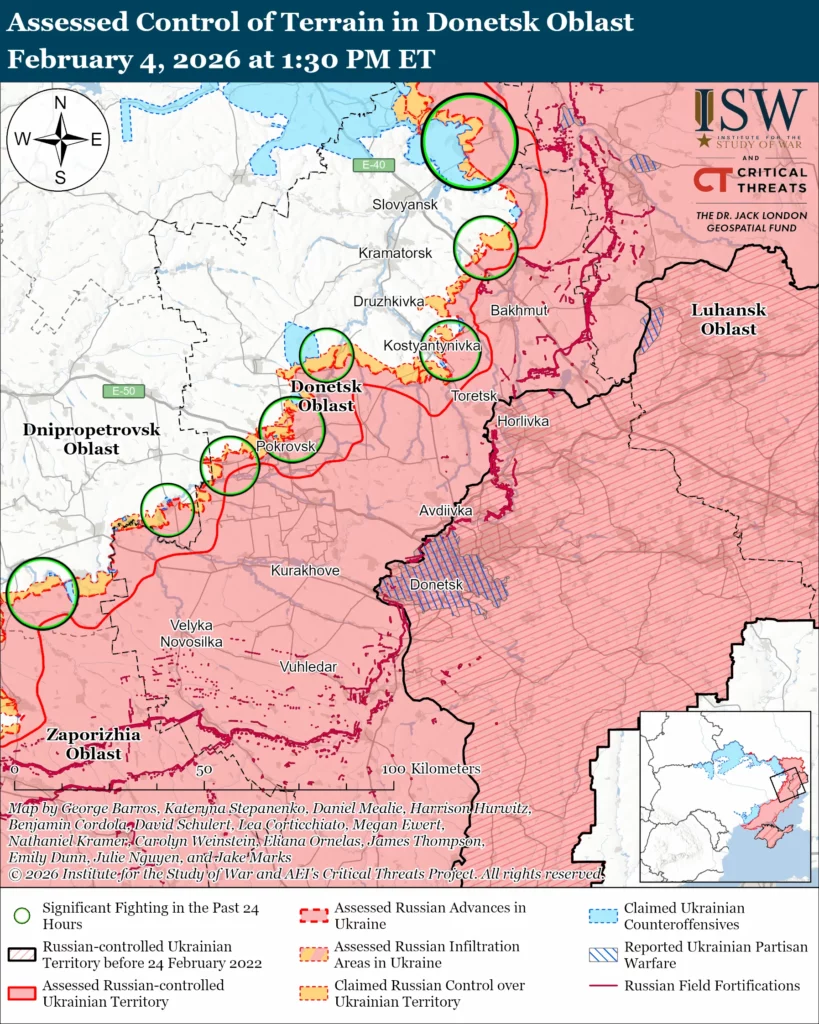
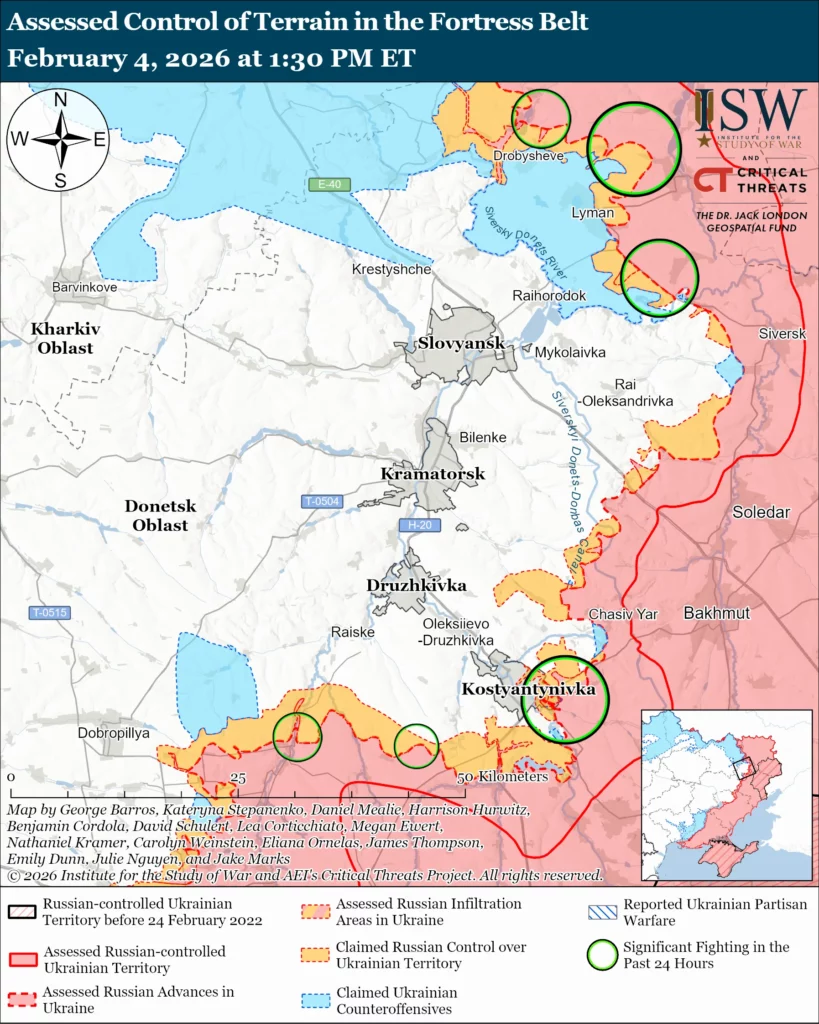
Ukrainian and Russian forces recently advanced in the Slovyansk direction.
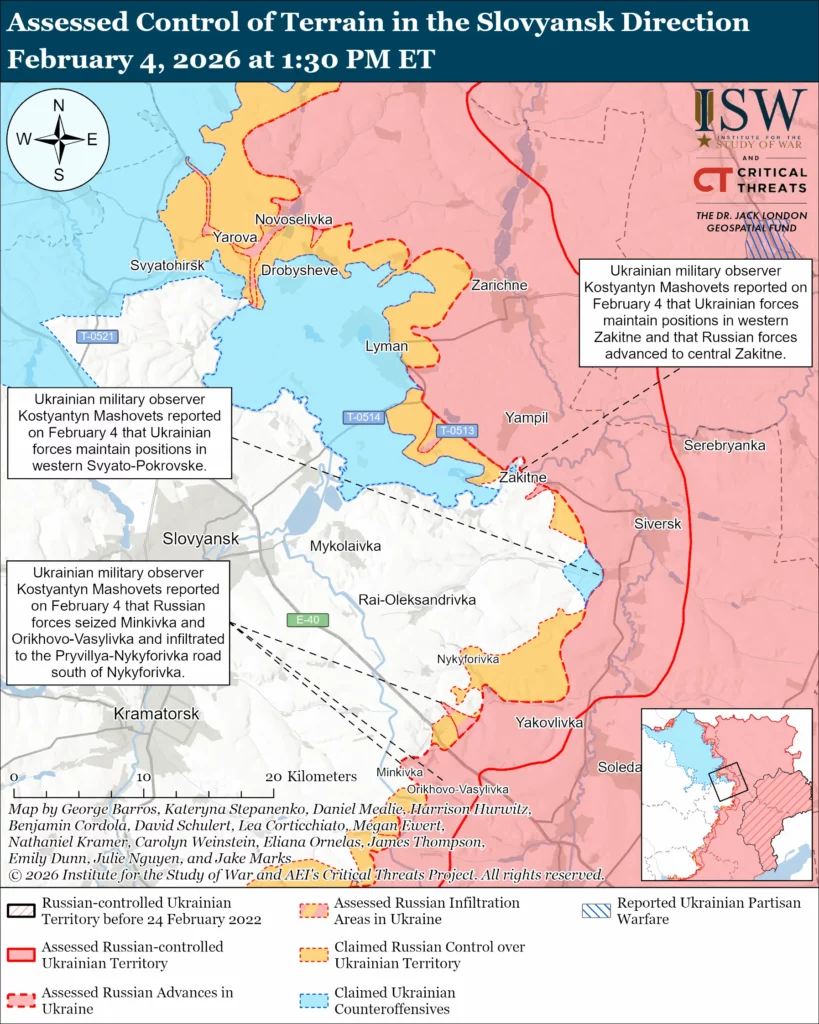
Assessed Ukrainian advances: Ukrainian military observer Kostyantyn Mashovets reported on February 4 that Ukrainian forces maintain positions on the western and southeastern outskirts of Zakitne (northeast of Slovyansk).[39] Mashovets stated that Ukrainian forces also maintain positions within Svyato-Pokrovske (east of Slovyansk) and that Russian forces are trying to advance through the settlement to Riznykivka (just west of Svyato-Pokrovske), indicating that Ukrainian forces maintain positions in western Svyato-Pokrovske and within Riznykivka.
Assessed Russian advances: Mashovets stated that Russian forces advanced to central Zakitne, indicating that Russian forces advanced in eastern Zakitne and to the north (left) bank of the Siverskyi Donets River north of the settlement on a prior date.[40] Mashovets reported that small Russian groups reached the Nykyforivka-Pryvillya road (southeast of Slovyansk), indicating that Russian forces advanced south of the settlements.
Assessed Russian infiltrations: Mashovets reported that small Russian groups reached the Nykyforivka-Pryvillya road, indicating that Russian forces recently conducted infiltration missions in the area that did not change control of terrain or the forward edge of the battle area (FEBA).[41] Mashovets reported that small Russian groups are trying to bypass Zakitne from the south by moving from Platonivka (just northeast of Zakitne) toward Kryva Luka (just southwest of Zakitne), indicating that Russian forces recently conducted infiltration missions in the area.
Unconfirmed claims: A Russian milblogger claimed that Russian forces advanced within Tetyanivka (northwest of Lyman).[42]
Russian forces attacked near Lyman itself; northwest of Lyman near Novoselivka; north of Lyman near Stavky and Drobysheve; northeast of Lyman near Zarichne, Zakitne, and Dronivka; east of Slovyansk near Platonivka and Svyato-Pokrovske and toward Riznykivka; and southeast of Slovyansk near Nykyforivka and Vasyukivka and toward Rai-Oleksandrivka on February 3 and 4.[43] Russian milbloggers claimed that Ukrainian forces counterattacked near Novoselivka and Zakitne.[44]
Ukraine’s Joint Forces Task Force stated on February 4 that Russian forces are constantly trying to infiltrate Lyman but have not been successful.[45] A spokesperson of a Ukrainian brigade operating in the Lyman direction reported that Russian drone operators are focusing on severing Ukrainian logistics and that poorly equipped Russian infantry personnel are attacking to expose Ukrainian positions.[46] The spokesperson reported that Russian forces follow such probing efforts by attacking with well-trained infantry or by launching drone strikes against the exposed positions.[47] A spokesperson of a Ukrainian brigade operating in the Slovyansk direction reported that small Russian groups continue to conduct infiltration missions toward Platonivka from near Siversk (east of Slovyansk), along the T-0513 Siversk-Platonivka road.[48] The spokesperson stated that Russian forces are also attacking in the Serebryanske forest area from near Yampil (both southeast of Lyman). The spokesperson noted that small Russian groups are trying to cross the Siverskyi Donets River, which has started to freeze. A Russian milblogger claimed that part of Svyatohirsk (northwest of Lyman) is a contested “gray zone.”[49] The milblogger claimed that Russian forces conducted two glide bomb strikes against a crossing over the Siverskyi Donets River on the northeastern outskirts of Mayaky (west of Lyman) that Ukrainian forces had repaired after a January 2025 Russian Tornado-S Multiple Launch Rocket System (MLRS) strike.
Order of Battle: Mashovets reported that elements of the Russian 123rd Motorized Rifle Brigade (3rd Combined Arms Army [CAA], formerly 2nd Luhansk People’s Republic Army Corps [LNR AC], Southern Military District [SMD]) are attacking near Nykyforivka.[50] Mashovets reported that elements of the 6th Motorized Rifle Brigade, 127th Motorized Rifle Brigade, 85th Motorized Rifle Brigade, and 88th Motorized Rifle Brigade (all four of the 3rd CAA) are operating in the Siversk-Slovyansk direction.[51] Drone operators of the Russian 7th Motorized Rifle Brigade (3rd CAA) are intercepting Ukrainian drones northeast of Kryva Luka.[52] Reconnaissance elements of the 752nd Motorized Rifle Regiment (3rd Motorized Rifle Division, 20th CAA, Moscow Military District [MMD]) are reportedly operating in the Lyman direction.[53]
Ukrainian and Russian forces recently advanced in the Kostyantynivka-Druzhkivka tactical area.
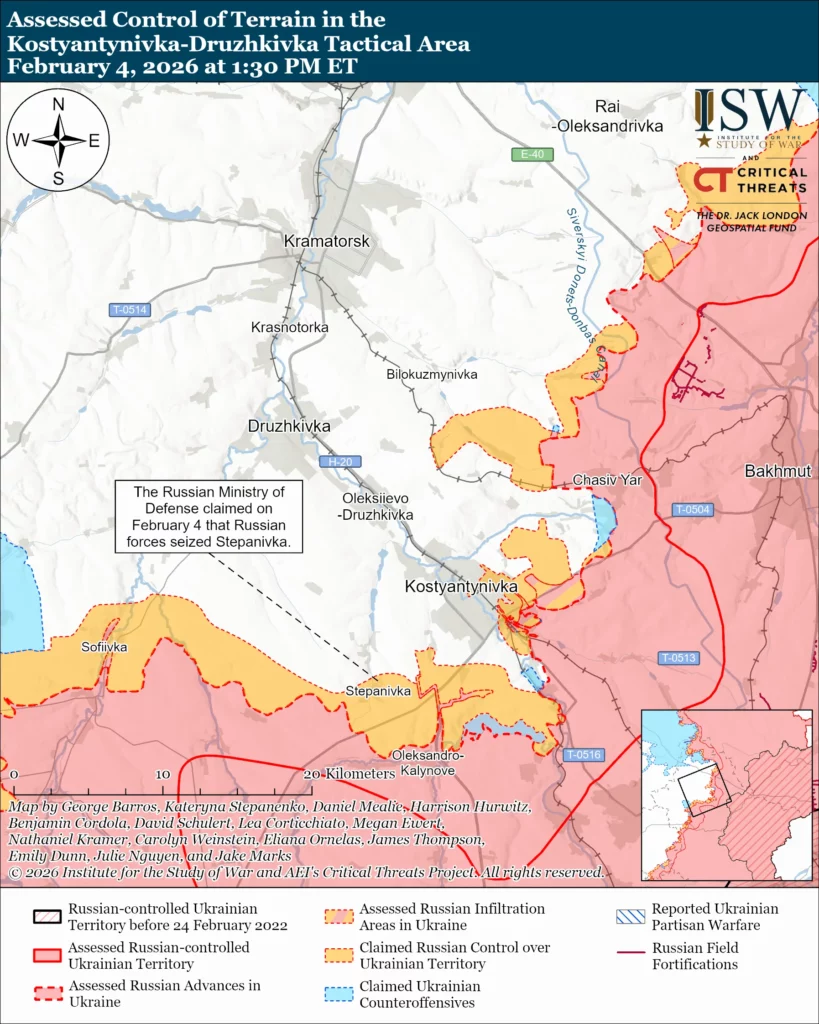
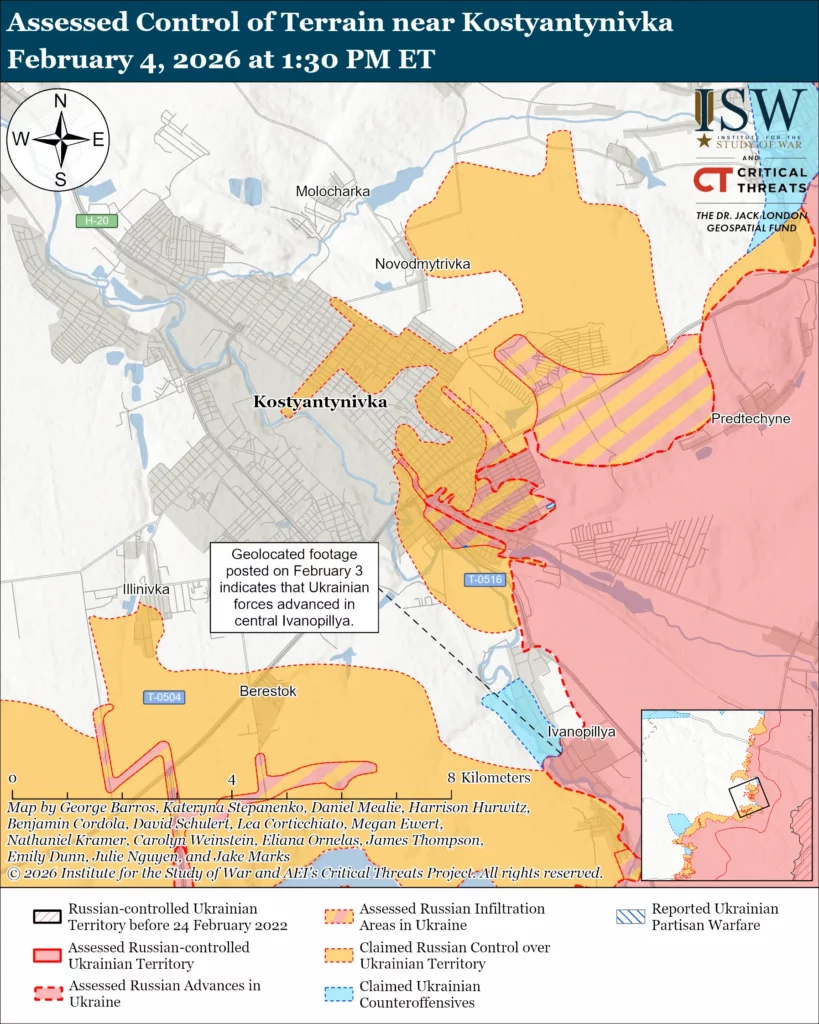
Assessed Ukrainian advance: Geolocated footage published on February 3 indicates that Ukrainian forces recently advanced in central Ivanopillya (southeast of Kostyantynivka).[54]
Assessed Russian advances: Mashovets reported that Russian forces seized Minkivka (northeast of Kostyantynivka) on a prior date, indicating that Russian forces likely also seized Orikhovo-Vasylivka (southeast of Minkivka).[55]
Unconfirmed claims: The Russian Ministry of Defense (MoD) claimed on February 4 that Russian forces seized Stepanivka (southwest of Kostyantynivka).[56] Russian milbloggers claimed that Russian forces also advanced east of Novodmytrivka (north of Kostyantynivka) and north of Sofiivka (southwest of Druzhkivka).[57]
Russian forces attacked near and within Kostyantynivka itself; northeast of Kostyantynivka near Minkivka; east of Kostyantynivka near Predtechyne; southeast of Kostyantynivka near Shcherbynivka, Pleshchiivka, and Ivanopillya; south of Kostyantynivka near Kleban-Byk; and southwest of Druzhkivka near Sofiivka and Novopavlivka and toward Pavlivka on February 3 and 4.[58]
Ukrainian Donetsk Oblast Military Administration Head Vadym Filashkin reported on February 4 that Russian forces conducted a cluster munitions strike against residential infrastructure in Druzhkivka, killing seven and injuring eight others.[59]
Ukrainian 11th Army Corps (AC) Spokesperson Lieutenant Colonel Dmytro Zaporozhets reported on February 3 that Russian forces recently deployed an unspecified fresh unit (likely at battalion echelon or lower) with armored fighting vehicles (AFVs) to the Kramatorsk direction and that Russian forces often attack in broad daylight without camouflage in open terrain.[60] Zaporozhets reported that Russian forces are using AFVs due to worsening weather conditions, likely to probe Ukrainian defenses.
Order of Battle: Drone operators of the Russian 13th Rusichi Assault Detachment of the 1194th Motorized Rifle Regiment (4th Motorized Rifle Brigade, 3rd CAA, SMD) and of the 70th Motorized Rifle Division (18th CAA, SMD) are striking Ukrainian positions in western and northern Kostyantynivka, respectively.[61] Reconnaissance elements of the 72nd Separate Motorized Rifle Brigade (3rd Army Corps [AC], under operational control of the Southern Grouping of Forces) are observing Russian strikes in Kostyantynivka.[62] Elements of the Rubikon Center for Advanced Unmanned Technologies and of the Smuglyanka Detachment are reportedly coordinating Russian FAB glide bomb strikes against Kindrativka (south of Druzhkivka).[63] First-person view (FPV) drone operators of the 238th Artillery Brigade (8th CAA, SMD) reportedly continue to strike Ukrainian forces near Raiske (southwest of Druzhkivka).[64] FPV drone operators of the 68th Separate Reconnaissance Battalion of the 20th Motorized Rifle Division (8th CAA) are reportedly striking Ukrainian forces near Mykolaipillya (south of Druzhkivka) and Novohryhorivka (southwest of Druzhkivka).[65] Elements of the 150th Motorized Rifle Division (8th CAA) are reportedly operating toward Pavlivka (southwest of Druzhkivka).[66]
Russian forces continued offensive operations in the Dobropillya tactical area on February 4 but did not advance.
Russian forces attacked east of Dobropillya near Shakhove, Novyi Donbas, Ivanivka, and Toretske and toward Hannivka and southeast of Dobropillya near Dorozhnie on February 3 and 4.[67]
Russian forces recently advanced in the Pokrovsk direction.
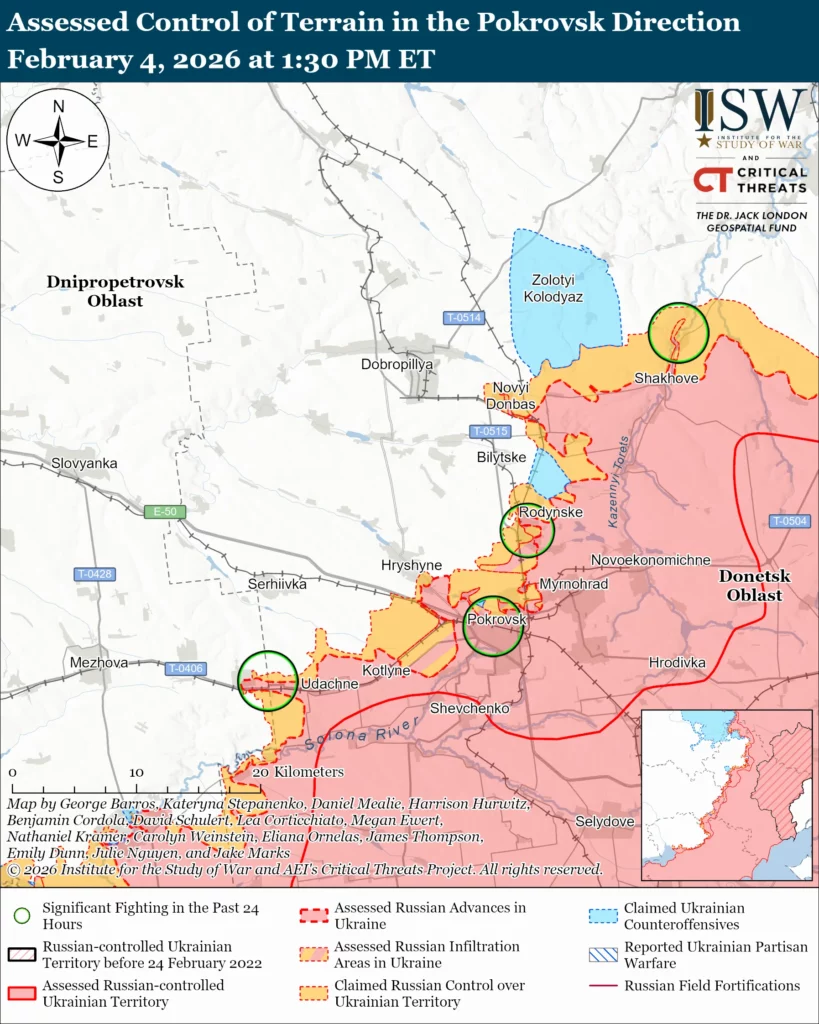
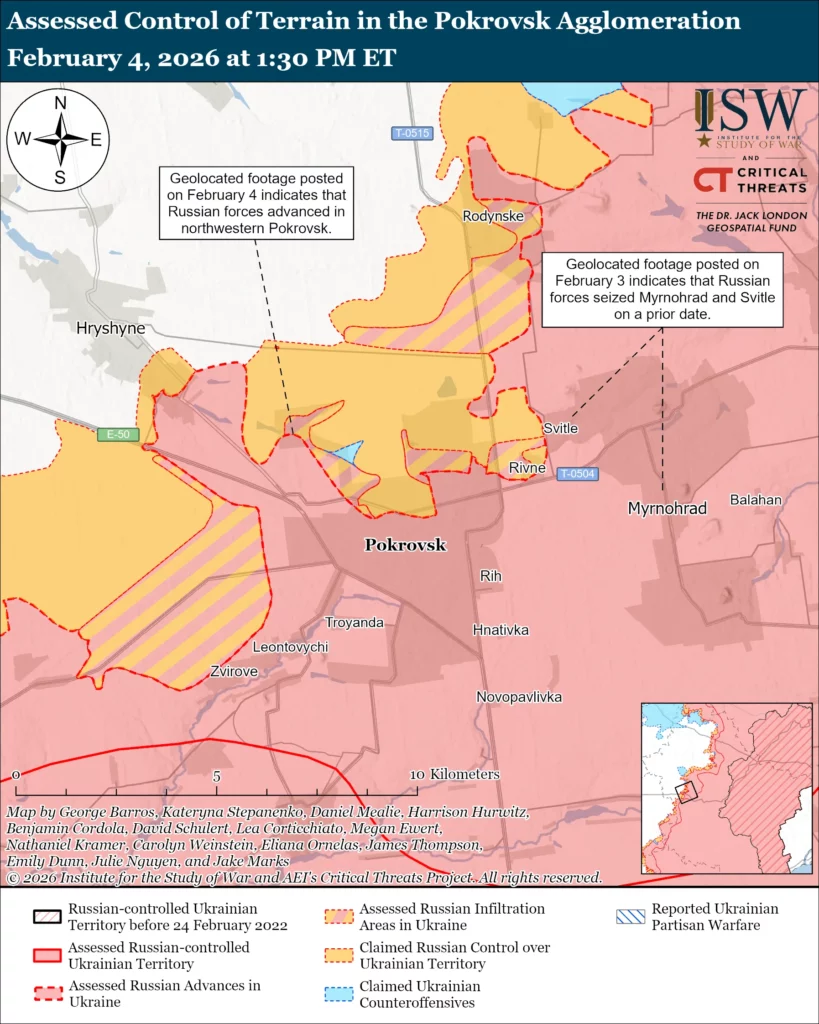
Assessed Russian advances: Geolocated footage published on February 3 shows Ukrainian forces striking a Russian artillery system in southern Myrnohrad, and Ukrainian new outlet Ukrainska Pravda reported on January 28 that Russian forces have begun moving command posts into Myrnohrad, indicating that Russian forces seized Myrnohrad (east of Pokrovsk) on a prior date.[68] ISW has not observed evidence in the past few weeks that would indicate that Ukrainian forces continue to maintain defensive positions in the area. Geolocated footage published on February 4 indicates that Russian forces recently advanced in northwestern Pokrovsk.[69]
Russian forces attacked near and within Pokrovsk itself; northwest of Pokrovsk near Hryshyne; north of Pokrovsk near Rodynske and toward Bilytske; east of Pokrovsk near Myrnohrad and Svitle; and southwest of Pokrovsk near Kotlyne, Udachne, and Molodetske on February 3 and 4.[70] A Russian milblogger claimed that Ukrainian forces counterattacked near Rodynske.[71]
Ukrainian sources reported on February 3 and 4 that Russian forces attempted to advance in Hryshyne under the cover of fog in a roughly platoon-sized mechanized assault consisting of three AFVs, but Ukrainian forces repelled the advance.[72] The commander of a Ukrainian battalion operating in the Pokrovsk direction reported on February 4 that Russian forces are exhausted and have somewhat decreased the intensity of their attacks in the Pokrovsk direction.[73]
Order of Battle: The Russian Ministry of Defense (MoD) credited elements of the Russian 55th Naval Infantry Division (Pacific Fleet) (newly formed from the 155th Naval Infantry Brigade) with the claimed seizure of Sukhetske (northeast of Pokrovsk).[74] Elements of the 35th Motorized Rifle Brigade (41st CAA, Central Military District [CMD]) are reportedly operating in the Pokrovsk direction.[75]
Russian forces continued offensive operations in the Novopavlivka direction on February 4 but did not advance.
Russian forces attacked near Novopavlivka itself and south of Novopavlivka near Filiya on February 3 and 4 but did not advance.[76]
A Ukrainian brigade operating in the Novopavlivka direction reported on February 4 that Ukrainian forces repelled a roughly platoon-sized Russian mechanized assault that consisted of two tanks and an unarmored civilian vehicle carrying up to 15 Russian infantry near Novopavlivka on January 31.[77] The brigade reported that Ukrainian forces heavily damaged the Russian tanks, destroyed the vehicle, and inflicted heavy casualties on the Russian infantry.
Russian forces continued offensive operations in the Oleksandrivka direction on February 4 but did not advance.
Russian forces attacked northeast of Oleksandrivka near Andriivka-Klevtsove and Ivanivka on February 3 and 4.[78]
Order of Battle: Drone operators of the Russian Rubicon Center for Advanced Unmanned Technologies reportedly struck a Ukrainian ammunition facility and Grad Multiple Launch Rocket System (MLRS) near Orly (northeast of Oleksandrivka).[79] Elements of the 11th Air Force and Air Defense Army (Russian Aerospace Forces [VKS] and Eastern Military District [EMD]) are reportedly striking Ukrainian forces in the Vremivka (Oleksandrivka) direction.[80]
Ukrainian forces continued their mid-range strike campaign against Russian military assets in occupied Donetsk Oblast on the night of February 3 to 4. The Ukrainian Special Operations Forces (SSO) reported on February 3 that Ukrainian forces struck a temporary deployment point of the Russian 29th CAA (EMD) in occupied Velyka Novosilka and ammunition depots of the 58th CAA (SMD) in occupied Velyka Novosilka (roughly 23 kilometers behind the frontline) and a drone maintenance workshop in occupied Mykilske (roughly 54 kilometers behind the frontline).[81]
Russian Supporting Effort: Southern Axis
Russian objective: Maintain frontline positions, secure rear areas against Ukrainian strikes, and advance within tube artillery range of Zaporizhzhia City
Ukrainian and Russian forces recently advanced in the Hulyaipole direction.
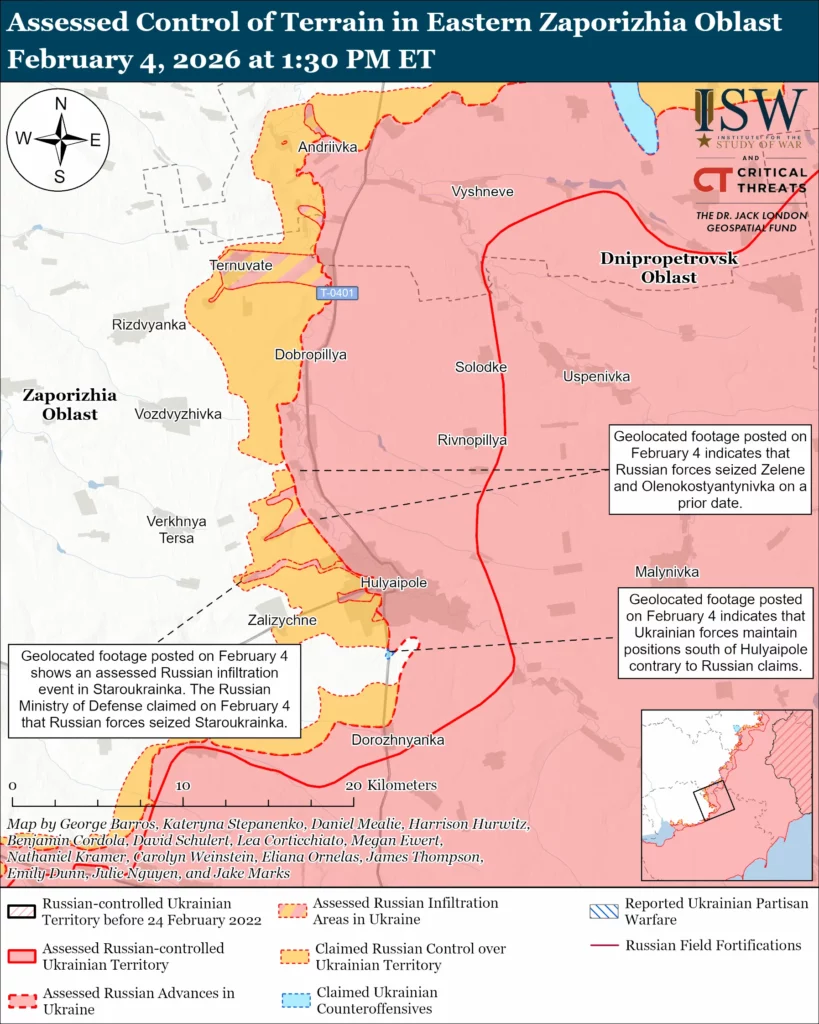
Assessed Ukrainian advances: Geolocated footage posted on February 3 indicates that Ukrainian forces recently advanced along the T-0401 Hulyaipole-Polohy highway south of Hulyaipole.[82]
Assessed Russian advances: Geolocated footage published on January 14, 16, and 31 and on February 4 showing Russian infiltration missions in and near Svyatopetrivka (northwest of Hulyaipole) and in Staroukrainka (west of Hulyaipole), as well as geolocated footage published on January 31 and February 1 showing Ukrainian forces striking Russian positions along the C-080606 Hulyaipole-Pryluky road indicates that Russian forces recently seized Pryluky, Olenokostyantynivka, and Zelene (all northwest of Hulyaipole) and that the Russian forward edge of battle area (FEBA) is further southwest than ISW previously assessed.[83] Geolocated footage published on February 3 indicates that Russian forces recently advanced to the T-0401 Hulyaipole-Podoly highway south of Hulyaipole.[84]
Assessed Russian infiltrations: Geolocated footage published on February 4 shows elements of the Russian 114th Motorized Rifle Regiment (127th Motorized Rifle Division, 5th Combined Arms Army [CAA], Eastern Military District [EMD]) raising a Russian flag in western Staroukrainka during what ISW assesses was a Russian infiltration mission that did not change the control of terrain or the FEBA at this time.[85]
Unconfirmed claims: The Russian Ministry of Defense (MoD) and Russian milbloggers claimed that Russian forces seized Staroukrainka and advanced west of Olenokostyantynivka.[86]
Russian forces attacked near Hulyaipole itself; northwest of Hulyaipole near Zelene, Prydorozhnie, Pryluky, and Svyatopetrivka and toward Tsvitkove and Nove Pole; north of Hulyaipole near Dobropillya and Nove Zaporizhzhia; northeast of Hulyaipole near Solodke; south of Hulyaipole near Dorozhnyanka; southwest of Hulyaipole near Myrne; and west of Hulyaipole near Zaliznychne and Staroukrainka on February 3 and 4.[87] A Russian milblogger claimed that Ukrainian forces have successfully counterattacked from near Vozdvyzhivka and Rizdvyanka (both northwest of Hulyaipole) due to sparse Russian positions in the area and poor weather conditions that hinder Russian drone operations.[88]
A Kremlin-affiliated Russian milblogger claimed on February 4 that Russian forces are struggling to consolidate positions and clear the windbreaks between the Yanchur and Haichur rivers, as Russian forces are unable to concentrate forces for assaults in the immediate vicinity of the settlements they intend to seize.[89] The milblogger noted that Russian forces are also having to deploy vehicles and troops very far from the intended assault areas, likely due to the extended Ukrainian “kill zone” (an area of elevated drone strike risk).
Russian forces continued offensive operations in western Zaporizhia Oblast on February 4 but did not advance.
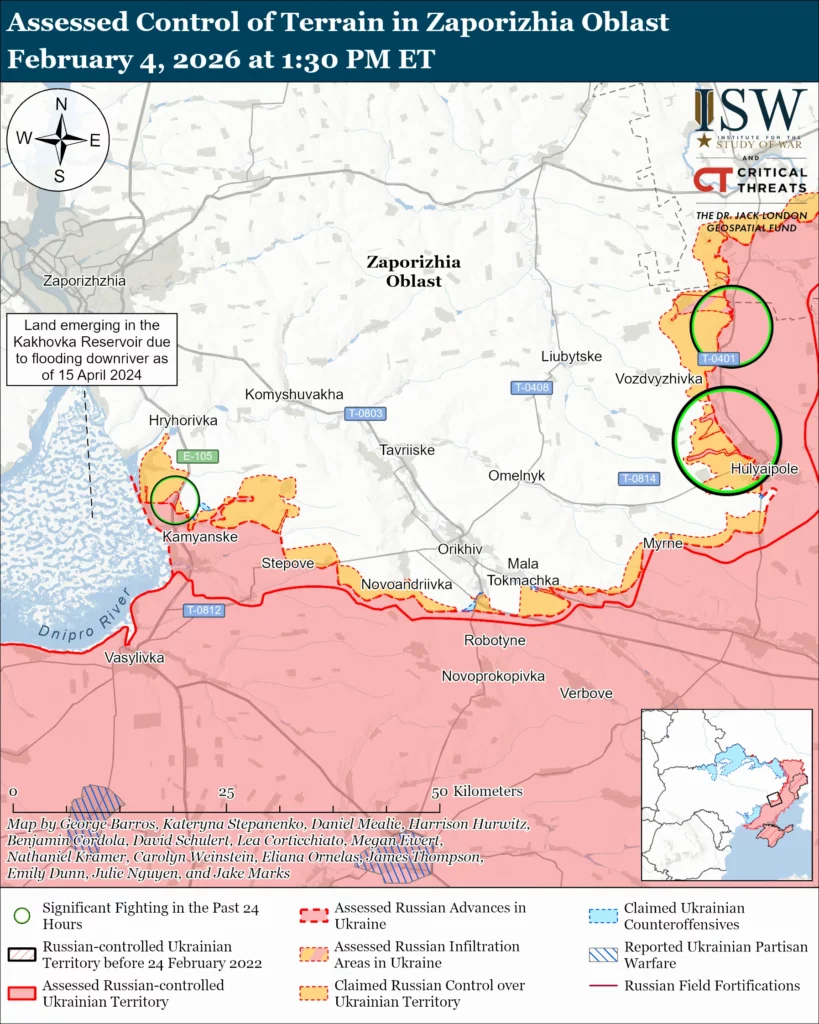
Russian forces attacked west of Orikhiv near Stepnohirsk and Plavni and northwest of Orikhiv near Prymorske and toward Mahdalynivka, Zapasne, and Richne on February 3 and 4.[90] A Russian milblogger claimed that Ukrainian forces counterattacked within Prymorske and Richne.[91]
Geolocated footage published on February 4 shows Russian loitering munition operators, likely of the 7th Airborne (VDV) Division, reportedly destroying a Ukrainian Buk air defense system east of Kushuhum (south of Zaporizhzhia City and roughly 10 kilometers from the frontline) and Lancet loitering munition operators of the 2nd Battalion of the Grom-Kaskad Drone Brigade (reportedly of the 4th Air Force and Air Defense Army, VKS]) reportedly striking a Ukrainian Raven air defense system just northeast of Zaporizhzhia City.[92] The commander of a Ukrainian unmanned systems brigade reported on February 4 that Russian forces have modernized Lancet drones to operate as autonomous reconnaissance and fire systems, possibly indicating that Russian forces have equipped Lancet drones with some artificial intelligence (AI) or machine learning (ML) capabilities to conduct strikes deeper into the Ukrainian rear and against moving targets.[93]
Geolocated footage published on February 3 shows Ukrainian Special Operations Forces (SSO) elements conducting FP-2 long-range drone strikes against Russian military infrastructure in Vasylivka (southwest of Orikhiv in the Russian near rear).[94]
Order of Battle: Drone operators of the Nemets group of the 3rd Assault Company of the Russian 291st Motorized Rifle Regiment (42nd Motorized Rifle Division, 58th CAA, Southern Military District [SMD]) reportedly continue to strike Ukrainian forces near Orikhiv.[95]
Ukrainian forces continue their medium-range strike campaign against Russian military assets in occupied Zaporizhia Oblast. The Ukrainian SSO published geolocated footage on February 3 showing Ukrainian FP-2 drones striking a Russian ammunition depot and manpower concentration in occupied Zelenyi Hai (southwest of Orikhiv and roughly 23 kilometers from the frontline) and a drone maintenance point of an unspecified unit of the Russian 22nd Spetsnaz Brigade (Russian General Staff’s Main Directorate [GRU]) in Tokmak (roughly 23 kilometers from the frontline).[96]
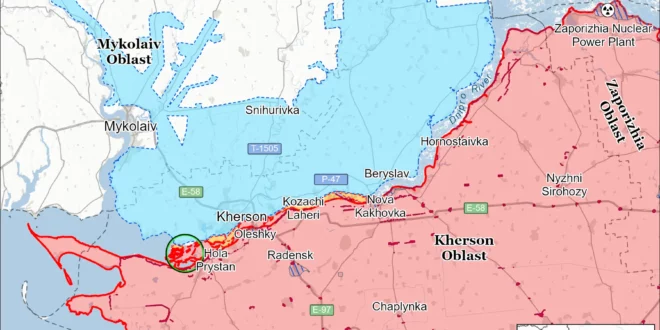
Neither Ukrainian nor Russian sources reported ground activity in the Kherson direction on February 4.
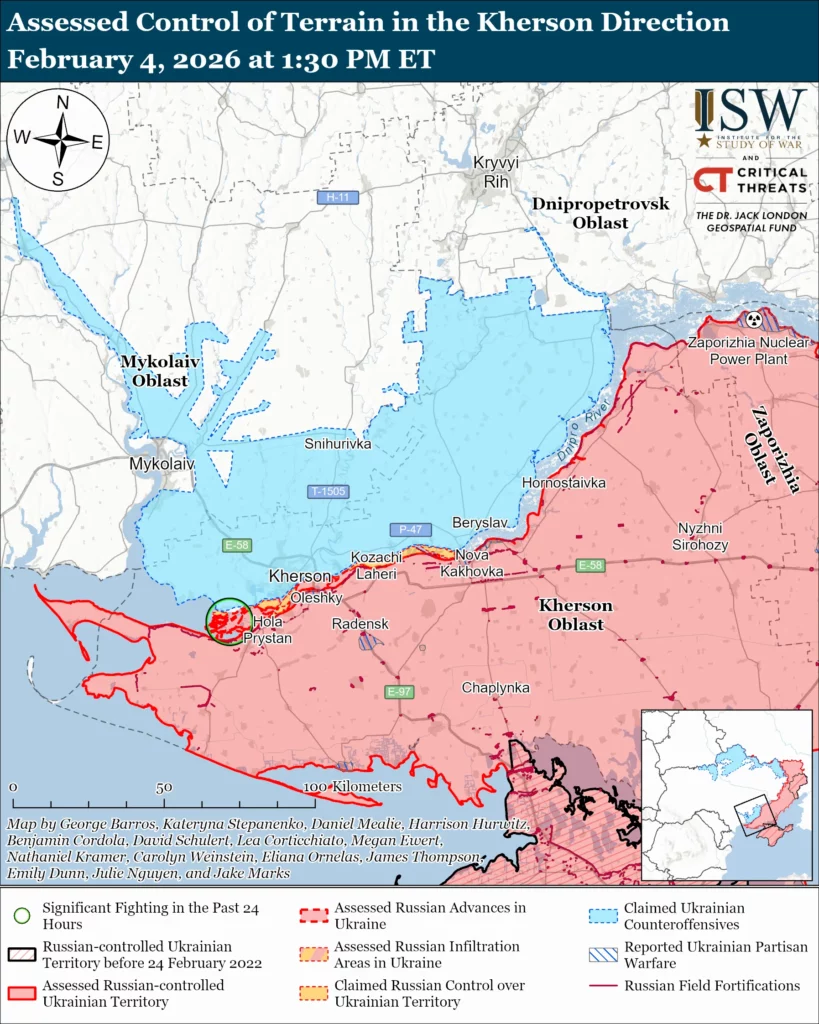
A Russian milblogger claimed on February 4 that the newly formed SAFRON unmanned aerial vehicles (UAVs) detachment of the Russian 4th Military Base (58th CAA, Southern Military District [SMD]) recently deployed to the Kherson direction.[97] The milblogger claimed that the detachment is focusing its efforts on intercepting Ukrainian heavy drones. The milblogger claimed that terrain conditions, such as the soil, are hindering Russian attempts to seize the Dnipro River Delta islands.
Order of Battle: Elements of the Russian 98th VDV Division reportedly continue to strike Ukrainian forces in the Kherson direction.[98]
Russian Air, Missile, and Drone Campaign
Russian Objective: Target Ukrainian military and civilian infrastructure in the rear and on the front line
Russian forces conducted a series of drone strikes against Ukraine on the night of February 3 to 4. The Ukrainian Air Force stated that Russian forces launched 105 Shahed-, Gerbera-, Italmas-type, and other drones – of which roughly 70 were Shahed drones – from the directions of Oryol and Bryansk cities; Primorsko-Akhtarsk, Krasnodar Krai; occupied Donetsk City; and occupied Cape Chauda, Crimea.[99] The Ukrainian Air Force reported that Ukrainian forces downed 88 drones, that 17 drones hit 14 locations, and that drone debris fell at five locations as of 0800 local time. Ukrainian officials reported that Russian forces struck civilian infrastructure in Odesa and Kharkiv oblasts.[100] Ukrainian President Volodymyr Zelensky stated that more than 1,100 apartments in Kyiv City remain without heat.[101]
Russia continues to expand its Shahed drone launch sites. A Ukrainian source reported on February 4 that satellite imagery from January 3 of the Shatalovo Airbase in Smolensk Oblast indicates that Russian forces are expanding their Shahed launch points at the airbase.[102] The source reported that the imagery shows four stationary launchers and four Shahed launchers and noted that the launchers are similar to those at the Hvardiivske Airbase in occupied Crimea, which Russian forces use to launch Shaheds. The source reported that Russian forces can launch 22 Shaheds at once from the Shatalovo Airbase and hundreds of drones during one strike series. The source noted that Russian forces have equipped Shatalovo Airbase with air defense systems for protection. The source reported that satellite imagery from January 3 also shows that Russian forces are building garages for the first time at the Millerovo Airbase in Rostov Oblast.[103] The source assessed that the garages could hold 96 drones and that the garages will be able to hold 126 drones when ongoing construction is complete.
Russian forces are reportedly increasing their drone payloads to maximize damage even as Ukrainian forces’ interception rates improve. The commander of a Ukrainian unmanned systems brigade stated on January 4 that Russian forces are using Supercam, Zala, Orlan, and Knyaz Vandal Novgorodsky (KVN) drones to conduct reconnaissance during both the day and night, increasing Russian forces’ ability to coordinate more strikes at any time of day.[104] The commander stated that Russian forces have significantly modernized Molniya fixed-wing FPV drones by increasing the payload that the drones can carry. The commander noted that single-engine Molniyas are cheap and poorly made but can carry a payload of over three kilograms. The commander stated that Russian forces are using these drones with fragmentation ammunition to strike Ukrainian logistics, artillery positions, and airfields. The commander stated that the twin-engine Molniyas can carry payloads weighing roughly 10 kilograms. The commander stated that Ukrainian forces are suppressing most of the drones with electronic warfare (EW) and are improving their interception rates but that even one drone with a 10-kilogram payload can cause serious damage.
Significant Activity in Belarus
Russian efforts to increase its military presence in Belarus and further integrate Belarus into Russian-favorable frameworks
Nothing Significant To Report.
Note: ISW does not receive any classified material from any source, uses only publicly available information, and draws extensively on Russian, Ukrainian, and Western reporting and social media as well as commercially available satellite imagery and other geospatial data as the basis for these reports. References to all sources used are provided in the endnotes of each update.