 Eurasia Press & News
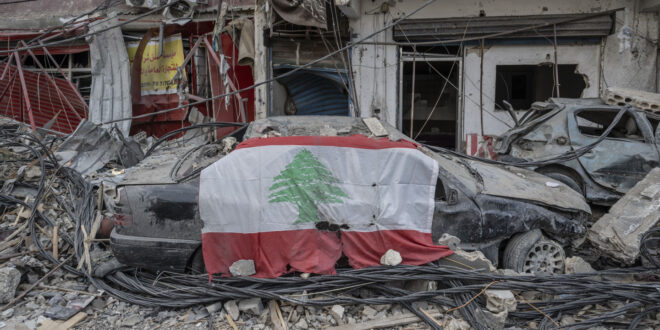
One year after it formed, the new technocratic government faces mounting challenges as it struggles to disarm Hezbollah and implement economic reforms
One year after its formation, Lebanese Prime Minister Nawaf Salam’s ‘Reform and Rescue’ government faces mounting challenges as it struggles to consolidate weapons under state control and implement economic reforms in a divided country recovering from war and decades of crisis.
The government’s first ministerial statement in 2025 marked a clear departure from the past, discarding the “Army, People, and Resistance” formula long used by Hezbollah to legitimise its weapons.
This stance quickly drew opposition from Hezbollah, particularly over the issue of weapons in the southern Litani region, which has remained effectively under the party’s influence since 2000.
Nawaf Salam’s government was formed on 8 February 2025 after two years of a caretaker Cabinet in the aftermath of what became known as the “Support War”, the 2023-2024 conflict between Hezbollah and Israel triggered by the Gaza war.
Initially, Salam’s government raised expectations among the Lebanese public. But these ambitions have been steadily eroded amid a deepening economic crisis and stalled reconstruction efforts.
“Instead of an Israeli withdrawal, Lebanon experienced an escalation of demolitions and assassinations, exposing the US incapacity to fulfil its commitments and turning the government into a party offering concessions without any security guarantees,” political writer Mohammad Hamieh told The New Arab.
The question of Hezbollah’s weapons
Political analyst Georges Akouri described Salam’s government as one of the most sovereignty-minded since the Taif Agreement – the 1989 accord that ended Lebanon’s civil war by redistributing political power and reinforcing Lebanon’s sectarian power-sharing system.
Akouri noted that the cabinet’s momentum was relatively slow initially, as President Joseph Aoun and Prime Minister Salam sought to absorb Hezbollah’s response to regional transformations through bilateral dialogue. “However, this approach failed, prompting a shift towards asserting state sovereignty,” he told TNA.
On 5 August 2025, the Lebanese government tasked the army with consolidating all weapons under state control, a move aimed at restoring sovereignty. The decision specifically targeted non-state actors, including Hezbollah.
Criticising the government’s delay on this step, Akouri argued that such a decision should have been taken from the outset to give the Lebanese army more time to assert control.
“Moving from crisis management to resolution remains impossible without disarming Hezbollah,” he added, describing the issue as a fundamental condition for international support, a prerequisite for reconstruction, and essential for an effective diplomatic track with Israel.
Political writer Mohammad Hamieh offered a contrasting view. “Having failed to extend effective protection over the southern Litani, the government has lost any justification to demand disarmament, as the resistance will not entrust its security to diplomatic guarantees that have repeatedly proven hollow, particularly while Israel continues assassinations, house demolitions, and daily airstrikes,” he said.
Hamieh directly criticised Foreign Minister Youssef Reji, claiming that “his reliance on American appeals to halt attacks produced only more assaults, particularly as he implicitly justified them due to Hezbollah’s weapons, before contradicting himself by filing a complaint with the UN Security Council regarding ongoing raids”.
Reflecting on recent events, political analyst Akouri said that “the Raouche Rock incident reflected a clear message that dealings with Hezbollah cannot be based on appeasement but must adhere to the law and constitution, and strict judicial measures are warranted”.
In September 2025, Hezbollah supporters projected images of the group’s slain leaders onto Beirut’s Raouche Rock during a commemorative gathering, despite a government ban.
The act drew sharp criticism from Prime Minister Nawaf Salam, who said it violated public space regulations and challenged state authority. The incident became a flashpoint in Lebanon’s debate over political symbolism and sovereignty.
Akouri acknowledges the Salam government’s gradual progress on the weapons issue, which began with proposals to schedule disarmament. However, he considers the appointment of former ambassador Simon Karam to Lebanon’s delegation in the ceasefire mechanism committee with Israel a “misstep.”
The government now needs a unified ministerial stance in response to Hezbollah Secretary-General Naim Qassem, Akouri said, particularly after Qassem’s recent remarks suggesting the potential opening of a “Support Front” to defend Iran.
Reconstruction delays
Lebanon’s post-war reconstruction remains notably delayed, officially launching only in late 2025 – more than a year after the ceasefire. In early January 2026, Prime Minister Salam announced plans to accelerate rebuilding in the south, following parliament’s approval of a $250 million World Bank loan, with $52 million secured as initial funding.
The country needs around $11 billion to repair housing, infrastructure, and public services. Over 30% of homes in the south have been damaged, millions of tonnes of debris remain uncleared, and tens of thousands of displaced civilians have yet to return.
Political writer Alain Sarkis stated that while Salam’s cabinet has not achieved any major accomplishments, it has not entirely failed, having managed to stabilise a minimum level of institutional functioning after the war.
“Yet it inherited a heavy burden, as the previous government’s ceasefire agreement included secret clauses giving Israel a margin of ‘self-defence’ without a clear mechanism.”
Regarding reconstruction, Sarkis said that the Arab and international stance was decisive, as no funding will be provided before weapons are surrendered, making Hezbollah the key obstacle rather than the government. “Handing over weapons could unlock economic projects and reconstruction efforts,” he added.
“The government failed to complete reconstruction by the end of 2025, with ongoing uncertainties in southern Litani, and delays of the weapons consolidation plan for northern Litani, leaving it vulnerable to external pressure and scrutiny,” Sarkis said.
According to Akouri, the Lebanese government’s reconstruction proposals amounted to little more than “a form of consolation” for the Lebanese, warning that any unplanned expenditure could result in wasteful spending of public funds.
Economic failures and public distrust
On the economic front, Mohammad Hamieh noted that Salam’s cabinet faces a critical test. Despite inheriting a heavy legacy of financial and political failures spanning three decades, it has yet to develop a coherent rescue plan aligned with its ministerial statement.
As part of its intended economic reform, the Nawaf Salam government voted on the Financial Gap Law in late December 2025, aiming to address the $70-$80 billion shortfall between depositors’ claims and banks’ assets.
The law provides for partial repayment to small depositors and long-term securities for larger balances, while distributing losses among banks, the state, and depositors. The law has sparked controversy for potentially legalising losses, while placing a burden on ordinary citizens.
Hamieh described the proposed law as representing “the peak of governmental failure,” arguing that “the proposed budget and disregard for public sector employee rights will inevitably provoke street unrest and place the government in direct confrontation with both the public and Hezbollah”.
Akouri asserted the need for greater government seriousness, noting that the Financial Gap Law lacks clear figures and defined responsibilities between the state, banks, and the central bank. It also shows incomplete adherence to appointment mechanisms and reflects Hezbollah and Amal’s continued influence in some decision-making areas.
For many observers, economic reforms have fallen far short of expectations. “Despite the appointment of a central bank governor and the passage of some laws, the government has made no serious anti-corruption efforts and achieved little progress on depositors’ funds, while poorly considered financial decisions reflect a timid reformist performance,” Sarkis says.
As the Lebanese government enters its second year, it faces the twin challenges of asserting sovereignty over weapons while delivering economic relief to a population exhausted by the crisis – with little sign that either goal is within reach.