 Eurasia Press & News
Toplines
The Kremlin continues to reject any meaningful security guarantees that would protect Ukraine from complete diplomatic or military capitulation. Russian Foreign Minister Sergei Lavrov reiterated on February 6 the Kremlin’s rejection of Western-provided security guarantees in Ukraine and reiterated the Kremlin’s support of the “security guarantees” that Russia agreed to in the April 2022 Istanbul talks.[1] The 2022 Istanbul Protocol draft document did not provide the groundwork for meaningful security guarantees and would have left Ukraine defenseless against renewed aggression. The Istanbul Protocol draft stipulated that Russia – the aggressor in the war in Ukraine – would be treated as a neutral ”guarantor state” of Ukraine; that Russia and the People’s Republic of China (PRC) would have veto power over a mechanism to respond to future aggression in Ukraine; and that Ukraine commit to neutrality, severe restrictions on military size and composition, and never accepting military assistance from its allies.[2] Lavrov’s February 6 statement is the latest in a series from senior Kremlin officials indicating that the Kremlin continues to view the 2022 Istanbul draft treaty as the basis for any future peace settlement and is unwilling to compromise on its demands of both Ukraine and NATO.[3] Russian President Vladimir Putin and other Kremlin officials have repeatedly rejected the US-proposed 28-point peace plan or any plan requiring Russia to compromise on any of its original war aims.[4]
The Russian military command is reportedly planning to deploy its likely limited strategic reserves to a planned Summer 2026 offensive in southern and/or eastern Ukraine. The Russian military likely lacks sufficient reserves to both adequately prepare for such an offensive and achieve the offensive’s objectives, however. Ukrainian military observer Kostyantyn Mashovets assessed on February 5 that Russian forces have begun to prepare for their anticipated Summer 2026 offensive, which Mashovets forecasted will likely begin as soon as late April 2026.[5] Mashovets assessed that Russian forces will likely focus on the Slovyansk-Kramatorsk direction and/or the Orikhiv-Zaporizhzhia City direction. Mashovets noted that Russian forces are struggling to seize the necessary starting positions to launch the summer offensive in the coming months, as Russian forces have become bogged down in achieving tactical objectives in these directions and are failing to advance rapidly enough to meet the Russian military command’s deadlines. Mashovets assessed that the Russian military command does not want to use its strategic reserves, which Mashovets reported that Russian command has been trying to accumulate since Fall 2025, in order to accelerate these preparatory tactical actions as doing so would reduce consume reserves needed for the summer campaign. ISW has observed reports that Russia has been forming a strategic reserve from new recruits since July 2025, potentially to facilitate such an offensive, but has been struggling to replace its losses in Ukraine and has had to deploy operational reserves to support ongoing combat operations.[6] The Russian military command will likely have to choose between deploying its likely limited strategic reserves now to better prepare for the summer offensive or risk using the strategic reserve later in the summer but from less advantageous positions.
Russian forces have been setting conditions for future offensive operations in the Slovyansk-Kramatorsk and Orikhiv-Zaporizhzhia City directions yet have been struggling to make significant advances in the area. Russian forces have been conducting strikes in the Slovyansk and Hulyaipole (northeast of Orikhiv) directions, particularly against Ukrainian ground lines of communication (GLOCs) that supply forward positions, in order to generate battlefield air interdiction (BAI) effects and degrade Ukrainian defenses but have struggled to leverage these preparations to make operationally significant advances.[7] Russian forces been attacking north and south of Lyman (northeast of Slovyansk) but have been struggling to seize the town and have thus far been limited to small-scale infiltration missions into Lyman.[8] The recent successful Ukrainian counteroffensive in the Kupyansk direction has also reportedly diverted Russian reserves from the Lyman direction to respond to Ukrainian attacks in and near Kupyansk. Russian forces seized Siversk in December 2025 and are still roughly 23 kilometers from Slovyansk.[9] Russian forces have also been unable to make significant progress fighting through Kostyantynivka (south of Slovyansk), where Russian forces are mostly relying on small group infiltration missions.[10]
Russian forces made relatively quicker advances in the Hulyaipole direction in November 2025 following an extended battlefield air interdiction (BAI) strike campaign but have not made operationally significant advances since.[11] Russian forces likely intended to bypass Ukrainian defenses south of Orikhiv from the Hulyaipole direction and to join the Russian efforts in the Orikhiv and Hulyaipole direction to advance on Zaporizhzhia City but have failed to cut the T-0814 Hulyaipole-Orikhiv highway supplying Orikhiv and advance very far toward Orikhiv from the east.[12] Russian forces in the Hulyaipole direction are still roughly 35 kilometers from Orikhiv. Russian forces have also faced tactical struggles near Orikhiv itself, particularly in Mala Tokmachka (just southeast of Orikhiv) where Russian forces advanced using an at least reduced company-sized mechanized assault in November 2025 but subsequently lost these positions to Ukrainian counterattacks.[13] Russian forces have also been entangled in fighting for Stepnohirsk (northwest of Orikhiv and south of Zaporizhzhia City) and other settlements on the eastern bank of the largely dried-up Kakhovka Reservoir despite intensified assaults in the area since July 2025.[14]
Russian plans for a summer offensive highlight Russia’s determination to achieve its war aims, including the seizure of Donetsk and Zaporizhia oblasts, through military means if need be. Senior Kremlin officials have repeatedly stated that Russia will continue efforts on the battlefield to achieve its aims if it cannot achieve them through negotiations.[15] The Russian military command’s intention to conduct a large-scale summer offensive — even if Russian forces may struggle to achieve its objectives — demonstrates the Kremlin’s disinterest in finding a solution to end the war via negotiations in the coming weeks or months.
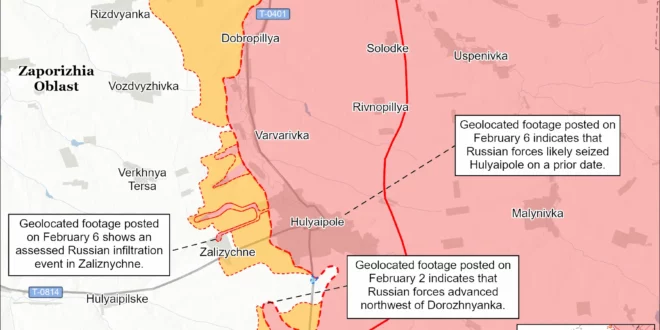
Russian forces likely seized Hulyaipole — a town with a pre-war population of roughly 13,000 – after three months of fighting and are unlikely to make rapid advances beyond Hulyaipole without deprioritizing other areas of the frontline. Geolocated footage published on February 6 shows Ukrainian forces striking Russian positions in northern Zaliznychne (west of Hulyaipole), indicating that Russian forces advanced beyond Hulyaipole at a prior date.[16] ISW has not observed evidence in the past few weeks that Ukrainian forces continue to maintain defensive positions in Hulyaipole, and the pattern of recent Russian infiltrations and advances in area suggests that Russian forces hold the town.[17] Russian forces began making relatively rapid advances in the Hulyaipole direction in early November 2025 after a months-long battlefield air interdiction (BAI) campaign that degraded Ukrainian logistics and ability to sustain frontline forces and defense against subsequent Russian ground operations.[18] Russian forces first infiltrated into Hulyaipole in mid-to-late November 2025, began consolidating positions in the town by mid-December 2025, and claimed to have seized Hulyaipole as of December 27.[19] These advances were contingent upon both the weather conditions in the area and the Russian prioritization of the effort. The relatively rapid Russian advances in the Hulyaipole direction exploited seasonal foggy and rainy weather conditions that hindered Ukrainian strike and reconnaissance drone operations, which allowed Russian forces to accumulate forces and advance under less threat.[20] These weather conditions did not last, however, as Russian forces entered the Hulyaipole built up area and winter conditions began degrading infantry operations since late December 2025.[21] The Russian military command had also committed elements of at least three combined arms armies (CAAs) to the areas east and northeast of Hulyaipole, while deprioritizing other sectors of the frontline.[22] Russian forces initially attempted to maintain simultaneous advances in the Hulyaipole and Oleksandrivka directions, but lacked the combat power to sustain both efforts, causing the Russian military command to deprioritize the Oleksandrivka direction.[23] Russian forces have consistently proven themselves unable to build large enough reserves to be able to flood a sector of the front without redeploying personnel from other areas.[24] Russian forces may seek to accelerate their advance in the Hulyaipole direction to support a potential Summer 2026 offensive toward Zaporizhzhia City from the south, but are likely unable or unwilling to redeploy forces and means from other frontline sectors to accomplish such an objective.
SpaceX’s block on unregistered Starlink terminal operations in Ukraine is reportedly hindering Russian ground operations and tactical strikes. Ukrainian General Staff sources told Ukrainian broadcaster Suspilne on February 5 that SpaceX’s efforts to block unregistered Starlink satellite communication terminals have forced Russian forces to reduce the number of assaults on the frontlines and have temporarily stopped all assaults on unspecified areas of the frontline.[25] The spokesperson of a Ukrainian brigade operating in the Zaporizhia direction reported that Russian forces reduced their assault operations and first-person view (FPV) drone operations after SpaceX blocked unregistered Starlink terminals.[26] The spokesperson noted that Ukrainian forces no longer have to expend additional resources striking Russian Starlink terminals in order to disable them. The Ukrainian Joint Forces Task Force, whose area of responsibility comprises northern Kharkiv Oblast and the Kupyansk and Lyman directions, reported that the Starlink terminal blocking is affecting both Russian and Ukrainian forces but that is affecting Russian forces more.[27] Russian milbloggers broadly expressed concern about the unregistered terminal block, claiming that the lack of access to Starlink is hindering Russian military operations and that Russian forces are ”scrambling to establish an equivalent.”[28] One milblogger indicated that the Starlink terminal block will likely impact Russian operations in the Kostyantynivka direction.[29] A Russian milblogger reportedly affiliated with the Northern Grouping of Forces claimed that some Russian soldiers have managed to operate Starlink terminals, but ISW is unable to confirm this report, and it is unclear how, where, or in what capacity Russian forces would be operating these Starlink terminals.[30]
Unknown actors conducted an assassination attempt on Russian General Staff Main Intelligence Directorate (GRU) First Deputy Head Lieutenant General Vladimir Alekseyev in Moscow City on February 6. Russia’s Investigative Committee claimed on February 6 that unknown actors fired three shots at Alekseyev near his home in northwestern Moscow City, leaving Alekseyev hospitalized.[31] A Russian insider channel claimed that the assailants shot Alekseyev’s torso and that he is in critical condition.[32] Alekseyev was reportedly heavily involved in Russian volunteer formations and private military companies (PMCs), including the Russian Volunteer Corps and the Redut PMC.[33] Alekseyev reportedly played a significant role in organizing Russia’s initial invasion of Ukraine in February 2022, participated in negotiations for a humanitarian corridor from Mariupol in Spring 2022, and was affiliated with the Wagner Group PMC.[34] Alekseyev reportedly supported Wagner Group Head Yevgeny Prigozhin in Prigozhin’s June 2023 rebellion against the Russian Ministry of Defense (MoD).[35] Former Russian officer and imprisoned prominent ultranationalist, Igor Girkin, claimed in 2023 that Alekseyev was responsible for the creation of the Wagner Group.[36]
Key Takeaways
The Kremlin continues to reject any meaningful security guarantees that would protect Ukraine from complete diplomatic or military capitulation.
The Russian military command is reportedly planning to deploy its likely limited strategic reserves to a planned Summer 2026 offensive in southern and/or eastern Ukraine. The Russian military likely lacks sufficient reserves to both adequately prepare for such an offensive and achieve the offensive’s objectives, however.
Russian forces have been setting conditions for future offensive operations in the Slovyansk-Kramatorsk and Orikhiv-Zaporizhzhia City directions yet have been struggling to make significant advances in the area.
Russian forces likely seized Hulyaipole – a town with a pre-war population of roughly 13,000 – after three months of fighting and are unlikely to make rapid advances beyond Hulyaipole without deprioritizing other areas of the frontline.
SpaceX’s block on unregistered Starlink terminal operations in Ukraine is reportedly hindering Russian ground operations and tactical strikes.
Unknown actors conducted an assassination attempt on Russian General Staff Main Intelligence Directorate (GRU) First Deputy Head Lieutenant General Vladimir Alekseyev in Moscow City on February 6.
Ukrainian forces recently advanced near Borova. Russian forces recently advanced near Pokrovsk and Hulyaipole and in the Kostyantynivka-Druzhkivka tactical area.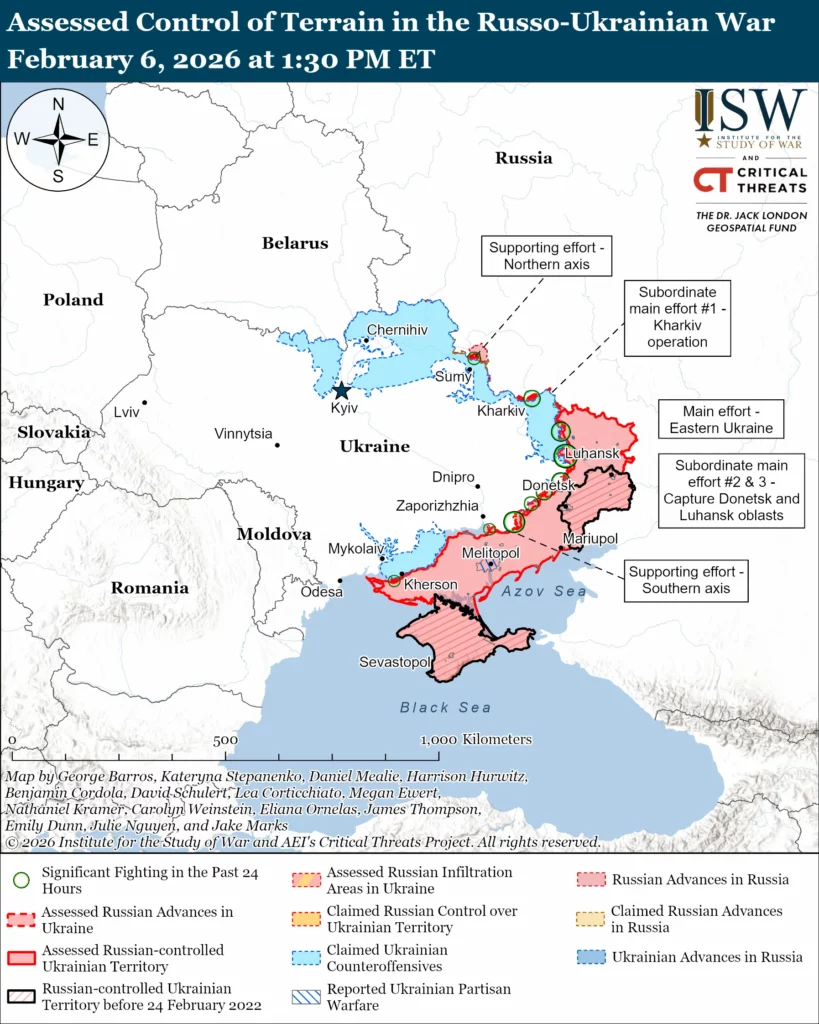
We do not report in detail on Russian war crimes because these activities are well-covered in Western media and do not directly affect the military operations we are assessing and forecasting. We will continue to evaluate and report on the effects of these criminal activities on the Ukrainian military and the Ukrainian population and specifically on combat in Ukrainian urban areas. We utterly condemn Russian violations of the laws of armed conflict and the Geneva Conventions and crimes against humanity even though we do not describe them in these reports.
Ukrainian Operations in the Russian Federation
Ukrainian forces may have continued their long-range strike campaign against Russian infrastructure on February 6. Footage posted on February 6 shows likely Ukrainian forces striking Russian infrastructure in Belgorod City, Belgorod Oblast.[37] Russian opposition media Astra reported that Ukrainian forces struck Belgorod Combined Heat and Power Plant (CHP).[38] Belgorod Oblast Governor Vyacheslav Gladkov acknowledged the strike and claimed that the strikes caused power and heat outages.[39] Bryansk Oblast Governor Alexander Bogomaz claimed on February 6 that Ukrainian forces conducted a HIMARS strike against energy infrastructure near Klintsy, Bryansk Oblast (southwest of Bryansk City), causing power outages.[40]
Russian Supporting Effort: Northern Axis
Russian objective: Create defensible buffer zones in Sumy Oblast along the international border
Russian forces continued offensive operations in northern Sumy Oblast on February 6 but did not make confirmed advances.
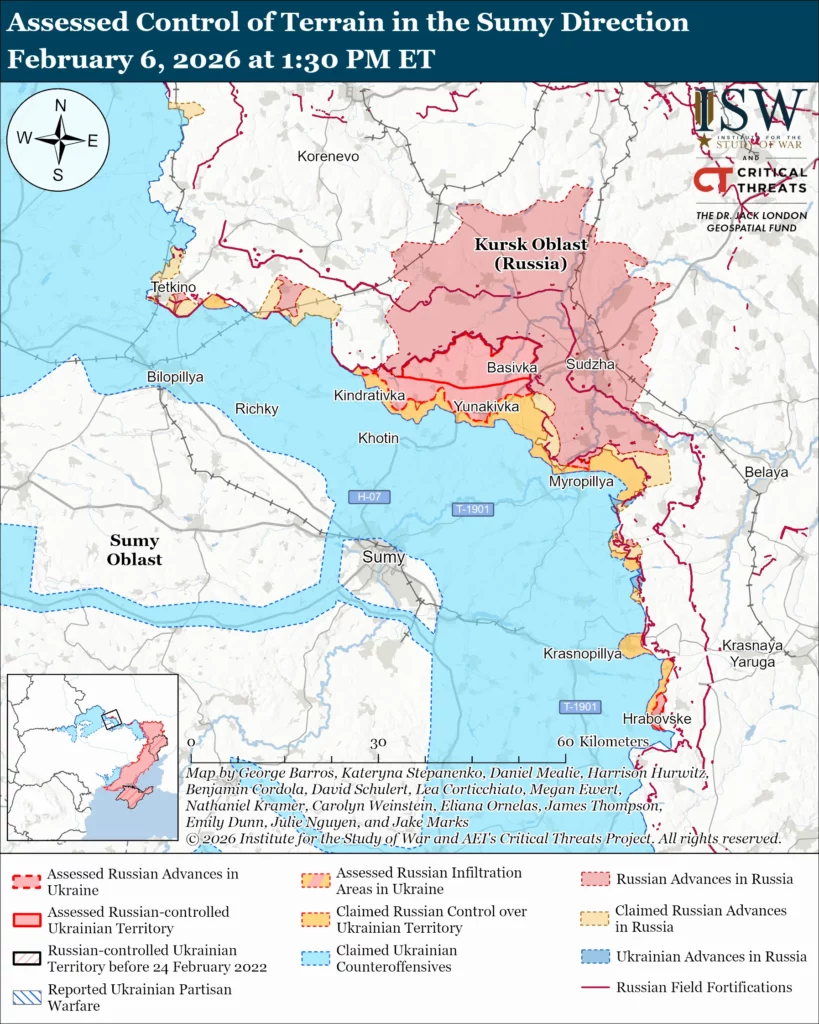
Unconfirmed claims: The Russian Ministry of Defense (MoD) and several Russian milbloggers claimed that elements of the Russian 34th Motorized Rifle Brigade (49th Combined Arms Army [CAA], Southern Military District [SMD]) seized Popivka (southeast of Sumy City along the international border).[41] This assault, if it occurred, was likely a limited cross-border assault that does not portend the start of a new Russian offensive operation in the area.
Russian forces attacked in Kursk and Sumy oblasts, including north of Sumy City near Kindrativka, northeast of Sumy City near Yunakivka, and southeast of Sumy City near Pokrovka and toward Krasnopillya, on February 5 and 6.[42]
A Russian milblogger reportedly affiliated with the Russian Northern Grouping of Forces claimed that Russian forces seized Popivka in a similar manner to the seizure of Hrabovske (southeast of Sumy City along the international border) in late December 2025.[43] The milblogger claimed that Russian forces fired on limited Ukrainian positions in the area and forced the Ukrainian forces to withdraw to nearby forest areas.
Order of Battle: Drone operators of the Russian Rubikon Center for Advanced Unmanned Technologies, the 217th Airborne (VDV) Regiment (98th VDV Division), and the 30th Motorized Rifle Regiment (44th Army Corps [AC], Leningrad Military District [LMD]) are reportedly operating in the Sumy direction.[44] Elements of the 56th VDV Regiment (7th VDV Division) are reportedly training in rear areas in Kursk Oblast.[45]
Russian Main Effort: Eastern Ukraine
Russian Subordinate Main Effort #1 – Kharkiv Oblast
Russian objective: Push Ukrainian forces back from the international border to create a defensible buffer zone with Belgorod Oblast and approach to within tube artillery range of Kharkiv City
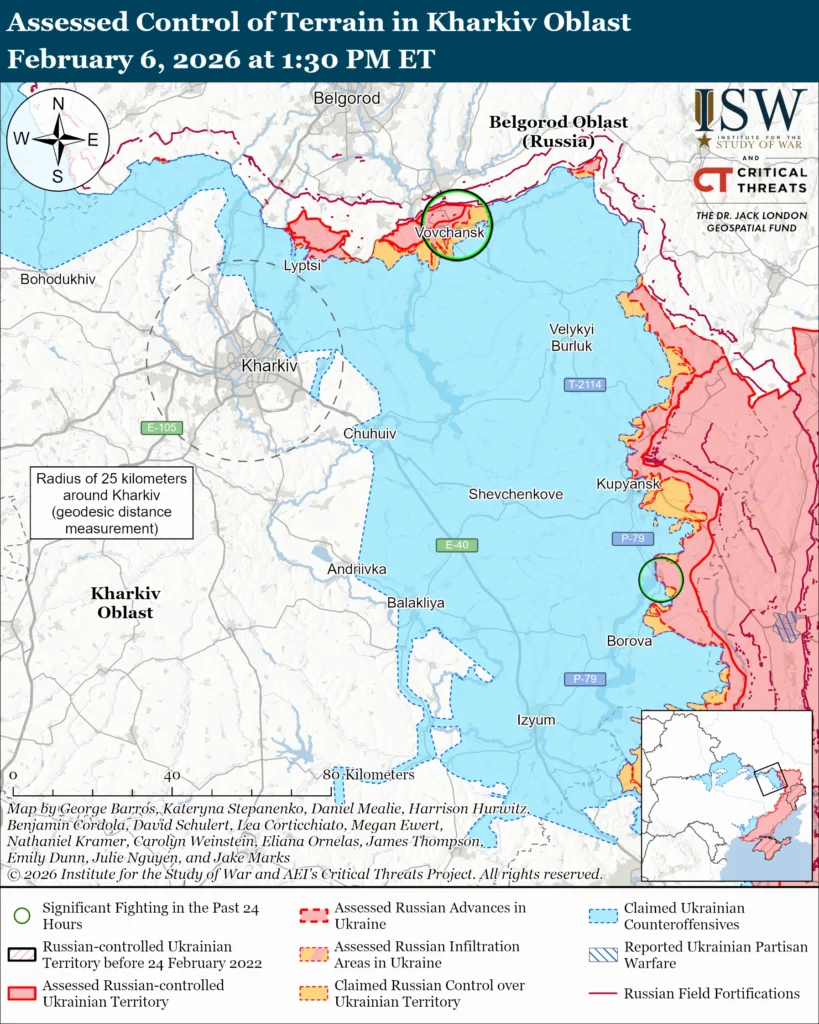
Russian forces continued offensive operations in northern Kharkiv Oblast on February 6 but did not advance.
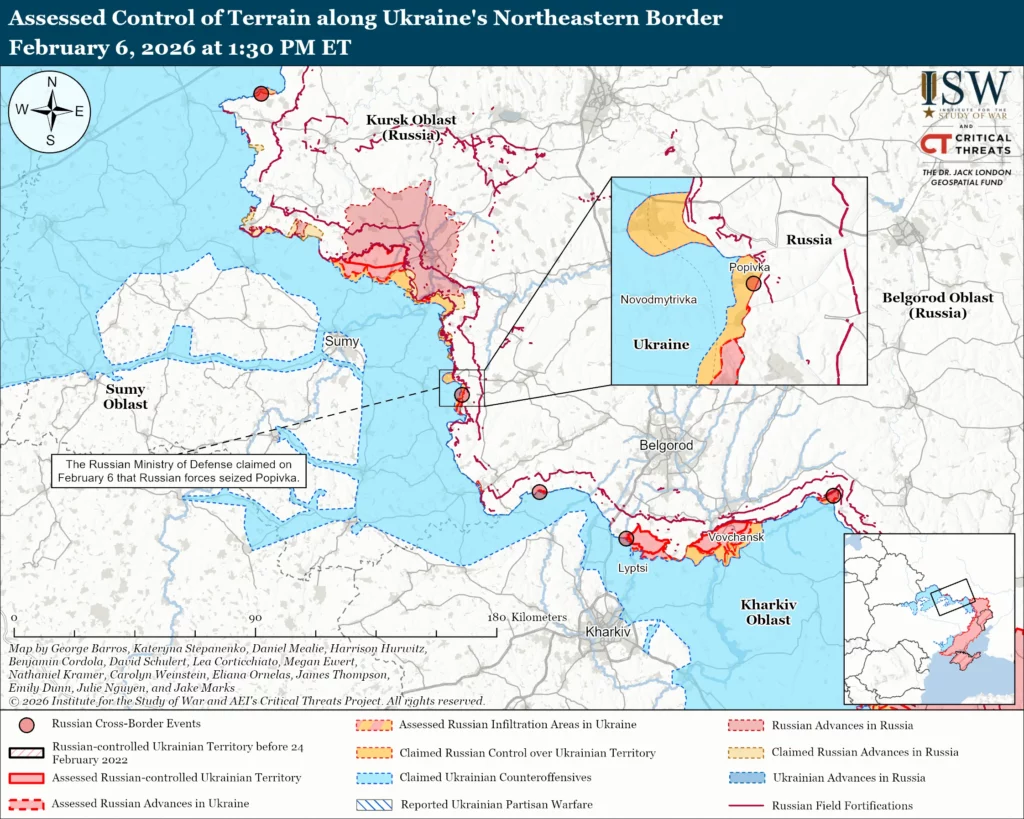
Russian forces attacked northeast of Kharkiv City near Hrafske, Prylipka, Vovchansk, Vovchanski Khutory on February 5 and 6.[46]
The spokesperson of a Ukrainian brigade operating in the South Slobozhansk direction reported on February 6 that Russian forces are attacking from the international border towards Dehtyarne (northeast of Kharkiv City), but that Ukrainian forces maintain fire control over the settlement and the border.[47]
Neither Ukrainian nor Russian sources reported ground activity in the Velykyi Burluk direction on February 5 and 6.
Russian Subordinate Main Effort #2 – Oskil River
Russian objective: Cross the Oskil River in Kharkiv Oblast and push westward into eastern Kharkiv Oblast and northern Donetsk Oblast
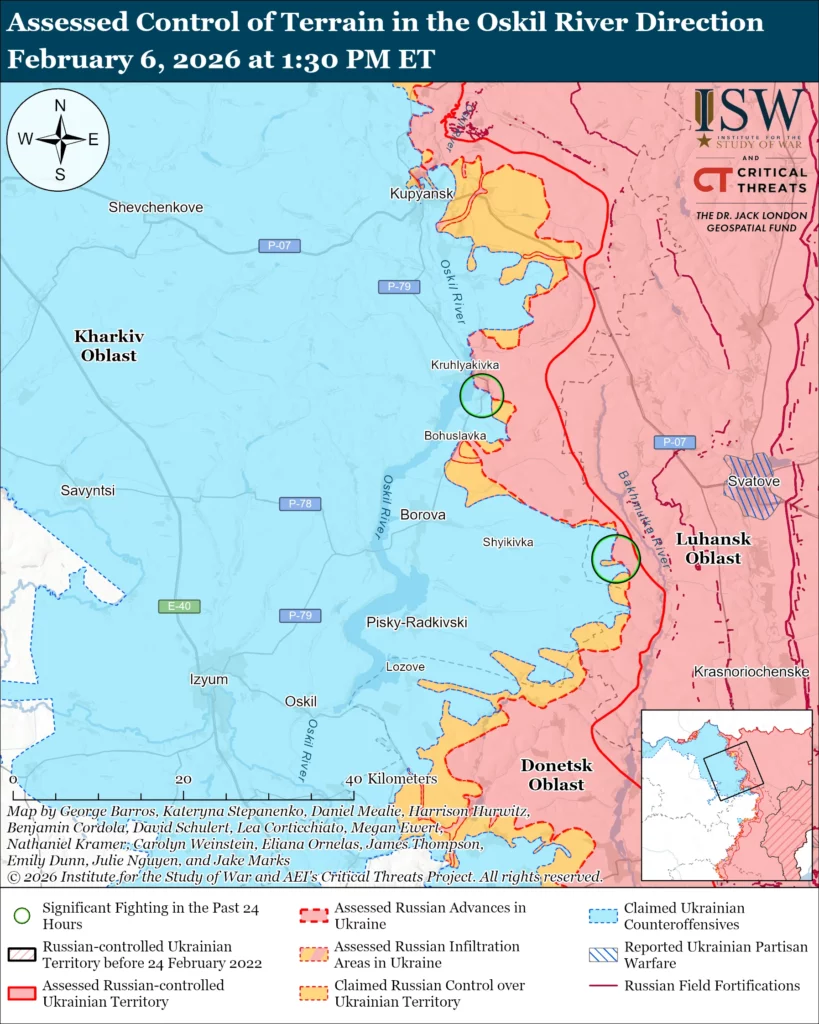
Russian forced continued offensive operations in the Kupyansk direction on February 6 but did not make confirmed advances.
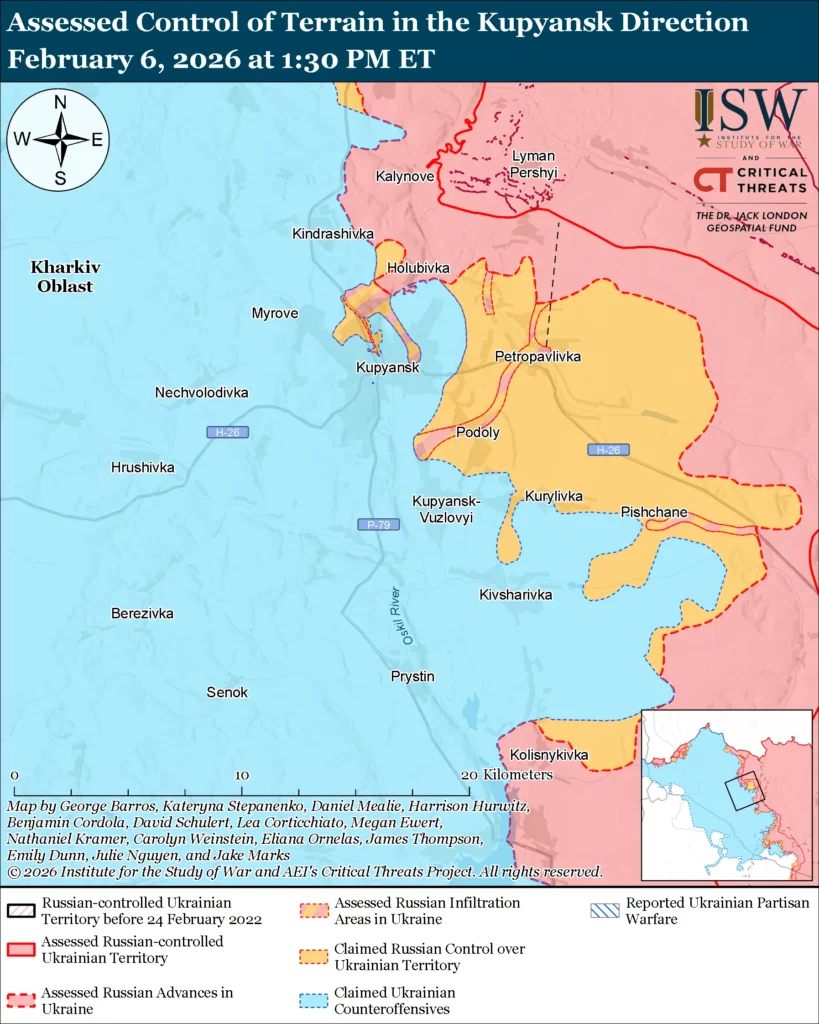
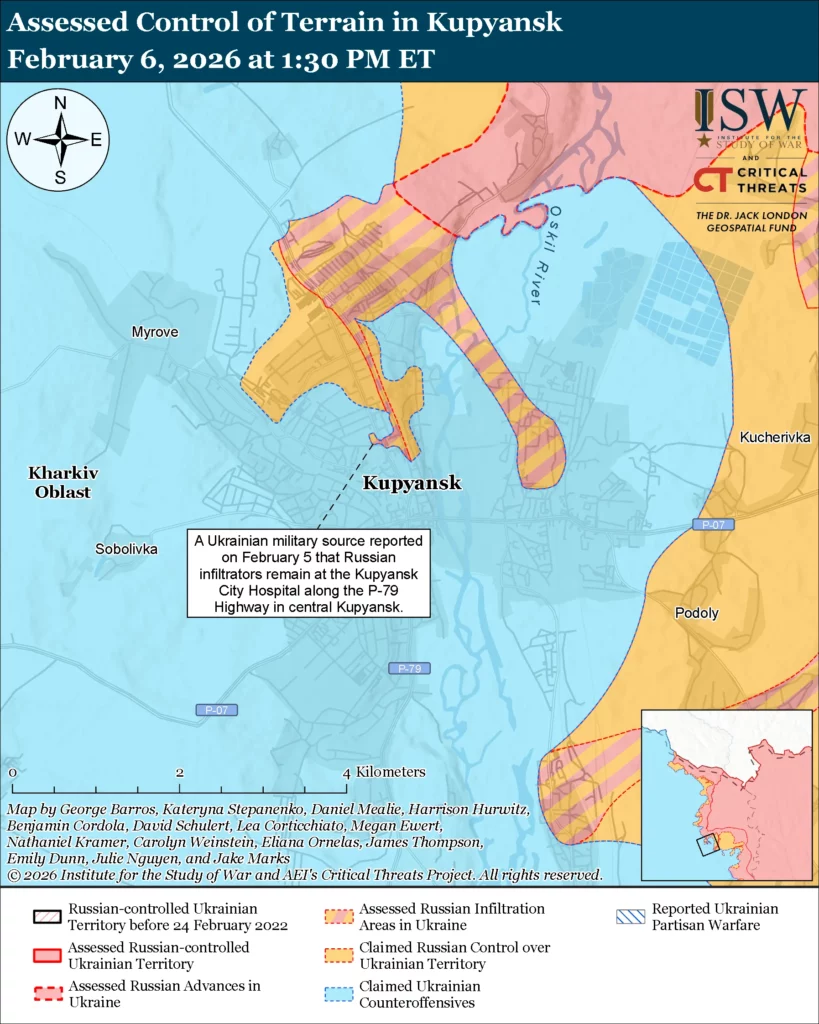
Assessed Russian infiltrations: Ukrainian Joint Forces Task Force Spokesperson Colonel Viktor Trehubov reported on February 5 that Russian servicemembers maintain positions in the hospital in central Kupyansk after what ISW assesses was a Russian infiltration mission that did not change control of terrain or the forward edge of the battle area (FEBA) at this time.[48]
Unconfirmed claims: A Russian milblogger claimed that Russian forces advanced north of Petropavlivka (east of Kupyansk), in Kurylivka, and west of Tabaivka (both southeast of Kupyansk).[49]
Russian forces attacked near Kupyansk itself; north of Kupyansk toward Kindrashivka; east of Kupyansk toward Petropavlivka and Podoly; and south of Kupyansk toward Kupyansk-Vuzlovyi on February 5 and 6.[50]
The spokesperson of a Ukrainian brigade operating in the Kupyansk direction reported on February 5 that Russian forces are conducting sporadic assaults and attacking less frequently than previously as they are unable to operate in freezing and snowy weather.[51]
Ukrainian forces recently advanced in the Borova direction.
[Borova Tactical Area map]Assessed Ukrainian advances: Geolocated footage published on February 4 indicate that Ukrainian forces recently advanced along the P-79 Highway in northern Zahryzove (northeast of Borova).[52]
Russian forces attacked northeast of Borova near Zahryzove and south of Borova near Oleksandrivka on February 5 and 6.[53]
Russian Subordinate Main Effort #3 – Donetsk Oblast
Russian objective: Capture the entirety of Donetsk Oblast, the claimed territory of Russia’s proxies in Donbas, and advance into Dnipropetrovsk Oblast
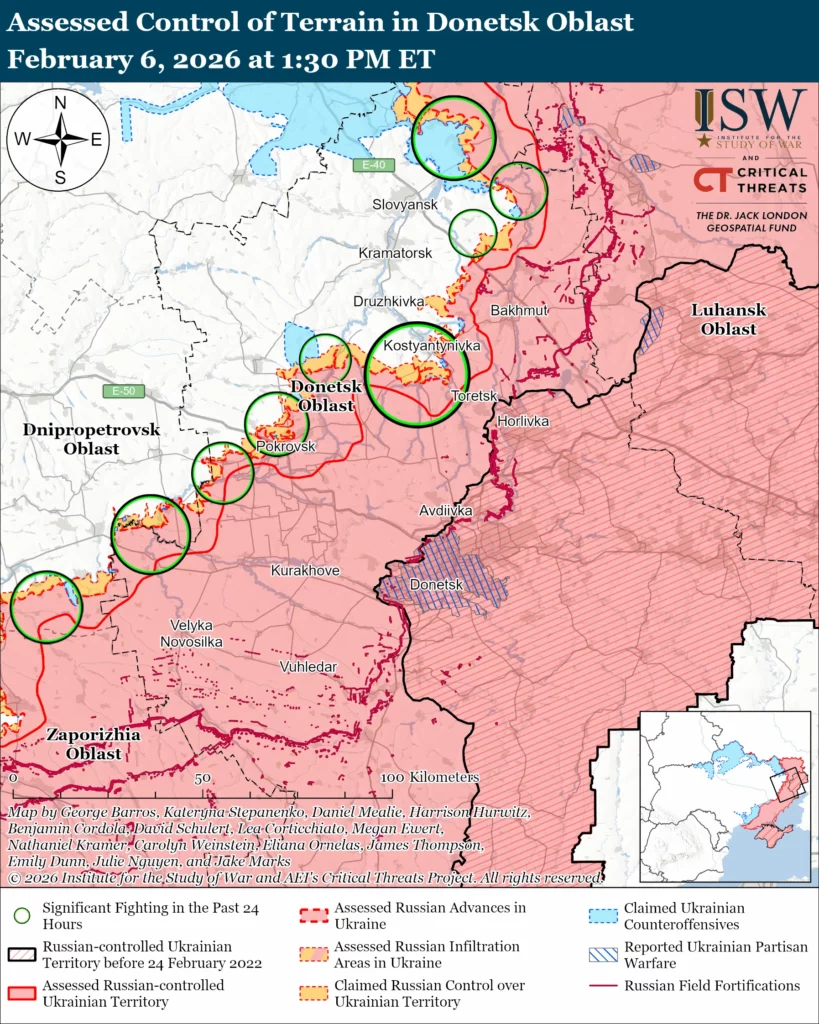
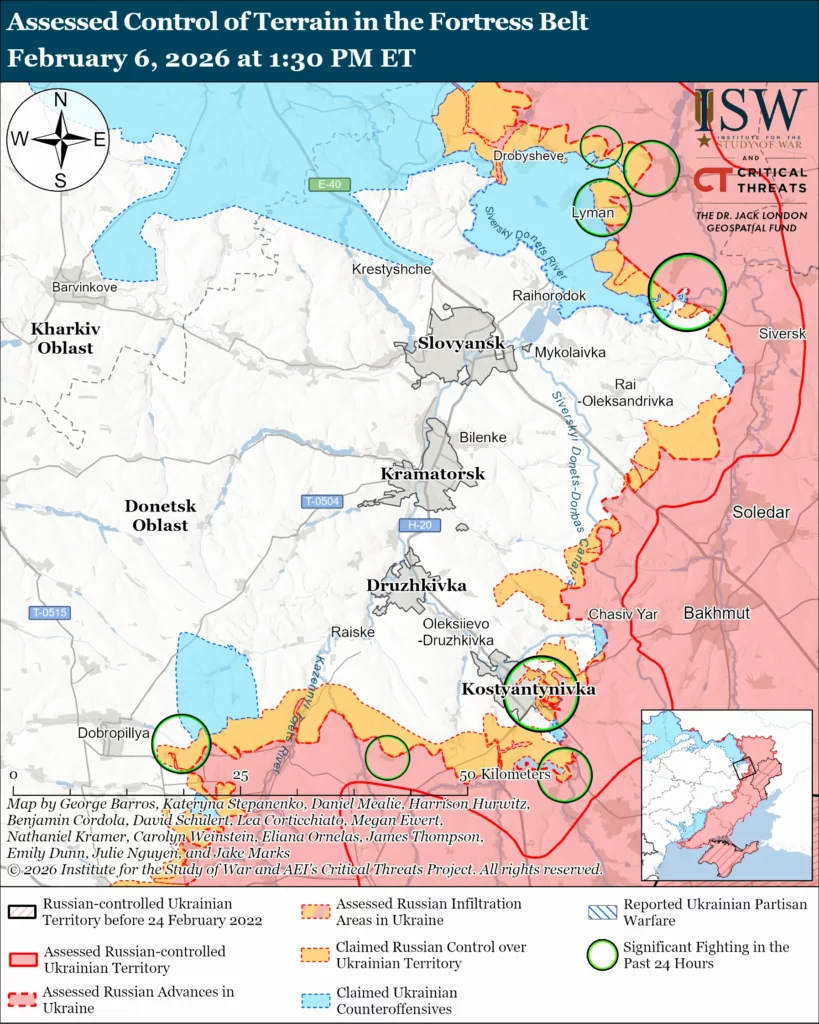
Russian forces continued offensive operations in the Slovyansk direction on February 6 but did not make confirmed advances.
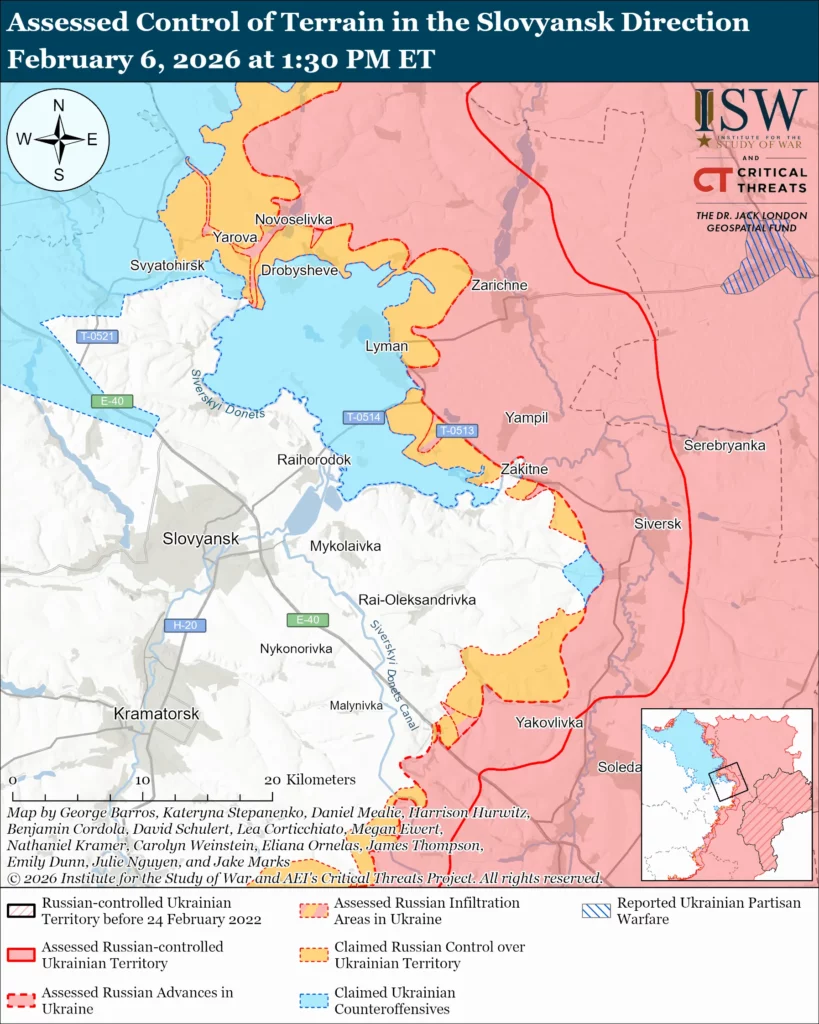
Unconfirmed claims: Russian milbloggers claimed that Russian forces recently advanced south of Stavky (north of Lyman) and Nykyforivka (southeast of Slovyansk), and north of Ozerne (southeast of Lyman).[54]
Russian forces attacked near Lyman itself; northwest of Lyman near Svyatohirsk; north of Lyman near Drobysheve and Stavky; east of Lyman near Zarichne and Yampil; southeast of Lyman near Dibrova; northeast of Slovyansk near Dronivka, Zakitne, and Platonivka; east of Slovyansk toward Riznykivka and Kryva Luka; and southeast of Slovyansk toward Rai-Oleksandrivka on February 5 and 6.[55]
The Ukrainian Joint Forces Task Force reported on February 6 that Russian forces are unsuccessfully infiltrating into Lyman.[56] The spokesperson of a Ukrainian brigade operating in the Slovyansk direction reported that Russian forces are attempting to cross frozen sections the Siverskyi Donets River in groups of two to three.[57] The spokesperson reported that Russian forces are still conducing infiltration tactics in this direction, usually from the area of Siversk (east of Slovyansk). The spokesperson stated that Russian forces are attempting to advance near Zakitne, Dronivka, and Platonivka but have not made significant advances.
Order of Battle: Drone operators of the Russian Rubicon Center for Advanced Unmanned Technologies are reportedly operating in the Lyman direction.[58] Elements of the 7th Motorized Rifle Brigade (3rd Combined Arms Army [CAA], formerly 2nd Luhansk People’s Republic Army Corps [LNR AC], Southern Military District [SMD]) reportedly continue to operate near Siversk and Zakitne.[59]
Russian forces recently advanced in the Kostyantynivka-Druzhkivka tactical area.
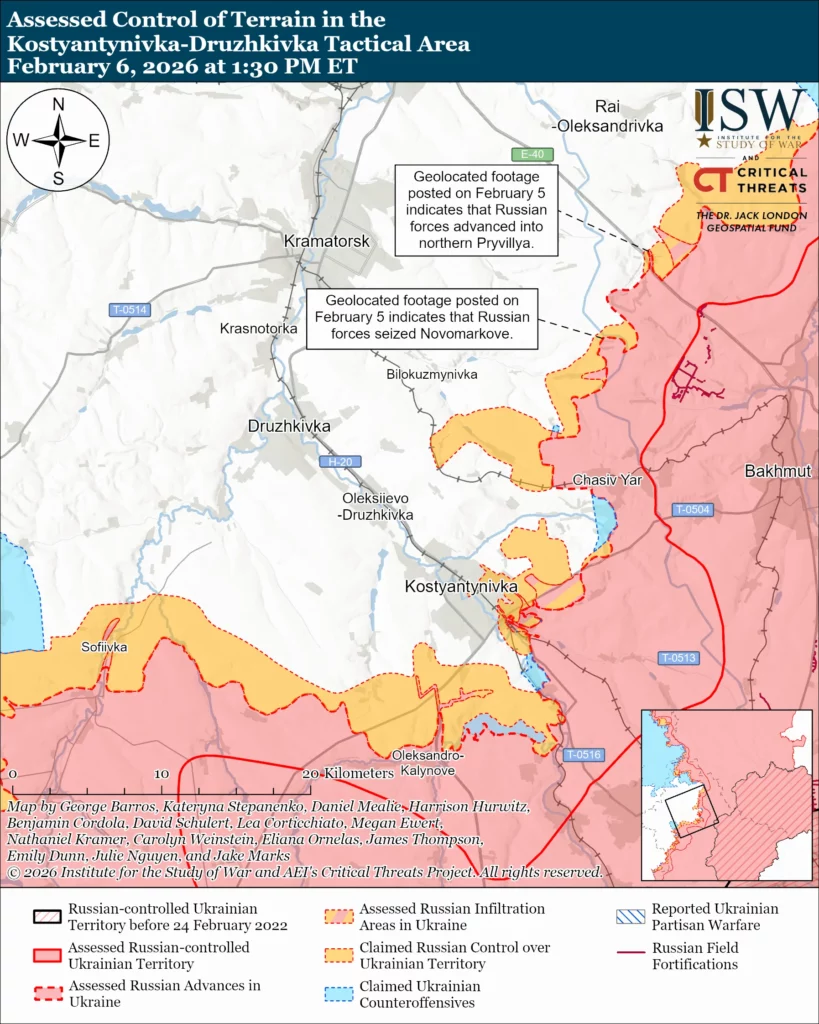
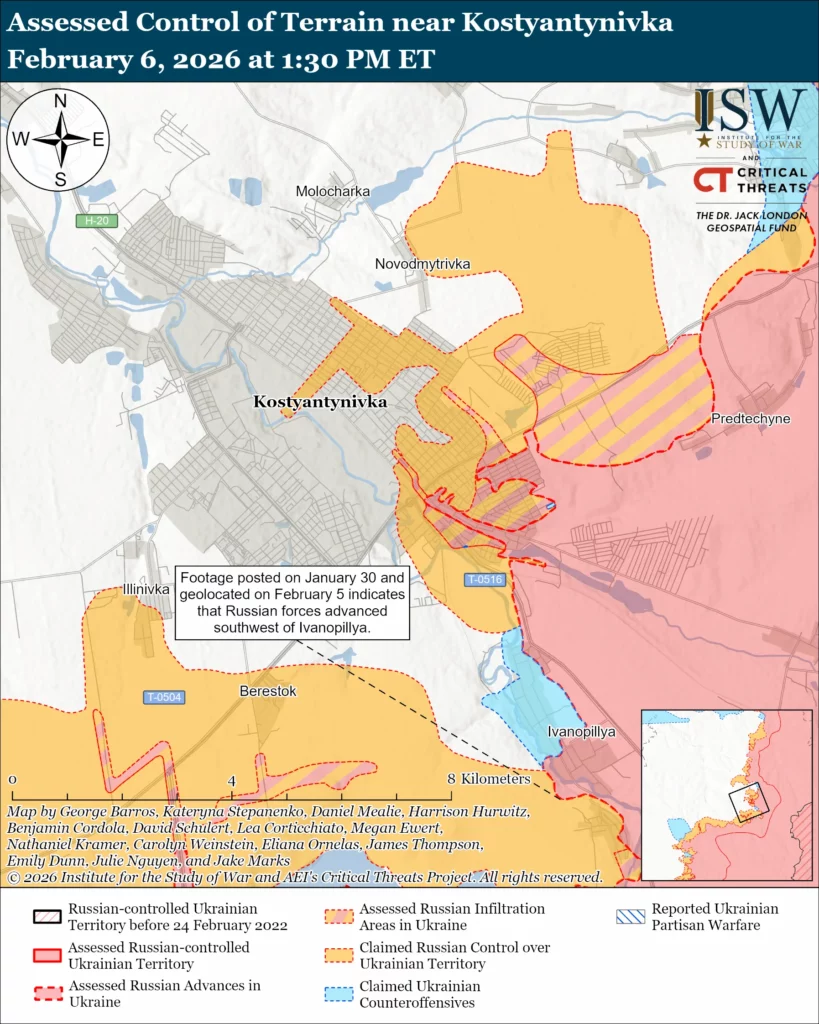
Assessed Russian advances: Geolocated footage published on February 2 and 5 indicates that Russian forces likely seized Novomarkove (northeast of Kostyantynivka).[60] Additional geolocated footage published on January 30 and February 5 indicates that Russian forces advanced into northern Pryvillya (northeast of Kostyantynivka) and southwest of Ivanopillya (south of Kostyantynivka).[61]
Russian forces attacked near Kostyantynivka itself; northeast of Kostyantynivka near Minkivka; southeast of Kostyantynivka near Pleshchiivka, Shcherbynivka, and Ivanopillya; south of Kostyantynivka near Kleban-Byk and Berestok; southwest of Kostyantynivka near Yablunivka, Illinivka, and Stepanivka; south of Druzhkivka near Rusyn Yar; and southwest of Druzhkivka near Sofiivka and Novopavlivka on February 5 and 6.[62]
A Russian milblogger claimed that the Russian operational tempo in the Kostyantynivka direction will likely decrease due to ongoing Starlink-related connectivity issues affecting battlefield coordination.[63]
Order of Battle: Drone operators of the Russian 1st Krasnodar Battalion of the 238th Artillery Brigade (8th CAA, SMD) and of the 58th Separate Spetsnaz Battalion (unofficially designated the Okhotnik [Hunter] Spetsnaz Detachment) (51st CAA, formerly 1st Donetsk People’s Republic [DNR] AC, SMD) are reportedly striking Ukrainian personnel and equipment in the Kostyantynivka direction.[64] Drone operators of the 255th Motorized Rifle Regiment (20th Motorized Rifle Division, 8th CAA, SMD) struck a Ukrainian position near Rusyn Yar.[65] Drone operators of the Russian 68th Separate Reconnaissance Battalion of the 20th Motorized Rifle Division (8th CAA, SMD) are reportedly striking Ukrainian forces near Novopavlivka.[66]
Russian forces continued offensive operations east of Dobropillya near Vilne and Novyi Donbas on February 5 and 6 but did not advance.[67]
Russian forces recently advanced in the Pokrovsk direction.
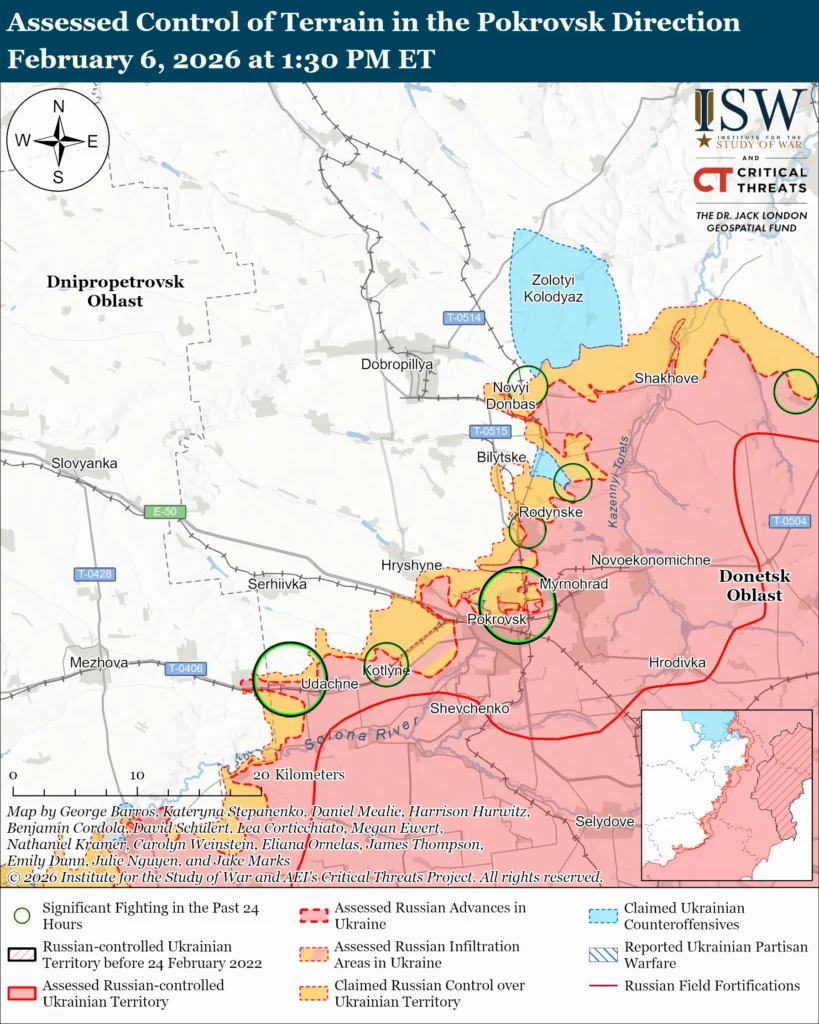
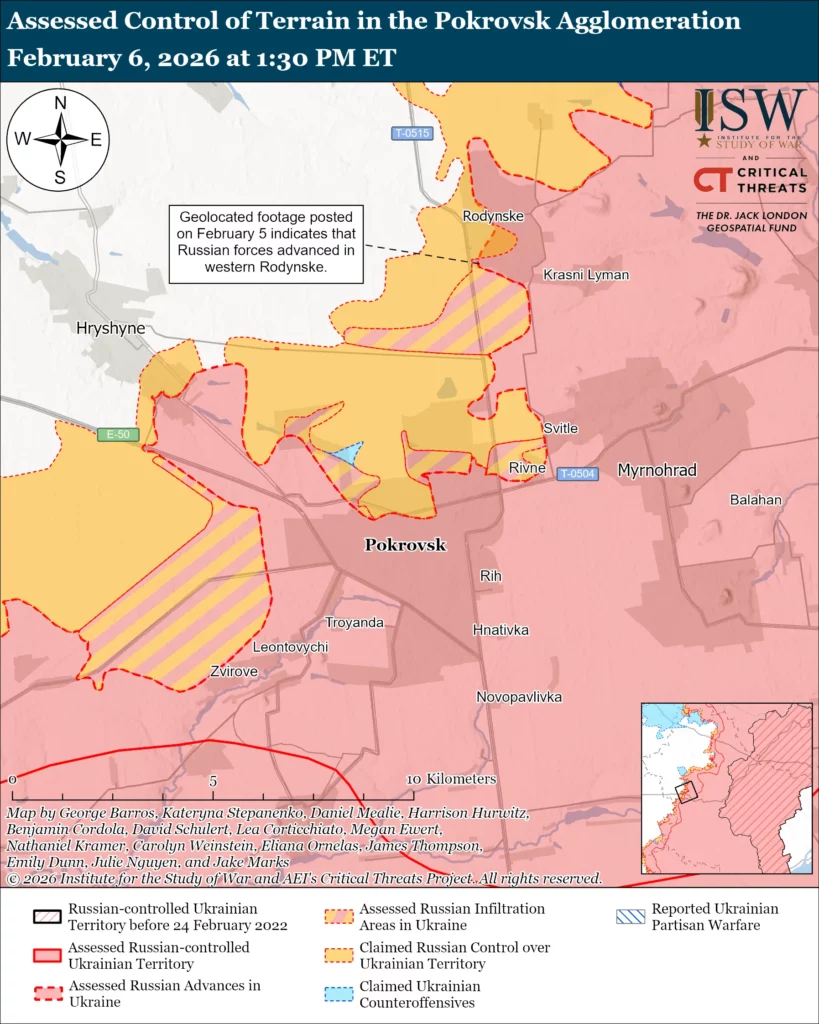
Assessed Russian advances: Geolocated footage published on February 6 indicated that Russian forces recently advanced in southern Rodynske (north of Pokrovsk).[68]
Unconfirmed claims: A Russian milblogger claimed that Russian forces advanced in the southern outskirts of Bilytske (north of Pokrovsk) and southeast of the settlement and south of Dorozhnie (north of Pokrovsk).[69]
Russian forces attacked near and within Pokrovsk itself; northwest of Pokrovsk near Hryshyne and toward Novooleksandrivka; north of Pokrovsk near Rodynske and toward Bilytske; northeast of Pokrovsk near Zatyshok; east of Pokrovsk near Myrnohrad; southwest of Pokrovsk near Kotlyne, Udachne, Molodetske, and Novopidhorodne; and west of Pokrovsk toward Serhiivka on February 5 and 6.[70]
An officer of a Ukrainian brigade operating in the Pokrovsk direction reported on February 6 that Russian forces have saturated the frontline with Mavic drones on the line of contact, Supercam, Zala, and Orlan reconnaissance drones in the operational rear, and Molniya drones for logistics purposes in the Pokrovsk direction.[71] The Ukrainian 7th Rapid Reaction Corps of the Air Assault Forces reported on February 6 that Russian forces are relocating heavy equipment, including artillery, into central Myrnohrad while fighting is ongoing in the northern outskirts of Myrnohrad.[72] The commander of a Ukrainian tank brigade operating in the Pokrovsk direction reported that Russian forces intensify their assaults in the area by deploying a large number of assault soldiers and exploiting foggy and poor weather conditions to advance.[73]
Order of Battle: Elements of the Russian 506th Motorized Rifle Regiment (27th Motorized Rifle Division, 2nd CAA, Central Military District [CMD]) are reportedly operating near Svitle (east of Pokrovsk).[74]
Russian forces continued offensive operations in the Novopavlivka direction on February 6 but did not make confirmed advances.
Unconfirmed claims: A Russian milblogger claimed that Russian forces advanced in central Novopavlivka and west and northwest of the settlement.[75]
Russian forces attacked near Novopavlivka itself and south of Novopavlivka near Dachne and Filiya on February 5 and 6.[76]
Russian forces continued offensive operations in the Oleksandrivka direction on February 6 but did not make confirmed advances.
Unconfirmed claims: A Russian milblogger claimed that Russian forces advanced north of Ivanivka (northeast of Oleksandrivka).[77]
Russian forces attacked toward Oleksandrivka itself, northeast of Oleksandrivka near Ivanivka, and east of Oleksandrivka near Oleksandrohrad on February 5 and 6.[78] A Russian milblogger claimed that Ukrainian forces counterattacked east of Oleksandrivka near Kolomiitsi and Tykhe.[79]
Order of Battle: Elements of the 30th Separate Reconnaissance Battalion (reportedly of the 90th Tank Division, 41st CAA, CMD) are reportedly operating in the Dnipropetrovsk direction.[80]
Russian Supporting Effort: Southern Axis
Russian objective: Maintain frontline positions, secure rear areas against Ukrainian strikes, and advance within tube artillery range of Zaporizhzhia City
Russian forces recently advanced in the Hulyaipole direction.
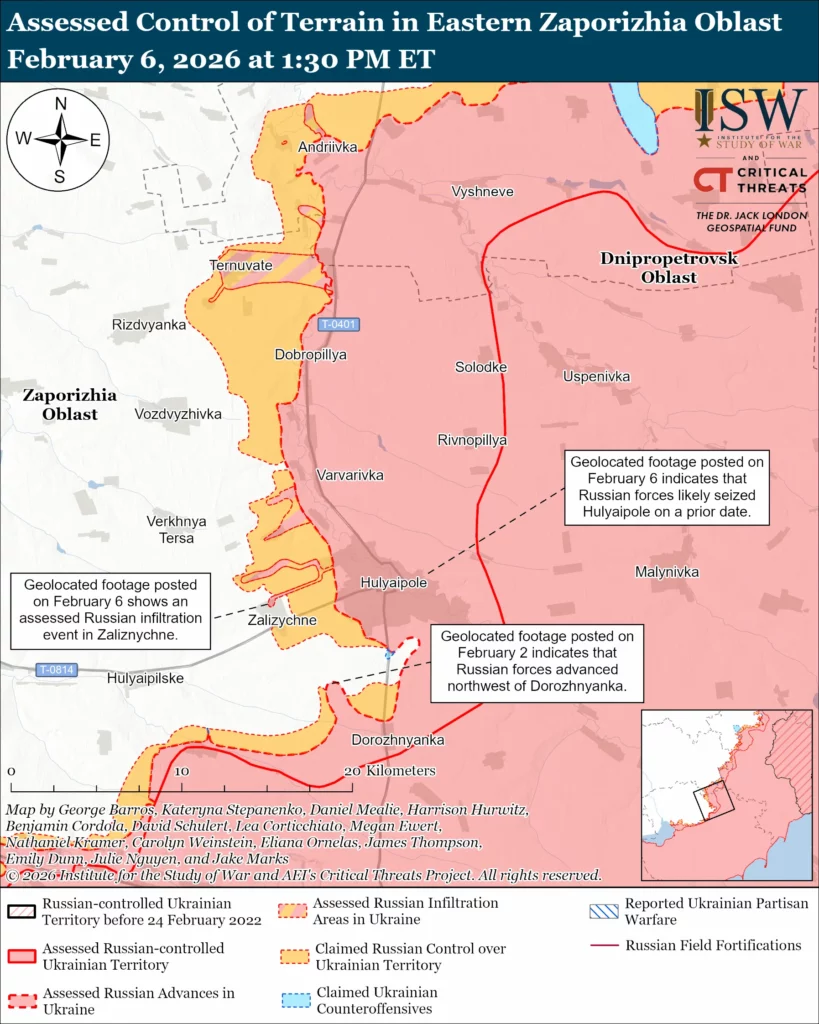
See topline text for Russian advances west of Hulyaipole.
Assessed Russian advances: Geolocated footage published on February 2 indicates that Russian forces advanced northwest of Dorozhnyanka (south of Hulyaipole).[81]
Assessed Russian infiltrations: Geolocated footage published on February 6 shows Ukrainian forces striking a Russian position in Zaliznychne (west of Hulyaipole) after what ISW assesses was infiltration operation that did not change the control of terrain or the forward edge of battle (FEBA).[82]
Russian forces attacked near Hulyaipole itself; northwest of Hulyaipole near Pryluky, Zelene, and Svyatopetrivka and toward Tsvitkove; north of Hulyaipole near Dobropillya and Varvarivka; northeast of Hulyaipole near Zlahoda; southwest of Hulyaipole near Myrne; and west of Hulyaipole near Zaliznychne and Staroukrainka on February 5 and 6.[83] Russian milbloggers claimed that Ukrainian forces counterattacked near Rizdvyanka, Bratske, and Tsvitkove (all northwest of Hulyaipole), and Zaliznychne.[84]
Order of Battle: Elements of the 11th Air Force and Air Defense Army (Russian Aerospace Forces [VKS] and Eastern Military District [EMD]) are reportedly striking Ukrainian positions near Hirke (west of Hulyaipole and Lyubytske (northwest of Hulyaipole).[85]
Russian forces continued offensive operations in western Zaporizhia Oblast on February 6 but did not advance.
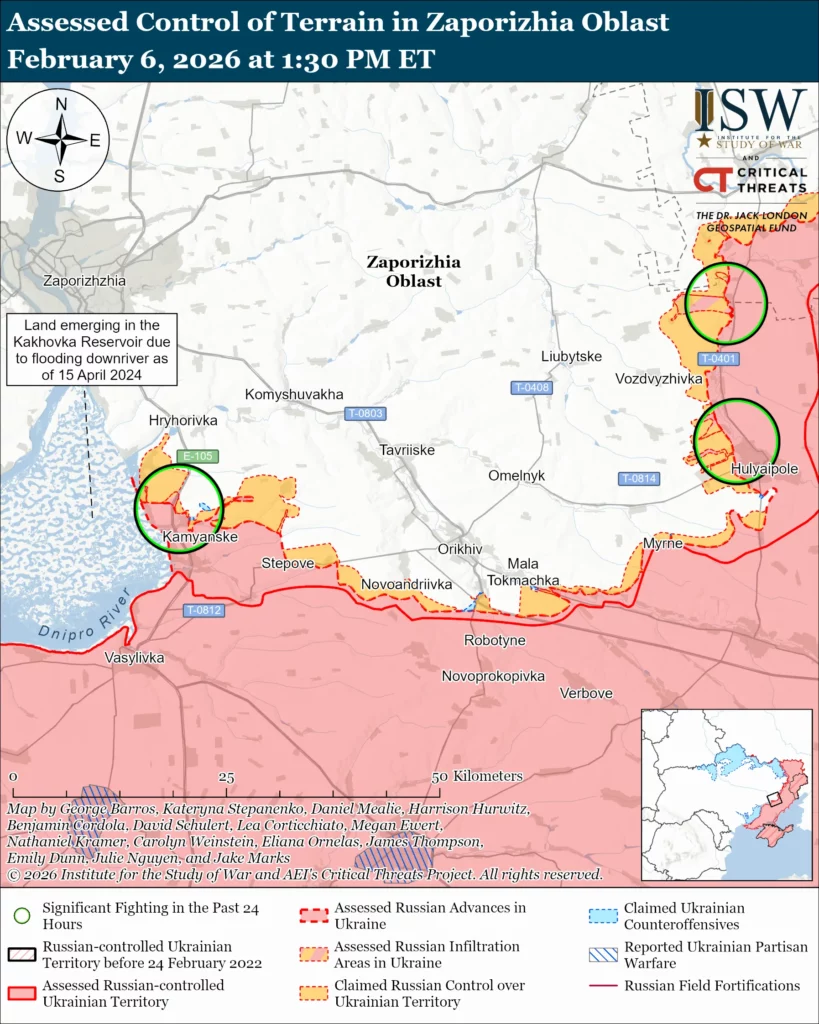
Russian forces attacked south of Orikhiv near Novodanylivka, west of Orikhiv near Prymorske, and northwest of Orikhiv near Richne, Lukyanivske, and Mahdalynivka on February 5 and 6.[86]
Order of battle: Drone operators and other elements of the Russian 7th Airborne (VDV) Division are reportedly striking Ukrainian forces in the Zaporizhia direction, including near Prymorske.[87] Elements of the 11th Air Force and Air Defense Army (Russian Aerospace Forces [VKS] and Eastern Military District [EMD]) are reportedly striking Ukrainian positions near Hulyaipilske (east of Orikhiv).[88]
Russian forces continued limited ground attacks in the Kherson direction on February 6 but did not advance.
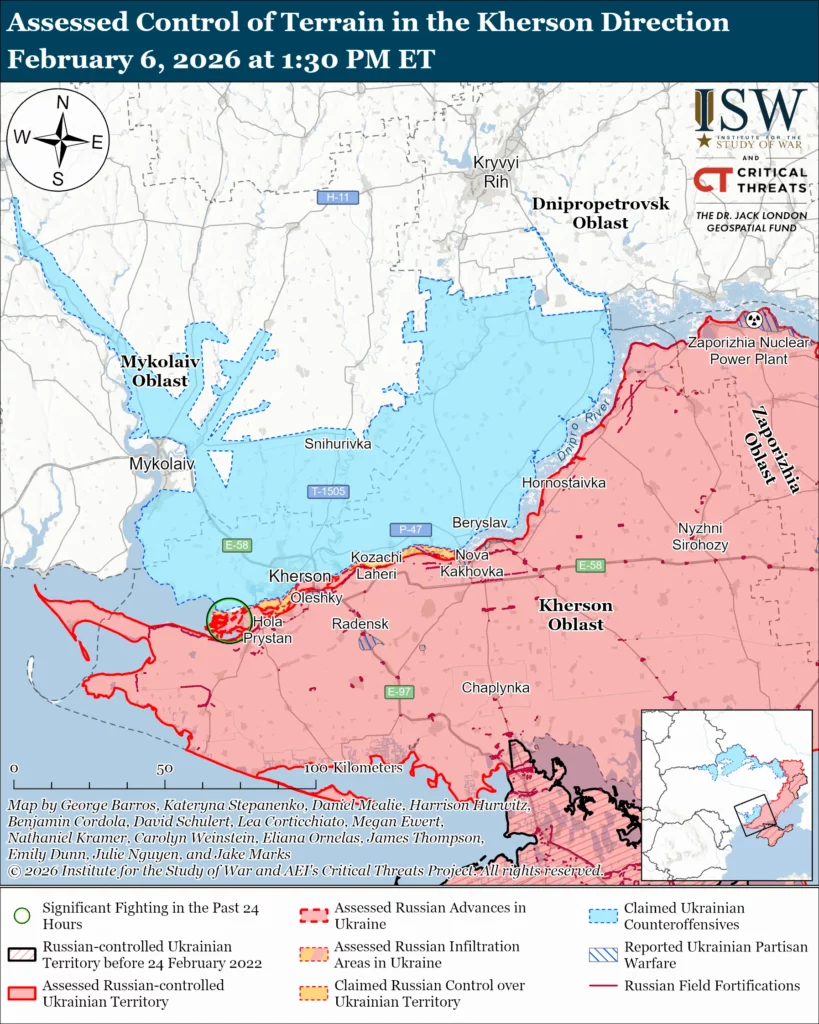
Russian forces attacked in the Kherson direction on February 5 and 6.[89]
Order of Battle: Drone operators of the Russian 98th VDV Division are reportedly striking Ukrainian equipment in Kherson City.[90]
Russian Air, Missile, and Drone Campaign
Russian Objective: Target Ukrainian military and civilian infrastructure in the rear and on the front line
Russian forces conducted a series of drone and missile strikes against Ukraine on the night of February 5 to 6. The Ukrainian Air Force reported that Russian forces launched two Kinzhal ballistic missiles, five Kh-59/69 guided missiles, and 328 Shahed-type, Gerbera-type, Italmas-type, and other drones – of which about 200 were Shaheds – from the directions of Oryol and Kursk cities; Millerovo, Rostov Oblast; Primorsko-Akhtarsk, Krasnodar Krai; and occupied Donetsk City.[91] The Ukrainian Air Force reported that Ukrainian forces downed 297 drones, that none of the missiles reached their targets, that 22 drones struck 14 locations, and that drone fragments fell in two locations. Ukrainian officials reported that Russian forces struck homes, power grids, an electrical substation, and energy infrastructure in Kharkiv and Zaporizhia oblasts.[92]
Russian forces are targeting railway infrastructure in Ukraine. Geolocated footage posted on February 6 shows Russian forces likely using a Geran drone to strike the Pivdenna railway in Trostyanets, Sumy oblast.[93] Ukrainian Center for Countering Disinformation Head Lieutenant Andriy Kovalenko stated on February 5 that Russian forces conducted a drone and missile strike on a railway junction in Kropyvnytskyi, Kirovohrad oblast.[94] ISW continues to assess that Russian forces are striking Ukrainian railway infrastructure, seeking to target Ukrainian rear logistics hubs, which are part of the Russian forces’ ongoing battlefield air interdiction (BAI) campaign intended to facilitate Russian battlefield gains.[95]
Ukrainian Ground Forces Commander Colonel General Oleksandr Syrskyi stated on February 6 that Ukrainian forces are able to destroy 70 percent or more of Russian air targets with aviation, helicopters, and interceptor drones in good weather and noted that anti-aircraft missile forces remain the main and most effective way of destroying air targets.[96]
Significant Activity in Belarus
Russian efforts to increase its military presence in Belarus and further integrate Belarus into Russian-favorable frameworks
Nothing significant to report.
Note: ISW does not receive any classified material from any source, uses only publicly available information, and draws extensively on Russian, Ukrainian, and Western reporting and social media as well as commercially available satellite imagery and other geospatial data as the basis for these reports. References to all sources used are provided in the endnotes of each update.