 Eurasia Press & News
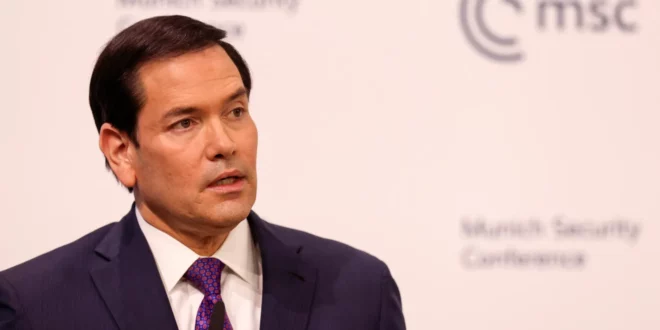
Secretary of State Marco Rubio on Saturday gave the keynote speech at the Munich Security Conference, assuring European allies that the transatlantic relationship remains intact, if strained.
“Our destiny will always be intertwined with yours,” Rubio said. “The end of the transatlantic era is neither our goal or our wish,” adding that the U.S. “will always be a child of Europe.”
“I’m here today to make it clear that America is charting the path for a new century of prosperity and that once again, we want to do it together with you, our cherished allies and our oldest friends,” Rubio said, who noted that “while we are prepared, if necessary, to do this alone, but it is our preference, and our hope, to do this together with you, our friends here in Europe.”
Why It Matters
Since President Donald Trump returned to the White House last January, tensions with Europe have risen sharply over security and foreign policy, particularly regarding Ukraine in its ongoing war against Russia and North Atlantic Treaty Organization (NATO).
Trump has questioned continued U.S. military aid to Kyiv, expressed skepticism about sanctions on Russia, and signaled that Europe should shoulder far more responsibility for its own defense, prompting concern among European leaders that Washington is stepping back from its traditional leadership role.
Economic and diplomatic frictions have also intensified after Trump threatened tariffs on European goods and revived confrontational rhetoric toward the European Union. His administration’s withdrawal from major international agreements and institutions, along with provocative remarks about NATO commitments and even Greenland, have unsettled European governments and forced them to plan for a future with less reliable U.S. backing.
What To Know
European leaders had anticipated Rubio’s speech at the Munich Security Conference would serve as a strong indicator of where the U.S. stood with regards to Europe after a fairly contentious month in which Trump tried to force Denmark to hand over Greenland.
During his speech, Rubio stressed the desire to continue working with Europe and the lineage from one side of the Atlantic to the other, mentioning America’s centuries-old roots in Europe, for which the two continents were forever tied, even as the U.S. pushes for changes in the relationship and institutions.
His speech strikes a different tone from Vice President JD Vance, who only a year earlier criticized European nations and allies and warned them that Europe faced a greater “threat from within” than they did from external adversaries such as Russia or China.
However, Rubio’s speech did criticize the complacency that followed the end of the Cold War when nations fell into a “dangerous delusion that we had entered ‘the end of history,’ that every nation would now be a liberal democracy, that the ties formed by trade and by commerce alone would now replace nationhood…and that we would now live in a world without borders where everyone became a citizen of the world.”
“We made these mistakes together and now together we owe it to our people to face those facts and to move forward to rebuild,” Rubio said, for which Trump now “demands seriousness and reciprocity from our friends here in Europe.”
“I’m here today to make it clear that America is charting the path for a new century of prosperity. and that once again, we want to do it together with you, our cherished allies and our oldest friends,” he said.
U.S. officials who accompanied Rubio told the Associated Press the message the secretary delivered did not depart much in spirit from that of Vance from just one year earlier, but it had been crafted to have a softer landing and to heal some of the burn from the more blistering rhetoric the U.S. had used over the past year.
How Did European Leaders Respond to Rubio’s Speech?
European Commission President Ursula von der Leyen said she felt reassured by Rubio’s speech, even as she noted to the AP that “in the administration, some have a harsher tone on these topics.”
“We know him. He’s a good friend, a strong ally. Indeed, this was, for me, very reassuring to listen to him,” she said. “We know that in the administration, some have a harsher tone on these topics, but the Secretary of State was very clear: He said, ‘We want a strong Europe in the alliance,'” and this is what we are working for, intensively in the European Union.”
“We have to be an independent Europe, not a Europe that is leaning on someone, but a Europe that is going forward with friends and allies, together facing the challenges that are out there, and therefore, strong Europe, I completely align with the Secretary of State what that is concerned, but we have to build it,” von der Leyen said.
Kaja Kallas, the vice-president of the commission, told the BBC she thought Rubio delivered a “good speech” for which “Europeans sighed with relief, because it was saying that Europe is important, that Europe and America are very intertwined and good allies, and have been for so long and will be in the future.”
She did, however, also note there are key differences in policy in “some areas” between the two groups.
British Prime Minister Keir Starmer also welcomed the secretary’s message but warned that “we shouldn’t get in the warm bath of complacency” and that European nations must find a way to “stand on our own two feet” on matters of defense, echoing the need for investment to transform Europe from an entity of “overdependence to interdependence.”
Estonia’s Defense Minister Hanno Pevkur hailed Rubio’s statement stressing the connection between Europe and the U.S., and that the speech was “needed,” but similarly cautioned that “doesn’t mean that we can rest on pillows now. So, still a lot of work has to be done.”