 Eurasia Press & News
Toplines
The Kremlin continues cognitive warfare efforts to attempt to convince the West to abandon Ukraine by projecting the false narrative that Russian battlefield victory in Ukraine is inevitable and that Russian forces are making widespread battlefield gains. Russian Chief of the General Staff’s Main Operations Directorate Colonel General Sergei Rudskoy claimed on February 20 that Russian forces have seized approximately 900 square kilometers and 42 settlements since the beginning of 2026.[1] Rudskoy claimed that Russian forces seized over 6,700 square kilometers of territory and over 300 settlements in 2025. Rudskoy claimed that elements of the Northern Grouping of Forces have seized 26 settlements in Sumy Oblast and 15 settlements and the town of Vovchansk in northern Kharkiv Oblast as of February 20 and that Russian forces are “establishing a security zone” along the Ukraine-Russia international border. Rudskoy claimed that elements of the Western Grouping of Forces seized “over 50” settlements in 2025, including Kupyansk — an oft-repeated Kremlin claim that Russian milbloggers have widely refuted.[2] Rudskoy claimed that Russian forces seized 49 settlements in 2025 and control “more than half” of Kostyantynivka. Rudskoy claimed that elements of the Central Grouping of Forces seized 86 settlements in 2025, including major cities such as Pokrovsk, Toretsk, and Myrnohrad. Rudskoy claimed that elements of the Eastern Grouping of Forces seized Hulyaipole in 2025 and seized 160 square kilometers and 11 settlements in eastern Zaporizhia and southern Dnipropetrovsk oblasts in January and February 2026. Rudskoy did, however, acknowledge recent Ukrainian counterattacks in the area.[3] Rudskoy claimed that elements of the Dnepr Grouping of Forces have seized 12 settlements in western Zaporizhia Oblast since November 2025 and that Russian forces have advanced within 12 kilometers of the southern and southeastern outskirts of Zaporizhzhia City.
ISW has only collected evidence to assess that Russian forces have only seized 19 settlements and 572 square kilometers of total territory since the beginning of 2026 — a difference of 23 settlements and 328 square kilometers. ISW has only collected evidence to assess that Russian forces only seized 252 settlements in 2025 — roughly 50 fewer settlements than Rudskoy claimed — and that Russian forces seized nine settlements in Sumy Oblast and seven settlements in northern Kharkiv Oblast. ISW has only collected evidence to assess that Russian forces seized 17 settlements in the Western Grouping of Forces’ area of responsibility (AoR) (roughly from Kupyansk to Lyman). ISW collected evidence to assess that Russian forces seized 50 settlements in the Southern Grouping of Forces’ AoR, roughly consistent with Rudskoy’s claim. ISW has only collected evidence to assess that Russian forces have advanced or conducted infiltration missions in only seven percent of Kostyantynivka. ISW has only collected evidence to assess that Russian forces seized 38 settlements in the Central Grouping of Forces’ AoR (roughly near Pokrovsk). ISW assesses that Russian forces have seized 99 square kilometers and only three new settlements, including Hulyaipole, in eastern Zaporizhia Oblast in 2026 while losing full or partial control of 18 settlements in eastern Zaporizhia Oblast and southern Dnipropetrovsk Oblast as Ukrainian forces have retaken 86 square kilometers in these areas. ISW assesses that Russian forces have only seized two settlements in western Zaporizhia Oblast since November 2025 and that Russian forces have advanced within 20 kilometers of the southern administrative boundary of Zaporizhzhia City.
Russia is seizing small, rural settlements that lie along the Russia-Ukraine international border and presenting these seizures as alleged evidence of the prowess of the Russian military to further the false narrative that Russian victory in Ukraine is inevitable.[4] Russian forces have repeatedly claimed that Russian forces are expanding the “buffer zone” in Sumy and Kharkiv Oblasts.[5] ISW continues to assess that Russian forces are conducting limited cross-border attacks in previously dormant areas of northern Sumy Oblast to convince the West that the frontlines in Ukraine are collapsing and that Ukraine should concede to all of Russia’s demands.[6] In reality, Russian forces continue to make marginal gains at very high costs. Russian forces in 2025 advanced between 13-15 square kilometers per day at a cost of 83 casualties per square kilometer gained.[7]
The Kremlin continues to crack down on former pro-Russian proxy forces and separatist leaders who criticized the Kremlin to consolidate control over the Russian information space. Kremlin newswire TASS stated on February 18, citing a Russian law enforcement source, that Russian authorities filed an administrative case against former pro-Russian separatist leader and self-proclaimed “People’s Governor of Donetsk Oblast” Pavel Gubarev for “discrediting the Russian Armed Forces,” reportedly facing a fine of 30,000 to 50,000 rubles ($391 to $651).[8] Gubarev told Russian outlet RBK on February 18 that ”someone may have not liked [his] writing,” presumably referring to Gubarev’s posts in his Telegram channel that counts almost 35,000 subscribers.[9] Gubarev stated on his Telegram channel on February 18 that he suspected that an affiliate of Russian Ministry of Defense’s (MoD) Main Military-Political Directorate Deputy Head and Chechen Akhmat Spetsnaz Commander Major General Apti Alaudinov filed the case on Alaudinov’s behalf.[10] Gubarev recently criticized Alaudinov as a “TikTok general” and ineffective battlefield commander for his failures in Kursk Oblast.[11] Gubarev also criticized the Kremlin-endorsed Donetsk People’s Republic (DNR) Head Denis Pushilin for profiteering off the water supply crisis in occupied Donetsk Oblast.[12]
The case against Gubarev is part of the Kremlin’s long-running effort to censor and silence prominent former pro-Russian Ukrainian separatist leaders with platforms in the ultranationalist information space who criticize the Kremlin’s handling of its war in Ukraine. Gubarev was a prominent leader of pro-Russian separatists in Donetsk Oblast during the 2014 “Russian Spring” — the Kremlin-fomented insurgency movement in eastern and southern Ukraine in 2014 — and is a known associate of ardent nationalist and former Russian officer Igor Girkin. Gubarev cofounded the Angry Patriots Club — an ultranationalist pro-war social movement that aims to correct perceived issues in the war effort in Ukraine so that Russian forces can achieve victory — with Girkin in 2023, and has chaired the club since.[13] The Kremlin has imprisoned Girkin since 2023.[14] The Kremlin’s repression of former separatist leaders is an effort to shield itself from backlash from veterans disgruntled with Putin’s failure to live up to the aims of the Russian Spring and larger Novorossiya project and thus to eliminate witnesses of the Kremlin’s lies about its original invasion of eastern Ukraine in 2014. The case also comes against the backdrop of Russian authorities’ throttling of Telegram, indicating that the case may be part of Russian authorities’ larger efforts to control the Russian ultranationalist information space.[15]
Russia’s war in Ukraine is increasingly impacting the Russian people, forcing the Russian Presidential Administration and the ruling United Russia Party to invest in mitigating strategies ahead of the September 2026 State Duma elections. Sources in a major Russian news outlet told Russian opposition outlet Meduza on February 20 that the Russian Presidential Administration political bloc has instructed news outlets to write more frequently about United Russia ahead of the September 2026 elections.[16] The Presidential Administration reportedly strongly encouraged journalists to promote articles about United Russia, primarily focused on the party’s social initiatives supporting families and legislation on housing and medical benefits for Russian war veterans. Meduza noted that United Russia is very concerned that rising food and utility prices are threatening the party’s popularity, with a source in United Russia’s Presidential Representative’s Office in the Northwestern Federal Okrug stating that United Russia’s polling numbers dropped by an average of 10 percent in recent months and as much as 13 to 15 percent in St. Petersburg. Russia’s domestic populace has been increasingly bearing the economic costs of Russia’s protracted war in Ukraine, with ongoing price spikes in food and utilities, as Russian civilians also struggle to afford homes.[17] United Russia reportedly also instructed media outlets to cover the party’s purchase and delivery of military equipment for the frontline.[18] United Russia’s emphasis on the war effort in Ukraine reflects ongoing Kremlin efforts to popularize the war effort as a marker of national unity.[19] The Russian Presidential Administration and United Russia Party are spending resources to retain popularity and maintain control of the domestic situation, although the outcomes of Russia’s 2026 State Duma elections are predetermined.
Ukrainian and Moldovan authorities prevented a Russian attempt to assassinate prominent Ukrainians and destabilize Ukraine. Prosecutor General of Ukraine Ruslan Kravchenko reported on February 20 that Ukrainian and Moldovan authorities detained ten people in connection with a Russian plot to assassinate prominent Ukrainians.[20] Kravchenko and the Ukrainian Security Service (SBU) reported that Russian intelligence promised the individuals up to $100,000 to assassinate Ukrainian journalists, public figures, the head of a strategically important company, and personnel of the Ukrainian Foreign Legion and Ukraine’s Main Military Intelligence Directorate (GUR), including Ukrainian Coordination Headquarters for the Treatment of Prisoners of War (POWs) Deputy Head Andriy Yusov.[21] Kravchenko noted that the plot’s organizers intended for these murders to provoke public outrage in Ukraine, generate negative media coverage of the Ukrainian security situation, and incite further subversive acts.[22] This plot is likely a continuation of Russia’s campaign to conduct sabotage operations within Ukraine that include assassinations of Ukrainian public figures. Russian agents assassinated former Ukrainian Verkhovna Rada Chairperson Andriy Parubiy in August 2025, for example.[23]
Leaked messages from a senior Russian general support ISW’s assessment that the Russian military command itself condones and encourages war crimes against Ukrainian prisoners-of-war (POWs). Radio Svoboda’s Skhemy project published on February 19 leaked Telegram messages from Russian Major General Roman Demurchiev, deputy commander of the 20th Combined Arms Army (CAA, Moscow Military District [MMD]), indicating that Demurchiev discussed the torture and killing of Ukrainian prisoners-of-war (POWs) as routine practice.[24] Demurchiev’s discussion of these crimes with Russian 49th CAA (Southern Military District [SMD]) commander Lieutenant General Mikhail Kosobokov, 20th CAA (Moscow Military District [MMD]) commander Lieutenant General Oleg Mityayev, 36th CAA (Eastern Military District [EMD]) First Deputy Commander Major General Igor Timofeev, and favored counterintelligence officer Colonel Alexei Shvedov, highlights the extent of senior Russian commanders’ normalization and complicity in such atrocities. Demurchiev’s statements are consistent with ISW’s longstanding assessment that the Russian military command is sanctioning the torture and execution of Ukrainian POWs.[25] Skhemy noted that the leaked messages also contained December 2024 infrared drone footage showing Russian forces murdering Ukrainian POWs near Makiivka, Donetsk Oblast. The far-right Russian paramilitary unit Rusich Sabotage Assault Reconnaissance Group also explicitly trumpeted imagery of executions of Ukrainian POWs and offered cash rewards for imagery of such executions in November 2025.[26] Russian forces’ circulation and amplification of execution footage on social media further legitimizes violence within the Russian military narrative, degrades the dignity of victims, and reinforces conditions that enable continued war crimes on the battlefield.
Key Takeaways
The Kremlin continues cognitive warfare efforts to attempt to convince the West to abandon Ukraine by projecting the false narrative that Russian battlefield victory in Ukraine is inevitable and that Russian forces are making widespread battlefield gains.
The Kremlin continues to crack down on former pro-Russian proxy forces and separatist leaders who criticized the Kremlin to consolidate control over the Russian information space.
Russia’s war in Ukraine is increasingly impacting the Russian people, forcing the Russian Presidential Administration and the ruling United Russia Party to invest in mitigating strategies ahead of the September 2026 State Duma elections.
Ukrainian and Moldovan authorities prevented a Russian attempt to assassinate prominent Ukrainians and destabilize Ukraine.
Leaked messages from a senior Russian general support ISW’s assessment that the Russian military command itself condones and encourages war crimes against Ukrainian prisoners-of-war (POWs).
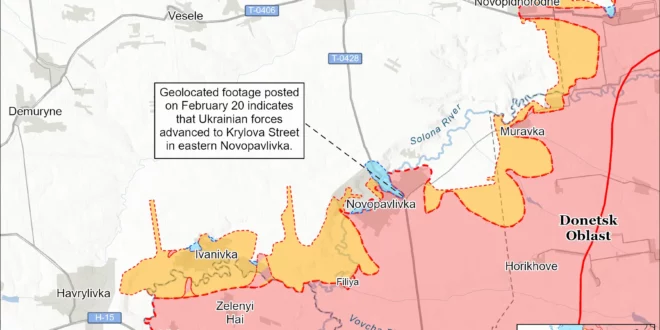
Ukrainian forces recently advanced near Novopavlivka and Hulyaipole. Russian forces recently advanced near Hulyaipole.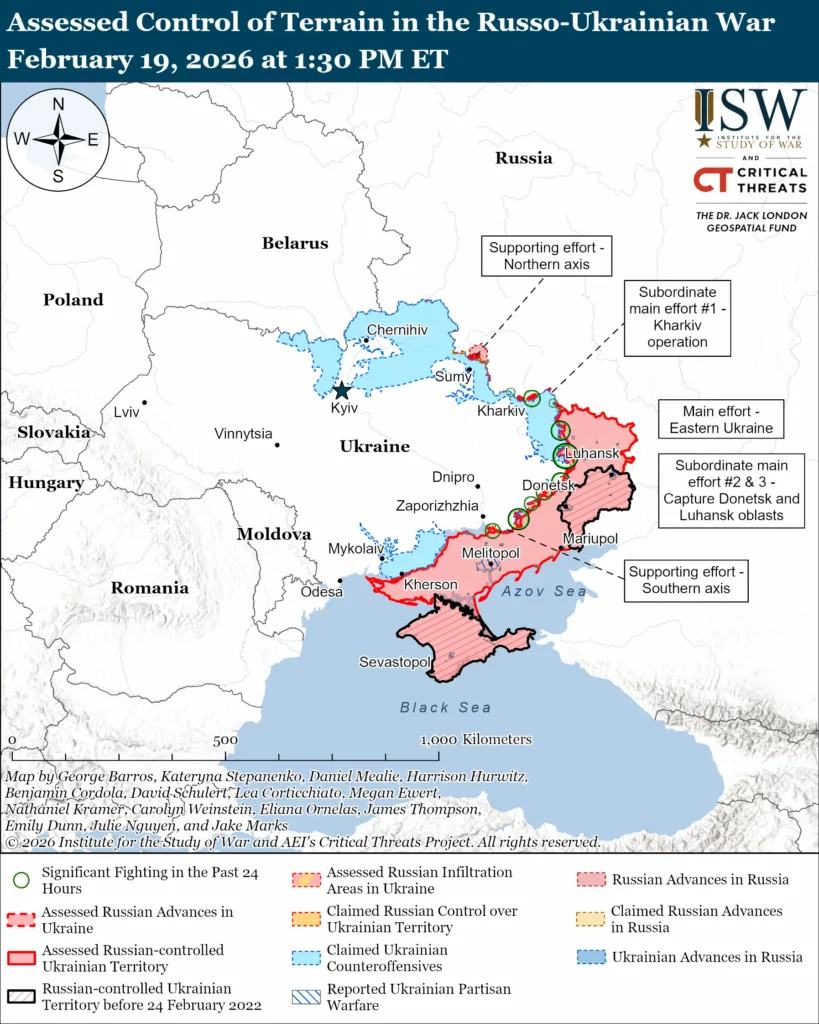
We do not report in detail on Russian war crimes because these activities are well-covered in Western media and do not directly affect the military operations we are assessing and forecasting. We will continue to evaluate and report on the effects of these criminal activities on the Ukrainian military and the Ukrainian population and specifically on combat in Ukrainian urban areas. We utterly condemn Russian violations of the laws of armed conflict and the Geneva Conventions and crimes against humanity even though we do not describe them in these reports.
Ukrainian Operations in the Russian Federation
Ukrainian forces continued their long-range strike campaign against Russian military infrastructure on the night of February 19 to 20. The Ukrainian 16th Army Corps published geolocated footage showing Ukrainian forces striking a Russian ammunition depot in Maksimovka, Belgorod Oblast (approximately 10 kilometers from the international border).[27]
Satellite imagery published on February 20 provided additional battle damage assessments (BDA) from Ukrainian strikes on the night of February 14 to 15. Updated high-resolution satellite imagery published on February 20 indicates that Ukrainian strikes on the Tamanneftegaz oil refinery in Krasnodar Krai burned down a warehouse in the center of the complex and destroyed several silos.[28]
Russian Supporting Effort: Northern Axis
Russian objective: Create defensible buffer zones in Sumy Oblast along the international border
Russian forces continued offensive operations in northern Sumy Oblast on February 20 but did not advance.
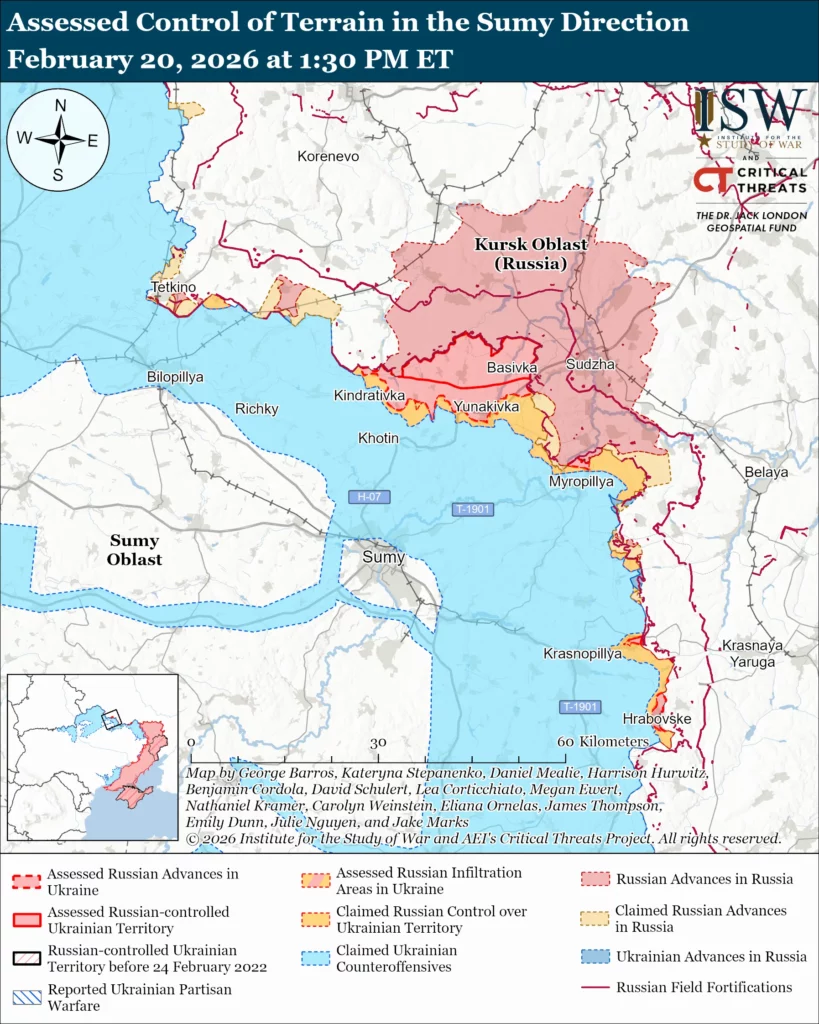
Russian forces attacked in Sumy and Kursk oblasts, including northeast of Sumy City near Vodolahy, Oleksiivka, Mala Korchakivka, Yablunivka, and Nova Sich and toward Khrapivshchyna on February 19 and 20.[29] A Russian milblogger claimed that Ukrainian forces counterattacked near Krasnopillya (southeast of Sumy City).[30]Order of Battle: Artillery elements of the Russian 30th Motorized Rifle Regiment (72nd Motorized Rifle Division, 44th Army Corps [AC], Leningrad Military District [LMD]) are reportedly striking Ukrainian forces in Sumy Oblast.[31] Drone operators and other elements of the Rubikon Center for Advanced Unmanned Technologies and of the 137th Airborne (VDV) Regiment (106th VDV Division) are reportedly conducting reconnaissance and are striking Ukrainian forces in the Sumy direction.[32]
Russian Main Effort: Eastern Ukraine
Russian Subordinate Main Effort #1 – Kharkiv Oblast
Russian objective: Push Ukrainian forces back from the international border to create a defensible buffer zone with Belgorod Oblast and approach to within tube artillery range of Kharkiv City
Ukrainian forces recently maintained positions or advanced in northern Kharkiv Oblast.
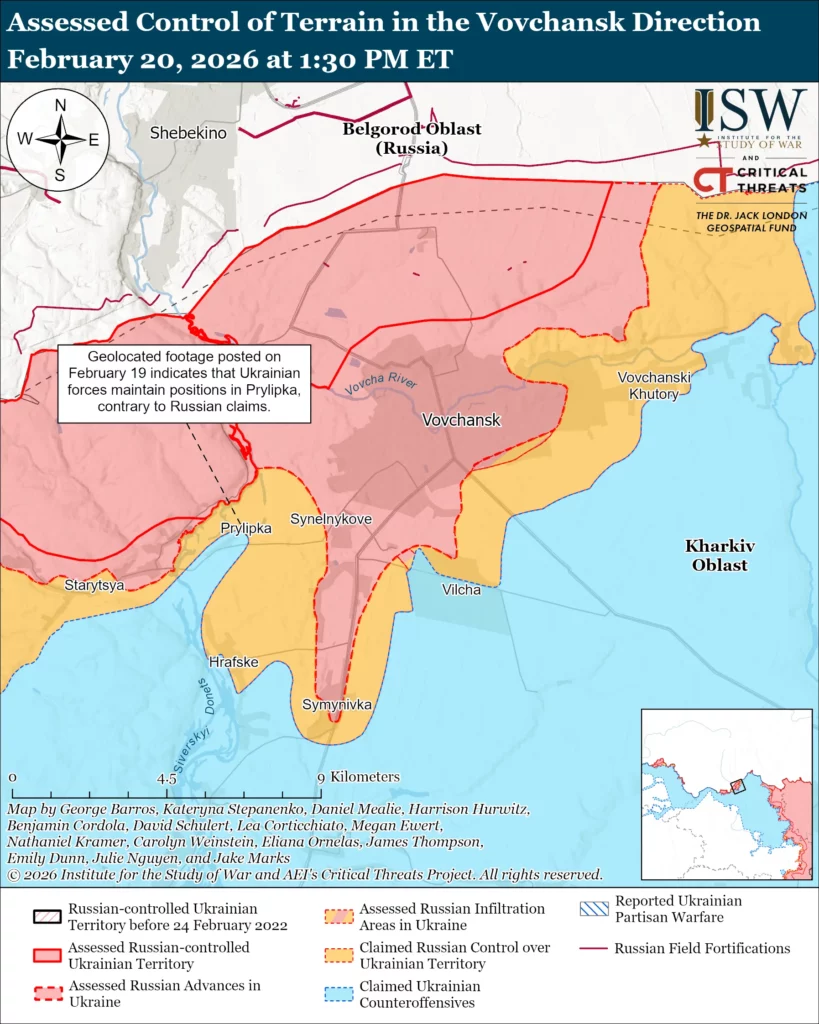
Refinement of areas under Russian claims: Geolocated footage published on February 19 shows Russian forces striking Ukrainian positions in Prylipka (northeast of Kharkiv City) — an area where Russian sources previously claimed that Russian forces maintained positions.[33]
Unconfirmed claims: A Russian milblogger reportedly affiliated with the Russian Northern Grouping of Forces claimed that Russian forces advanced near Symynivka (northeast of Kharkiv City).[34]
Russian forces attacked north of Kharkiv City near Veterynarne and northeast of Kharkiv City near Vovchanski Khutory, Zelene, Starytsya, Vovchansk, Vilcha, and Hrafske and toward Okhrimivka on February 19 and 20.[35]
Order of Battle: Artillery crews of the Russian 27th Motorized Rifle Brigade (1st Guards Tank Army [GTA], Moscow Military District [MMD]) are striking Ukrainian positions in Prylipka.[36]
Russian forces continued offensive operations northeast of Velykyi Burluk near Chuhunivka and Khatnie and toward Zarubynka on February 19 and 20 but did not advance.[37]
Russian Subordinate Main Effort #2 – Oskil River
Russian objective: Cross the Oskil River in Kharkiv Oblast and push westward into eastern Kharkiv Oblast and northern Donetsk Oblast
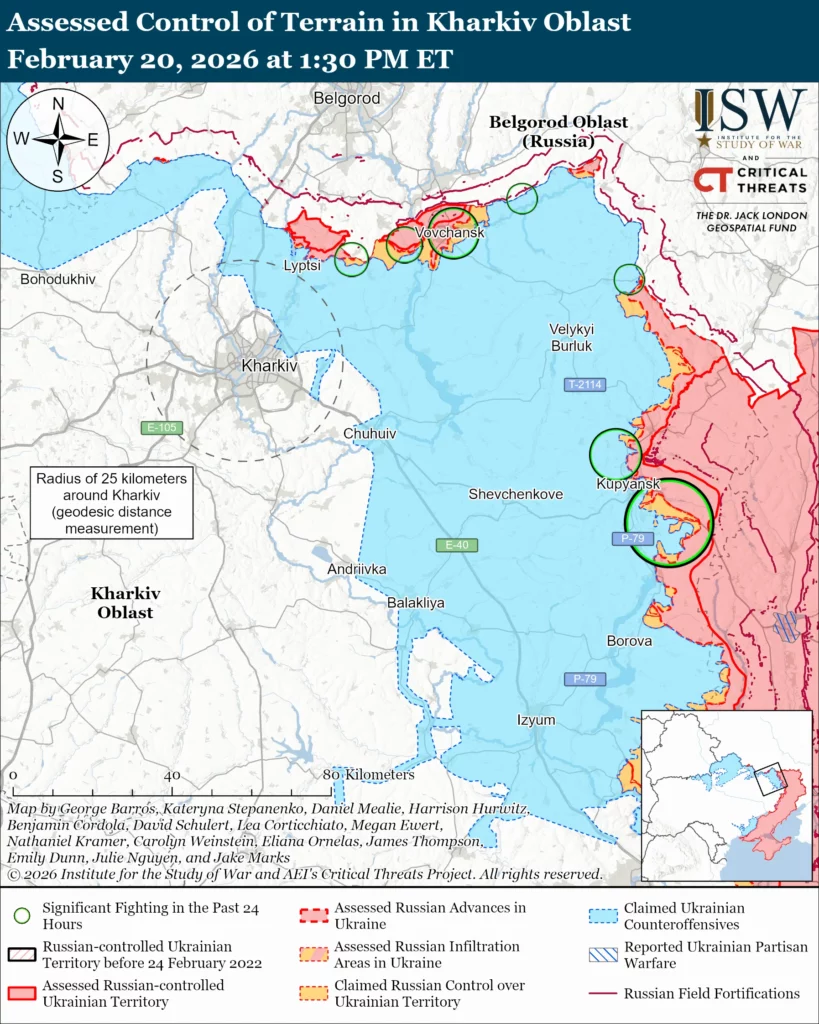
Russian forces continued offensive operations in the Kupyansk direction on February 20 but did not advance
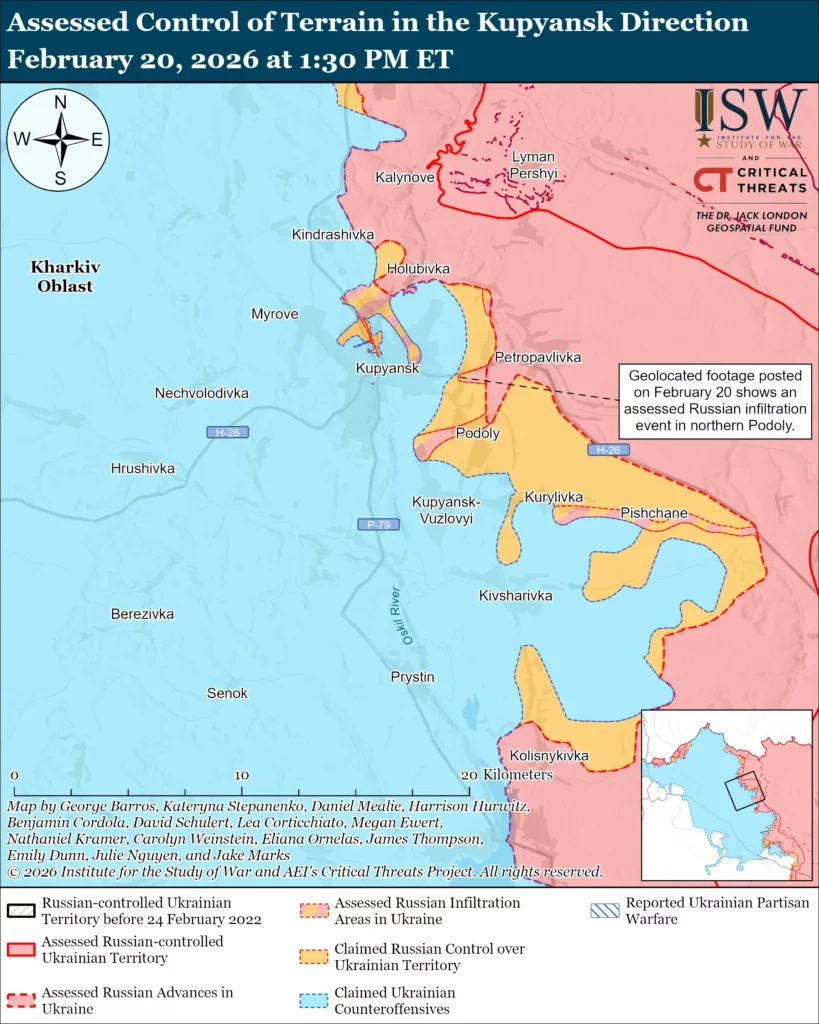
Assessed Russian infiltrations: Geolocated footage published on February 20 shows Ukrainian forces striking a Russian position in northern Podoly (east of Kupyansk) after what ISW assessed was a Russian infiltration mission that did not change the control of terrain or the forward edge of the battle area (FEBA) at this time.[38]
Russian forces attacked near Kupyansk itself; west of Kupyansk toward Myrove; north of Kupyansk near Kindrashivka and toward Radkivka; east of Kupyansk near Petropavlivka; and southeast of Kupyansk near Kurylivka, Pishchane, and Novoosynove on February 19 and 20.[39]
Ukrainian Joint Forces Task Force Spokesperson Colonel Viktor Trehubov reported on February 20 that Ukrainian forces assess that only approximately 30 Russian servicemembers remain in Kupyansk.[40] Trehubov noted that these Russian servicemembers are isolated at a small block of high-rise buildings in the center of Kupyansk near the city hospital. Trehubov reported that Russian forces are attempting to infiltrate east of the Oskil River and are prioritizing that area over the area north of Kupyansk.
Russian forces continued offensive operations in the Borova direction on February 20 but did not advance.
Russian forces attacked southeast of Borova near Shandryholove and Novyi Mir and south of Borova near Oleksandrivka on February 19 and 20.[41]
Order of Battle: Elements of the Russian 423rd Motorized Rifle Regiment (4th Tank Division, 1st Guards Tank Army [GTA], Moscow Military District [MMD]) are reportedly operating near Zelenyi Hai.[42]Ukrainian forces continued their mid-range strike campaign against Russian military assets in occupied Luhansk Oblast. The Ukrainian General Staff reported on February 20 that Ukrainian forces struck a Russian forces materiel and technical equipment depot near occupied Mozhnyakivka (roughly 90 kilometers from the front line).[43]
Russian Subordinate Main Effort #3 – Donetsk Oblast
Russian objective: Capture the entirety of Donetsk Oblast, the claimed territory of Russia’s proxies in Donbas, and advance into Dnipropetrovsk Oblast
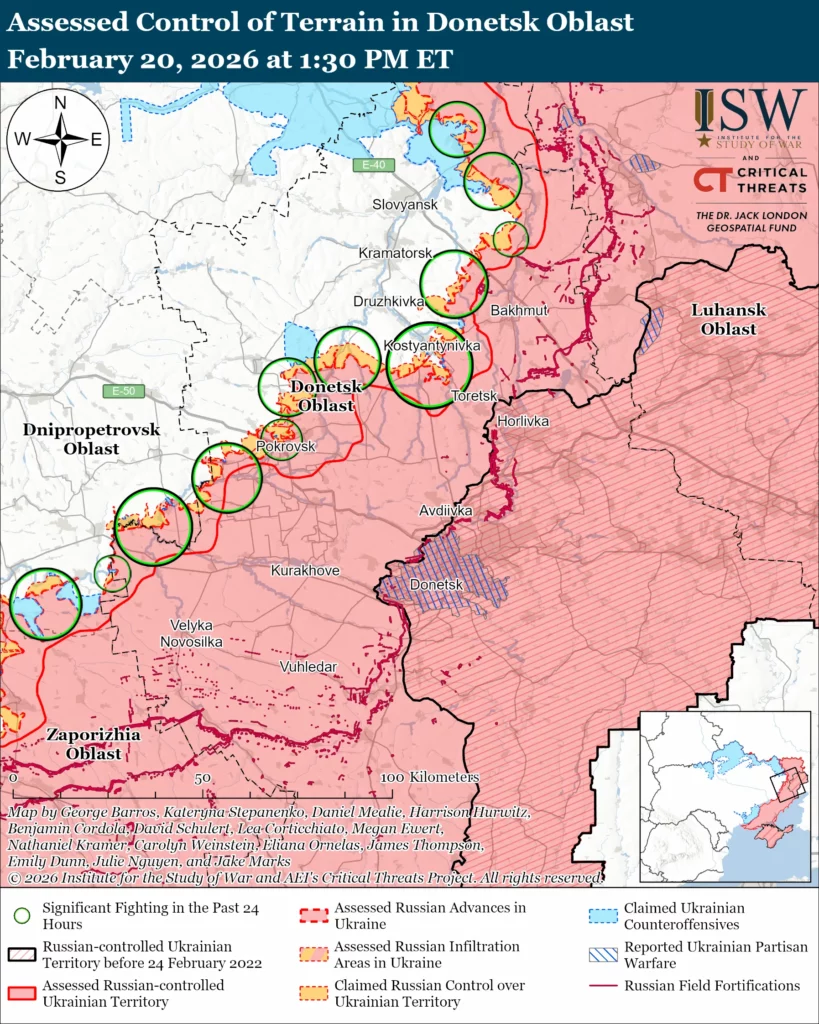
Russian forces continued offensive operations in the Slovyansk direction on February 20 but did not advance.
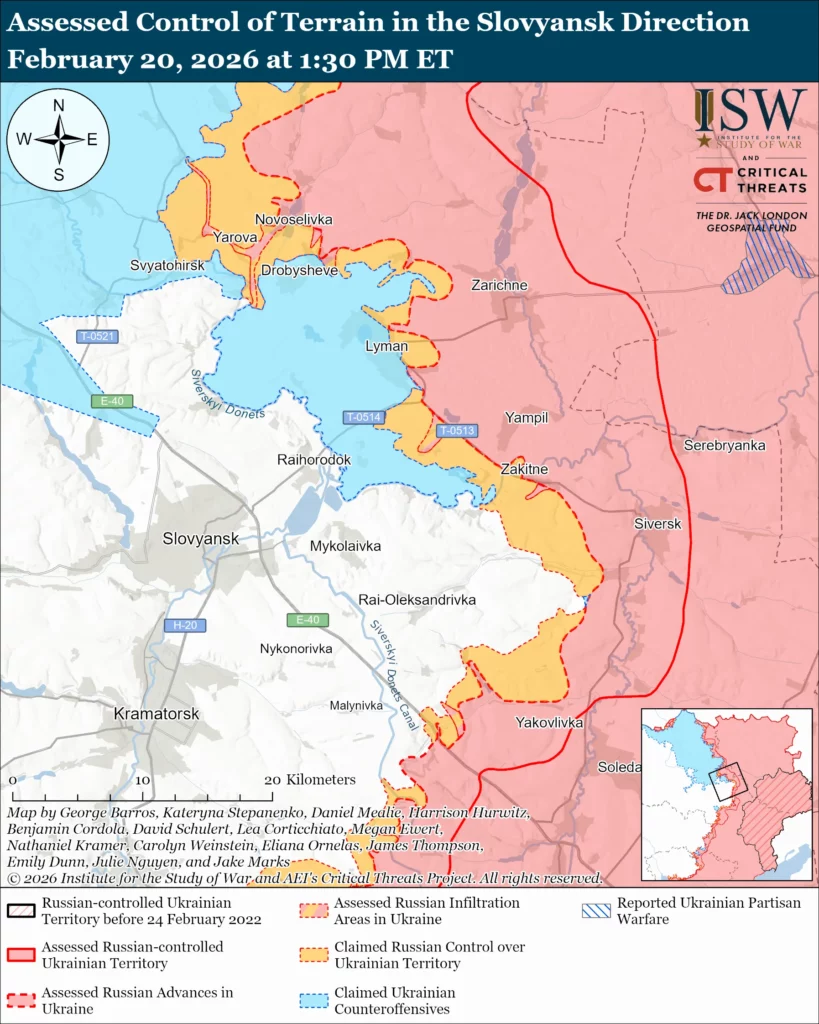
Russian forces attacked near and within Lyman itself; northwest of Lyman near Yarova and Sosnove; north of Lyman near Stavky and Drobysheve; east of Lyman near Zarichne; northeast of Slovyansk near Zakitne and Dronivka; east of Slovyansk near Ozerne, Yampil, and Riznykivka and toward Rai-Oleksandrivka and Kryva Luka; and southeast of Slovyansk near Zvanivka, Vasyukivka, and Nykyforivka on February 19 and 20.[44]
Order of Battle: First-person view (FPV) drone operators of the Russian 16th Spetsnaz Brigade (Russian General Staff’s Main Directorate [GRU]) and of the Rubikon Center for Advanced Unmanned Technologies are reportedly striking Ukrainian forces in the Lyman direction.[45]
Russian forces continued offensive operations in the Kostyantynivka-Druzhkivka tactical area on February 20 but did not advance.
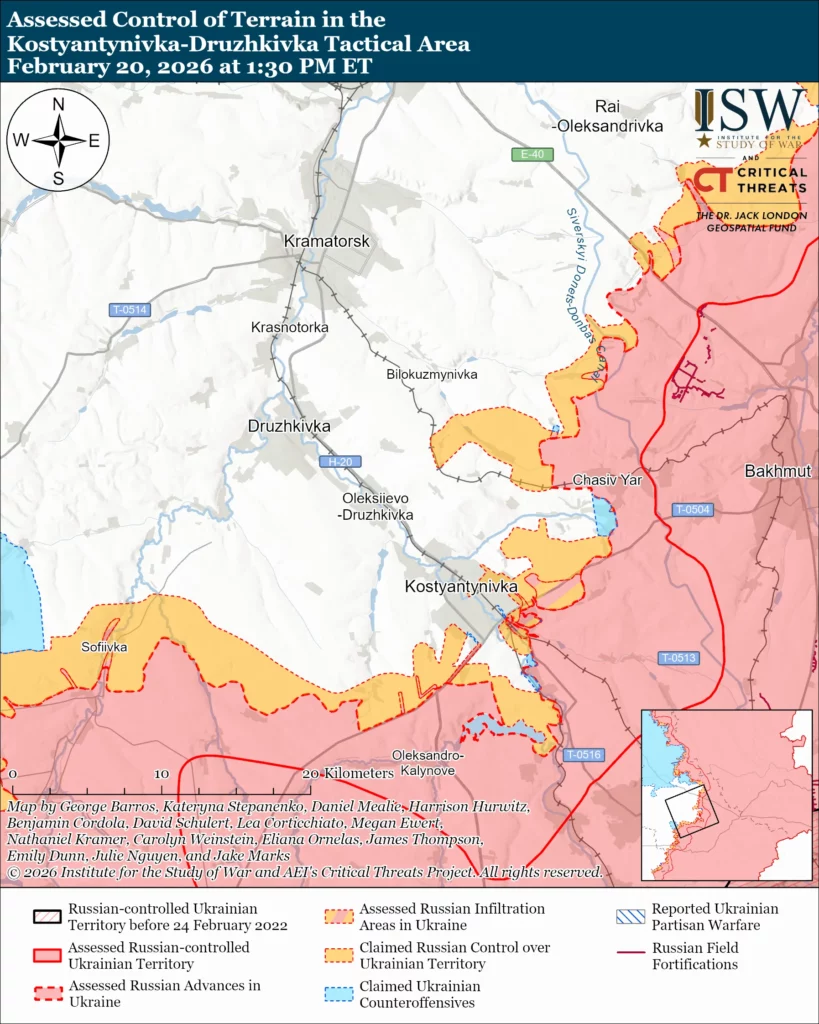
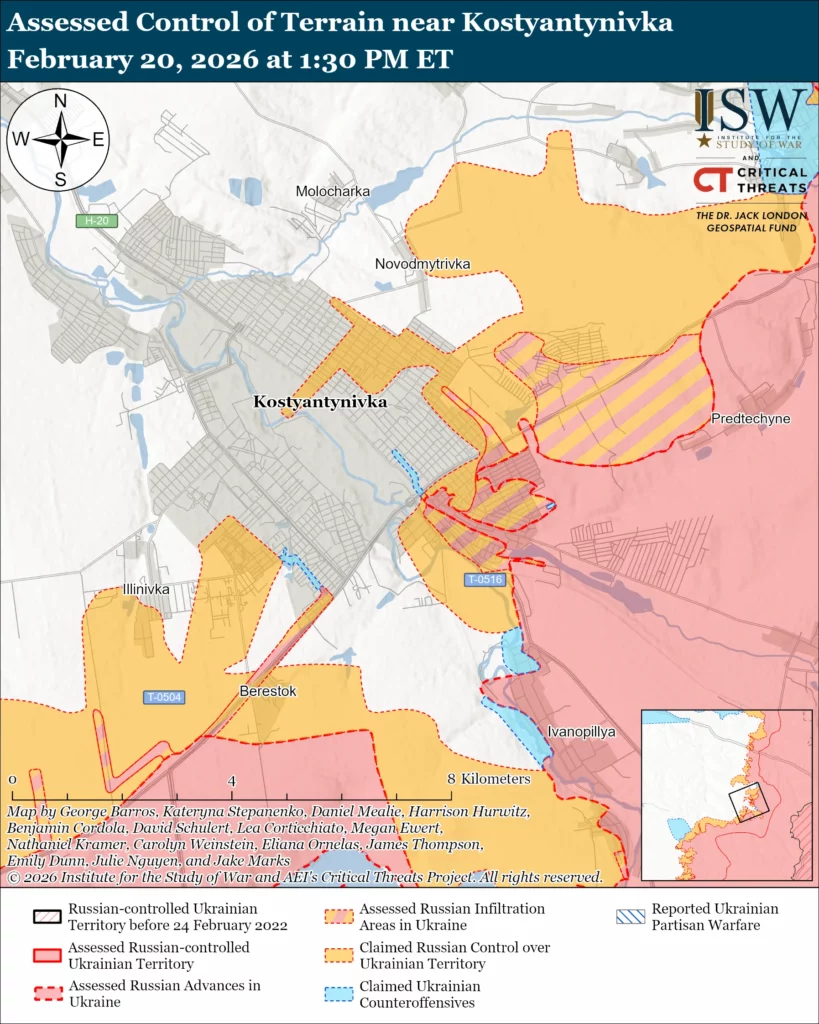
Russian forces attacked near Kostyantynivka itself; north of Kostyantynivka near Fedorivka; northeast of Kostyantynivka near Orikhovo-Vasylivka and Holubivka; southeast of Kostyantynivka near Ivanopillya; south of Kostyantynivka near Pleshchiivka, Illinivka, and Berestok; southwest of Kostyantynivka near Stepanivka; south of Druzhkivka near Rusyn Yar; and southwest of Druzhkivka and Novopavlivka and Sofiivka on February 19 and 20.[46]
The commander of a Ukrainian drone battalion reported February 20 that Russian forces do not control Minkivka (northeast of Kostyantynivka) and that fighting is still ongoing for the settlement despite Russian claims to the contrary.[47] The commander noted that Russian forces are engaging in “flag raising” tactics to create the illusion of advances, but that the Russian servicemembers surrender or flee as soon as Ukrainian forces detect them.
Order of Battle: Elements of the Russian Cossack Terek Brigade (Russian Volunteer Corps) are reportedly operating in Orikhovo-Vasylivka.[48] Infantry and first-person view (FPV) drone elements of the Russian Vostok Brigade (Russian Volunteer Corps) are reportedly operating near Minkivka.[49] FPV drone operators of the 150th Motorized Rifle Division (8th CAA, SMD) are reportedly intercepting Ukrainian drones near Sofiivka and Torske (southwest of Druzhkivka).[50]
Russian forces continued offensive operations in the Dobropillya direction on February 20 but did not advance.
A Russian milblogger claimed that Russian forces attacked southeast of Dobropillya near Zapovidne on February 20.[51]
Order of Battle: FPV drone operators of the Russian 33rd Motorized Rifle Regiment (20th Motorized Rifle Division, 8th CAA, SMD) and of the 150th Motorized Rifle Division (8th CAA) are reportedly striking Ukrainian positions and equipment near Toretske (east of Dobropillya).[52]
Russian forces continued offensive operations in the Pokrovsk direction on February 20 but did not make confirmed advances.
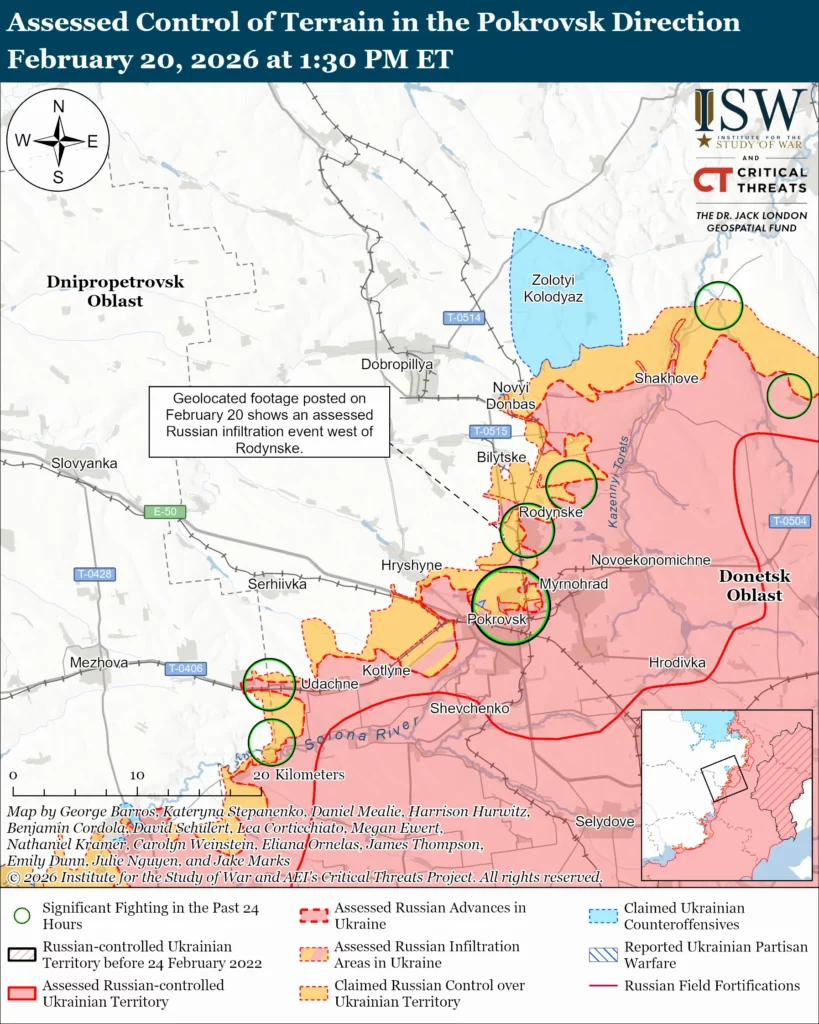
Assessed Russian infiltration: Geolocated footage published on February 20 shows Ukrainian forces striking a Russian position west of Rodynske (north of Pokrovsk) after what ISW assesses was a Russian infiltration mission that did not change the forward edge of the battle area (FEBA) at this time.[53]
Unconfirmed claims: A Russian milblogger claimed that Russian forces advanced north of Udachne (southwest of Pokrovsk).[54]
Russian forces attacked near Pokrovsk itself; northwest of Pokrovsk near Hryshyne and toward Novooleksandrivka; north of Pokrovsk near Rodynske and Zatyshok; east of Pokrovsk near Myrnohrad; and southwest of Pokrovsk near Kotlyne, Udachne, and Molodetske on February 19 and 20.[55]
Order of Battle: Drone operators of the Russian Zmey Gorynych detachment (Russian Federal Security Service’s [FSB] Donetsk People’s Republic [DNR] Directorate) are reportedly striking Ukrainian forces near Myrnohrad.[56] Tank and artillery elements of the 9th Motorized Rifle Brigade (51st CAA, formerly 1st Donetsk People’s Republic Army Corps [DNR AC], SMD) and TOS-1A thermobaric artillery crews of the 2nd Radiation, Chemical, and Biological Defense Regiment (2nd CAA, Central Military District [CMD]) are reportedly operating in the Pokrovsk direction.[57]
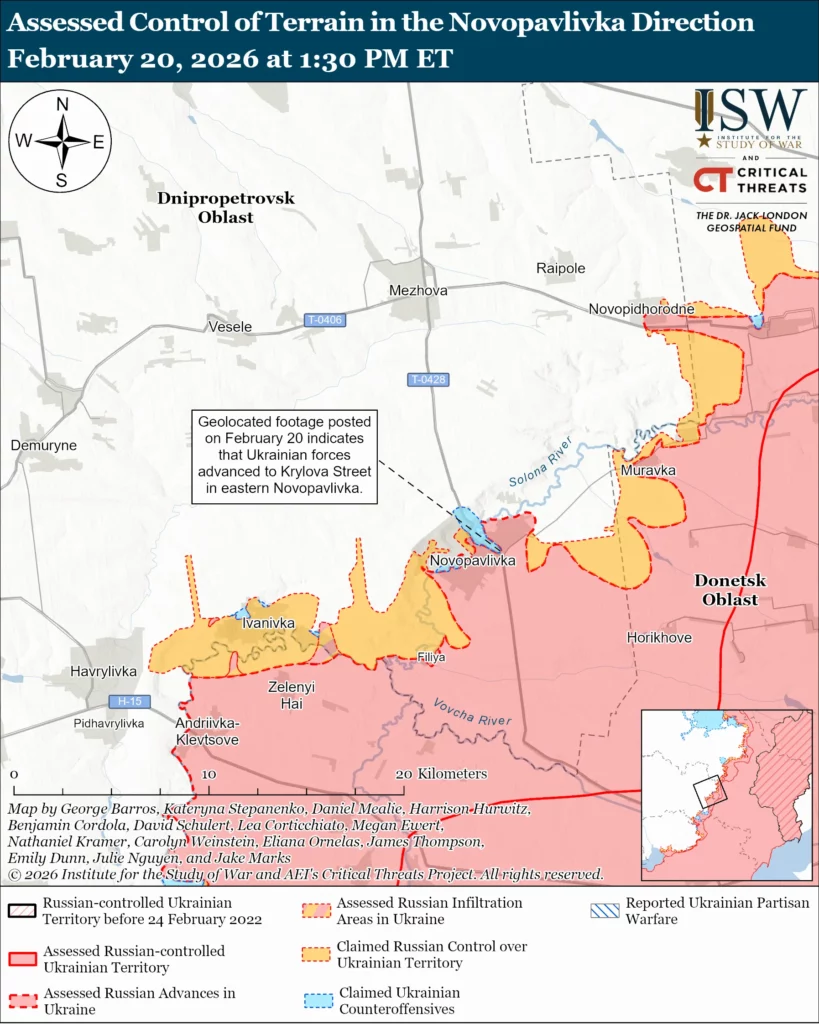
Ukrainian forces recently advanced in the Novopavlivka direction.
Assessed Ukrainian advances: Geolocated footage published on February 20 indicates that Ukrainian forces recently advanced in eastern Novopavlivka.[58]
Russian forces attacked toward Novopavlivka itself, northeast of Novopavlivka near Muravka and Novomykolaivka, and south of Novopavlivka near Filiya on February 19 and 20.[59]
Russian forces continued offensive operations in the Oleksandrivka direction on February 20 but did not advance.
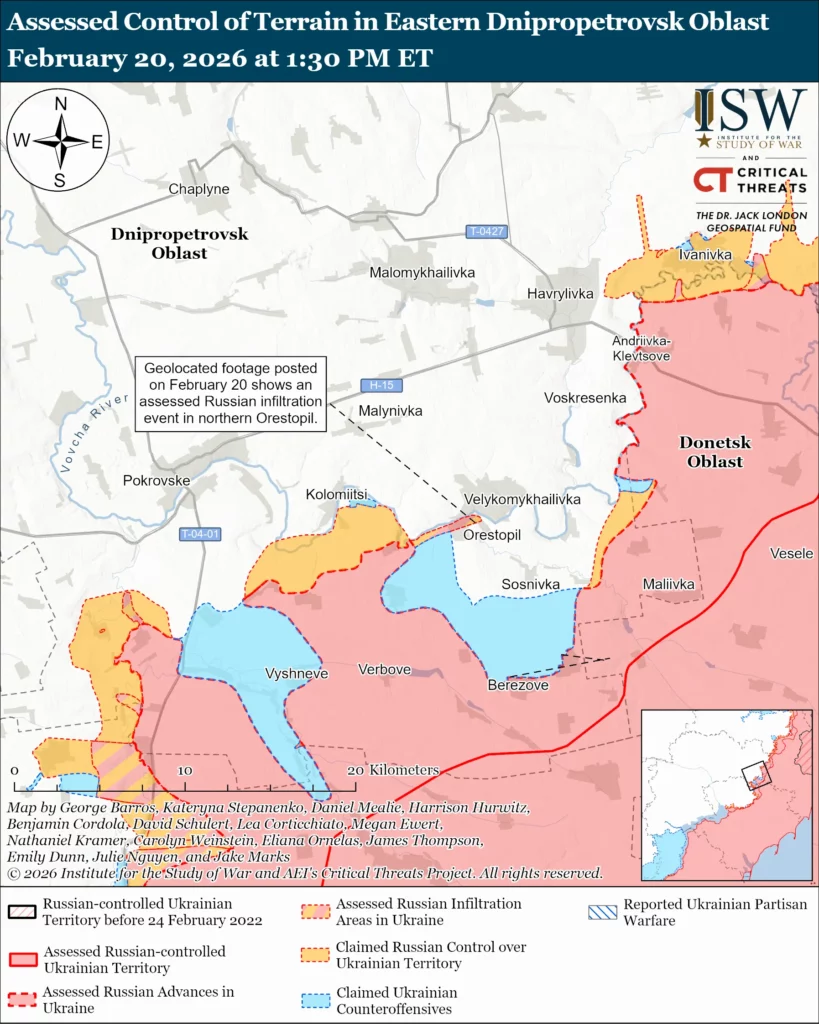
Assessed Russian infiltrations: Geolocated footage published on February 19 shows Ukrainian forces clearing Russian infiltrators from northern Orestopil (east of Oleksandrivka), indicating that Russian forces infiltrated on a prior date.[60] ISW assesses that this Russian infiltration mission did not change the control of terrain or FEBA at this time.
Russian forces attacked toward Oleksandrivka itself; northeast of Oleksandrivka Andriivka-Klevtsove; southeast of Oleksandrivka near Stepove and Sosnivka; south of Oleksandrivka toward; and southwest of Oleksandrivka toward on February 19 and 20.[61] A Russian milblogger claimed that Ukrainian forces counterattacked near Sosnivka and Novooleksandrivka (southeast of Oleksandrivka).[62]Order of Battle: Elements of the Russian 11th Air Force and Air Defense Army (Russian Aerospace Forces [VKS] and Eastern Military District [EMD]) are reportedly striking Ukrainian positions near Lisne (southeast of Oleksandrivka) and Orly (northeast of Oleksandrivka).[63]
Russian Supporting Effort: Southern Axis
Russian objective: Maintain frontline positions, secure rear areas against Ukrainian strikes, and advance within tube artillery range of Zaporizhzhia City
Ukrainian and Russian forces recently advanced in the Hulyaipole direction.
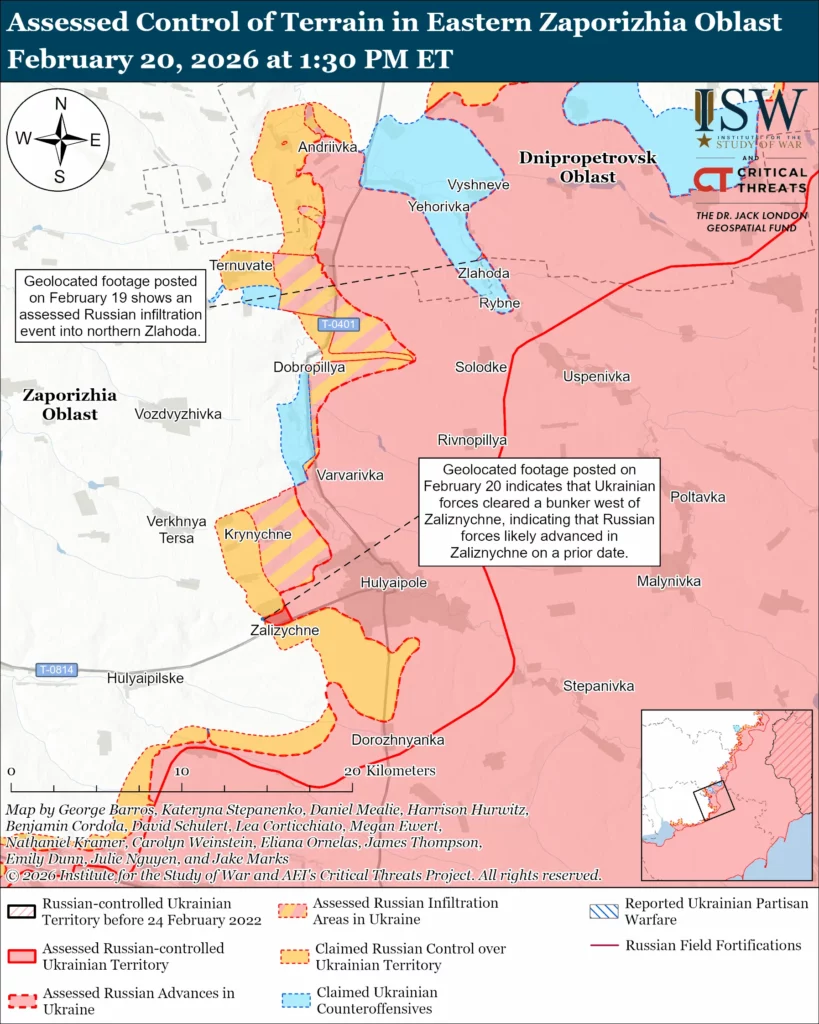
Assessed Ukrainian counteroffensives: Geolocated footage published on February 19 indicates that Ukrainian forces recently advanced west of Zaliznychne (west of Hulyaipole).[64]
Assessed Russian advances: Geolocated footage published on February 19 and additional geolocated footage published on February 20 indicates that Russian forces recently advanced into eastern and west of Zaliznychne.[65]
Assessed Russian infiltration: Geolocated footage published on February 19 shows Ukrainian forces striking Russian servicemembers in northern Zlahoda (northeast of Hulyaipole) after what ISW assesses is an infiltration mission that did not change the control of terrain or the forward edge of the battle area (FEBA) at this time.[66]
Russian forces attacked near Hulyaipole itself; northwest of Hulyaipole near Svyatopetrivka and toward Vozdvyzhivka, Rizdvyanka, Verkhnya Tersa, Zelene, and Olenokostyantynivka; northeast of Hulyaipole near Zlahoda; and west of Hulyaipole near Zaliznychne and Staroukrainka and toward Hirke on February 19 and 20.[67] A Russian milblogger claimed that Ukrainian forces counterattacked near Andriivka (north of Hulyaipole) and toward Zaliznychne.[68]
Ukrainian counterattacks are reportedly constraining Russian offensive operations in the Hulyaipole direction. Ukrainian military observer Kostyantyn Mashovets reported on February 20 that elements of the Russian 36th Combined Arms Army (CAA) (Eastern Military District [EMD]) are unable to cover the northern flank of the 5th CAA’s (EMD) area of responsibility (AoR) (east and northeast of Hulyaipole) because they are defending against Ukrainian counterattacks along the seam between the 36th CAA and 29th CAA’s (EMD) AoR in the neighboring Oleksandrivka direction.[69] Mashovets reported that Russian forces deployed reserves of the 69th Separate Cover Brigade (35th CAA, EMD) to the seam between the 29th and 36th CAA within the past few days. Mashovets noted that elements of the 5th CAA continue efforts to advance toward Hulyaipole despite the threat that Ukrainian counterattacks pose to its northern flank. Mashovets assessed that Ukrainian advances could force the Russian military command’s plans for a possible summer offensive in the direction if Ukrainian forces manage to cut the Hulyaipole-Velyka Novosilka road during these counterattacks.
Order of Battle: Elements of the Russian 11th Air Force and Air Defense Army (Russian Aerospace Forces [VKS] and EMD) are reportedly striking Ukrainian positions near Lyubytske (northwest of Hulyaipole).[70] Drone operators of the 14th Spetsnaz Brigade (Russian General Staff’s Main Directorate [GRU]) are reportedly operating in Zaporizhia and Dnipropetrovsk oblasts, likely referring to the Hulyaipole direction.[71]
Russian forces continued offensive operations in western Zaporizhia Oblast on February 20 but did not advance.
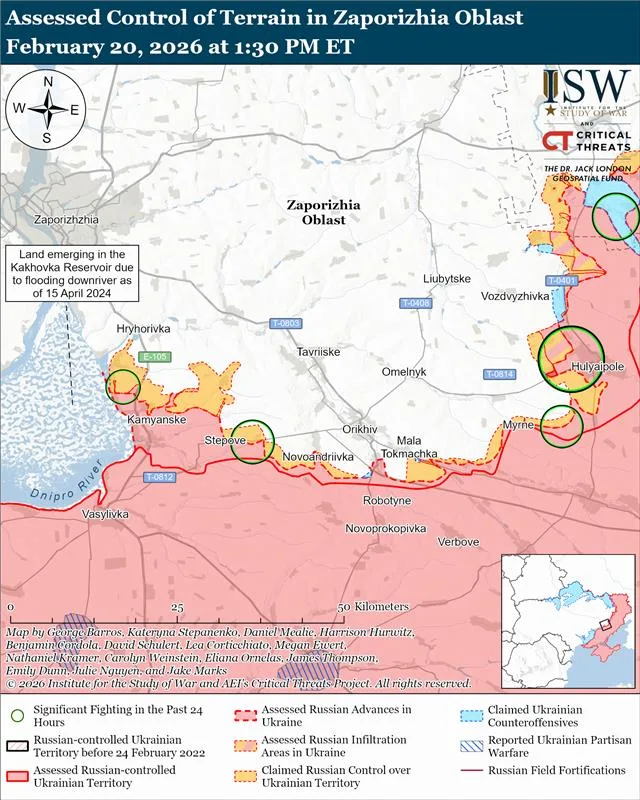
Russian forces attacked east of Orikhiv near Zahirne and west of Orikhiv near Stepove, Mali Shcherbaky, Stepnohirsk, and Prymorske on February 19 and 20.[72]
Order of Battle: Elements of the Russian 104th Airborne (VDV) Division, including its 328th VDV Regiment, are reportedly operating near Mahdanylivka (northwest of Orikhiv).[73] Drone operators of the 291st Artillery Brigade (58th Combined Arms Army [CAA], Southern Military District [SMD]) are reportedly striking Ukrainian forces in the Orikhiv direction.[74] Elements of the 7th VDV Division reportedly continue to operate in the Zaporizhia direction.[75]
Ukrainian forces continued their frontline and mid-range strike campaign against Russian military assets in occupied Zaporizhia Oblast. The Ukrainian General Staff reported on February 20 that Ukrainian forces struck a Russian drone control point near occupied Zlatopil (roughly 32 kilometers from the frontline); a material and technical warehouse in occupied Bohdanivka (roughly 45 kilometers from the frontline); a repair base near occupied Rozivka (roughly 65 kilometers from the frontline); and a manpower concentration near Stepnohirsk (west of Orikhiv).[76] Ukrainian Unmanned Systems Forces (USF) Commander Robert ”Magyar” Brovdi reported on February 20 that Ukrainian forces conducted FP-2 drone strikes against three Russian Tor anti-aircraft missile systems in occupied Zaporizhia Oblast, causing roughly $75 million in damage.[77]
Russian forces continued limited ground attacks in the Kherson direction, including toward the Antonivskyi Bridge, on February 19 and 20 but did not advance.[78]
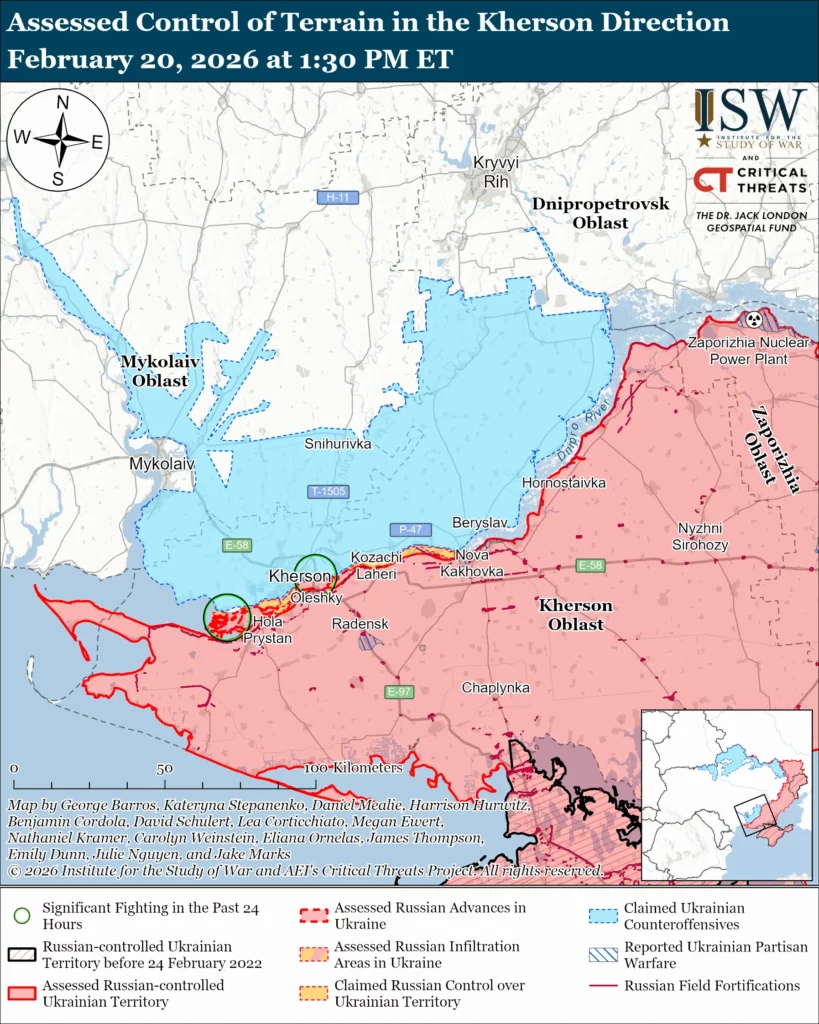
Order of Battle: Fiber optic drone operators of the Russian 98th VDV Division are reportedly striking Ukrainian vehicles in Inhulets (northeast of Kherson City).[79]
The Ukrainian General Staff reported on February 20 that Ukrainian forces struck a Russian command and observation post and manpower concentration near occupied Lyubymivka, Kherson Oblast (northeast of Kherson City on the left bank of the Tendra Spit).[80]Ukrainian forces continued their long-range strike campaign against Russian military assets in occupied Crimea. The Ukrainian General Staff reported on February 20 that Ukrainian forces struck a Russian material and technical equipment depot near occupied Lobanove, Crimea (roughly 130 kilometers from the frontline).[81]
Russian Air, Missile, and Drone Campaign
Russian Objective: Target Ukrainian military and civilian infrastructure in the rear and on the front line
Russian forces conducted a series of missile and drone strikes against Ukraine on the night of February 19 to 20. The Ukrainian Air Force reported that Russian forces launched one Iskander-M ballistic missile from Rostov Oblast and 128 Shahed-type, Gerbera-type, Italmas-type, and other drones, of which roughly 80 were Shahed-type drones, from the direction of Bryansk, Kursk, and Oryol cities; Primorsko-Akhtarsk, Krasnodar Krai; and occupied Donetsk Oblast.[82] The Ukrainian Air Force reported that Ukrainian forces downed 107 drones, that one ballistic missile and 21 drones struck 14 locations, and that downed debris fell on one location. Ukrainian officials reported that Russian forces struck civilian and residential infrastructure in Dnipropetrovsk Oblast; an administrative building and civilian, agricultural, and residential infrastructure in Kharkiv City and Oblast; critical and energy infrastructure in Mykolaiv Oblast; and oil and gas infrastructure in Poltava Oblast.[83]Ukrainian state energy operator Ukrenergo reported on February 20 that most oblasts have energy restrictions and that Russian shelling left settlements in Kharkiv, Sumy, Dnipropetrovsk, Zaporizhia, and Mykolaiv oblasts without power.[84]
Significant Activity in Belarus
Russian efforts to increase its military presence in Belarus and further integrate Belarus into Russian-favorable frameworks
Russian President Vladimir Putin and Belarusian President Alexander Lukashenko spoke on February 19 to discuss the agenda for the upcoming Union State meeting set to take place in Moscow the week of February 22.[85] A Belarusian outlet claimed that the leaders also discussed several unspecified issues around Belarusian-Russian relations.[86]
Note: ISW does not receive any classified material from any source, uses only publicly available information, and draws extensively on Russian, Ukrainian, and Western reporting and social media as well as commercially available satellite imagery and other geospatial data as the basis for these reports. References to all sources used are provided in the endnotes of each update.