 Eurasia Press & News
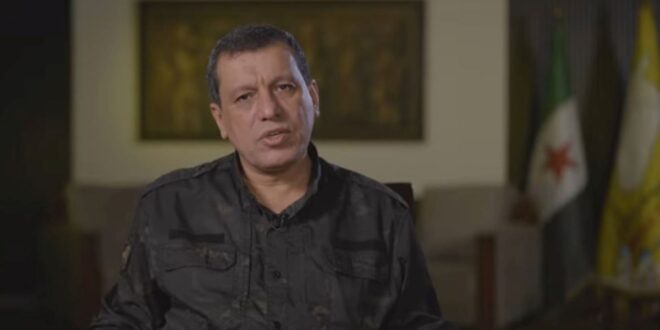
The leader of the Syrian Democratic Forces (SDF), Mazloum Abdi, said in a speech on the occasion of World Mother Language Day that “the Republican Decree on the recognition of the Kurdish language as a national language in Syria is an achievement and a big and positive step, but it is not enough.”
During his speech, which was reported by the agency “Rudaw” close to the “SDF” today, Saturday, February 21, a meeting is expected between the Syrian Ministry of Education and the Education Authority in the “Autonomous Administration”, to discuss the mechanisms of adopting the Kurdish language in the school curriculum.
Abdi described the recognition of the Kurdish language as “a declining step compared to the level of the Kurdish language in eastern Syria,” he said.
He pointed out that recent years have seen thousands of pupils study in schools in Kurdish up to the university level.
Abdi called for the need to take into account the level reached by the Kurdish language in the practical aspect when applying the republican decree.
Abdi stressed that this issue was a major focus in the recent meetings with Damascus, explaining that the SDF delegation stopped a lot in its meetings with the Syrian government on this issue.
He considered that Decree No. 13 issued by the Syrian President, Ahmed al-Sharaa, regarding the rights of the Kurds “is a basis on which to work and build to take a greater step.”
Abdi called for strengthening the work of Kurdish cultural and language institutions, and urged Kurdish language specialists to redouble efforts in this period and work within the Kurdish language institutions and raise their level.
The Syrian President, Ahmed al-Sharaa, issued Decree No. 13 of 2026, which provides for the granting of citizenship to citizens of Kurdish origin residing on Syrian territory, all of whom, including those who are covered by the registration.
The decree, issued on January 16, abolished the application of all exceptional laws and measures resulting from the 1962 census of Hasaka.
He also considered the Kurdish language a national language, which is allowed to be taught in public and private schools in areas where the Kurds constitute a significant proportion of the population, as part of the elective curriculum or as an educational cultural activity, in addition to other rights of the Kurdish component.
Executive instructions for the adoption of the Kurdish language
The Syrian Ministry of Education has issued its own executive instructions for the adoption of the Kurdish language in the Syrian curriculum.
In a decision published on January 26, the Ministry tasked the National Center for the Development of Educational Curriculums to prepare the educational curricula for the Kurdish language for all educational levels, within a period not exceeding six months, provided that the preparation, accreditation and printing process is completed before the start of the next academic year.
The Directorates of Education and Educational Supervision provide the necessary cadres to teach the Kurdish language from inside or outside the owners, according to conditions, including:
Those who have a university degree or a certificate from the Teacher Training Institute who are fluent in the Kurdish language.
Those who have a high school diploma who are fluent in the Kurdish language, when necessary and according to the actual need.
To verify the proficiency of the Kurdish language, it is required to pass written and oral tests, conducted by the directorates of education and educational supervision in coordination with the National Center for Curriculum Development, according to unified standards, as guaranteed by the decision.
The decision also tasked the Directorate of Rehabilitation and Training to prepare and implement training programs for those in charge of teaching the subject, including specialized courses upon assignment, and other continuous to raise educational and educational competencies and develop professional performance.
The decree provides for the adoption of Kurdish as a national language that is allowed to be taught in public and private schools in areas where Kurdish citizens constitute a significant proportion of the population.
It is an optional subject for students, and is taught at a rate of two classes per week in all classes without affecting success or failure, with a score in the total.
Schools that teach the Kurdish language currently continue with their approved plans until the new curriculum is officially adopted.
The decision called on the directors of education in the provinces to propose schools in which the Kurdish language will be taught in areas where Kurdish citizens constitute a significant proportion of the population, according to objective criteria that take into account the population reality and the available educational potential to be approved by the ministry.
The decision provided for the formation of a central committee headed by the Minister of Education and the membership of his assistants and directors of the National Center for the Development of Educational Curriculum, Educational Supervision, Education, Administrative Development, Planning and Statistics, to take the necessary decisions and procedures to implement the instructions, secure technical and human requirements, respond to the inquiries of the directorates, and develop plans to respond to any needs that may arise during implementation.