 Eurasia Press & News
AYATOLLAH Ali Khamenei’s top crony has said Iran is “ready” for the doomsday scenario of sustained Trump-sanctioned strikes.
The country’s leadership has been putting up a brave front as an armada and fleet of fighter jets – the biggest US military build-up in the region since the Iraq war – gather on Tehran’s doorstep.
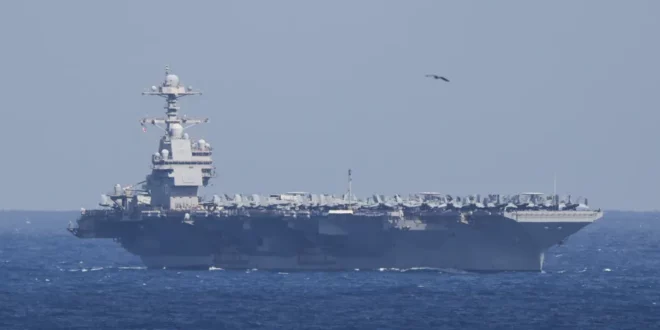
This includes the world’s largest warship – the USS Gerald R. Ford – which was today spotted arriving at Souda Bay on the island of Crete, Greece.
Counterterrorism bosses have warned that Iran’s bloodthirsty proxies – al-Qaeda, Hamas, Hezbollah and the Houthis – are primed to unleash retaliatory terror against the West.
Heightened “chatter” – spy jargon for terrorist communications – intercepted by security analysts indicates attack planning and coordination is underway.
Sleeper cells in Europe are rumoured to be plotting bombing campaigns against US bases and embassies.
Read more about Iran
Yemen’s Houthis may also resume assaults on Western shipping in the Red Sea.
They may also target the pivotal Bab el-Mandeb strait connecting the Red and Arabian seas, potentially triggering a global energy crisis to force Western diplomatic retreat.
“A lot” of activity has been tracked by US intelligence, one senior official told the New York Times.
Donald Trump has meanwhile set a 10-day deadline on Thursday for Tehran to agree to a litany of nuclear concessions, with Israel pressing for even tougher forfeits of ballistic missiles.
Special envoy Steve Witkoff, Trump’s son-in-law Jared Kushner, and Iranian negotiators will try to hammer out a deal in another round of talks in Geneva this Thursday.
But Trump has still not ruled out blitzing strategic military and nuclear sites in the meantime.
Ali Larijani, Iran‘s top national security official and a former Revolutionary Guards Corps commander, has appeared unperturbed by rumours of impending US strikes.
“We are ready in our country, he told Al Jazeera.
“We are definitely more powerful than before. We have prepared over the past seven, eight months.
“We found our weaknesses and fixed them.
“We are not looking for war, and we won’t start the war. But if they force it on us, we will respond.”
Larijani, 67, has effectively taken command of the country over the past few months, with Supreme Tyrant Khamenei entrusting the veteran politician with the lethal crackdown on protesters challenging Islamic rule.
He has been in charge of suppressing any revolutionary aftershock and ensuring that Iran’s top brass survive the existential threat of an American-led offensive.
“The supreme leader fully trusts Larijani,” Nasser Imami, a conservative analyst with government ties, told the New York Times.
“He believes Larijani is the man for this sensitive juncture because of his political track record, sharp mind and knowledge.”
Larijani has taken the lead on negotiations with powerful allies like Russia and regional players like Qatar and Oman.
He will also be responsible for coordinating the contingency plan in the event of a US attack.
Iran has also been preparing for life after Khamenei, with the 86-year-old reportedly naming three candidates who could succeed him.
Larijani is not one of them, because he is not a senior Shiite cleric.
Both are dealing with the reality in front of them, and Larijani expects to be a martyr, after Israel’s June strikes wiped out Iran’s senior military command chain within minutes.
Iran has reportedly been placed on the highest state of alert and is preparing to fight tooth and nail.
Ballistic missile launchers have been lined up along the Iraq border within range of Israel as well as along the Persian Gulf, threatening America’s regional bases.
A chilling propaganda video released by the Iranian state media threatened a major bombing campaign against a US military base.
The terrifying AI video, aired by Iranian state media, marks up the Muwaffaq Salti, a key airbase in Jordan, for obliteration.
Just days ago at least 60 US military jets touched down on the site, located near the Syrian boarder.
The video begins with an aerial view of the base before Iranian missiles lock onto and target dozens of F-35s stealth jets, Boeing KC-135 refuelling tankers and MQ-9 Reaper UAVs.
Sensational Call of Duty style music can be heard in the background as different areas of the mega hub appear to be targeted.
The clip then suddenly ends with an Iranian fighter jet flying overhead.
Iran’s Axis of Resistance
The Axis of Resistance – comprising of Hezbollah, the Houthis and Hamas – is Iran’s primary geopolitical network, designed to project power and combat Israel and the US through a “unity of fronts.”
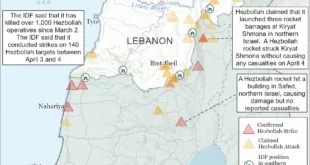
Hezbollah serves as the heavy military deterrent and are Iran’s most loyal and capable proxy.
Despite current efforts to rebuild after the 2025 conflict, they maintain an arsenal of roughly 25,000 rockets and a specialized elite unit.
In a war scenario, they may launch precision-guided strikes against Israeli power grids and military hubs to divert US and allied attention away from the Iranian mainland.
The Houthis act as the primary economic disruptor.
From their bases in Yemen, they would resume large-scale drone and anti-ship missile attacks on commercial and naval vessels in the Red Sea.
Hamas currently plays a diminished, symbolic role. Following the 2025 peace framework, they have largely transitioned to a clandestine insurgent model in Gaza.
Their contribution would likely be limited to localized civil unrest and small-scale guerrilla attacks intended to tie down security forces and maintain ideological pressure within the Palestinian territories.