 Eurasia Press & News
Toplines
A senior US official told Axios on February 22 that the United States and Iran may discuss the possibility of an interim deal during the third round of negotiations in Geneva on February 26.[1] An interim deal that only addresses Iran’s nuclear program would enable Iran to drag out the current negotiations and likely not meet the United States’ core nuclear demands. An Iranian official told Reuters on February 22 that the “possibility of reaching an interim deal exists.”[2] The Iranian Foreign Affairs Ministry spokesperson rejected the possibility of an interim deal, however.[3] Israeli media separately reported on February 22 that the United States is pursuing an agreement with multiple “stages” in which the United States will address Iran’s nuclear program in the first stage and Iran’s ballistic missile program and support for the Axis of Resistance in later stages.[4] An interim agreement that only addresses the nuclear issue would enable Iran to drag out the current talks. CTP-ISW previously assessed that Iranian officials may be floating the possibility of talks about non-nuclear issues, including Iran’s ballistic missile program, to try to drag out the talks and thereby delay potential US military action.[5] Dragging out the talks would also give Iran more time to prepare for potential military conflict.[6]
An interim deal focused on the nuclear issue would also unlikely meet the United States’ stated demand for zero enrichment. Supreme National Security Council (SNSC) Secretary Ali Larijani will reportedly travel to Oman on February 24 to deliver Iran’s official response to the United States’ demands through Omani mediators.[7] Iranian Foreign Affairs Minister Abbas Araghchi emphasized in an interview with Face the Nation on February 22 that Iran has “every right to enjoy a peaceful nuclear program, including enrichment.”[8] An Iranian official speaking to Reuters on February 22 said that Iran would “seriously consider” sending half of its highly enriched uranium stockpile abroad, diluting the rest of its stockpile, and creating a regional enrichment consortium in exchange for the United States recognizing Iran’s “right” to enrich uranium and lifting its economic sanctions on Iran.[9] These proposed terms would not meet the stated US demand for zero enrichment. US Special Envoy to the Middle East Steve Witkoff confirmed to Fox News on February 21 that US President Donald Trump’s “red lines” include zero enrichment.[10]
There are some conflicting reports about the United States’ position on enrichment. Axios reported on February 22 that Witkoff and Jared Kushner told Araghchi during the second round of talks that the United States would be willing to consider an Iranian proposal that includes “token enrichment” if Iran can prove that its proposal would block Iran from developing a nuclear weapon.[11] The New York Times similarly reported that the United States and Iran are considering a proposal in which Iran would have a “very limited nuclear enrichment program” that Iran could only use for medical research and treatments.[12] These reports contradict Witkoff’s statement that Trump’s red lines include zero enrichment.
Some Iranian regime officials may calculate that capitulating to the United States in negotiations would harm the regime more than potential military conflict. A Middle Eastern source with knowledge of the US-Iran negotiations told Fox News on February 20 that Iranian negotiators are not authorized to cross Supreme Leader Ali Khamenei’s red line on ballistic missiles because any Iranian concessions on its missile program would be viewed internally as the equivalent of losing a war.[13] This report is consistent with Iranian officials’ previous statements that ruled out any negotiations on Iran’s ballistic missiles.[14] Iran’s ballistic missiles are an integral part of its defense and deterrence strategies. Any changes to these strategies would require a strategic rethink that would take months, if not years.[15] Former Islamic Revolutionary Guards Corps (IRGC) Commander Mohammad Ali Jafari argued in October 2025 that Iran deliberately prioritized developing its missile and drone programs over its air and ground forces to counter the superior capabilities of the United States and Israel.[16]
US President Donald Trump is reportedly leaning toward conducting a limited strike against Iran that would aim to pressure Iran to make concessions on its nuclear program, according to sources familiar with the Trump administration’s deliberations speaking to the New York Times on February 22.[17] The sources said that Trump told his advisers that he would consider a more comprehensive air campaign aimed at toppling the regime if Iran did not give into US demands after diplomacy or a limited US attack.[18] A senior adviser to Trump told Axios on February 20 that the US Department of Defense has presented Trump with several options, including a plan to kill Iranian Supreme Leader Ali Khamenei and his son, Mojtaba Khamenei, who is widely considered a top contender to succeed his father.[19] The New York Times report is consistent with a February 19 Wall Street Journal report that Trump is considering a limited strike on Iran to pressure the regime to reach a nuclear agreement.[20] The Trump administration’s deliberations come amid a large number of US military deployments to the region, including the imminent arrival of the USS Gerald R. Ford carrier strike group.[21]
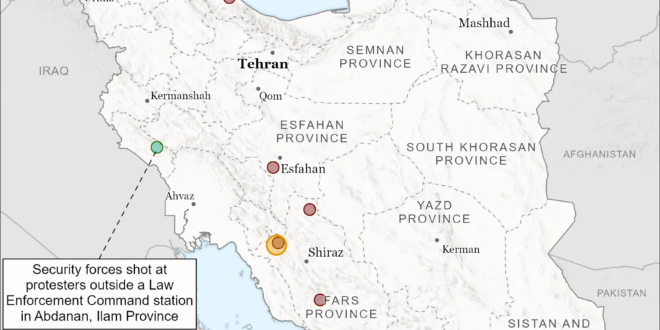
Iranians have held at least 32 protests–the majority of which were student-led anti-regime protests–since February 21, which highlights the Iranian population’s continued anger and frustration with the regime for its refusal to address its people’s grievances. CTP-ISW has recorded 26 anti-regime protests at 17 universities across Iran since February 21.[22] Twenty of these protests occurred at 14 universities in Tehran City.[23] CTP-ISW also recorded three instances of clashes between pro- and anti-regime students at three different universities in Tehran City on February 22 and 23.[24] BBC Persian reported on February 23 that the regime has highly securitized university campuses.[25] Iranian media also reported that universities have warned students against protesting amid the 40-day mourning ceremonies.[26] The Iranian regime almost certainly views university students as a threat to the regime, given that university students played a key role in sustaining the 2022-2023 Mahsa Amini protest movement.[27] CTP-ISW observed multiple protests at university campuses in December 2025 and January 2026, but students were not at the forefront of the recent protests.[28]
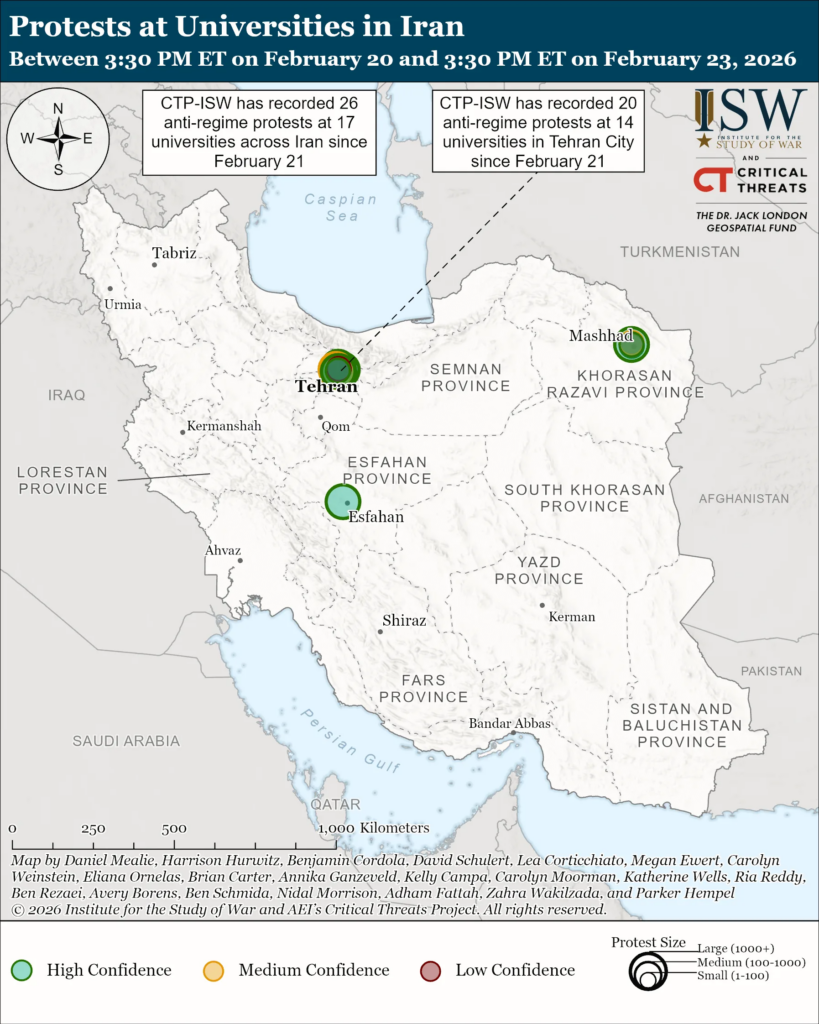
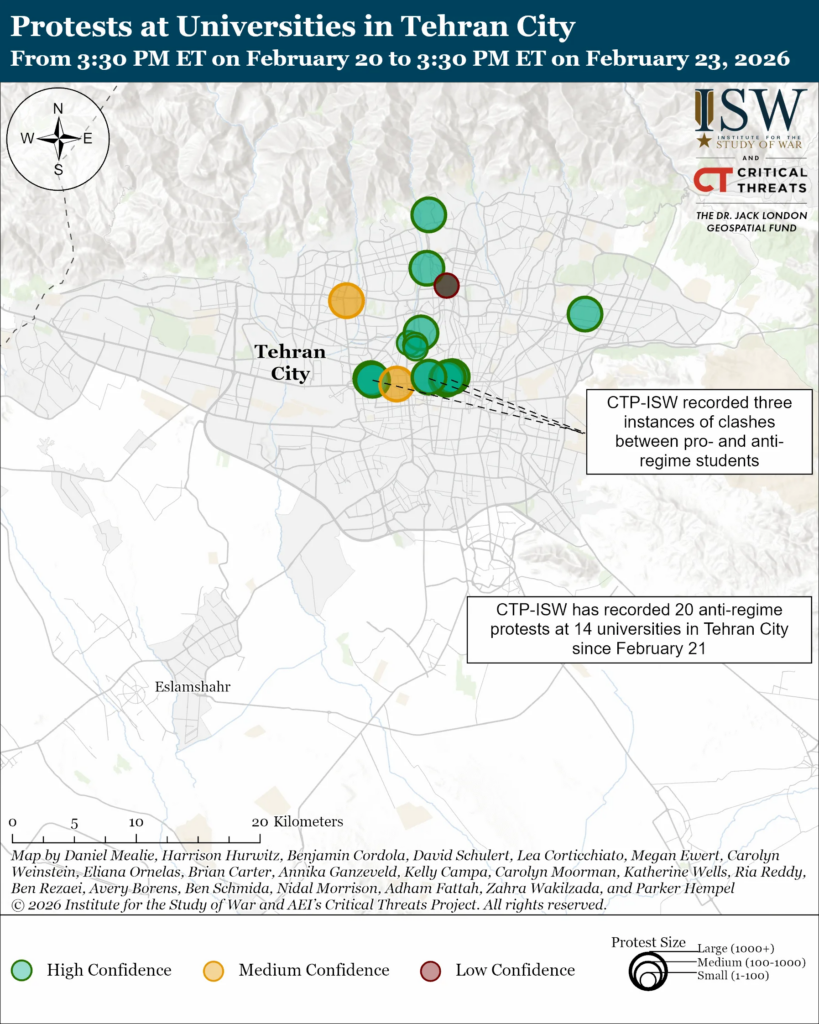
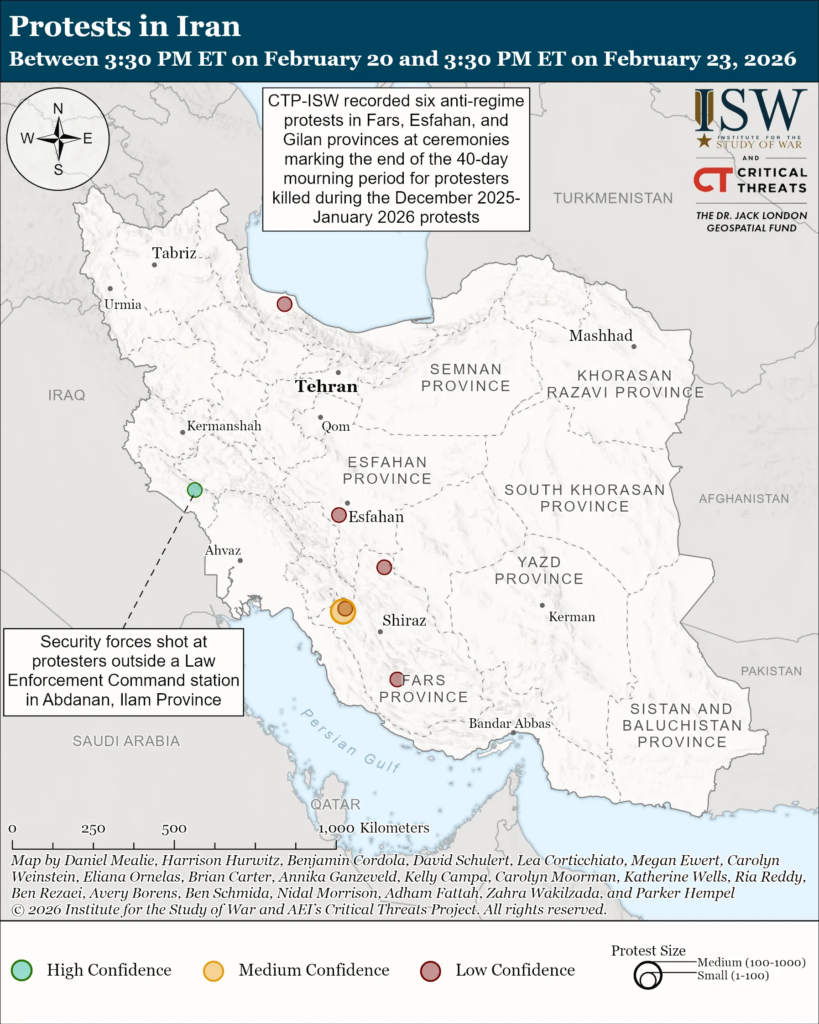
CTP-ISW separately recorded six anti-regime protests in Fars, Esfahan, and Gilan provinces between February 20 and 23.[29] These protests took place at memorials marking the end of the 40-day mourning period for protesters killed by Iranian security forces during the December 2025 and January 2026 protests.[30] Iranian security forces shot at protesters outside a Law Enforcement Command station in Abdanan, Ilam Province.[31]
Various Western media outlets have reported that senior Iranian regime officials are competing for influence following the Israel-Iran War and ahead of potential renewed conflict with the United States and Israel. Some of the claims in these reports are consistent across Western media outlets, while others are not.
The following claims are consistent across Western media reports:
SNSC Secretary Ali Larijani has assumed a prominent decision-making role within the Iranian regime in recent months. The New York Times reported on February 22 that Khamenei tasked Larijani with “steering the country” during the recent protests and that Larijani has “effectively been running the country” since then.[32] The report cited six senior Iranian officials, including one affiliated with Khamenei’s office, and three IRGC members. An English-language diaspora outlet, IranWire, citing a former regime official, reported on January 18 that Larijani oversaw the regime’s crackdown on the recent protests.[33] The New York Times report’s claim about Larijani’s influential role within the regime is also consistent with CTP-ISW’s assessment that moderate and pragmatic hardliners, including Larijani, have driven the regime’s restructuring efforts since the June 2025 Israel-Iran War.[34] Iranian President Masoud Pezeshkian appointed Larijani as the secretary of Iran’s highest national security and foreign policy decision-making body, the SNSC, after the war, for example.[35] The January 18 IranWire article added that Larijani is preparing to “lead the system after Khamenei’s death.”[36] IranWire, citing an Iranian diplomat, similarly reported in September 2025 that Larijani and former First Vice President Mohammad Mokhber are maneuvering to secure their influence in the regime after Khamenei dies.[37] Larijani has also played an important role in developing Iran’s relations with Russia, the People’s Republic of China, and the Axis of Resistance, in addition to engaging in diplomacy with Western officials.[38] Larijani, alongside Iranian Foreign Affairs Minister Abbas Araghchi, has played a central role in the recent US-Iran talks.[39]

Parliament Speaker Mohammad Bagher Ghalibaf reportedly played a central role in commanding Iranian forces during the Israel-Iran War and has shaped Iran’s restructuring efforts after the war. The February 22 New York Times report stated that Ghalibaf is part of Khamenei’s trusted inner circle.[40] The report added that Khamenei designated Ghalibaf as a “de facto deputy” to command the Iranian armed forces if the United States attacks Iran. Ghalibaf previously commanded the IRGC Air Force but has held a senior civilian political post since September 2005.[41] An Iranian official claimed in October 2025 that Ghalibaf assumed a very senior military command during the June 2025 Israel-Iran War after Israel killed several senior Iranian commanders.[42] Ghalibaf has also played a significant role in the regime’s restructuring efforts after the Israel-Iran War. Ghalibaf reportedly advocated for the establishment of the Defense Council and for the Defense Council to operate independently of the SNSC, for example.[43] CTP-ISW previously assessed that Ghalibaf’s prominent role within the regime, similar to Larijani, is part of a broader trend of pragmatic regime elements leading the restructuring of Iran’s decision-making apparatus following the 12-day war.[44]

President Masoud Pezeshkian has limited influence within the regime. The New York Times reported on February 22 that Pezeshkian appears to have deferred his authority to Larijani and that Larijani has assumed greater influence over the negotiations between the United States and Iran.[45] The Guardian similarly reported on February 22 that US officials believe that Pezeshkian has become increasingly sidelined in negotiations, although the officials did not provide evidence for this assessment.[46] UK-based Amwaj Media reported on February 3 that Araghchi and Larijani have exerted greater influence in negotiations than Pezeshkian despite the president’s formal authority over the Foreign Affairs Ministry and the SNSC.[47]
The following claims are inconsistent across Western media reports:
 Supreme Leader Ali Khamenei has reportedly been sidelined. The February 22 Guardian report claimed that Khamenei, like Pezeshkian, has been sidelined in the US-Iran negotiations.[48] Some reports after the June 2025 Israel-Iran War similarly suggested that Khamenei was sidelined during and after the war.[49] An X account attributed to Israel’s Mossad claimed in October 2025 that Khamenei’s Deputy Chief of Staff for Political and Security Affairs, Ali Asghar Hejazi, and IRGC Commander Major General Mohammad Pakpour had sidelined Khamenei and were “making decisions independently,” for example.[50] The account did not provide evidence for this claim. The February 22 New York Times report identified Hejazi as a member of Khamenei’s inner circle.[51] The New York Times report suggests that Khamenei has played a central role in preparing for a possible renewed conflict with the United States, such as by appointing successors for key regime positions.

The regime is considering choosing former Iranian President Hassan Rouhani to lead Iran if the United States or Israel kills Khamenei and other senior leaders in a future conflict. The February 22 New York Times report claimed that “the Iranian leadership,” presumably referring to Khamenei, selected Rouhani as a possible option to govern Iran if the United States or Israel kills Khamenei.[52] Khamenei’s reported support for Rouhani is inconsistent with reports that Rouhani has attempted to sideline Khamenei. A French outlet, citing unspecified sources, reported on February 22 that Rouhani led an effort during the recent protests to remove Khamenei.[53] The source added that Larijani blocked the effort, which further highlights Larijani’s influential role in the regime and close relationship with Khamenei. Rouhani has repeatedly criticized the regime’s approach to its relations with the West and domestic unrest.[54] Iranian media outlets have accused Rouhani of fueling division.[55] The French media report, if true, may reflect Rouhani’s efforts since the June 2025 Israel-Iran War to reassert his political influence.[56] Rouhani met with senior clerics in Qom during the war to urge them to persuade Khamenei to adjust the regime’s policy regarding the war.[57]
The Israel Defense Forces (IDF) conducted several airstrikes targeting members of Hezbollah’s missile array in the Baalbek District, northeastern Lebanon, on February 20.[58] Israel often conducts airstrikes that kill one or two Hezbollah fighters, but it has not conducted a strike of this scale since its campaign in Fall 2024.[59] Hezbollah’s missile array oversees Hezbollah’s various missile units and their operations, including missile and rocket attacks against Israel.[60] The IDF conducted at least six strikes on three different Hezbollah headquarters in Baalbek on February 20, killing at least eight Hezbollah fighters and wounding at least 50 others.[61] Some of the fighters were reportedly commanders. The IDF stated that the fighters sought to conduct attacks into Israel and were “centers of knowledge in launching and operating long-range missiles.”[62] Israeli media, citing Israeli officials, reported on February 22 that Israel conducted the strikes in preparation for renewed conflict with Iran and to disrupt Hezbollah’s readiness and force build-up.[63] Hezbollah would almost certainly activate its missile units if it decided to join any conflict between the United States, Israel, and Iran. Hezbollah responded to the Israeli strikes, warning that it would have “no choice but to fight on” after the strikes.[64] Hezbollah Political Council Deputy Head Mahmoud Qamati said on February 22 that Hezbollah’s only option is resistance.[65]
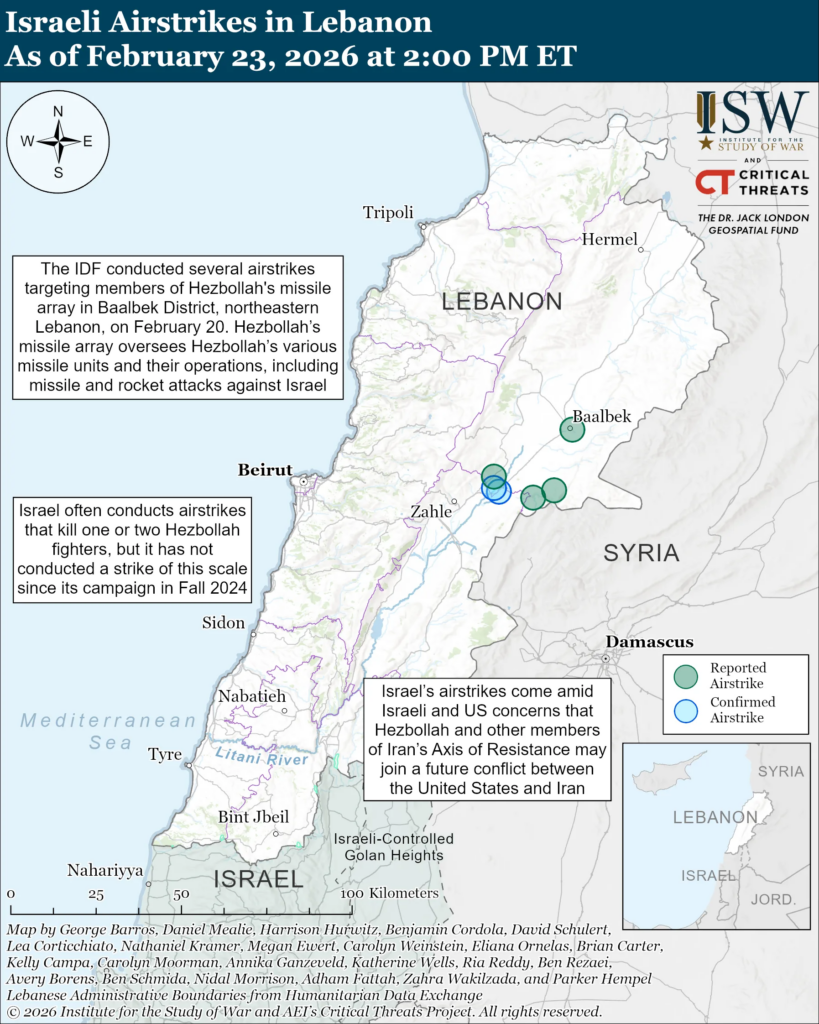
Israel’s airstrikes come amid Israeli and US concerns that Hezbollah and other members of Iran’s Axis of Resistance may join a future conflict between the United States and Iran. The IDF reportedly assesses that Hezbollah would launch missiles and drones at northern and central Israel if the United States or Israel attacks Iran.[66] CTP-ISW previously assessed that Hezbollah may decide to participate in a future conflict if it perceives that the United States or Israel seeks to topple the Iranian regime and identified missile and drone attacks on civilian areas across Israel as Hezbollah’s most dangerous course of action.[67] US and Western security officials told the New York Times on February 22 that there are “increasingly worrisome” signs that Iran may use its proxies to conduct retaliatory attacks against US targets in Europe and the Middle East if the United States attacks Iran.[68] The officials noted that there is heightened “chatter” indicating some level of attack planning and coordination among Iran’s Axis of Resistance.[69]
These concerns come amid reports that Iran has taken steps to prepare and pressure Hezbollah and its regional partners to participate in any upcoming conflict. Iranian officials, including Deputy Foreign Affairs Minister for Legal and International Affairs Kazem Gharibabadi, have warned that a US or Israeli attack against Iran could cause regional escalation.[70] Israeli media reported on February 18 that Iranian Foreign Affairs Minister Abbas Araghchi traveled to Beirut in January 2026 to ensure that Hezbollah would intervene in a new conflict.[71] Sources close to Hezbollah said on February 21 that Iranian IRGC officers have effectively “taken over” Hezbollah and are working to rebuild Hezbollah’s military capabilities to prepare for an upcoming conflict.[72] Israeli media also reported on February 22 that Iran and Lebanon have been working to rebuild Hezbollah’s drone stockpile at a rapid rate.[73] The IDF estimates that Hezbollah possesses a significant number of short- and long-range ballistic missiles.[74]
Israel and the United States are preparing for potential Axis of Resistance attacks. The US Embassy in Beirut evacuated dozens of non-essential personnel on February 23 due to “anticipated regional developments.”[75] An Israeli source told Saudi media that Israel may similarly evacuate some of its embassies and consulates and has asked some senior employees to return to Israel because there is a significant threat that Iranian-backed groups will attack Israeli “interests.”[76] Israel previously announced a state of alert on its northern border on February 18 over concerns of an escalation with Hezbollah and reportedly instructed the Israeli Home Front Command and Israeli rescue services to prepare for war.[77] Israeli officials and media have continued to warn that the IDF is preparing to both defend against and attack Hezbollah, noting that the IDF has forces deployed along the Israel-Lebanon border and deep inside Lebanese territory.[78] The IDF has also emphasized that any Hezbollah or Hezbollah-affiliated attack against Israel would cause a broad IDF attack on Hezbollah targets throughout Lebanon.[79]
Lebanese officials appear divided over whether they believe Hezbollah will join a renewed conflict. Unspecified sources told Saudi media on February 23 that Lebanese Parliament Speaker and long-time Hezbollah ally Nabih Berri does not seem “concerned” about Hezbollah becoming involved in a US-Iran conflict.[80] Berri has reportedly held intense political and security talks with Hezbollah in an attempt to prevent Hezbollah from militarily backing Iran.[81] The sources said that they understood, based on “Berri’s attitude,” that Hezbollah would not take any action in the event of a US or Israeli strike on Iran.[82] Lebanese government officials have not received any guarantees that Lebanon would not be dragged into a wider conflict, however.[83] Hezbollah previously assured Lebanese officials in June 2025 that it would not join the Israel-Iran War.[84] Hezbollah may act and respond differently than it did in the June 2025 Israel-Iran War if it assesses that US or Israeli objectives against Iran in a new conflict are different and pose an existential threat to the Iranian regime.
A senior Iraqi Resistance Coordination Committee source told al Araby al Jadeed on February 22 that four of the seven Iranian-backed Iraqi militias in the committee have decided to provide military support to Iran and “open fronts” in a potential conflict between Iran and the United States.[85] The source added that the militias’ participation would depend on “developments on the ground, the nature of the confrontation, and its scope.”[86] The Iraqi Resistance Coordination Committee includes Kataib Hezbollah, Asaib Ahl al Haq, Harakat Hezbollah al Nujaba, Kataib Sayyid al Shuhada, a Kataib Sayyid al Shuhada front group, and Harakat Ansar Awfiya, according to the committee’s last statement on January 4.[87] It is unclear which militia is the seventh militia that the source referred to. The source added that some militias have started to recruit and train new fighters in preparation for a US-Iran conflict.[88] Kataib Hezbollah posted images on January 27 and 28 of individuals who have reportedly volunteered to “defend the people of Islam,” referring to Iranians.[89] Kurdish media reported on February 7 that nearly 5,000 individuals in Diyala Province have signed a pledge to serve as a “reserve force” to support the Iranian-backed Popular Mobilization Forces (PMF) and Iran in a potential conflict with the United States.[90] A Badr Organization member reportedly organized the pledge.[91] The Badr Organization is notably not a member of the Iraqi Resistance Coordination Committee. Saudi media also reported on February 17 that Iran continues to equip Iranian-backed Iraqi militias for a potential conflict with the United States and Israel.[92] Iran has long equipped Iranian-backed Iraqi militias with a variety of missiles and drones.[93]
Most Iranian-backed Iraqi militias have not publicly issued threats to target US forces or interests in the region if the United States or Israel attacks Iran. Shia Coordination Framework leaders may be pressuring the militias not to increase tensions with the United States amid ongoing government formation. Kataib Sarqhat al Quds, which is commonly considered a front group for Harakat Hezbollah al Nujaba or Asaib Ahl al Haq, threatened on February 22 to target US “sovereign, military, and security” sites in Iraq and the region if the United States attacks Iran.[94] CTP-ISW has not observed any other threats from Iranian-backed Iraqi militias to respond to a US-Iran conflict. Iranian-backed Iraqi militias have previously threatened to target US forces and interests in the region to try to deter US action against Iran, such as during the June 2025 Israel-Iran War. Kataib Sayyid al Shuhada threatened in June 2025 to attack the United States and its regional allies if the United States supported Israel’s air campaign against Iran.[95] The framework could be pressuring the militias to refrain from threatening the United States in order to avoid further complicating government formation. The United States has threatened to impose large-scale sanctions on Iraq, including the Iraqi financial sector, if the framework maintains its nomination of State of Law Coalition head and former Prime Minister Nouri al Maliki as prime minister designate or if figures with ties to Iranian-backed Iraqi militias are included in the next Iraqi government.[96] Most of the militias in the Iraqi Resistance Coordination Committee are either represented within the framework or likely have strong ties to individuals in the framework.[97] Iraqi political developments have previously limited militia action. CTP-ISW previously assessed that the militias’ restraint in June 2025 was probably partially a response to concerns that attacking the United States would have negative political ramifications for the militias’ political wings in the November 2025 parliamentary elections.[98] The Iraqi Resistance Coordination Committee source implied that committee members with political wings that performed well in the recent elections would not get involved in a conflict between the United States and Iran.[99]
Iranian-backed Iraqi militias would probably participate in a potential conflict between Iran and the United States or Israel if the militias perceived that the conflict posed an existential threat to the Iranian regime’s survival. Many Iranian-backed Iraqi militias, most notably Kataib Hezbollah, share close ideological ties to Iran.[100] The Iranian regime also provides military, financial, and political support to the militias.[101] The militias would probably intervene in a conflict that posed an existential threat to their benefactor because the collapse of the Iranian regime would weaken Iranian-backed Iraqi militias’ influence and ability to operate.
CTP-ISW has identified several courses of action that Iranian-backed Iraqi militias may take in the event of a US or Israeli attack on Iran.
The militias fire munitions targeting US forces in Iraqi Kurdistan. Iranian-backed Iraqi militias have long attacked US forces in Iraq in response to US or Israeli actions. Iranian-backed Iraqi militias conducted multiple unclaimed attacks targeting US forces in Iraq after the United States struck Iran during the June 2025 Israel-Iran War.[102] The militias also conducted over 100 attacks targeting US forces in Iraq and Syria between October 2023 and January 2024 in response to Israel’s operations in the Gaza Strip.[103] US-led international coalition forces redeployed from federal Iraq to Iraqi Kurdistan in late 2025 as part of the first phase of the planned US withdrawal from Iraq.[104] The militias would likely be more willing to target US forces in Iraqi Kurdistan than other US interests, such as the US Embassy in Baghdad, given that a strike on the latter could hurt the militias’ economic interests by deterring economic investment in Baghdad.

The militias fire munitions targeting US forces in Syria: US forces are currently withdrawing from Syria and have withdrawn from several US bases in Syria at the time of this writing.[105] [106] Iranian-backed Iraqi militias frequently targeted US forces in Syria between October 2023 and January 2024 in response to Israel’s operations in the Gaza Strip and US self-defense strikes on militia targets in Iraq.[107]

The militias fire munitions targeting Israel: The militias frequently conducted drone attacks targeting Israel during the October 7 War and launched approximately 40 drones into Israeli territory during the June 2025 Israel-Iran War.[108] The militias could attack Israel if Israel participated in or supported a conflict against Iran.[109]

The militias’ political counterparts conduct anti-US political activity: Iranian-backed Iraqi politicians have pressured the Iraqi federal government to take action against the United States and Israel following previous periods of US or Israeli action against Iran. Iranian-backed Iraqi actors called for Iraqi Prime Minister Mohammad Shia al Sudani to adopt policies that would restrict the United States and Israel’s freedom to operate in Iraqi airspace during the June 2025 Israel-Iran War.[110] The Iraqi parliament also passed a non-binding resolution to force US forces to withdraw from Iraq following the killing of former IRGC Quds Force Commander Brigadier General Qassam Soleimani and Kataib Hezbollah head Abu Mahdi al Muhandis in January 2020.[111] The militias could pursue this course of action to avoid negative repercussions on government formation. Any resumed conflict in Iraq that could be blamed on the militias could have negative repercussions on the militias’ political efforts and the government formation process, which is crucial for determining Iranian-backed actors’ ability to dominate Iraq.
The Houthis are reportedly preparing to potentially resume attacks against US and Israeli targets if the United States or Israel attacks Iran. Yemeni media reported on February 23 that Oman-based Houthi spokesperson Mohammad Abdulsalam told Iranian SNSC Secretary Ali Larijani during a meeting in Oman on February 10 that the Houthis are ready to participate in any conflict targeting Iran.[112] Senior Houthi officials, including Defense Minister Mohammad al Atifi and acting Prime Minister Mohammad Muftah, warned on February 17 that the Houthis may target US interests or Israel if the United States or Israel strikes Iran and threatened that the Houthis would attack any foreign or domestic actors that attack Houthi territory.[113] Israeli and Hezbollah-affiliated media reported that the Houthis have conducted military exercises and repositioned their weapons, including missiles and drones, in preparation to launch offensive attacks against US interests and Israel.[114]
The Houthis have also taken steps to try to mitigate the impact of potential US or Israeli strikes on Houthi positions in Yemen. Muftah chaired a Houthi Emergency Committee meeting on February 21 to discuss increasing preparedness and enhancing the group’s emergency response capabilities to address emergencies “in the coming period.”[115] The committee approved several measures to ensure effective responses, including requiring medical staff to sign pledges to remain on call and report to medical facilities when summoned and designating government facilities and schools as civilian bomb shelters.[116] Hezbollah-affiliated Lebanese media reported on February 23 that the Houthis have acquired unspecified shoulder-mounted surface-to-air missile systems to improve the group’s low-altitude air defense capabilities.[117]
The Houthis’ efforts to increase their preparedness and military capabilities underscore the enduring security threat that the Houthis pose to the United States and its allies. The Houthis will continue to pose a threat to international shipping and US interests and allies in the region so long as the group retains the ability and willingness to attack these targets.[118]
Key Takeaways
US-Iran Negotiations: A senior US official told Axios on February 22 that the United States and Iran may discuss the possibility of an interim deal during the third round of negotiations in Geneva on February 26. An interim deal that only addresses Iran’s nuclear program would enable Iran to drag out the current negotiations and likely not meet the United States’ core nuclear demands. Some Iranian regime officials may calculate that capitulating to the United States in negotiations would harm the regime more than potential military conflict.
Potential US Military Action Against Iran: US President Donald Trump is reportedly leaning toward conducting a limited strike against Iran that would aim to pressure Iran to make concessions on its nuclear program, according to sources familiar with the Trump administration’s deliberations speaking to the New York Times on February 22.
Anti-Regime Protests in Iran: Iranians have held at least 32 protests–the majority of which were student-led anti-regime protests–since February 21, which highlights the Iranian population’s continued anger and frustration with the regime for its refusal to address its people’s grievances.
Western Media Reports About Internal Iranian Regime Divisions: Various Western media outlets have reported that senior Iranian regime officials are competing for influence following the Israel-Iran War and ahead of potential renewed conflict with the United States and Israel. Some of the claims in these reports are consistent across Western media outlets, while others are not.
Hezbollah’s Participation in a Future US-Israel-Iran Conflict: The IDF conducted several airstrikes targeting members of Hezbollah’s missile array in Baalbek District, northeastern Lebanon, on February 20. Israel often conducts airstrikes that kill one or two Hezbollah fighters, but it has not conducted a strike of this scale since its campaign in Fall 2024. Israel’s airstrikes come amid Israeli and US concerns that Hezbollah and other members of Iran’s Axis of Resistance may join a future conflict between the United States and Iran.
Iraqi Militias’ Participation in a Future US-Israel-Iran Conflict: A senior Iraqi Resistance Coordination Committee source told al Araby al Jadeed on February 22 that four of the seven Iranian-backed Iraqi militias in the committee have decided to provide military support to Iran and “open fronts” in a potential conflict between Iran and the United States. Most Iranian-backed Iraqi militias have not publicly issued threats to target US forces or interests in the region if the United States or Israel attacks Iran. Shia Coordination Framework leaders may be pressuring the militias not to increase tensions with the United States amid ongoing government formation. Iranian-backed Iraqi militias would probably participate in a potential conflict between Iran and the United States or Israel if the militias perceived that the conflict posed an existential threat to the Iranian regime’s survival.
The Houthis’ Participation in a Future US-Israel-Iran Conflict: The Houthis are reportedly preparing to potentially resume attacks against US and Israeli targets if the United States or Israel attacks Iran. The Houthis have also taken steps to try to mitigate the impact of potential US or Israeli strikes on Houthi positions in Yemen.
Iran
See the topline section.
Iraq
See the topline section.
Syria
Nothing significant to report.
Arabian Peninsula
CTP-ISW has temporarily suspended its coverage of Yemen beginning on January 9.
Palestinian Territories & Lebanon
See the topline section.