 Eurasia Press & News
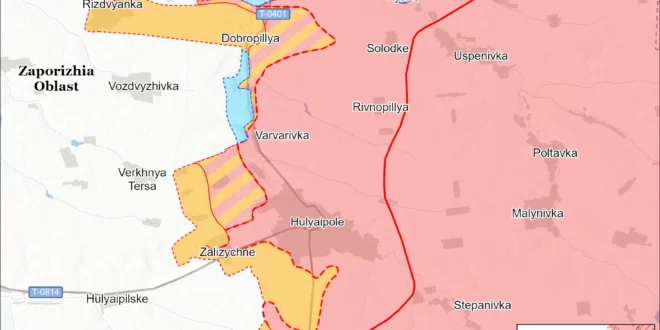
Toplines
The fifth year of Russia’s invasion is not beginning well for Moscow. Recent Ukrainian successes on the battlefield disprove Russian claims that things can only get worse for Ukraine the longer Kyiv delays surrendering to Russian demands. Battlefield realities as of late February 2026 show that continued significant Russian battlefield gains, let alone total victory, are not inevitable. Ukrainian forces have recently made the most significant gains on the battlefield since Ukraine’s incursion into Kursk Oblast in August 2024 and liberated the most territory in Ukraine itself since the 2023 counteroffensive.[1] Ukrainian forces began a series of counterattacks in the area of Kupyansk in mid-December 2025 that stabilized Ukrainian control over the town of Kupyansk and retook at least 183 square kilometers between December 11 and 25, pushing Russian forces out of several settlements near the town.[2] Ukraine has held its gains in Kupyansk since mid-December despite Russian efforts to reverse them, and current battlefield dynamics do not suggest that Russia will quickly regain land in the area. Ukrainian forces also began limited counterattacks in early February 2026 that liberated multiple settlements in the Oleksandrivka and Hulyaipole directions in Dnipropetrovsk and Zaporizhia oblasts.[3] ISW has observed evidence to assess that Ukrainian forces have liberated roughly 200 square kilometers in some areas of the Novopavlivka, Oleksandrivka, and Hulyaipole directions, losing 35 square kilometers in other areas of those three directions during the same time frame for a net gain of 165 square kilometers in February.[4] Ukrainian forces continue limited counterattacks in these areas.
Events on the battlefield refute Moscow’s claims that a Russian battlefield victory is inevitable and that Ukraine should surrender to Russia’s demands before its position deteriorates further. Localized Ukrainian counterattacks are unlikely to grow into a large-scale counteroffensive in these areas, and Russian forces will very likely stabilize their positions and even begin advancing again as preparations for Russia’s Spring-Summer 2026 offensive approach completion. But Ukrainian counterattacks have reportedly disrupted Russian efforts to set conditions for that Spring-Summer 2026 offensive and will force the Russians first to fight to establish stable defensive positions before starting the fight to regain lost ground. Only then will they be able to move into their planned offensive operations with troops already attrited and worn down rather than fresh. Ukrainian forces have not liberated operationally significant areas, apart from Kupyansk, but the multiple localized Ukrainian counterattacks will likely have lasting effects on the ability of Russian forces to make significant advances in key sectors of the line this spring.
Ukraine’s counterattacks have taken advantage of opportunities presented by Russian vulnerabilities and mistakes. Ukrainian forces were able to conduct counterattacks in the Hulyaipole and Oleksandrivka directions in part because of problems with Russian command and control (C2) and communications caused by Elon Musk’s efforts, together with the Ukrainian Ministry of Defense (MoD), to stop Russian forces from illegally using Starlink for their operations in Ukraine.[5] Russian forces’ command, control, and communications also suffered from Moscow’s decision to throttle their access to and use of Telegram, a platform that Russian soldiers use to conduct a variety of essential military communications along the frontline.[6] It appears that the Kremlin was unaware of the degree to which Russian forces continued to rely on that platform for operational military purposes and prioritized securing control of the information space over the conduct of military operations even once they were made aware of that reliance.[7]
Ukraine conducted its successful push to retake land in Kupyansk before Russian forces experienced the series of issues with communications, however, taking advantage of the fact that Russian forces had advanced in Kupyansk on fragile ground lines of communication (GLOCs) that Ukrainian forces were able to sever. Events in Kupyansk show that Ukrainian forces are still able to make noteworthy gains on the battlefield even absent exogenous disruptions to Russian communications and C2. Ukrainian forces on the counterattack are leveraging the sparsity and exhaustion of Russian troops that have advanced in small numbers using infiltration tactics and are being pushed by the Kremlin to move faster than they can consolidate lines of communication and secure reinforcements. The Russians will likely recover and adapt, and the lines will continue to shift in either direction as each side gains a temporary advantage, but one thing should be clear: Russia has not secured a permanent edge that will simply allow Russian forces to continue advancing unchecked the longer the war goes on.
Putin’s invasion of Ukraine enters its fifth year with Russia having failed to achieve any of its original war aims and facing setbacks on the battlefield amid mounting casualties. Putin launched his full-scale invasion of Ukraine four years ago with a failed attempt to seize Kyiv City in three days. Russian forces also tried and failed to seize Kharkiv City; all of Donetsk, Zaporizhia, and Kherson oblasts; or Mykolaiv and Odesa oblasts, among other initial targets of Russian military operations. Russian forces have still not yet managed to seize the four oblasts that Russia illegally annexed in 2022. Putin launched his invasion with the objective of “de-nazifying” Ukraine — Russian code for replacing Ukraine’s democratically elected government with a pro-Russian puppet state.[8] Ukraine has, on the contrary, remained committed to holding free and fair democratic elections under its own constitution and laws.[9] Putin also intended to ”demilitarize” Ukraine — reducing Ukraine‘s military to such a low level that Ukraine would be unable to defend itself against future Russian aggression.[10] The Ukrainian Armed Forces are instead now second only to Russia’s as the largest and strongest military in Europe and are sharing four years of combat experience with the West.[11] Putin’s pre-war demands also included that NATO cease expanding and refrain from deploying weapons to new NATO member states.[12] Russia’s invasion prompted both Finland and Sweden to join the alliance instead. Europe has banded together to help Ukraine fight Russian aggression, providing billions in military support and aid alongside the billions the US has provided.[13] Ukraine’s European allies have also established the Coalition of the Willing that will deploy peacekeepers to defend a peace agreement in Ukraine.[14] Putin’s pre-war demands included that Ukraine commit to neutrality. Ukraine has not joined NATO, to be sure, but has signed several partnerships and agreements with Western states, including a 100-year agreement with the United Kingdom, and is in negotiations with the EU for accession to that bloc.[15]
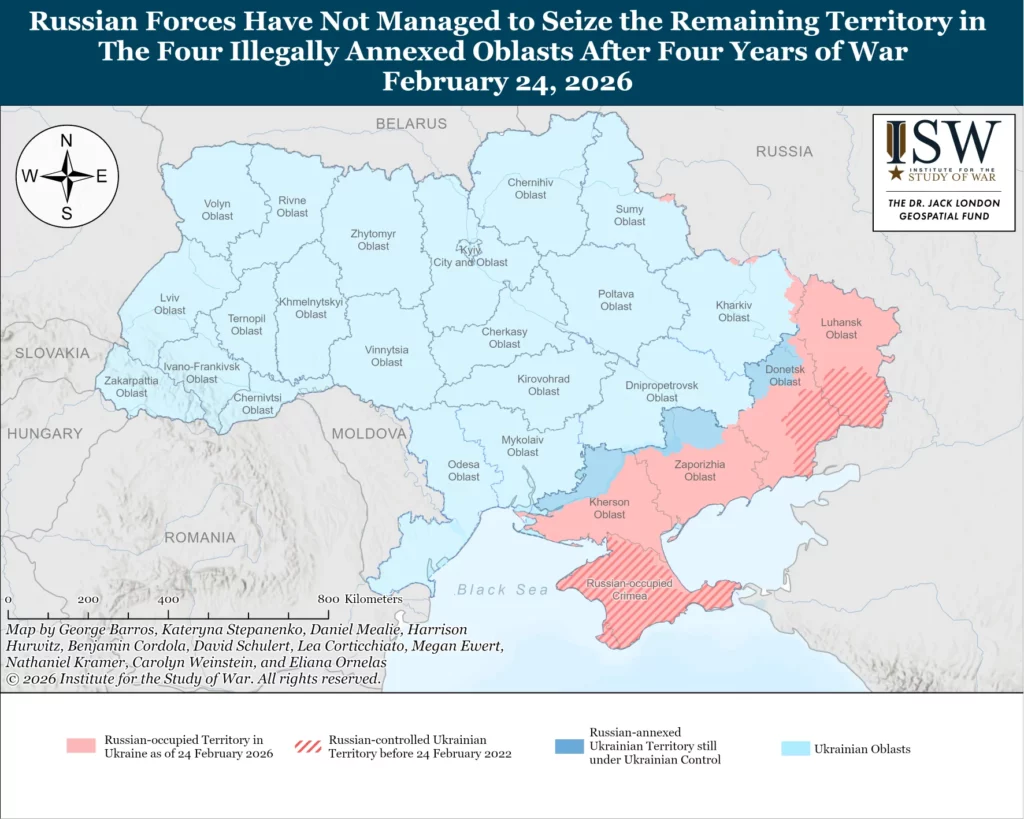
Russia’s challenges on and off the battlefield are forcing Kremlin leadership to make difficult decisions to sustain its war effort, as ISW has long forecasted that it would have to do.[16] Russia is facing critical force generation issues that complicate its ability to find manpower for Putin’s war. Russia’s casualty rate surpassed its recruitment rate in January 2026 after years in which Russia’s recruitment rate consistently met its replacement rate targets.[17] Russia is facing issues with financing its current means of recruitment, as the Russian government is struggling to find funds at both the federal and local levels to continue to pay the large cash incentives that it has used to generate the necessary number of volunteers.[18] Russia’s domestic economy is suffering from labor shortages and inflation, and Western sanctions on Russia’s energy exports have forced a sharp decline in Russia’s oil and gas revenues, which form a substantial part of Russia’s budget.[19] Russia’s growing military and economic issues are forcing Putin to consider how he can continue his war at its current tempo. Putin is having to reassess Russia’s force generation mechanisms to determine how Russia can continue to send the number of troops to the front lines needed to sustain the incessant offensive operations he demands. Putin is clearly considering and preparing for domestically unpopular measures such as rolling involuntary reserve callups.[20] Putin has been avoiding these domestically unpopular decisions since the nearly disastrous involuntary callup of 2022, and he must now convince an increasingly tired Russian populace not only to support a fifth year of war but also to accept involuntary mobilization for a war that has already cost Russia well over a million casualties.[21] Putin has been setting conditions to order such a callup, such as tightening control of the information space and increasing censorship efforts.[22] The care and aggressiveness with which Putin is taking such steps indicate the concern with which he contemplates his people’s reaction to the measures he is considering.
The Kremlin is attempting to divert attention on the anniversary away from the Russian military’s inability to achieve Putin’s objectives. Kremlin officials largely avoided acknowledging the fourth anniversary of Russia’s full-scale invasion of Ukraine. A few Russian officials made boilerplate remarks, including about the war’s alleged “root causes,” the need for Ukraine’s “demilitarization” and “denazification,” and Russia’s unwavering commitment to achieving its original objectives, but Russian officials clearly felt that they had little good news or causes for optimism to share with the Russian people.[23] Kremlin officials focused instead on a baseless claim by the Russian Foreign Intelligence Service (SVR) that the United Kingdom (UK) and France are attempting to transfer a “dirty bomb” or nuclear weapon and delivery systems to Ukraine.[24] Senior Russian officials amplified the SVR’s claim in what ISW assesses was a coordinated information effort designed to elevate nuclear escalation rhetoric and divert attention away from the war anniversary.[25] Senior Russian officials stated that the alleged actions of the UK and France are unacceptable to Russia and escalatory, posing a threat to Russian security. Kremlin officials made explicit nuclear threats, with Russian Security Council Chairperson Dmitry Medvedev stating that Russia should use nuclear weapons, including “non-strategic” systems, against Ukrainian targets and, “if necessary,” against “supplier states” that are complicit in starting a nuclear conflict with Russia.[26] This nuclear rhetoric fits into a recurring pattern, as the Kremlin has leveraged the false narrative that Ukraine intends to use a “dirty bomb” in the past to influence Western discussions about support for Ukraine or to set conditions for Russian false flag attacks.[27] ISW continues to assess that Russian nuclear use remains unlikely.[28]
The Kremlin is using the SVR claims to relitigate its justifications for the war that it initiated, which has now lasted longer than the Soviet Union’s participation in World War II without accomplishing any of the Kremlin’s original aims. Kremlin Spokesperson Maria Zakharova responded to the SVR’s allegations on February 24, falsely claiming that Zelensky expressed Ukraine’s willingness to reconsider its non-nuclear status during the February 2022 Munich Conference, just a few days before Russia launched its full-scale invasion.[29] Zelensky did not make any such statements at the conference. Zelensky stated, rather, that Ukraine did not have nuclear weapons and received security guarantees in return for abandoning its nuclear capability — a reference to the 1994 Budapest Memorandum in which Russia, the UK, and the United States committed to respect Ukraine’s territorial integrity and sovereignty in exchange for Ukraine’s relinquishment of its nuclear weapons to the Russian Federation.[30] Ukraine abided by that agreement and gave the Russian Federation the Soviet nuclear weapons left on its soil when the USSR collapsed, but Russia has violated that agreement by attacking Ukraine twice and illegally annexing Ukrainian territory. Zakharova and Russian Federation Council Chairperson Valentina Matvienko seized on the SVR allegations to claim that Ukraine’s non-nuclear status was a key condition of Russia’s recognition of Ukraine as an independent state — an irrelevance, since Ukraine was in 2022 and remains today a non-nuclear weapons power.[31] Zakharova further made a series of illogical claims about the Budapest Memorandum and the 1997 Russian-Ukrainian Friendship Treaty and alleged that Ukraine has long violated its commitment to remain neutral, non-aligned, and non-nuclear.[32] Putin has demanded Ukrainian neutrality–by which he actually means pro-Russian — since the onset of the full-scale invasion in 2022 and has justified his war as necessary to eradicate the threat that Ukraine and NATO allegedly pose to Russia. The Kremlin appears to be now using the SVR’s baseless claims about Ukraine’s nuclear aspirations in 2022 to bolster Russia’s ex post facto justifications for a costly and failing war. Russian attempts to fabricate new justifications for its war four years in suggests that the Kremlin is concerned that its messaging is not holding sufficiently within the Russian populace to support the protracted losses and economic damage that continuing to pursue its maximalist objectives will inflict on the Russian people.
Russia is also using the SVR’s claim as an excuse to threaten the UK and France with potential nuclear strikes, likely in order to disrupt ongoing discussions about Western security guarantees for Ukraine. Russian officials widely used the SVR’s claim to make nuclear threats against Ukraine, the UK, and France.[33] The UK and France have been leading discussions within the Coalition of the Willing about security guarantees for post-war Ukraine — guarantees that the Kremlin has adamantly rejected.[34] Kremlin attempts to veto these guarantees have so far failed, however, with Ukraine’s European partners continuing to make progress on the matter with US support. The Kremlin is likely resorting to renewed nuclear threats, this time explicitly targeting the UK and France, in order to create fear about a possible escalatory conflict between nuclear powers, to deter Europe from providing security guarantees, and to push the United States to block such guarantees.
The Kremlin may additionally be planning to blame Ukraine for a Russian-generated radiological incident in Ukraine, possibly to convince the West to abandon Ukraine or as a further attempt to break Ukrainian will to continue to resist. Russia has been intensely striking Ukrainian nuclear energy infrastructure, repeatedly targeting Ukrainian nuclear power plants (NPPs) and the infrastructure that supports the plants.[35] Russian strikes on these targets risk causing a radiological incident. Russia may intentionally or unintentionally cause an incident and then accuse Ukraine of using a nuclear or radiological weapon.
The SVR claim is also part of a wider Kremlin effort to justify future limited involuntary reserve callups, which are likely to be highly unpopular at home. The Kremlin appears to be preparing to conduct limited, rolling involuntary reserve callups in the future and has been intensely setting conditions to justify such callups for the past several months.[36] The SVR claim likely aims to create fear among Russians about the threat Ukraine allegedly poses to Russia and to increase support for Russia’s protracted war. Putin also used a February 24 speech to the Federal Security Service (FSB) Board to justify a future callup.[37] Putin thanked FSB employees who are ensuring Russia’s security in Russia’s “historical lands” in Donbas and Novorossiya (i.e., participating in Russia’s invasion of Ukraine) and called on Russian authorities to improve security agencies’ management systems in occupied Donetsk, Luhansk, Zaporizhia, and Kherson oblasts. Putin noted that the number of Ukrainian strikes against Russian infrastructure increased significantly in the past year and called on the FSB to intensify its efforts to protect this infrastructure. Putin called on the FSB to firmly suppress attempts to promote Russophobia, xenophobia, and religious intolerance to divide Russian society, which Putin claimed is united by patriotism and a “shared responsibility for the fate of the Motherland.”
Putin’s February 24 speech to the FSB, specifically highlighting the need to protect Russian infrastructure, is very likely meant to prepare for decisions to announce limited involuntary reservist callups for the ostensible purpose of protecting such infrastructure. Putin’s statements follow his November 4 signing of a law requiring active reservists to participate in special training to protect critical and other infrastructure in Russia.[38] The Russian Ministry of Defense (MoD) first proposed a version of this law in October 2025 that would have permitted the Russian military to use Russia’s active reserve (“human mobilization reserve”) in expeditionary deployments outside of Russia without an official Kremlin declaration of mobilization or a state of war.[39] Senior Russian officials claimed at that time that the law would allow the Kremlin to deploy active reservists outside of Russian territory, including to areas in northern Ukraine.[40] ISW previously assessed that the Kremlin was using the law permitting the deployment of active reservists to protect critical infrastructure to set conditions to call up active reservists for combat in the future, including in Ukraine.[41] Putin has started to invoke the “responsibility” of not only Russian soldiers but also the Russian people to defend Russia, likely to preemptively garner more support from the population for involuntary service by normalizing the concept of sacrifice and responsibility before he initiates such callups.[42]
Putin additionally continues to set conditions to justify the decisions that he will likely need to make to ensure that he can conduct involuntary reservist callups without significant domestic backlash. Putin paid particular attention in his FSB speech to alleged threats to Russian security on the internet.[43] Putin claimed that Russia is facing a growing number of cybercrimes, including foreign intelligence services’ cyber-sabotage against Russian critical infrastructure. Putin claimed that online recruitment schemes to conduct sabotage against Russian infrastructure are “commonplace.” Putin stated that Russian authorities must secure Russia’s information and digital space. ISW recently assessed that the Kremlin is intensifying its internet censorship campaign, including by increasingly restricting Telegram, in order to prepare the information space for future involuntary reserve callups.[44] Putin likely aims to minimize the risk of online criticisms and societal discontent, such as Russia experienced after his September 2022 partial involuntary callup. Putin’s preparation for limited, rolling callups and further internet and censorship restrictions are coming from a place of Russian weakness. Putin’s confidence in his ability to demand more sacrifices from his people without political repercussions is apparently waning, particularly as he protracts the war in Ukraine into its fifth year, yet remains far from achieving the strategic objectives for which he started the war in 2022.
Key Takeaways
The fifth year of Russia’s invasion is not beginning well for Moscow. Recent Ukrainian successes on the battlefield disprove Russian claims that things can only get worse for Ukraine the longer Kyiv delays surrendering to Russian demands.
Events on the battlefield refute Moscow’s claims that a Russian battlefield victory is inevitable and that Ukraine should surrender to Russia’s demands before its position deteriorates further.
Putin’s invasion of Ukraine enters its fifth year with Russia having failed to achieve any of its original war aims and facing setbacks on the battlefield amid mounting casualties.
Russia’s challenges on and off the battlefield are forcing Kremlin leadership to make difficult decisions to sustain its war effort, as ISW has long forecasted that it would have to do.
The Kremlin is attempting to divert attention on the anniversary away from the Russian military’s inability to achieve Putin’s objectives.
The Kremlin is using the SVR claims to relitigate its justifications for the war that it initiated, which has now lasted longer than the Soviet Union’s participation in World War II without accomplishing any of the Kremlin’s original aims.
Russia is also using the SVR’s claim as an excuse to threaten the UK and France with potential nuclear strikes, likely in order to disrupt ongoing discussions about Western security guarantees for Ukraine.
The Kremlin may additionally be planning to blame Ukraine for a Russian-generated radiological incident in Ukraine, possibly to convince the West to abandon Ukraine or as a further attempt to break Ukrainian will to continue to resist.
The SVR claim is also part of a wider Kremlin effort to justify future limited involuntary reserve callups, which are likely to be highly unpopular at home.
Ukrainian forces advanced in the Kostyantynivka-Druzhkivka tactical area. Russian forces recently advanced in northern Sumy Oblast and near Slovyansk.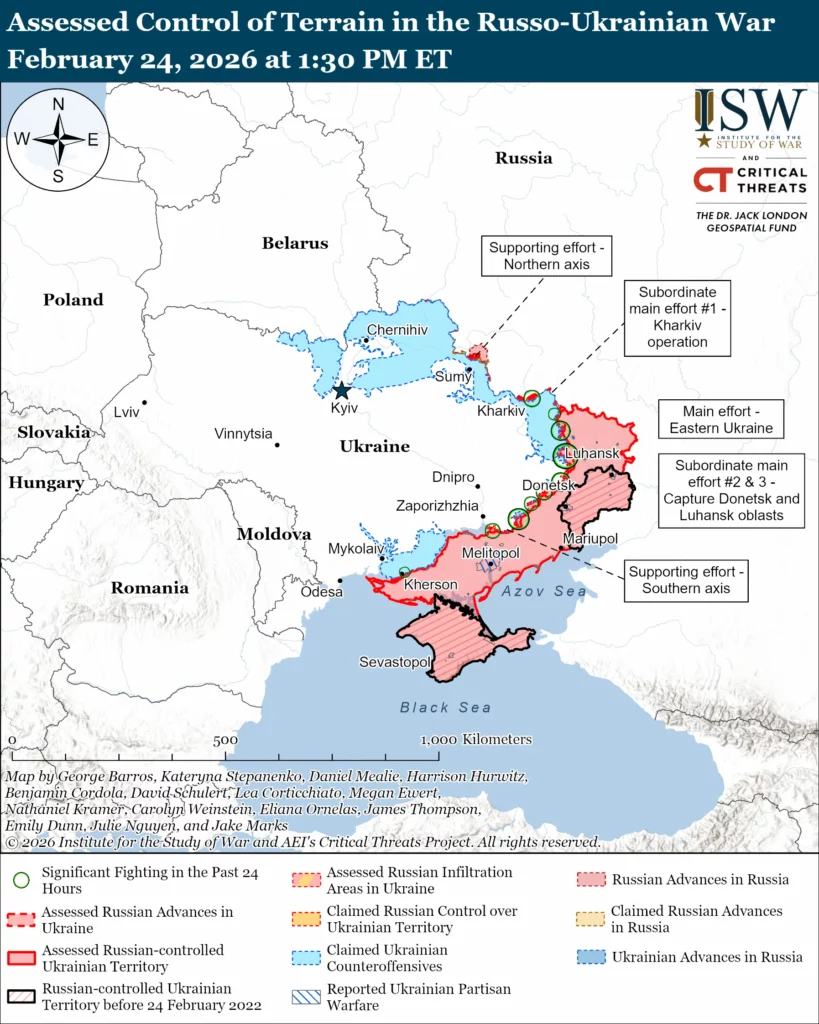
We do not report in detail on Russian war crimes because these activities are well-covered in Western media and do not directly affect the military operations we are assessing and forecasting. We will continue to evaluate and report on the effects of these criminal activities on the Ukrainian military and the Ukrainian population and specifically on combat in Ukrainian urban areas. We utterly condemn Russian violations of the laws of armed conflict and the Geneva Conventions and crimes against humanity even though we do not describe them in these reports.
Ukrainian Operations in the Russian Federation
Nothing Significant To Report.
Russian Supporting Effort: Northern Axis
Russian objective: Create defensible buffer zones in Sumy Oblast along the international border
Russian forces recently advanced in northern Sumy Oblast.
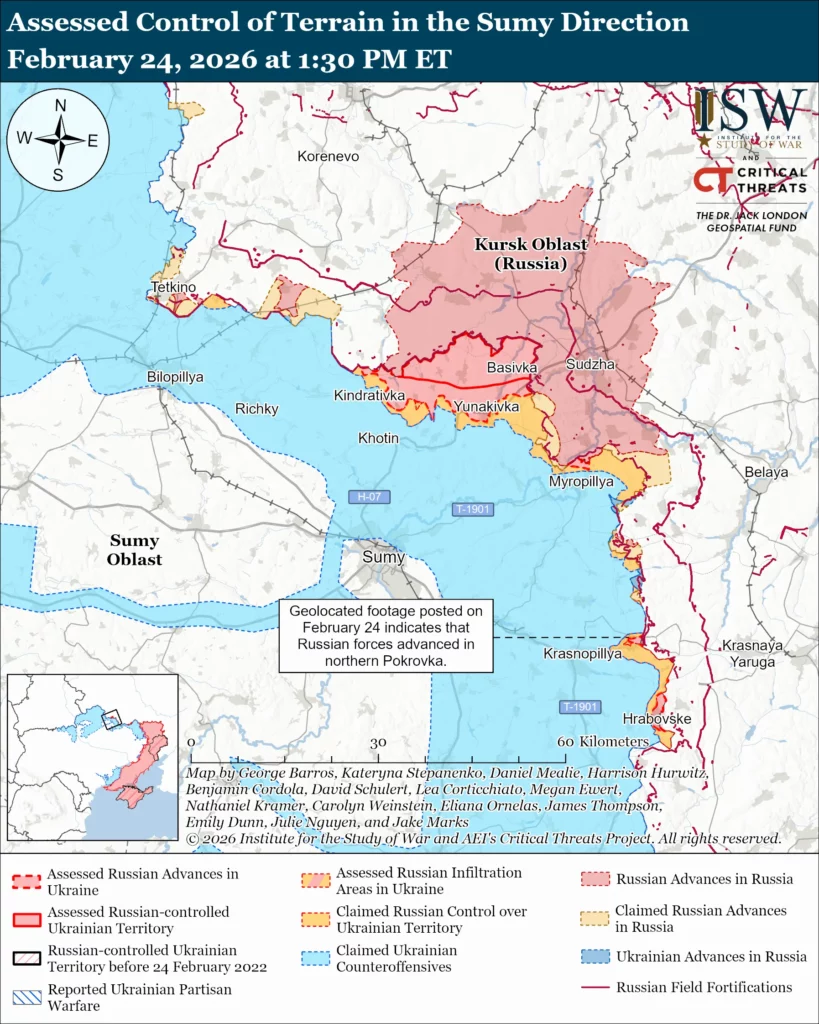
Assessed Russian advances: Geolocated footage published on February 24 indicates that Russian forces recently advanced in northern Pokrovka (southeast of Sumy City).[45]
Russian forces attacked in Sumy and Kursk oblasts, including northeast of Sumy City near Yablunivka and Yunakivka and southeast of Sumy City toward Krasnopillya, on February 24.[46]
Order of Battle: Rocket artillery elements of the Russian 106th Airborne (VDV) Division and drone operators of the Rubikon Center for Advanced Unmanned Technologies are reportedly striking Ukrainian forces in Sumy Oblast.[47]
Russian Main Effort: Eastern Ukraine
Russian Subordinate Main Effort #1 – Kharkiv Oblast
Russian objective: Push Ukrainian forces back from the international border to create a defensible buffer zone with Belgorod Oblast and approach to within tube artillery range of Kharkiv City
Russian forces continued offensive operations in northern Kharkiv Oblast on February 24 but did not advance.
Russian forces attacked northeast of Kharkiv City near Vovchansk, Vilcha, Symynivka, Starytsya, Hrafske, and Vovchanski Khutory on February 23 and 24.[48]
Order of Battle: Drone operators and other elements of the Russian Chechen Akhmat Spetsnaz Vakha Battalion (204th Akhmat Spetsnaz Regiment) are reportedly targeting Ukrainian light vehicles in the Kharkiv direction.[49]
Neither Ukrainian nor Russian sources reported ground activity in Velykyi Burluk on February 24.
Russian Subordinate Main Effort #2 – Oskil River
Russian objective: Cross the Oskil River in Kharkiv Oblast and push westward into eastern Kharkiv Oblast and northern Donetsk Oblast
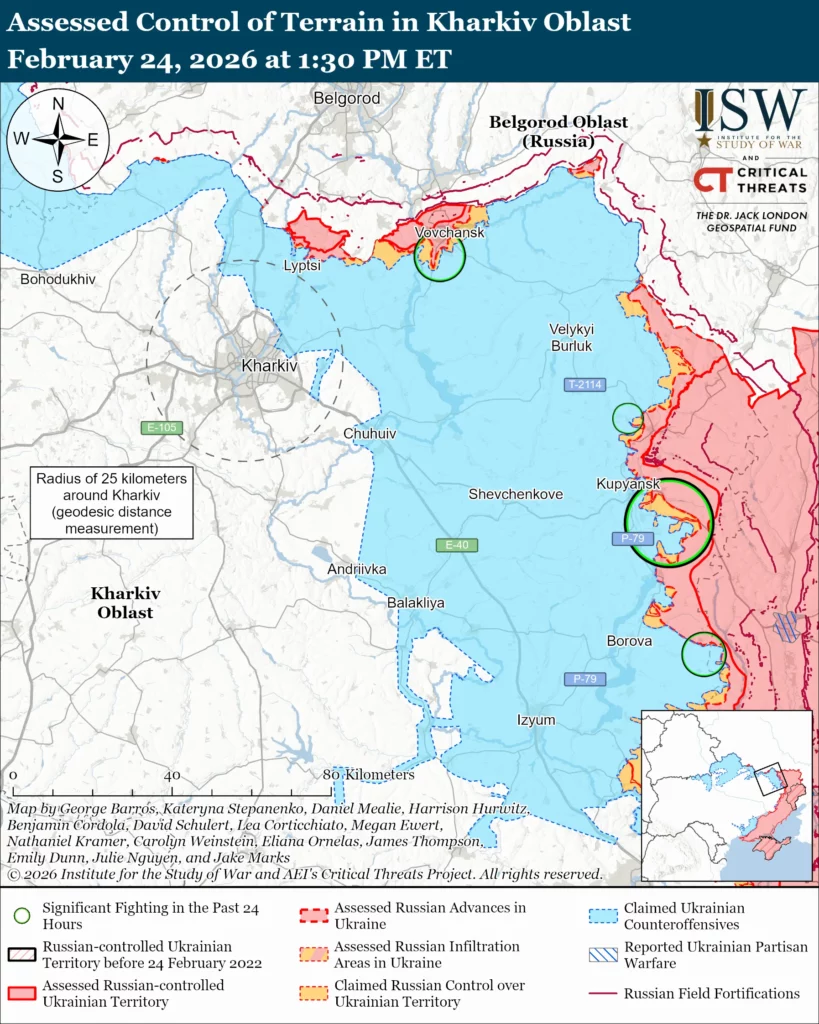
Russian forces continued offensive operations in the Kupyansk direction on February 24 but did not advance.
Russian forces attacked near and within Kupyansk itself; north of Kupyansk near Kutkivka; east of Kupyansk near Petropavlivka and Kucherivka; and southeast of Kupyansk near Pishchane and Hlushkivka and toward Kupyansk-Vuzlovyi on February 23 and 24.[50]
The spokesperson of a Ukrainian brigade operating in the Kupyansk direction reported on February 23 that Russian forces periodically use light armored vehicles like all-terrain vehicles (ATVs), motorcycles, and light armored multi-purpose towing vehicles (MTLBs) for assault operations.[51] The spokesperson stated that Russian guided glide bombs and strike drones continue to pose a significant threat in this direction.
Russian forces continued offensive operations in the Borova direction on February 24 but did not advance.
Russian forces attacked east of Borova toward Shyikivka; south of Borova near Korovii Yar and toward Oleksandrivka; and southeast of Borova toward Novoserhiivka on February 23 and 24.[52]
A Kremlin-affiliated Russian milblogger claimed on February 24 that Russian forces do not have full control of the bridgehead over the Oskil River and that only isolated Russian infiltration groups are operating in the area, despite Russian claims that Russian forces control a large part of the bridgehead east of Oskil.[53]
Russian Subordinate Main Effort #3 – Donetsk Oblast
Russian objective: Capture the entirety of Donetsk Oblast, the claimed territory of Russia’s proxies in Donbas, and advance into Dnipropetrovsk Oblast
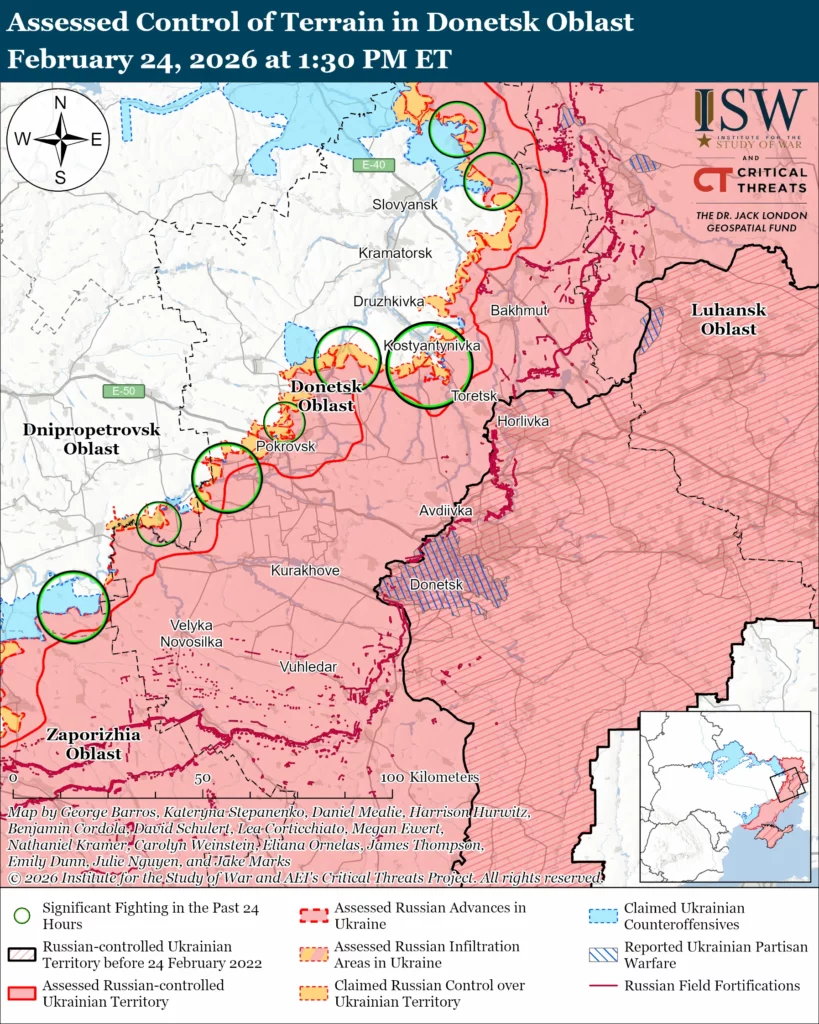
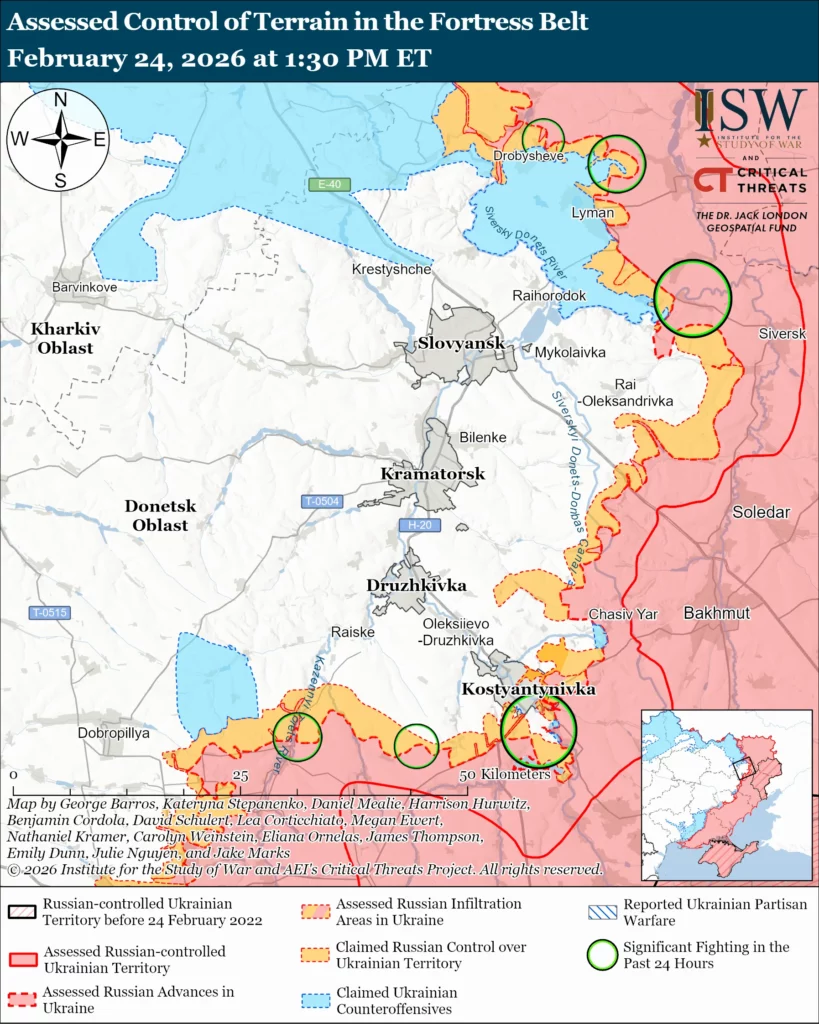
Russian forces recently advanced in the Slovyansk direction.
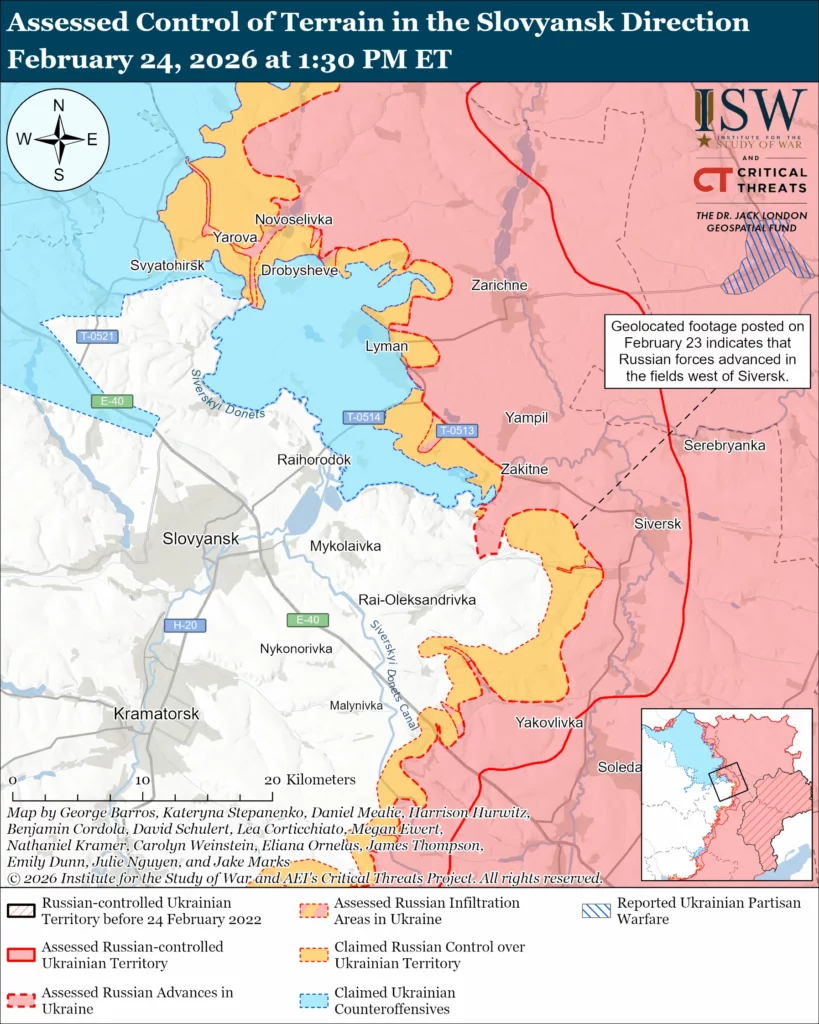
Assessed Russian advances: Geolocated footage published on February 23 indicates that Russian forces recently advanced west of Siversk (east of Slovyansk).[54]
Unconfirmed claims: Russian milbloggers claimed that Russian forces seized Lypivka and Nykyforivka (both southeast of Slovyansk) and advanced into central Kryva Luka, south of Riznykivka (both east of Slovyansk), and west of Nykyforivka.[55]
Russian forces attacked near Lyman itself; northwest of Lyman near Yarova and Sosnove; north of Lyman near Drobysheve and Stavky; southeast of Lyman near Yampil; south of Lyman toward Staryi Karavan; northeast of Slovyansk near Zakitne and Dronivka; east of Slovyansk near Kryva Luka, Kalenky, Platonivka, and Riznykivka and toward Rai-Oleksandrivka; and southeast of Slovyansk near Nykyforivka and Lypivka on February 23 and 24.[56]
A Russian milblogger reporting on the Russian Western Grouping of Forces claimed on February 24 that Russian forces in the Lyman direction are experiencing communication issues, which is essential for fire control, evacuation, and coordination of assault groups.[57] The milblogger claimed that these communication issues are impacting the pace of Russian advances in the area.
Order of Battle: Drone operators of the Russian Rubikon Center for Advanced Unmanned Technologies are reportedly striking Ukrainian forces in the Lyman direction.[58]
Ukrainian forces continued their mid-range strike campaign against Russian military assets in occupied Donetsk Oblast on the night of February 23 to 24. The Ukrainian General Staff reported that Ukrainian forces struck a Russian manpower concentration near Torske (east of Lyman, roughly nine kilometers from the frontline).[59]
Ukrainian forces recently advanced in the Kostyantynivka-Druzhkivka tactical area
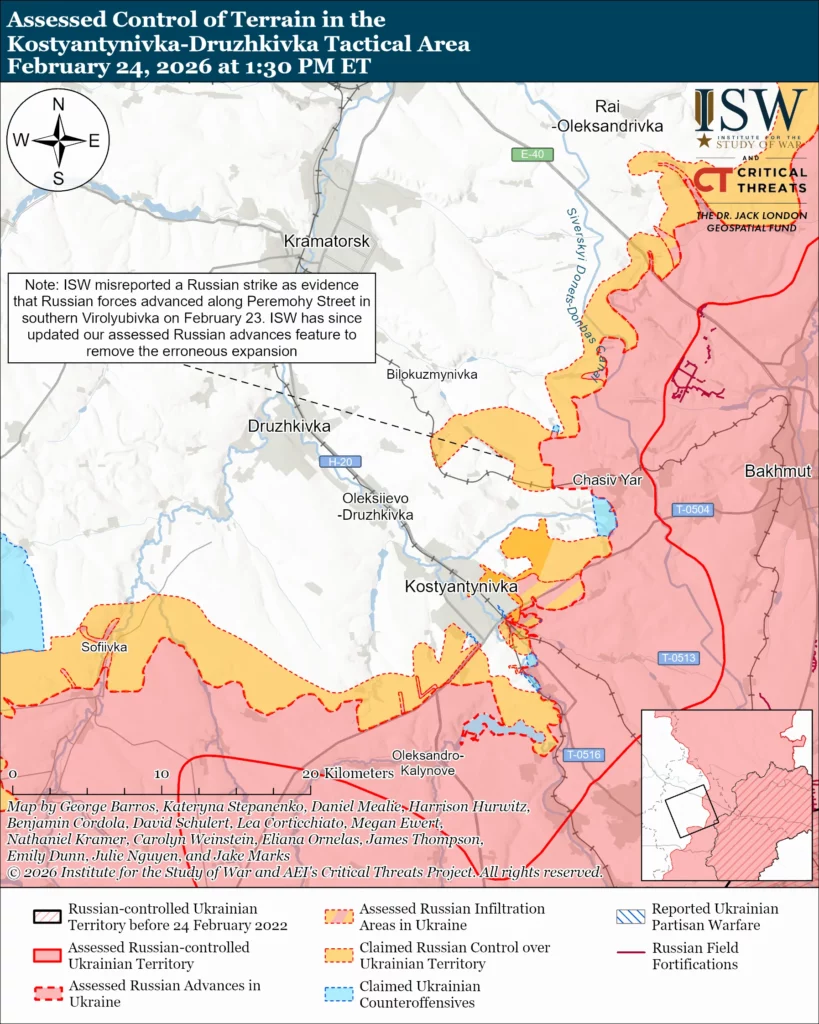
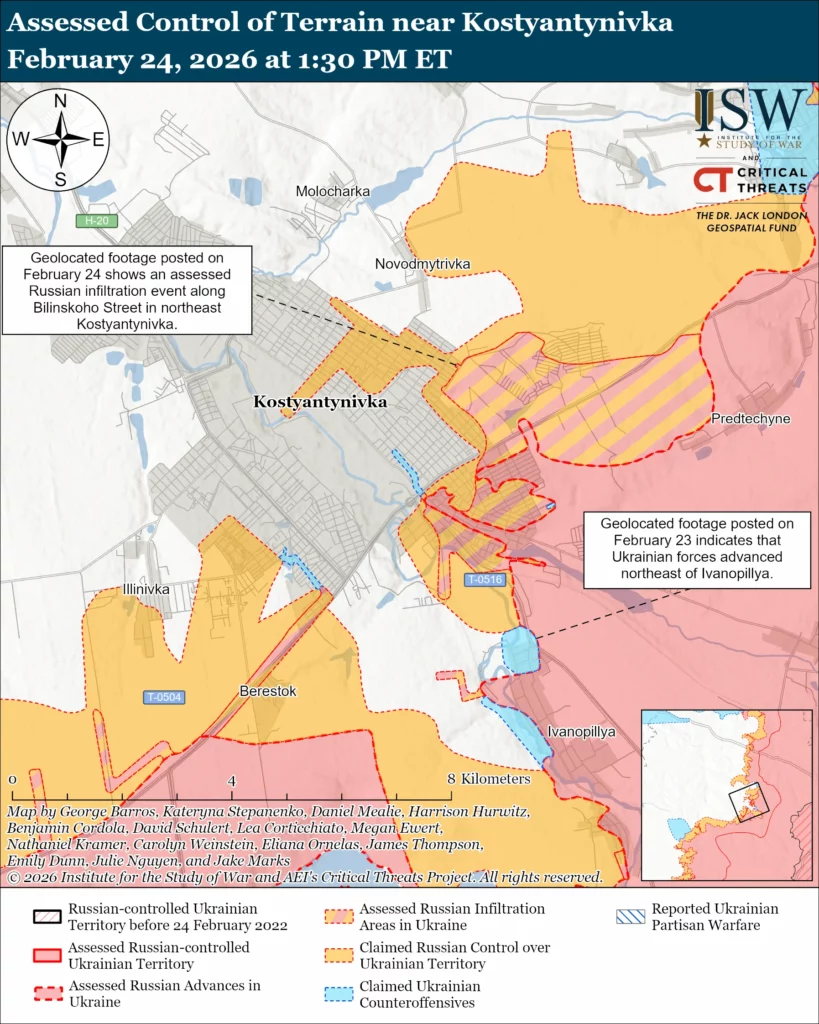
Assessed Ukrainian advances: Geolocated footage published on February 21 indicates that Ukrainian forces advanced northeast of Ivanopillya (southeast of Kostyantynivka).[60]
Assessed Russian infiltrations: Geolocated footage published on February 23 shows Ukrainian forces striking a Russian position in northeastern Kostyantynivka after what ISW assesses was a Russian infiltration mission that did not change the control of terrain or the forward edge of the battle area (FEBA) at this time.[61]
Refinement of areas under Russian claims: Geolocated footage published on February 20 shows Russian forces striking Ukrainian positions in Virolyubivka (north of Kostyantynivka) – an area where Russian sources previously claimed that Russian forces maintained positions.[62]
Russian forces attacked near Kostyantynivka itself; southeast of Kostyantynivka near Shcherbynivka, Ivanopillya, and Kleban-Byk; south of Kostyantynivka near Pleshchiivka and Berestok; southwest of Kostyantynivka near Stepanivka; and southwest of Druzhkivka near Sofiivka and Novopavlivka on February 23 and 24.[63]
Geolocated footage published on February 24 shows Russian forces conducting FAB-3000 guided glide bomb strikes against Ukrainian positions along the H-20 highway in western Kostyantynivka and a FAB-500 strike against a bridge in Kostyantynivka.[64] ISW assesses that the strikes are part of Russian forces’ ongoing battlefield air interdiction (BAI) campaign against Ukrainian roads, railways, and bridges that support Ukrainian ground lines of communication (GLOCs) aimed at degrading Ukraine’s ability to sustain forces and defend against subsequent Russian offensive operations.[65]
A spokesperson of a Ukrainian brigade operating in the Chasiv Yar (northeast of Kostyantynivka) direction reported on February 24 that Russian forces attacked with tanks, MT-LBs, and infantry over the past week (roughly between February 16 and 21).[66] The spokesperson noted that Russian forces are not attacking in large tank columns as they did in 2022 and instead use tanks as mobile firing points to provide cover for Russian infantry and to strike Ukrainian forces.
Order of Battle: Knyaz Vandal Novgorodsky (KVN) fiber optic drone operators of the Russian 4th Motorized Rifle Brigade (3rd Combined Arms Army [CAA], formerly 2nd Luhansk People’s Republic Army Corps [LNR AC], Southern Military District [SMD]), including its 1st Motorized Rifle Battalion, are striking Ukrainian forces in the Kostyantynivka direction, including near Osykove (northwest of Kostyantynivka) and northeast of Ivanopillya.[67] First-person view (FPV) drone operators of the 242nd Motorized Rifle Regiment (20th Motorized Rifle Division, 8th CAA, SMD) are reportedly intercepting Ukrainian drones in Poltavka (southwest of Kostyantynivka) and striking Ukrainian equipment in Mykolaipillya (east of Kostyantynivka).[68]
Russian forces continued offensive operations in the Dobropillya tactical area on February 24 but did not advance.
Russian forces attacked northeast of Dobropillya near Toretske and east of Dobropillya near Shakhove on February 23 and 24.[69]
Order of Battle: Elements of the Russian 33rd Motorized Rifle Regiment (20th Motorized Rifle Division, 8th CAA, SMD) reportedly continue to operate in the Dobropillya direction.[70]
Russian forces continued offensive operations in the Pokrovsk direction on February 24 but did not advance.
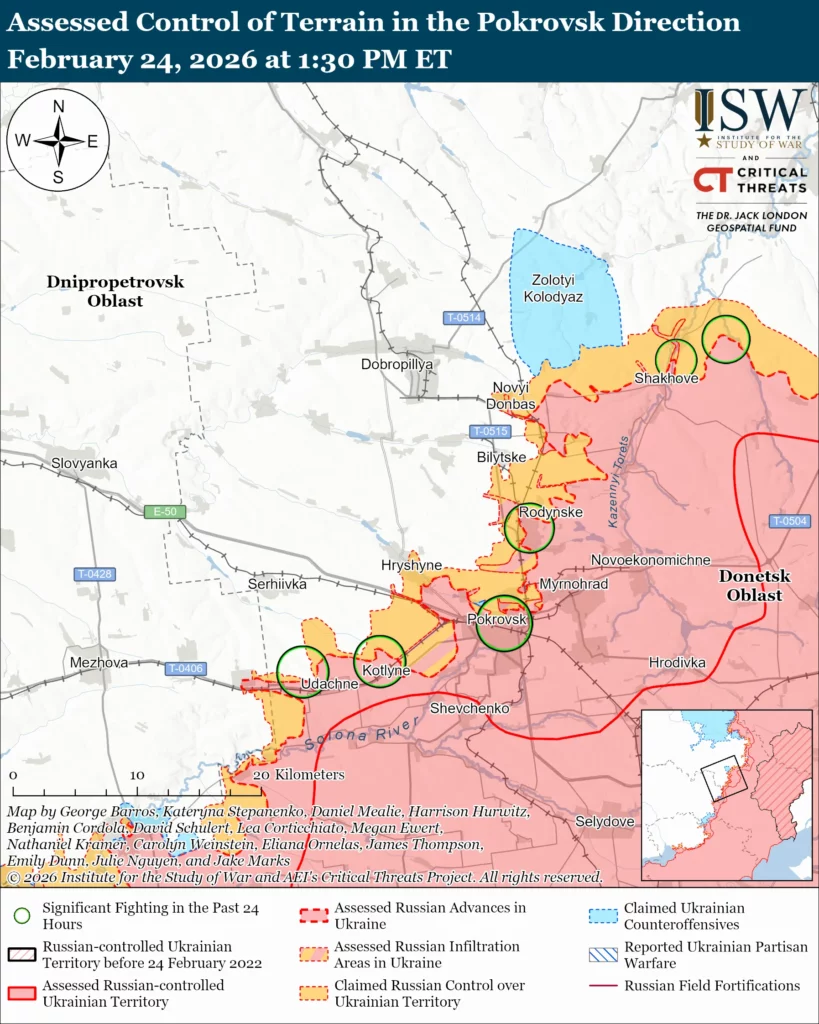
Russian forces attacked near Pokrovsk itself; northwest of Pokrovsk near Hryshyne and toward Shevchenko; north of Pokrovsk near Bilytske and Rodynske; and southwest of Pokrovsk near Kotlyne, Udachne, and Molodetske on February 23 and 24.[71]
A senior officer of a Ukrainian detachment operating in the Pokrovsk direction reported on February 23 that Russian forces are mainly assaulting Ukrainian positions under the cover of fog, but that Ukrainian forces have adapted to such tactics.[72]
The Ukrainian General Staff reported on February 24 that Ukrainian forces struck a Russian military command and observation post near Udachne and a drone control post near Pokrovsk.[73]
A Russian milblogger claimed on February 24 that Russian forces in the Pokrovsk direction are testing an unspecified smartphone-based application integrating Telegram with drone operations, which transmits drone footage feeds to rear battalion command posts.[74]
Order of Battle: Elements of the Russian Storm Special Purpose Detachment of the 9th Motorized Rifle Brigade (51st CAA, formerly 1st Donetsk People’s Republic [DNR] AC, SMD) are reportedly operating near Bilytske and Novoekonomichne (northeast of Pokrovsk).[75] Drone operators of the 5th Motorized Rifle Brigade (51st CAA) and artillery elements of the 385th Artillery Brigade (2nd CAA, Central Military District [CMD]) are reportedly striking Ukrainian forces in the Pokrovsk direction.[76]
Russian forces continued offensive operations southwest of Novopavlivka near Filiya on February 24 but did not advance.[77]
Russian forces continued offensive operations in the Oleksandrivka direction on February 24 but did not advance.
Russian forces attacked southeast of Oleksandrivka near Ternove, Stepove, and toward Vyshneve on February 23 and 24.[78] Russian milbloggers claimed Ukrainian forces counterattacked near Kolomiitsi, Stepove, Ternove, Berezove, Hai, and Novooleksandrivka (both southeast of Oleksandrivka).[79]
Ukrainian forces continued their frontline and mid-range strike campaign against Russian military assets in occupied Donetsk Oblast on the night of February 23 and 24, including using ATACMS. The Ukrainian General Staff reported that Ukrainian forces struck a Russian manpower concentration near Berezove (southeast of Oleksandrivka); a Russian Buk-1 anti-aircraft missile system near occupied Svobodne (roughly 85 kilometers from the frontline); a Russian command post near occupied Novopetrykivka (roughly 41 kilometers from the frontline); and a Russian ammunition and logistics depot near occupied Pryazovske (roughly 95 kilometers from the frontline).[80]
Russian Supporting Effort: Southern Axis
Russian objective: Maintain frontline positions, secure rear areas against Ukrainian strikes, and advance within tube artillery range of Zaporizhzhia City
Russian forces recently infiltrated in the Hulyaipole direction.
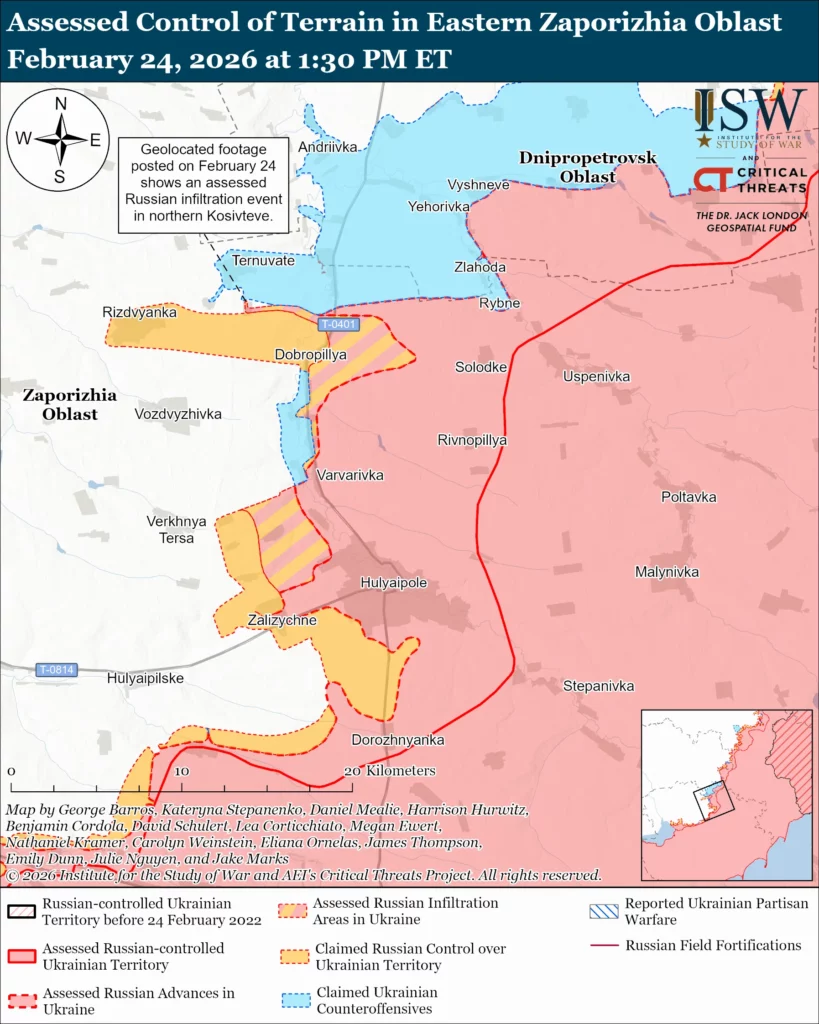
Assessed Russian infiltrations: Geolocated footage published on February 24 shows Ukrainian forces striking a Russian servicemember in northern Kosivtseve (northwest of Hulyaipole) after what ISW assesses was a Russian infiltration mission that did not change the control of terrain or the forward edge of the battle area (FEBA) at this time.[81]
Unconfirmed claims: The Russian Ministry of Defense (MoD) claimed that Russian forces seized Rizdvyanka (northwest of Hulyaipole).[82] A Russian milblogger claimed that Russian forces advanced west of Zaliznychne (west of Hulyaipole).[83]
Russian forces attacked near Hulyaipole itself; north of Hulyaipole near Yehorivka and toward Varvarivka and Nove Zaporizhia; northwest of Hulyaipole near Pryluky, Verkhnya Tersa, Rizdvyanka, Ternuvate, and Vozdvyzhivka; west of Hulyaipole toward Zaliznychne and Hirke; and southwest of Hulyaipole toward Zahirne on February 23 and 24.[84] Russian milbloggers claimed Ukrainian forces counterattacked near Bratske and toward Andriivka (north of Hulyaipole), Dobropillya, Ternuvate, and Pryluky (all north of Hulyaipole).[85]
Order of Battle: Drone operators of the Russian 38th Separate Motorized Rifle Brigade (35th Combined Arms Army [CAA], Eastern Military District [EMD]) are reportedly striking Ukrainian forces near Yehorivka and Myrne (southwest of Hulyaipole).[86]
Ukrainian forces continued their frontline strike campaign against Russian military assets in Zaporizhia Oblast. The Ukrainian General Staff reported that Ukrainian forces struck a Russian manpower concentration near Staroukrainka (west of Hulyaipole).[87]
Russian forces continued offensive operations in western Zaporizhia Oblast on February 24 but did not advance.
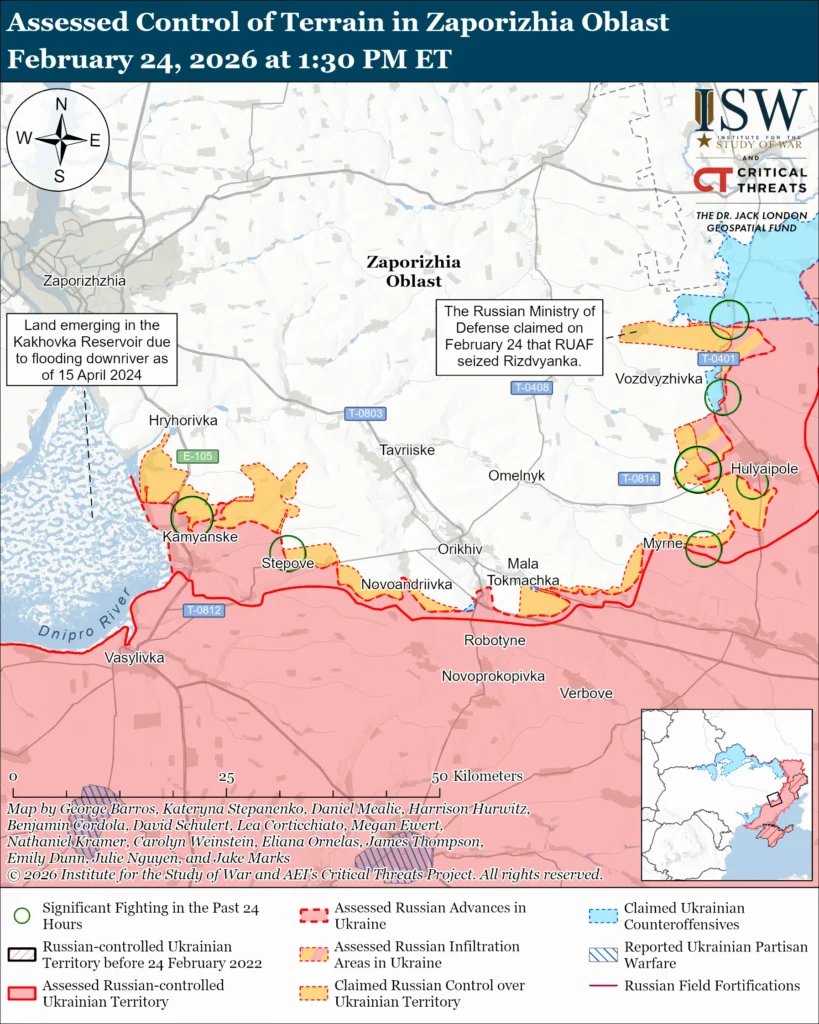
Russian forces attacked east of Orikhiv toward Hulyaipilske; west of Orikhiv near Prymorske, Stepove, Stepnohirsk, and Plavni, and northwest of Orikhiv near Mahdalynivka on February 23 and 24.[88]
Order of Battle: Elements of the Russian 7th Airborne (VDV) Division reportedly continue to operate in the Zaporizhia direction.[89]
Ukrainian forces continued their mid-range strike campaign against Russian military assets in occupied Zaporizhia Oblast on February 23 and 24. The Ukrainian General Staff reported that Ukrainian forces conducted mid-range strikes, including with ATACMS, against a Russian Uragan MLRS system near occupied Lyubymivka (roughly 26 kilometers from the frontline); a Russian manpower concentration near occupied Novomykolaivka (roughly 44 kilometers from the frontline); a Rubikon Center for Advanced Unmanned Technologies equipment depot near occupied Vasylivka (roughly 21 kilometers from the frontline); an ammunition depot near occupied Oleksandrivka (roughly 53 kilometers from the frontline).[90]
Russian forces continued limited ground attacks in the Kherson direction on February 23 and 24, but did not advance.[91]
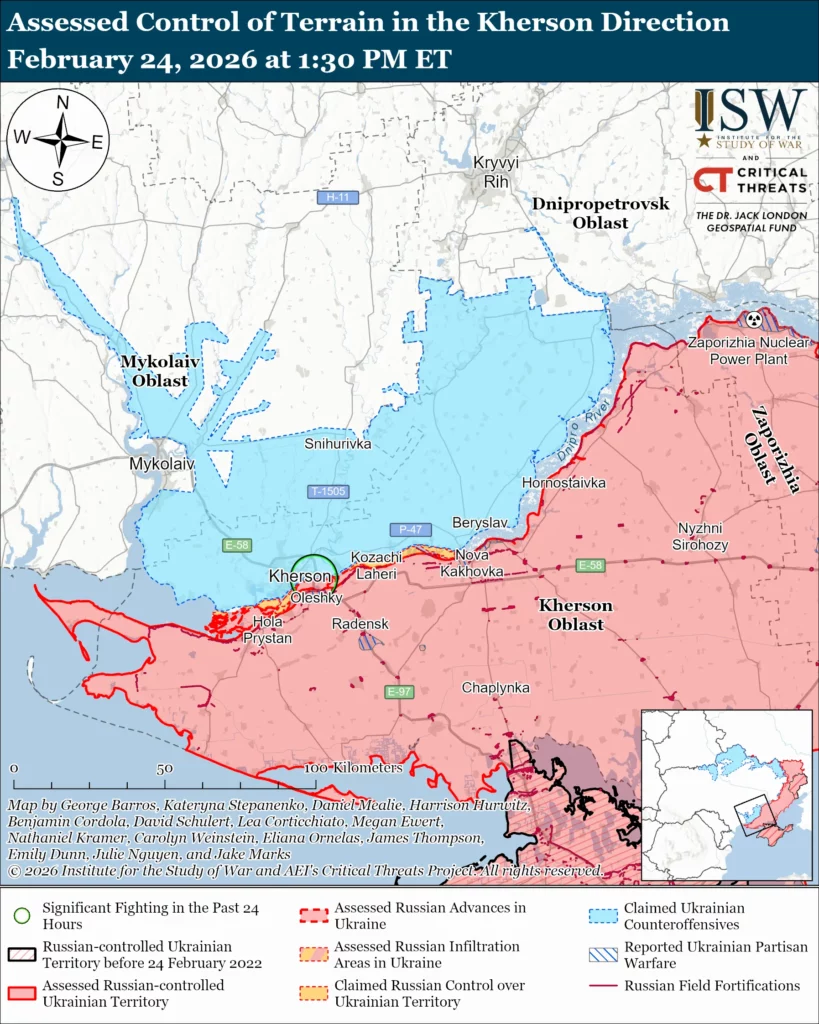
Order of Battle: Drone operators of the Russian 98th VDV Division and of the 4th Military Base (58th CAA, Southern Military District [SMD]) are reportedly striking Ukrainian forces in the Kherson direction.[92]
Russian Air, Missile, and Drone Campaign
Russian Objective: Target Ukrainian military and civilian infrastructure in the rear and on the front line
Russian forces conducted a series of drone and missile strikes against Ukraine on the night of February 23 to 24. The Ukrainian Air Force reported that Russian forces launched one Iskander-M ballistic missile from occupied Crimea and 133 Shahed-type, Gerbera-type, Italmas-type, and other drones — including roughly 80 Shahed-type drones — from the direction of Oryol, Kursk, and Bryansk cities; Primorsko-Akhtarsk, Krasnodar Krai; and Millerovo, Rostov Oblast.[93] The Ukrainian Air Force reported that Ukrainian forces downed 111 drones, that one missile and 19 drones struck 16 locations, and that drone debris impacted one location. Ukrainian officials reported that Russian forces killed one civilian and damaged residential infrastructure in Dnipropetrovsk Oblast; unspecified objects in Kharkiv City; and struck residential infrastructure and injured five in Zaporizhzhia City and Zaporizhia Oblast.[94]
Ukrainian Ministry of Defense (MoD) advisor on defense technology and drone and electronic warfare (EW) expert Serhiy “Flash” Beskrestnov reported on February 24 that Russian forces are able to produce roughly 60 Iskander ballistic missiles per month.[95]
The Ukrainian Air Force reported on February 24 that Ukrainian forces have destroyed more than 140,000 Russian missiles and drones over the past four years, including 86 Kh-47 M2 Kinzhal air-launched missiles; 709 Kalibr cruise missiles; 2,459 Kh-101 cruise missiles; 13 Kh22/Kh-32 cruise missiles; 12 Onyx anti-ship missiles; 261 Iskander-K cruise missiles; 274 Iskander-M/KN 23 ballistic missiles; 11 Zirkon anti-ship missiles; 30 missiles of other types; 540 guided glide bombs; 44,7000 Shahed drones; 14,900 reconnaissance drones; 7,500 Lancet drones; and 70,300 other drones.[96]
Significant Activity in Belarus
Russian efforts to increase its military presence in Belarus and further integrate Belarus into Russian-favorable frameworks
Nothing Significant To Report.
Note: ISW does not receive any classified material from any source, uses only publicly available information, and draws extensively on Russian, Ukrainian, and Western reporting and social media as well as commercially available satellite imagery and other geospatial data as the basis for these reports. References to all sources used are provided in the endnotes of each update.