 Eurasia Press & News
In early February, the Treaty on Measures for the Further Reduction and Limitation of Strategic Offensive Arms between the United States and Russia (START-3) expired, and no new agreement was concluded. START-3 was the last obstacle to a possible nuclear race between Moscow and Washington. However, at the moment, Russia has no resources for the mass production of new strategic weapons, said Nichor Graewski, an expert on nuclear policy, associate professor at the Center for International Studies (CERI) at the Institute of Sciences Po. Much more likely, in her opinion, looks to the strengthening of the systems already in the arsenal by additional warheads, as well as the expansion of the production of non-strategic weapons. The termination of the mutual inspections provided for START-3, but interrupted even during the pandemic, creates new opportunities for the implementation of such projects, although Russia has not so much money for them – the resources are exhausted due to the war in Ukraine. But China has resources, whose nuclear program worries the United States is already more concerned than the Russian one.
For more than 50 years, the cooperation between the United States and Russia in the nuclear sphere has been determined – albeit not without flaws – by a series of arms control agreements that established mechanisms for checks and limits of the arsenals of the two countries. For a long time, this system was gradually destroyed (the term of the contract for limiting missile defense systems expired in 2002, on the elimination of intermediate-range and shorter-range missiles in 2019), until it finally ceased to exist on February 5, 2026, when the Strategic Offensive Arms Treaty (START-3) ended.
The end of START-3 has revived long-standing fears of a new arms race, and they are not without reason. However, the Western-proven version that Russia will immediately begin building up strategic nuclear forces ignores both the real restrictions faced by Moscow and its current policies in this area.
Russia is unlikely to seek quantitative superiority in nuclear weapons. Rather, it will adhere to the strategy of recent decades: maintain a stable level of deterrence, avoid budget and diplomatic costs associated with demonstrative strategic capacity-building, and to transfer rivalry to areas where it is cheaper, more difficult to regulate and contributes more effectively to the achievement of current goals. The question is not whether Russia will use the expiration of the START-3 period, but how and at what cost it will do so.
Unknown START
Signed in 2010, START-3 (in English – New START) set for each side the limit of 1550 deployed strategic warheads with no more than 700 carriers: missiles and bombers. It also provided for field inspections, exchange of data every six months and a transparency regime that provided mutual understanding of each other ‘ s strength configuration. The treaty has frozen the strategic power of the United States at a level that Russia could maintain despite a significant economic imbalance. At the same time, he did not affect those areas where Moscow had advantages – primarily non-strategic nuclear weapons and the development of new delivery systems that are not formally subject to restrictions.
ICBMs is an intercontinental ballistic missile.
SLBM is a submarine-launched ballistic missile.
BRPP is an intermediate-range ballistic missile (IRBM) with a range of 3500-5500 km. It is used in the Western system of classification of missiles as an intermediate link between medium-range missiles (from 1000 to 3500 km) and intercontinental (over 5500 km) range. In the Russian system, there is no corresponding category, since all missiles with a range of 1000 to 5500 km are considered medium-range missiles. Sometimes the term long-range missile is used to describe them in Russian.
“Dagger” is a Russian aeroballistic missile, an adaptation of the Iskander missile to launch from the carrier aircraft (most often the MiG-31K). In various sources, the missile is often designated by the X-47M2, in fact, such an index in the system of designations of the equipment of the Armed Forces of the Russian Federation does not exist. It is positioned by Russian propaganda as hypersonic, but does not meet the modern criteria for such weapons. Nevertheless, it is an extremely difficult goal for air defense.
The START-3 Treaty has frozen the strategic power of the United States at a level that Russia could maintain. At the same time, he did not affect the areas where Moscow had advantagesThe treaty began to lose force long before its formal expiration. Mutual inspections stopped in 2020 amid the pandemic and were not fully resumed. By 2022, Russia began blocking attempts to check the United States and postpone key consultations on the agreement.
In February 2023, Vladimir Putin officially suspended Russian participation in the treaty, saying that NATO is directly talking about its goal of defeating Moscow in Ukraine. At the end of 2025, Putin proposed to Washington on an informal basis to extend the restrictions for one year, but the Trump administration, which was counting on a larger agreement with the participation of China, did not give an official response.
The Russian Response
In the short term, Russia is likely to maintain the deployment of its strategic forces at levels close to the ceiling of the previous agreement. This meets several tasks at once: to support their own narrative about restraint, avoid an immediate response from the United States and save budget funds in the context of the war in Ukraine and Western sanctions.
The Russian nuclear doctrine provides for the priority of sustainability over quantitative indicators; the limits set by START-3 in this context are not considered as restrictions on operational capabilities. The expiration of the treaty does not so much change the strategic approach of Moscow, as it opens up opportunities for its delicate adjustment within the framework of the already existing system.
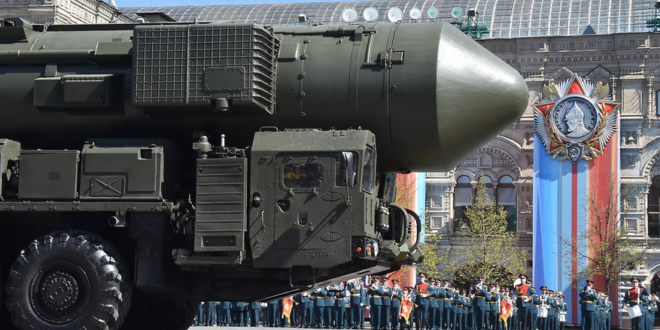
The most significant opportunity that opens in the near future is the increase in the combat load of existing missiles above the limits established by the agreement. So, RS-24 “Yars”, the main Russian ICBM of mine and mobile base, according to Western analysts, is able to carry up to six warheads, although during the period of START-3 it was usually deployed from three to four. The RS-28 Sarmat, which is still not put into operation, is designed for 10 or more charges, which is comparable to the heavy missiles of the Soviet era, which it should replace. As for sea-launched weapons, the Bulava SLBM, located on the submarines of the Borey project, is currently deploying six warheads to a missile, but its upper stage can carry more.
If half of the already deployed Russian SLBMs and ICBMs received only two additional warheads, the total number of the latter would increase by more than 500 units. Increasing the loading of existing missiles does not require the construction of new launchers, expansion of production lines or significant changes in the based structure. In addition, such actions can be easily concealed in the absence of inspections on the ground provided for START-3. However, this scenario is fraught with a retaliatory build-up of US strategic forces.
Production restrictions
The state of Russia’s industrial base limits its capabilities more than Western analysts believe. Today, there are several production of warheads in the country: in Sarov, Snezhinsk, Lesnoye and Trekhgorny. In a year, they produce several hundred units, having a certain potential for build-up. In general, the production of warheads is not a deterrent to Russia, unlike the United States. The situation with the carriers is much more complicated.
The war in Ukraine has revealed the shortcomings of the Russian military-industrial base, which prevent production from no less than any political barriers. The country has a shortage of high-precision machines, reliable navigation electronics and skilled labor, and Western sanctions have significantly limited access to foreign components, which historically depended on the industry.
The scale of the problem is easy to see on the example of the Sarmat system, which was originally planned to be adopted in 2018. It was designed by the State Rocket Center named after Makeev to replace the Soviet Voivode, and that was developed by the Ukrainian Yuzhnoye Design Bureau and was produced at the Yuzhmash plant in the Dnieper.
Russia was dependent on Ukrainian expertise in the field of designing intercontinental ballistic missiles, their engines and control systems. When military-technical cooperation between the two countries was severed in 2014, Moscow lost access to these competencies, and the development of its own expertise was much more difficult than expected. The consequences were a devastating accident at the Plesetsk cosmodrome during the tests of Sarmat in 2024 and the unsuccessful launch at the Yasny test site in November 2025, which threw the program back years.
The situation is similar with other components of the Russian nuclear triad. In the air, the leading role is still played by the modernized Soviet Tu-95MS and Tu-160 bombers. The serial production of the advanced Tu-160M aircraft at the Kazan Aviation Plant was seriously hampered by the closure of production lines in the 1990s. And the assembly of the new generation PAK DA bomber is unlikely to be able to be established until the mid-2030’s, if at all.
The Borey submarine series is the most successful example of the modernization of Soviet equipment, but here the construction of each unit takes 7-8 years, and the task for the 2030s is to replace the outdated submarine of the project 667 (according to the classification of NATO – Delta) with new ones than in the expansion of the fleet.
Perhaps the most indicative example of the Votkin Machine-Building Plant, where the Yars ICBMs is simultaneously being built, Bulava SLBM, Iskander missile systems and a number of other tactical systems. Since 2022, the company has sharply increased the production of Iskander – according to some estimates, from 72 to 500-600 units per year – to replenish the reserves spent in the strikes on Ukraine.
However, non-strategic systems now directly compete for production facilities with Yars. The new Russian medium-range missile “Oryashnik” is also assembled in Votkinsk; at the moment only 3-4 copies have been built, of which two are used in test launches. The production of additional “Hergates” is likely to be carried out by reducing the products of “Yars”.
The Confrontation Zone Shift
As Russia’s strategic capacity builds are hampered by production constraints, its competition with the U.S. is likely to shift to less costly and regulated areas, which are also better in meeting its security demands. We are talking primarily about non-strategic nuclear weapons and medium-range missiles. Moscow has about 1.5-2 thousand non-strategic warheads — an arsenal that has never been subject to the limitations of bilateral agreements and which the Russian authorities have long seen as a key advantage on the European continent.
The systems “Iskander-M”, “Caliber” and “Dagger” in the nuclear version of their device are in many ways similar to conventional weapons. The increase in their production is not associated with such economic and political costs as in the case of strategic forces. This line is complemented by the recently deployed intermediate-range ballistic missile “Oridnik”, which previously fell under the limitations of the INF Treaty, and now for the first time in several decades poses a nuclear threat to Europe.
ICBMs is an intercontinental ballistic missile.
SLBM is a submarine-launched ballistic missile.
BRPP is an intermediate-range ballistic missile (IRBM) with a range of 3500-5500 km. It is used in the Western system of classification of missiles as an intermediate link between medium-range missiles (from 1000 to 3500 km) and intercontinental (over 5500 km) range. In the Russian system, there is no corresponding category, since all missiles with a range of 1000 to 5500 km are considered medium-range missiles. Sometimes the term long-range missile is used to describe them in Russian.
“Dagger” is a Russian aeroballistic missile, an adaptation of the Iskander missile to launch from the carrier aircraft (most often the MiG-31K). In various sources, the missile is often designated by the X-47M2, in fact, such an index in the system of designations of the equipment of the Armed Forces of the Russian Federation does not exist. It is positioned by Russian propaganda as hypersonic, but does not meet the modern criteria for such weapons. Nevertheless, it is an extremely difficult goal for air defense.
Missile "Oreshnik" previously fell under the restrictions of the INF Treaty, and now for the first time in several decades poses a nuclear threat to EuropeThe logic of Russia’s investments in new strategic systems has also changed – however, it complements the previous one. In March 2018, Vladimir Putin presented the so-called “new weapons”: hypersonic planning unit “Avant-garde”, the Poseidon unmanned underwater vehicle and a cruise missile with a nuclear power plant “Burevestnik”.
These projects were developed to complicate the work of American missile defense systems and to maintain the possibility of a retaliatory strike amid the threat posed to the Russian nuclear potential. They also play the role of negotiation assets, that is, systems whose use may be limited under future arms control agreements in exchange for US concessions. The real effectiveness of these systems remains in question, but Moscow is well aware of their political and strategic importance.
The Chinese Factor
Against the background of all the voiced, there is another process that Moscow does not affect publicly, but cannot but take into account: the development of China’s nuclear program. According to satellite images, since 2021, almost 230 mine launchers of intercontinental ballistic missiles have been built in China. According to the US Department of Defense, China already has more than 600 warheads, and by 2030 there will be more than 1000. In 2021, Russian expert Vasily Kashin отмечалnoted that the third great nuclear power is being born before our eyes, and Russia will soon lose the status of the only equal rival of the United States in this area.
Officially, Moscow considers China an indispensable partner in the context of diplomatic and economic isolation. However, this friendship is preserved by historical distrust, rooted in the Soviet-Chinese split, mutual territorial claims and decades of ideological rivalry, which the post-Soviet rapprochement softened, but did not completely eliminate.
Moscow is increasingly difficult to ignore Beijing’s growing nuclear potential. The zone of destruction of Chinese missiles, developed primarily to deter the United States in the Pacific region, simultaneously affects a significant part of the territory of Russia. In addition, the development of China’s nuclear program serves as the main driver of the modernization of the American arsenal, and this directly affects the Russian defense budget, whether Moscow wants it or not.
The potential threat from China worries Russian analysts much less than its impact on the confrontation between Moscow and Washington. Figures such as Sergey Karaganov and Dmitry Trenin stated: “Russia needs a close dialogue with Chinese colleagues to convince them that their plans (if any) to build up the nuclear arsenal to the level of Russia and the United States are counterproductive. This will only push the Americans to the start of a new arms race.”
China’s growing influence has led to Russia’s reassessment of its strategic potential. Moscow can no longer compare its forces exclusively with the American ones. Now it has to take into account the combined dynamics of development of the United States and China.
ICBMs is an intercontinental ballistic missile.
SLBM is a submarine-launched ballistic missile.
BRPP is an intermediate-range ballistic missile (IRBM) with a range of 3500-5500 km. It is used in the Western system of classification of missiles as an intermediate link between medium-range missiles (from 1000 to 3500 km) and intercontinental (over 5500 km) range. In the Russian system, there is no corresponding category, since all missiles with a range of 1000 to 5500 km are considered medium-range missiles. Sometimes the term long-range missile is used to describe them in Russian.
“Dagger” is a Russian aeroballistic missile, an adaptation of the Iskander missile to launch from the carrier aircraft (most often the MiG-31K). In various sources, the missile is often designated by the X-47M2, in fact, such an index in the system of designations of the equipment of the Armed Forces of the Russian Federation does not exist. It is positioned by Russian propaganda as hypersonic, but does not meet the modern criteria for such weapons. Nevertheless, it is an extremely difficult goal for air defense.
China's growing influence led to Russia's reassessment of its strategic potentialThe most likely result of the expiration of START-3 will not be a sharp and demonstrative arms race, but a gradual adjustment of opportunities, unfolding below the threshold of formal strategic build-up. Russia can increase the loading of warheads at already deployed complexes, shift the focus to non-strategic systems and medium-range missiles, as well as continue to develop new asymmetric solutions, not limited to reciprocal checks. Separately, none of these steps means a strategic breakthrough, but together they increase political uncertainty, complicate planning for the United States and its allies, and erosion the basic level of mutual trust that, with all its shortcomings, has previously ensured control over nuclear weapons.