 Eurasia Press & News
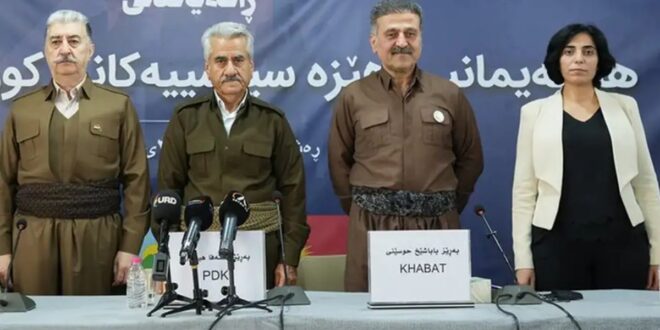
Three sources said that Iranian Kurdish armed groups have held consultations with the United States in recent days on whether and how they will attack Iranian security forces in the western part of the country.
The Iranian Kurdish alliance of groups based on the Iran-Iraq border in Iraq’s semi-autonomous Kurdistan region is training to launch such an attack in the hope of weakening the country’s army, as the United States and Israel bomb targets inside Iran with bombs and missiles.
Two sources said the aim was to pave the way for Iranians opposed to the Islamic Republic of Iran to rise up now after the killing of Supreme Leader Ayatollah Ali Khamenei and other senior officials since the start of the U.S.-Israeli offensive on Saturday.
The sources, who asked not to be identified to speak freely about sensitive military planning, said no final decision had yet been made about the operation and its possible timing. It said those groups had requested military support from the United States. Two sources said the groups were in talks with the United States about receiving assistance from the CIA to supply them with weapons.
In response to a question by DW about whether he could confirm or deny Western media reports, including CNN and Wall Street Journal, Hassan Sharafi, a member of the KDP’s Executive Committee, said in response to a question by DW about whether he could confirm or deny Western media reports, including CNN and the Wall Street Journal, about contacts between Donald Trump and Mustafa Hijri, the party’s chairman, or about possible U.S. support for Kurdish Peshmerga forces, that “for now, he cannot confirm or deny those reports.”
Asked whether the Kurdish areas in Iran would be attacked could create a security vacuum, and what his party’s plan for such a situation was, Sharafi said: “Our position is the struggle against the Islamic Republic, because this regime prevents the achievement of democracy, and stands against the demands of Iranian nationalities, equality, and non-discrimination.” “So we have been forced to repeatedly defend our legitimate rights and this also applies to the moment. We continue our struggle, but the big countries are a matter for them. We have not called on any country to attack Iran.”
On whether the Peshmerga forces will enter Iranian territory if the military confrontation continues, Sharafi said: “I can’t say anything specific about this. But when it comes to defending ourselves and our people, all possibilities are possible.”
U.S. President Donald Trump has held a phone call with Kurdish leaders in Iraq to discuss next steps in the fight against Iran. The PUK in Iraq said on Tuesday (March 3, 2026) that Trump had contacted Pavel Talabani, the party’s leader. They said Trump briefed Talabani on his future plans for war with Iran. There was no immediate confirmation from the U.S. government.
Consultations on possible ground operations
U.S. media reported that Trump also spoke with Kurdish leader Massoud Barzani a day after the start of U.S.-Israeli attacks in Iran. The Wall Street Journal quoted U.S. government officials as saying that Trump is considering supporting Iraqi Kurds in a fight against the Iranian leadership. Iraq’s Kurds are deploying a large number of fighters on the border with neighboring Iran and have links to Iran’s Kurdish minority.
It was the C-Net. In. N) was the first to report that the CIA was communicating with these groups and the possible ground operation. Reuters has not been able to independently ascertain the extent to which the CIA is involved in planning the operation, whether it has facilitated the provision of weapons or whether there are plans to send U.S. troops to Iran with Kurdish groups.
The CIA declined to comment. Neither the White House nor the Pentagon has yet responded to requests for comment. The Kurdistan Regional Government has also not yet responded to a request for comment.
Any operation from Iraq will likely require significant military and intelligence support from the United States. The Pentagon says the two U.S. bases in Erbil have supported the international coalition fighting Islamic State militants. Kurdish groups in Iraqi Kurdistan have a long history of working with the United States, but the volatility of their loyalties and ideology has sometimes strained relations with Washington. The United States worked with some Kurdish groups in Iraq during the Iraq War and the battle against ISIS.
But it is unclear how much success Iranian Kurdish groups can achieve in their battle inside Iran. The fighters of these groups have varying degrees of battlefield experience.
The position of neighboring countries on supporting the Kurds
The C network was moved. In. A source said the plan is for the Kurdish armed forces to confront Iranian security forces to facilitate the uprising of unarmed Iranians in the country’s cities. A senior Iranian Kurdish official told the U.S. network that Iranian Kurdish opposition forces were expected to take part in a ground operation in western Iran in the coming days. The source explained, explaining the timing of the operation: “We think we have a great opportunity now.” He said the militias expected U.S. and Israeli support.
Any attempt to arm Iranian Kurdish groups would require the support of Iraqi Kurds to allow the passage of weapons and the use of Iraqi Kurdistan as a launching pad. One of the sources familiar with the discussions said the idea was for the Kurdish armed forces to confront and besiege Iran’s security forces to facilitate the removal of unarmed Iranians in major cities without new massacres, as happened during the country’s unrest in January. Another U.S. official said the Kurds “could contribute to the chaos in the region and the depletion of the Iranian regime’s military resources.”
It is not clear exactly how other countries in the region will look at a Kurdish-implemented operation in Iran. An armed uprising carried out by Iranian Kurds could have serious consequences for the stability of their country.
It could intensify Iran’s armed separatist movement among the ethnic Baloch minority, which has close ties to separatists in Pakistan’s restive and neighboring province of Balochistan. Islamabad is unlikely to tolerate any move towards Baloch independence.
Turkey, a staunch supporter of Syrian President Ahmad al-Sharaa, sees the merger agreement between Damascus and Kurdish forces as crucial for restoring state authority throughout Syria. It has threatened to carry out a military operation against the Kurdish-led Syrian Democratic Forces in the north if the group does not agree to submit to central government control.
Ankara is working to advance its long-term efforts toward peace with the outlawed Kurdistan Workers Party (PKK) and is unlikely to tolerate the arming of Kurdish groups close to its borders.