 Eurasia Press & News
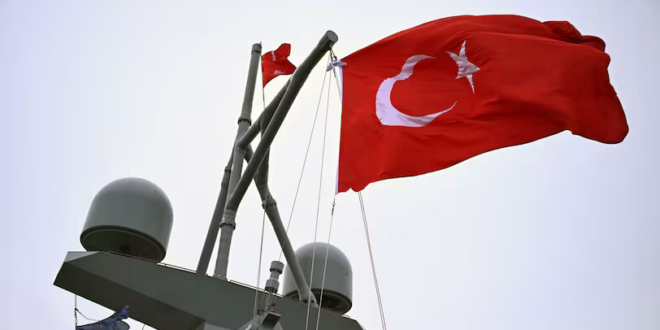
Ankara says weapon may have been aimed at base in Greek Cyprus but veered off course
Nato forces have shot down a ballistic missile that Iran fired towards Turkey, Ankara said, in an escalation of the Iran-US-Israel conflict spreading across the region.
“A ballistic munition, fired from Iran and detected heading towards Turkish airspace after passing through Iraqi and Syrian airspace, was neutralised in a timely manner by Nato air and missile defence elements deployed in the Eastern Mediterranean,” Turkey’s Defence Ministry said.
“One missile” had been heading towards Turkish airspace over the country’s south-eastern Hatay province, and “was intercepted and destroyed by Nato air defence systems”, presidential communications chief Burhanettin Duran said.
A senior Turkish official later told the AFP news agency that Turkey had not been the target of the missile.
“We believe it aimed at a base in Greek Cyprus but veered off course,” said the official, who wished to remain anonymous.
Iran previously hit the island on Monday, when a drone attack on the UK Royal Air Force base of Akrotiri caused limited damage and no casualties, British and Cypriot officials said.
Turkey summoned Iran’s ambassador to Ankara, while Foreign Minister Hakan Fidan immediately called his Iranian counterpart Abbas Araghchi after Wednesday’s interception, a Turkish official said. Mr Fidan said “any steps that could lead to the escalation of hostilities should be avoided”.
Pieces of interceptor missiles fell in the Dortyol area of Hatay, the Defence Ministry said. There were no casualties or injuries.
A Nato spokeswoman, Allison Hart, condemned the Iranian attack. “Our deterrence and defence posture remains strong across all domains, including when it comes to air and missile defence,” she said.
Nato member Turkey has the second-largest army in the alliance and also hosts US Air Force personnel, most of whom are based at Incirlik in south-eastern Adana province or at Izmir in the west.
Turkey had until now avoided retaliatory strikes from Iran that have hit countries such as the UAE, Oman and Qatar, despite Ankara and Gulf nations holding similar positions before the aerial conflict began. All host US interests and had advocated diplomacy and de-escalation.
Turkey is now ready to take “all necessary steps” to defend its territory and airspace “without hesitation”, Mr Duran said. “Necessary responses will be given within the framework of international law to any hostile actions that may be encountered.”
Analysts told The National earlier this week that an Iranian strike on Turkey would be a major escalation by Tehran.
A deliberate Iranian strike on a base such as Incirlik would amount to “a direct confrontation with a Nato member that has one of the alliance’s largest militaries”, said Burcu Ozcelik, a senior fellow at the Royal United Services Institute for Defence and Security Studies.
“That raises the risk of this tipping from a regional war into a far wider international crisis, not just rhetorically but operationally, because it would create immediate pressure for a collective Nato response and for Turkey to retaliate.”
Iran’s retaliation to Israeli and US military attacks has drawn in the Gulf, as well as the wider region as European countries shore up defences.
The UK government said on Tuesday that it was sending HMS Dragon, a Type 45 destroyer, and Wildcat helicopters to the Eastern Mediterranean, “to boost British defences in the region” and help protect allies. It did not specify locations.
HMS Dragon would strengthen the UK’s ability “to detect, track and destroy aerial threats, including drones,” the Ministry of Defence said.
“The decision comes as Iran’s reckless attacks continue to target British interests in the region, as the UK Armed Forces continue to adapt to the changing threats,” it said.