 Eurasia Press & News
Both women looked exhausted. They struggled to maintain eye contact, to focus on the conversation. They described feeling constantly on edge, unable to rest, waiting forever for news that never comes.
One had five children, the other four. Their husbands were killed in the fighting. Our husbands brought us here, the women said.
“We were young,” said one. “If I had been older and understood more about life, I would have refused.”
“I just want to leave here and forget everything.”
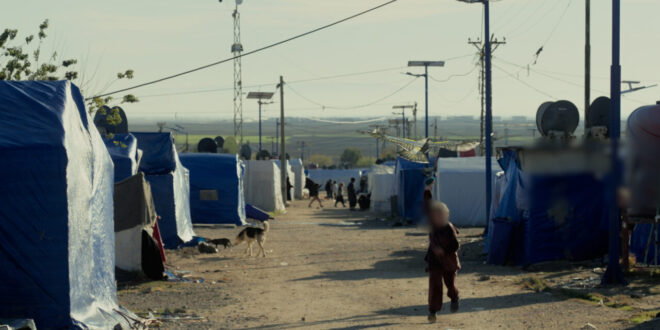
Behind them, children played with puppies in the dust, laughing and chasing one another.
But the people guarding them saw nothing innocent in the scene.
“Children here know how to train dogs to kill,” said one. “They know how to make and use weapons, knives and other objects.”
The Roj camp holds some 2,300 women and children of roughly 50 different nationalities; more than 1,500 are children, many of whom arrived as infants and have grown up in confinement, in the shadow of watchtowers.
The journey here is measured not in kilometres or miles but permits and complex logistics. It begins in Sarajevo, through Istanbul, followed by a night flight to Erbil in Iraqi Kurdistan.
From Erbil, the journey continues by car, west into Syria and another Kurdish-controlled region.
Oil pumpjacks pepper the flat terrain. In the city of Qamishli, shops stay open late and generators hum when the electricity cuts out; signs are written in Kurdish, Arabic, and Syriac.
Checkpoints dot the road to the Roj camp; documents change hands and men with rifles gesture calmly; the process is repetitive, procedural.
Oil-rich but impoverished, this territory was, for two years, controlled by Islamic State.
In 2016-17, it passed to the Autonomous Administration of North and East Syria, AANES, a Kurdish-led governing authority that emerged during the war. Backed militarily by the US-led coalition in the fight against Islamic State, the administration runs local councils, security forces, courts, and basic services across a multi-ethnic territory.
In 2024, however, Bashar al-Assad was driven from power, and in January this year, the fragile balance in northeastern Syria shifted as US-backed Syrian government forces moved to retake key oil and gas fields in the east, including strategic sites that had been under control of the Kurdish-led Syrian Democratic Forces, SDF, since 2016.
The government launched a coordinated military operation into SDF-held territories in northeastern Syria after months of tensions and stalled negotiations over integration and control of territory.
A ceasefire agreed in mid-January combined an immediate halt to fighting with a proposed reintegration framework whose implementation remains uncertain. Under its stated terms, Syrian government forces are to regain control over key cities, border crossings, and oil and gas fields, while Kurdish forces are expected to withdraw from frontline positions.
The United Nations took over formal responsibility for the camps at the turn of the year, but a lack of security means it has yet to assume full operational control. Among the detainees are some 100 citizens of Bosnia and Herzegovina and unconfirmed numbers from Albania, Kosovo, North Macedonia and Serbia. Some have been detained since 2017, most since 2019. BIRN visited them in late December.
Growing up in confinement
Roj camp becomes identifiable only at close range; from a distance, it blends into the surrounding terrain.
The perimetre consists of successive layers of fencing, a recently constructed concrete wall, and watchtowers positioned at regular intervals, one manned by an armed guard. A small number of unfinished private houses stand nearby, built with limited means, sharing the same landscape without visible interaction with the camp.
Geographically, Roj sits close to the borders of Iraq and southern Turkey, near the town of Al-Malikiyah, known in Kurdish as Derik. The camp was established in 2016 by Kurdish-led authorities in response to a growing number of foreign women and children on the move as Islamic State lost territory.
Approximately two-thirds of its population are children. Many arrived as infants and have grown up in the camp, effectively an open-air prison that they have never been allowed to leave.
The BIRN reporting crew was accompanied throughout the visit to the camp by two women, both in military uniform.
One was a public relations officer on behalf of the administration; she characterised the Kurdish authorities as humanitarian actors responsible for containing what she described as the remnants of Islamic State, left behind by the rest of the world. By her account, the camp is not just a place of detention but part of a broader effort to protect people beyond Syria’s borders. The women and children held there are dangerous, she said.
The other woman was the camp’s head of security, a veteran of Kurdish forces who said several of her close relatives were killed by Islamic State.
It is clear that both women see the Kurdish-run camps as proof of the legitimacy of the semi-autonomous territory, demonstrating to the world its capacity to provide security.
Conversations took place in English or Arabic; Bosnian was not permitted. Access was limited to two hours per day and all contact with women held inside had to be mediated through the escorts. Individuals were called by name and brought to the reporters.
It was only through these constraints that BIRN was able to observe life in the camp and interact with those held inside.
Rows of identical shelters stretch outward, intersected by paths of mud and dust. Very few guards are visible. The camp is divided into three zones and access between zones is not permitted.
The first section was built to host foreign nationals who arrived in 2016 and 2017. As the camp expanded, additional zones were constructed to accommodate later arrivals. The most recent residents of Roj were transferred only recently from another, bigger camp known as al-Hol.
Over the years, humanitarian organisations have repeatedly documented child fatalities linked to illness, accidents, violence, and delayed access to care. In 2021, a four-year-old boy, the child of a woman from Bosnia, died in al-Hol after being struck by a fuel tanker, Radio Free Europe reported.
‘No choice’
At the centre of Roj camp is a small marketplace, where women and children are allowed to shop on assigned days, scheduled by zone, for food and basic goods. Family members in their countries of origin can send funds through approved and “secure” channels, though the amounts are strictly limited and generally low.
The first women BIRN spoke to were from Serbia. They said that Serbian authorities had contacted the camp about them for the first time in November last year. They had heard nothing since.
Several Bosnian women approached, wearing niqabs. They came to Syria, they said, because they were young and had been told they would have better lives.
“Some people went to Germany,” said one. “We were offered Syria.”
“We didn’t really know what it was,” said another. “When we arrived, our passports were taken from us. After that, there was no choice, no choice about how to live, what to say or do, or where to go. Many of us spent time in Islamic State jails too, after trying to escape or not wanting to take part in their activities.”
They said they are required to pay for the plastic sheeting of their tents, around $100, as well as electricity, which is available once in the morning and again in the late afternoon.
They also said they had to pay for most food and medical expenses, including dental care.
Inside the tents, BIRN saw mattresses on the ground and basic cooking equipment, small decorations, images, empty perfume bottles. In some there were strings of decorative lights. The tents were clean and tidy and the paths between carefully maintained.
Water must be carried inside and heated manually. After nearly a decade, daily life has settled into routine. A television, switched on for a few hours each day to follow the news, becomes the only regular connection to the outside world.
What worries the women most is their children, who know nothing of life outside the confines of the camp.
“We try to teach them,” said one, “but the outside world is too abstract for them”.
There are no books, and the Arabic-language school is repetitive and limited, said the woman.
Classes are short, and teaching materials scarce. The women say their children are also physically underdeveloped due to the limits of their diet. When they reach adolescence, they often become withdrawn.
Boys reaching puberty, often around the age of 13, sometimes younger, are forcibly removed and transferred to separate detention facilities for boys, including one called al-Houri.
Some mothers described others trying to hide their sons by digging shallow holes beneath their tents, where they hid.
When boys reach 18, they can be transferred to prisons for men and, in some cases, lose all contact with their families. Camp authorities justify the indeterminate detention of boys by pointing to what they describe as the enduring pull of Islamic State ideology.
Out of earshot of the camp staff, the women spoke of being humiliated by guards, of violent behaviour and theft. They all reported being beaten at some point or confined alone in cage-like cells. Such punishment is meted out for rule violations, such as having a mobile phone or other prohibited items; sometimes, the violence is arbitrary.
BIRN also entered the al-Houri centre, where a 17-year-old Bosnian boy said he arrived in Syria aged three and was separated from his mother and sisters at the age of 11.
He said he sometimes has access to teaching, but mainly in deradicalisation, and to a small sports field where he likes to play football.
He shares a room with nine other boys. A television played cartoons on repeat. The boy’s answers were quick, without emotion, almost as if rehearsed. He spoke in broken Bosnian.
Tensions building
Under Article 33 of the Fourth Geneva Convention, collective punishment is strictly forbidden; under the International Covenant on Civil and Political Rights, ICCPR, any deprivation of liberty must be lawful, necessary, proportionate, and subject to judicial review; and under the UN Convention on the Rights of the Child, the detention of children must be used only as a last resort and for the shortest appropriate period of time, with children treated as rights holders and potential victims, not security threats.
According to Human Rights Watch, the detention camps in northeastern Syria violate these core principles.
Many of the children are very young; some were born in detention. None of the foreign women or children in these sites have been brought before a court or given access to legal review.
The blanket, indefinite detention of family members of alleged Islamic State suspects may amount to collective punishment, which constitutes a war crime, Human Rights Watch has warned.
Inside Kurdish-controlled territory, tensions are rising. Years of war, displacement, and political marginalisation have hardened nationalist sentiment among segments of the Kurdish population, and the prospect of losing the autonomy they fought so hard for has generated anger and fear.
Many Kurds believe they served for years as a buffer against the Islamic State, bearing the burden of securing camps holding tens of thousands of women and children whom other countries were unwilling or unable to repatriate.
“We fought the Islamic State on behalf of the rest of the world, and now the rest of the world is turning its back on us,” the head of security at Roj, who BIRN met in December, told CNN in late January, identifying herself by the nickname Chavre.
“I hope all these women and the prisoners go back to their countries and start attacking them.”
Within the camps, these dynamics are felt acutely.
Since the start of the fighting in mid-January, women detained in Roj have described a sharp rise in fear and uncertainty.
According to information passed to BIRN by sources, several women believe their safety depends on the continued presence of international organisations and fear retaliation if Kurdish authorities are left without external support.
The accounts allege abuse by camp guards following recent military losses suffered by the SDF, including intimidation and collective punishment, nighttime raids and destruction of tents, confiscation of belongings, prolonged exposure to cold, and physical violence, including against children.
BIRN could not independently corroborate the accounts, but similar concerns and allegations have been reported by other media outlets.
Women previously detained in al-Hol described the past month as a period of intense uncertainty and fear leading up to their departure.
According to the UN refugee agency, UNHCR, the number of people in the al-Hol has dropped significantly; the agency said it was informed by Syrian authorities of plans to relocate the remaining families to Akhtarin camp in Aleppo province.
All Bosnian nationals have since left al-Hol. Like many other women who departed during or after the turmoil, they were reportedly transferred to Idlib under unclear circumstances, and it remains unknown who organised or facilitated the movements. Several women said they were informed by unidentified sources that any potential departure to Bosnia would take place from Idlib. They are currently staying in private apartments, waiting for formal instructions.
Concerns have also been raised about possible attempts to reassert influence over the women by figures such as Bosnian Salafi cleric Nusret Imamovic – who has been designated a terrorist by the US and linked by security agencies to the recruitment and radicalisation of individuals from the Balkans who travelled to Syria – or a person identified in unverified messages circulating among detainees as Azur Marjanovic, who allegedly operates a Telegram channel seeking financial contributions purportedly to assist women who have left the camps.
A fundraising appeal titled “Help to our sisters from Syria” has been observed circulating online, including on social media accounts described as pro-Salafist. The content of these pages includes conservative religious messaging directed at women, combining themes of piety, obedience and marital devotion.
Analysts familiar with extremist online ecosystems note that similar messaging has in the past been used in environments that promote further radicalisation and restrictive gender norms. The identity of those managing the accounts and the ultimate destination of any funds could not be independently confirmed.
Considering the confinement of children
Although management of al-Hol formally passed to the United Nations at the turn of the year, the deteriorating security environment has prevented the UN from assuming full operational control. Access remains restricted, security continues to be handled largely by local forces, and humanitarian actors say their ability to monitor conditions or intervene remains severely limited, leaving responsibility fragmented at a time of heightened vulnerability.
In recent weeks, male nationals held in prisons and juvenile detention centres in northeastern Syria were transferred to Iraq as part of the broader security reconfiguration that followed the ceasefire and the shift in control over detention facilities.
Iraqi officials argued that Iraq was better positioned to ensure secure custody and pursue prosecutions. The US provided logistical and political backing for the transfers, describing them as a precautionary step to preventing security gaps and reduce the risk of prison breaks during a volatile transition period.
According to documents obtained by BIRN and attributed to Iraq’s Ministry of Justice and the Iraqi Correction Service, 37 nationals from Western Balkan countries were among those transferred, of whom 23 are from Bosnia, eight from Albania, three from Kosovo, two from Serbia and one from North Macedonia.
Since the escalation of fighting in mid-January 2026, civic initiatives, legal bodies, and human rights organisations across Europe and beyond have expressed concern for the fate of children held in Roj and al-Hol.
In Bosnia, Foreign Minister Elmedin Konakovic said in January that Sarajevo had received the “green light” from the United States to proceed with the repatriation of its citizens from northeast Syria.
No timeline, operational details, or confirmed transfers have been made public, and no repatriations had been reported as of the end of January.
As we drove away through the oil fields, the camp shrinking into the flat horizon, the pumpjacks continued their steady mechanical rhythm, indifferent to what lay behind the fences. It was impossible not to think about how this moment will one day be written, how scholars will dissect the policies, the legal formulas and the administrative vocabulary that rendered prolonged detention acceptable in the name of security.
It is not the first time. History has documented how systems, convinced of their necessity, have confined children and justified it through language of protection, order or prevention. Those periods are now analysed in books and lectures as warnings from the past. Yet witnessing it in the present disturbs any comfortable belief in moral evolution.
After nearly a decade of compressed lives, children growing up without horizons and women suspended in bureaucratic uncertainty, what strikes hardest is not spectacle but normalisation.
The danger is not only violence itself, but the way it becomes procedural, photographed, reported and absorbed into routine.
One day it will be studied as part of institutional history. Today, it feels closer to what Hannah Arendt warned about, the quiet transformation of extraordinary suffering into something administratively manageable. Not monstrous enough to interrupt systems, yet profound enough to mark a generation.