Eurasia Press & News
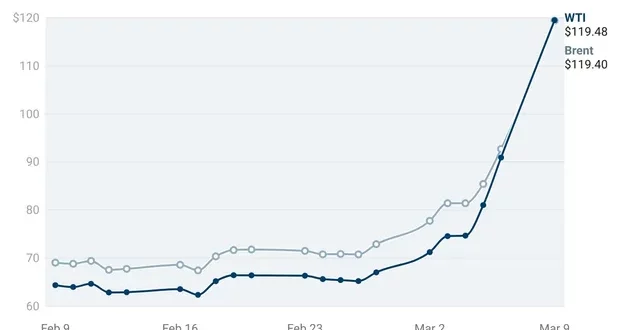
Israeli-US strikes on Iran and its retaliation against Gulf countries escalated over the weekend, sending oil prices towards $120 a barrel in early trading on Monday, and weighing down on the immediate economic outlook for the region and the world.
Brent crude contracts peaked at $119.40 per barrel at around 2:33am GMT, while West Texas Intermediate traded around $119.48 at the same time, after both surged in the evening in the US. Both had jumped above $90 a barrel at Friday’s close.
Iran appointed Mojtaba Khamenei to succeed his father Ayatollah Ali Khamenei, who was killed eight days ago on the first day of the military offensive against the Islamic Republic, as its next supreme leader, NBC and other US outlets reported on Sunday, citing Iranian state media.
Water desalinisation plants, seen as vital to life in this arid part of the world, were struck in Iran and Bahrain. Iranian strikes also hit residential buildings in Bahrain and the UAE, as well as civilian, government and energy facilities in Bahrain, Kuwait and Saudi Arabia.
Bahrain’s ministry of interior criticised Iran in a social media post for “indiscriminately” attacking civilian targets.
State-owned Kuwait Petroleum Corporation declared force majeure on Saturday, a notice given to customers that orders cannot be met due to extraordinary circumstances such as a war or a natural disaster.
QatarEnergy did the same for its LNG deliveries earlier this week, while Iraq also reduced oil production.
Saudi Arabia’s benchmark equity index, the Tadawul All-Shares, again closed higher, up over 2 percent, in the first trading day of the week on Sunday. Investors see ongoing disruptions to global energy flows as potentially benefiting Aramco.
The Saudi state oil producer’s highly anticipated earning call is scheduled for Tuesday.
Qatar’s stock exchange ended the day slightly lower, 0.11 percent down.
Markets in Dubai and Abu Dhabi opened again on Monday after the weekend.
“UAE equities ended the week lower as the widening conflict involving the US, Israel, and Iran continued to weigh heavily on risk sentiment,” said Vijay Valecha, chief investment officer at Century Financial.
“While the UAE continues to benefit from strong sovereign reserves, equity markets have come under sustained pressure as investors recalibrate their view of regional stability and growth prospects.”
A “short-lived conflict” that closes the Strait of Hormuz for upwards of “several weeks,” but does “no major damage” to the Gulf’s most important energy facilities and allows air travel to gradually resume remains Moody’s Ratings “baseline scenario”.
GCC banks and their credit profiles are equipped to weather this well, “owing to strong liquidity and capital buffers,” the company said in a note on Friday.
No flights took off or landed in Bahrain on Sunday; Doha’s airport saw only five departures or arrivals; Abu Dhabi logged 26 flights; Muscat 55 and Dubai 151, according to the latest data from Cirium, an aviation analytics company.
Ruth Gregory, Capital Economics’ deputy chief economist for the UK, wrote in a note that elevated oil and gas prices through May would put upward pressure on inflation, and reduce economic growth, in the UK.
S&P futures were down more than 1.5 percent at 6:30pm on Sunday evening ET. Spot gold was $5088.84 an ounce, up 0.26 percent, at 4:52 GMT on Monday.