 Eurasia Press & News
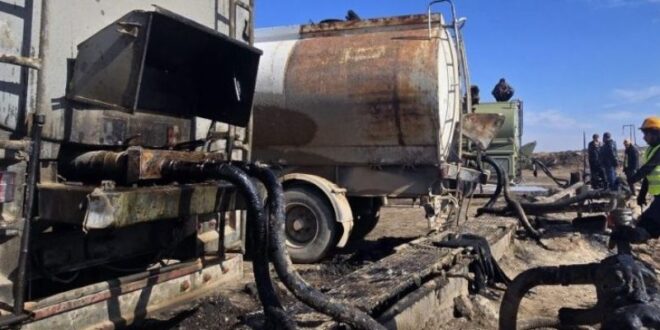
Syria today faces a severe crisis in energy resources, which form the backbone of the national economy and directly affect the Syrian state’s ability to provide basic services, from electricity, water, and transportation to operating factories and public facilities.
Despite a relative improvement in electricity supply in recent months, electricity prices have risen to levels that exceed most citizens’ financial capacity compared with average incomes, has raised questions about the benefits of regaining control of oil fields and their production. Questions have also emerged regarding the government’s role in extracting these oil reserves to operate power generation plants and who will ultimately bear the cost of oil investment contracts.
Before 2011, oil was one of the main pillars of the Syrian economy and a key source of foreign currency. Today, after more than a decade of war, Syria faces a completely different reality marked by declining production, aging infrastructure, a wide gap between consumption and production, and an investment file that is still taking shape.
With the war largely over, the state regaining most oil fields, and an agreement reached with the Syrian Democratic Forces (SDF), restoring previous production levels still faces major challenges. The most significant include the technical deterioration of oil and gas wells and damaged infrastructure that hinders foreign investment and the development of necessary technologies.
Oil’s importance was not limited to direct revenues. It also contributed to financing the state budget, subsidizing fuel and electricity, supporting the Syrian pound by supplying the central bank with foreign currency, and funding infrastructure projects.
In this report, Enab Baladi reviews Syrian oil and gas figures before 2011, during the war, and after the state regained control of the oil fields. It examines the impact of declining production on the economy, the cost of imports, the most important fields and their production levels, the local and foreign companies operating or interested in investment, and the technical, financial, and political challenges surrounding the sector’s future.
Oil reality: conflicting statements and declining production
With the outbreak of war in Syria and the government losing control of most oil fields between 2012 and 2013, production from fields concentrated in northeastern Syria declined sharply. Different actors, including the Syrian Democratic Forces (SDF), controlled these fields, while little attention was given to maintenance or exploration activities. The country also remained under strict sanctions, most notably the Caesar Act.
Syria’s proven oil reserves are estimated at around 2.5 billion barrels, ranking it 32nd globally among countries with the largest oil reserves, according to data from the Energy Platform.
Production levels before 2011
Precise figures on Syria’s oil production remain difficult to verify due to the lack of transparency in a sector that has long been shrouded in secrecy, regardless of the authority controlling it, from the Assad regime to the SDF, along with conflicting statements from Syrian officials today.
Most economic reports, including data from the US Energy Information Administration and S&P Global Commodity Insights, indicate that Syria produced about 385,000 barrels of oil per day before the outbreak of the Syrian revolution in 2011. Of this amount, the domestic market consumed around 200,000 barrels daily, while the remainder was exported.
Economic and political analyst specializing in Middle East affairs Mohammed al-Ftayeh told Enab Baladi that officials in the oil sector under the former regime used to cite a figure of about 80,000 barrels per day. However, this number included production from northeastern Syria under SDF control, while other regions produced only between 5,000 and 10,000 barrels per day.
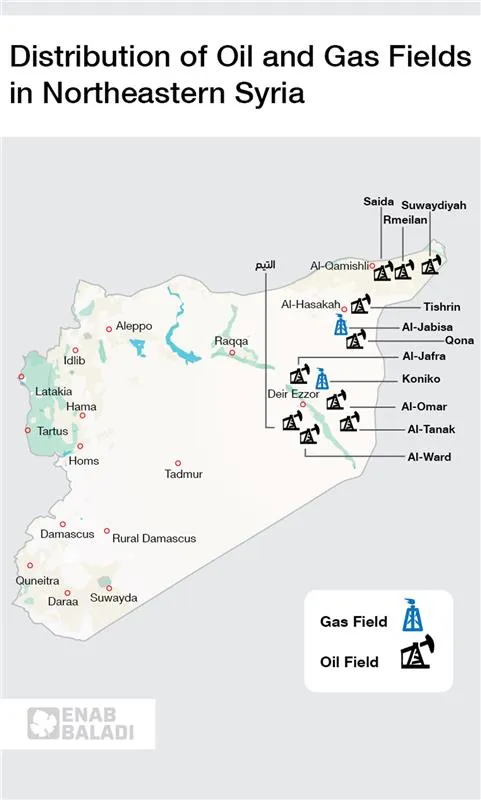
Major oil and gas fields before 2011
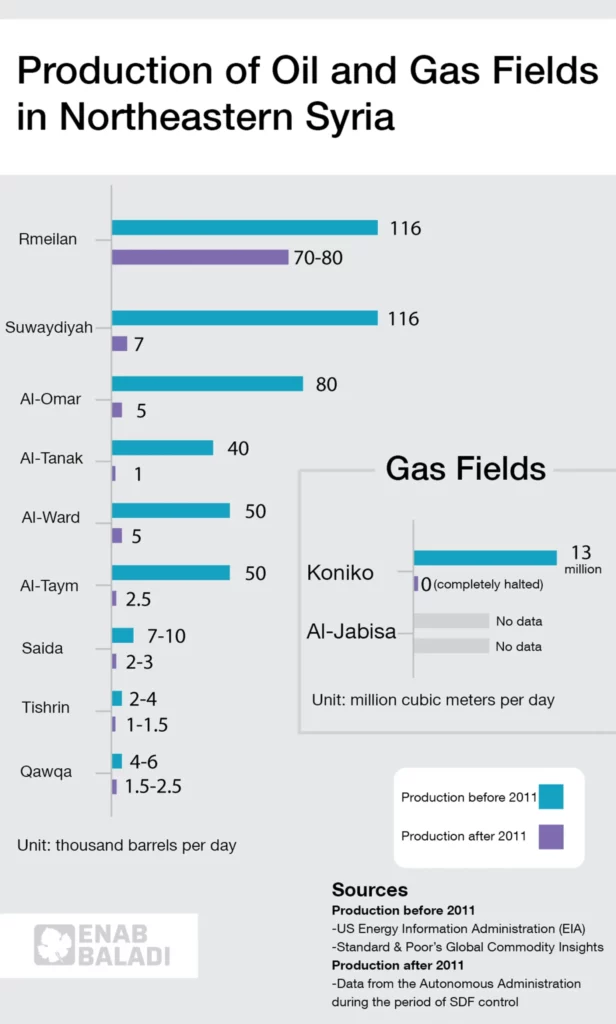
Rmeilan field: 116,000 barrels per day.
al-Suwaydiyah field: 116,000 barrels per day.
al-Omar field: 80,000 barrels per day.
al-Tanak field: 40,000 barrels per day of relatively light crude.
al-Ward and al-Taim fields: about 5,000 barrels per day, later downgraded from fields to stations due to depletion.
Koniko gas field: 13 million cubic meters of natural gas daily.
al-Shaer field: about 7 million cubic meters of gas daily.
Jihar field: about 3 million cubic meters daily.
Saida field: between 7,000 and 10,000 barrels daily.
Tishreen field: between 2,000 and 4,000 barrels daily.
Qoneh field: between 4,000 and 6,000 barrels daily.
Major fields: collapse in production capacity
Rmeilan field: once produced 116,000 barrels daily but declined to between 10,000 and 20,000 barrels. However, Ahmad Ibrahim, the SDF fields director, said production fell from 110,000 to about 70,000 to 80,000 barrels due to “emergency circumstances,” reflecting major discrepancies in figures.
al-Suwaydiyah field: dropped from 116,000 barrels to around 7,000 barrels per day.
al-Omar field: declined from 80,000 barrels to around 20,000 barrels daily.
al-Tanak field: fell from 40,000 barrels to about 1,000 barrels daily.
al-Ward and al-Taim fields: al-Ward dropped to 5,000 barrels daily and al-Taim to about 2,500 barrels.
Koniko gas field: completely stopped production after producing 13 million cubic meters daily before 2011.
al-Shaer and Jihar gas fields: production declined due to military operations, with no precise figures available.
Saida field: after 2013, production dropped to between 2,000 and 3,000 barrels daily due to aging wells and the absence of artificial lift technologies.
Tishreen field: declined to between 1,000 and 1,500 barrels daily due to mechanical failures and spare parts shortages.
Qoneh field: between 2016 and 2025, production fell to between 1,500 and 2,500 barrels daily, with limited well operations and reliance on primitive “burners” to refine part of the output.
Production since the start of the war
According to S&P Global Commodity Insights and data from the Autonomous Administration and media outlets close to it, production under SDF control has sharply declined since 2012 and 2013.
As the SDF expanded its control over most oil and gas fields east of the Euphrates River, production gradually decreased to unprecedented levels. Available data indicates a decline exceeding 80 percent compared with pre-war levels, amid a lack of proper maintenance and reliance on rudimentary operational methods.
Current government increases “ambiguity”
In January, Syrian Energy Minister Mohammed al-Bashir told a television channel that Syria produces about 100,000 barrels of oil per day. He said production in northeastern Syria ranges between 80,000 and 110,000 barrels, while areas under state control produce only about 15,000 barrels daily.
However, in mid-February, al-Bashir stated during a press conference that Syria produces only a quarter of its daily needs of 150,000 barrels, meaning roughly 40,000 barrels per day. The difference reflects a clear contradiction in official figures.
According to economic analyst Mohammed al-Ftayeh, even if the higher figure of 100,000 barrels daily were accurate, production would still cover only about two thirds of current consumption estimated at 120,000 barrels daily. Production is also expected to continue declining as wells age and demand rises.
Syrian academic Ziad Arbache told Enab Baladi that production figures before 2011 and during the war were confined to a narrow circle, making ambiguity a defining feature of the sector. al-Ftayeh added that the SDF did not disclose accurate figures and that recent government statements have increased the uncertainty.
The contradiction in the Syrian energy minister’s statements stems from a lack of accurate information, the complexity of control over the fields, and the historical sensitivity of the oil file.

Ziad Arbache

Syrian academic expert
Al-Ftayeh believes the contradiction in the Syrian energy minister’s statements stems from a lack of precise information and the complexities surrounding control of the oil fields, in addition to the historical sensitivity of the oil file. Officials, he said, have long avoided acknowledging the decline in production since the early 2000s. He cited earlier statements by the oil minister in 2004 warning that Syria’s oil could be depleted by 2020, as well as remarks by the prime minister that Syria would become an oil importer by 2015, before both statements were later walked back.
No response from the Ministry of Energy
Enab Baladi contacted Abdul Hamid Salat, director of public relations and media at the Ministry of Energy, asking about the oil fields the ministry had taken over in northeastern Syria, whether any fields remain outside government control, the reasons for that, plans to develop production, and the current output and its contribution to the domestic market.
Salat declined to answer the questions and asked the newspaper to contact the Syrian Petroleum Company, which is affiliated with the Oil and Mineral Resources Administration at the ministry. The company also did not respond to the inquiries.
Government measures: rehabilitation and investment
Operations room to sustain oil production
On February 5, the Syrian government announced the start of procedures to take over the two largest oil fields in northeastern Syria, Rmeilan and al-Suwaydiyah in al-Hasakah governorate, as part of an agreement with the Syrian Democratic Forces (SDF) to return resources to central state control.
The government began practical steps to evaluate the condition of these facilities and assess their technical readiness. Technical representatives from the Syrian Petroleum Company visited the Rmeilan fields in al-Hasakah to inspect the condition of oil fields and vital infrastructure.
Earlier in January, the company also visited the al-Omar field in Deir Ezzor governorate (eastern Syria) and announced the takeover of the al-Rasafa and Safyan fields and the strategic al-Thawra oil complex. An emergency operations room was established to ensure continued production and protect infrastructure.
Technical teams from the Ministry of Energy also inspected the al-Tanak field and its stations, and other sites in Deir Ezzor governorate (eastern Syria), including al-Jedo, al-Maleh, al-Azraq, and al-Ghalban, as well as the al-Omar field and its associated facilities, to determine rehabilitation requirements.
Timeline for rehabilitating the fields
Initial assessments by the Syrian Petroleum Company show that the reclaimed fields suffer from major declines and extensive infrastructure damage caused by unregulated operations.
Mousa al-Jabbara, director of field regulation, said in a February statement by the Ministry of Energy that restoring the fields to normal conditions could take three years. The ministry also announced the activation of an emergency operations room to coordinate field teams and ensure continuity of operations.
Economic expert Firas Shaabo told Enab Baladi that rehabilitation could take one to two years to increase production by 50 to 60 percent, while returning to pre-war levels may require four years if global companies such as Shell and Chevron become involved.
Challenges to rehabilitation
Shaabo identified several key challenges:
Lack of funding for well maintenance.
Damage to pumping stations and pipelines.
Need for modern technologies not available to the government.
Continued security risks in some areas.
Economic expert Ayman Dasouki added other obstacles, including:
Legal issues concerning wells previously operated by foreign companies.
Weak investment attractiveness amid security instability.
Shortage of qualified Syrian personnel.
The time factor, as rehabilitation may take one to three years.
High costs and a weak investment environment.
Shaabo said the cost of rehabilitation cannot be estimated without a detailed study, but it will likely amount to billions of dollars. He stressed that low investor confidence, the depreciation of the Syrian pound, and banking policies require comprehensive reform to attract global companies.
Nevertheless, he believes that increasing production to meet domestic demand could be achieved within two to three years after rehabilitation, reducing import costs.
Investment companies before and after the war
Since its early development, Syria’s oil sector has seen investments from the Syrian Petroleum Company and several international firms, most notably Shell, one of the largest foreign investors, as well as TotalEnergies, Gulfsands, Croatia’s INA, and Russia’s Tatneft.
Currently, two Saudi companies and three US-based firms are reportedly forming a consortium to explore and produce oil and gas in northeastern Syria. Reuters reported on February 10 that Baker Hughes, Hunt Energy, and Argent LNG plan to develop an energy project with Saudi Arabia’s ACWA Power and TAQA.
Representatives of these companies held meetings with the Syrian Petroleum Company in early February. According to Reuters, the project may include four to five exploration sites in northeastern Syria, and Argent LNG CEO Jonathan Bass expects a memorandum of understanding to be signed in the coming weeks.
Economic analyst Mohammed al-Ftayeh said the entry of these companies, if confirmed, would be crucial for rehabilitating oil fields and reviving wells. He noted that Syria began injecting distilled water into some fields nearly three decades ago to sustain production.
Offshore exploration in Syrian waters
On February 4, the Syrian Petroleum Company signed a memorandum of understanding with Chevron International and Power International Holding to explore Syria’s first offshore oil field.
According to the Ministry of Energy, the agreement aims to open new prospects for offshore oil and gas exploration in Syrian territorial waters and strengthen national energy security.
The media office of the Syrian Petroleum Company told Enab Baladi that the memorandum involves the two companies conducting exploration and drilling operations in Syrian waters.
In the absence of official figures on Syria’s offshore reserves, a June 1, 2025 report by the Energy Platform estimated Syria’s proven natural gas reserves at around 430 billion cubic meters.
Mohammed al-Ftayeh said there are no reliable estimates for potential oil or gas reserves off the Syrian coast, noting that recent exploration in Lebanon and northern Cyprus showed limited economic viability.
However, economic adviser Ziad Arbache believes that announced investments could increase production enough to fully cover domestic consumption.
Block 26, Gulfsands, and Makhlouf
Block 26 is located in northeastern Syria, an area the Syrian army recently regained control over. The block is rich in oil resources and covers a large area estimated at about 5,529 square kilometers. It was previously operated by the British company Gulfsands and includes several fields such as East Kharbet, al-Yusufiyah, and al-Khairat.
The British company obtained an exclusive contract to invest in Block 26 under Legislative Decree No. 43 of 2003, after Syrian businessman Rami Makhlouf, a cousin of former Syrian president Bashar al-Assad, acquired a stake in the company through the Mashreq Fund Group. The company halted operations in 2011 due to British sanctions and later European sanctions imposed on the former Syrian regime.
In August 2025, Gulfsands CEO John Bell held talks with Syrian Energy Minister Mohammad al-Bashir regarding the possibility of the company resuming work on rehabilitation and development projects in Syria’s oil fields, according to the Syrian Arab News Agency (SANA) at the time.
To determine whether similar exploration contracts would be signed between the company and the Syrian government, whether the company would be compensated for the losses it incurred after the fields left government control in 2013, and whether it would resume using the state owned Rmeilan company’s collection and pumping facilities, Enab Baladi sent a set of questions to John Bell via LinkedIn, but had not received a response by the time of publishing this report.
A director in the Oil and Mineral Resources Administration at the Syrian Ministry of Energy agreed to speak to Enab Baladi on condition of anonymity for administrative reasons. He revealed that Gulfsands, in which Rami Makhlouf holds a stake, is a partner with Dijla Petroleum Company (DPC) in investing in oil fields in the far northeastern part of Syria. However, the two companies have not resumed operations in the fields.
The official described the Syrian government’s overall vision, particularly that of the Ministry of Energy, regarding the oil sector as “unclear,” while the Syrian Petroleum Company is attempting to begin operations.
The Syrian official added, “This depends on rebuilding trust between local communities in oil field areas and the company, completing the company’s organizational structure, establishing a clear working mechanism with operating companies such as al-Furat, Dijla, and Deir Ezzor, and determining which foreign company will partner with the Syrian Petroleum Company and how issues related to international firms such as Gulfsands, which still considers itself a partner in companies such as Ebla, Dijla, and Hayyan, will be addressed.”
Shell Withdrawal, Speculation, and the Government’s Position
Regarding the reasons behind the withdrawal of the British company Shell, the same official said there has been widespread speculation among workers in the oil sector about how to interpret the company’s exit from Syria and its decision not to renew operations.
He added that some believe the company anticipated difficulties in modernizing oil wells and rising levels of soil contamination, which would significantly increase production costs, and that it preferred to invest in locations considered “untapped and safer.” Others believe the quantities expected to be extracted from its previous fields are no longer economically viable, particularly given Shell’s strict safety and environmental standards. All these interpretations remain part of the speculation circulating within oil sector circles, according to the official.
Syrian Petroleum Company CEO Youssef Qablawy said on January 19 that Shell had requested to withdraw from the al-Omar oil field in Deir Ezzor governorate (eastern Syria) and transfer its share to the Syrian government. He explained that Syria is still negotiating with the company over the terms of a financial settlement aimed at securing full ownership of the field.
During a press conference held by the Syrian Petroleum Company at the al-Omar field, attended by Enab Baladi, Qablawy said the field had previously been operated as a joint venture between the Syrian Petroleum Company and Shell. He added that the company had requested a full withdrawal and that work is underway to finalize a financial settlement in preparation for transferring full ownership of the field to the state.