 Eurasia Press & News
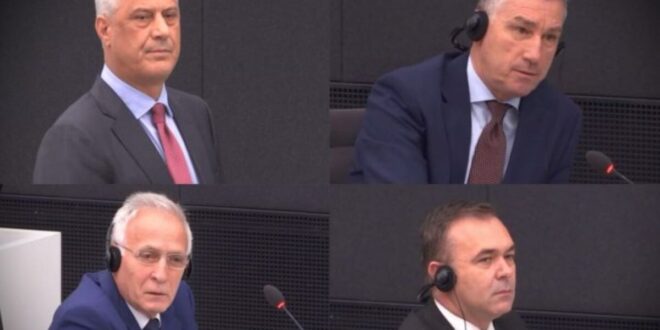
The three days of February 16, 17 and 18, 2026 were a confluence of interrelated events of historical significance for the United States, Kosovo, and the Kosovo Specialist Chambers, which is in the final process of establishing its legacy.
On February 16, the US celebrated George Washington’s birthday, the annual holiday commemorating America’s first president who served exactly 250 years ago at the founding of our democracy in 1776 with the signing of the Declaration of Independence.
This followed the bloody war for independence fought by insurgent citizens-turned-soldiers and led by Washington against the tyrannical British Empire.
On Tuesday, February 17, Kosovo celebrated its 18th Independence Day, honouring the fight for freedom by the Kosovo Liberation Army’s citizens-turned-soldiers from the shackles of Serbian oppression during a horrific war perpetrated by the forces of Slobodan Milosevic.
During the 1998-99 war, there were upwards of 10,000 Albanian deaths, greatly outnumbering Serbian casualties, and as many as one million displaced Albanians – men, women and children – forced to flee their homes and country as a result of Milosevic’s policy of ethnic cleansing.
But four of Kosovo’s war heroes, Hashim Thaci – dubbed “Kosovo’s George Washington” by former US president Joe Biden – Kadri Veseli, Rexhep Selimi and Jakob Krasniqi, were unable to attend the commemoration. They have been languishing in detention since November 2020, at the Kosovo Specialist Chambers, KSC, in The Hague, standing trial for alleged war crimes and crimes against humanity.
In 2008, Thaci, then prime minister, and Krasniqi, then assembly speaker, both signed Kosovo’s Declaration of Independence. This year, in their absence, tens of thousands of Kosovar citizens marched through the capital, Pristina, shouting their support for the four, for the KLA struggle, and in opposition to the KSC.
This followed previous demonstrations of a similar nature last year in Pristina, The Hague, Tirana, Strasbourg, and Skopje.
Then on Wednesday, February 18, the court itself reached a milestone. After thirty months of pre-trial proceedings, followed by a trial of nearly three years, the presiding judge declared the trial over following impassioned closing statements by the defendants themselves. They declared their innocence and extolled their fight for freedom and love of their country.
The trial panel now has 90 days to issue a judgment, with an additional 60 days available if necessary. It is likely that the defendants will remain in detention until that point.
The judgement of the court, whatever it might be, will have enormous consequences, not only for the defendants themselves, but for Kosovo and well beyond.
It will also determine the court’s legacy: will it go down in history as a stellar example of transitional justice, holding perpetrators of heinous war crimes accountable? Or will it be perceived as a flawed decision by a rogue court that never should have been created in the first place, targeting unjustly and exclusively KLA war heroes and liberators, and their valiant battle for freedom and dignity?
Command responsibility?
Thaci and his fellow defendants are accused of individual as well as command responsibility, and for participating in a joint criminal enterprise, for crimes perpetrated against persons who opposed the methods of the KLA and its political ambitions.
The offences allegedly occurred at 50 KLA detention sites throughout Kosovo and northern Albania between March 1998 to September 1999, during and shortly after the war.
They included war crimes and crimes against humanity, including illegal detention, cruel treatment, persecution, enforced disappearances, torture, and as many as 102 murders. The victims, many of whom were civilians, included Serbians, Albanian alleged collaborators, and members of various minority groups.
Because the defendants have all pleaded not guilty, prosecutors are required to prove any charge beyond a reasonable doubt, the highest standard of proof within the criminal justice system.
Beginning in April 2023, the prosecution called 125 witnesses to testify in court, plus others who testified under measures to protect their identities. The court also accepted into evidence thousands of documentary exhibits, including controversial records from various Serbian officials.
The defence case lasted all of several days in September last year, when seven high-level US and international officials took the stand.
One was US General Wesley Clark, who commanded the 11-week NATO air campaign that drove Serbian forces from Kosovo by June 1999.
Another was James Rubin, a former assistant US Secretary of State under Madeleine Albright, one of the chief architects, along with then US President Bill Clinton, of the NATO campaign. Former US ambassador Christopher Hill was another.
All seven witnesses supported the defence’s assertion that the KLA, which became NATO’s ally on the ground, was not well structured, but rather was a loose assemblage of guerilla freedom fighters built from the ground up; that there was no command responsibility and no Joint Criminal Enterprise; and that the defendants were not responsible, either individually or otherwise, for crimes that may have been committed by KLA soldiers in the field. Krasniqi’s lawyers presented two witnesses, the others none, but the testimony of Thaci’s witnesses applies to all.
Closing arguments concluded on February 18, after which the trial was declared closed, and the panel took the case under advisement. It is now up to the court to review all the evidence; to make findings of fact and conclusions of law; to carefully explain its reasoning; to issue a verdict, guilty or not guilty, or some combination; and to impose a sentence for any crimes that have been proven beyond a reasonable doubt.
Controversial from the outset
The very existence of the KSC has been controversial from the outset. Its genesis was the infamous Marty Report in 2010 which alleged heinous crimes committed by the KLA, including human organ trafficking, and which named Thaci among the alleged perpetrators.
In response, a Council of Europe resolution of January 2011 urged states to pursue the allegations further. This was followed by the investigation of the Special Investigative Task Force which, in 2014, validated many of Marty’s allegations and stated that there was enough evidence to proceed to trial, but only if a special court could be created to do so.
As a result of intense international pressure by Kosovo’s Western benefactors, the Kosovo assembly, in 2015, reluctantly amended the constitution to authorise the court and then enacted the Law on the Specialist Chambers and Specialist Prosecutor’s Office.
Only KLA veterans would be subject to the court’s jurisdiction, not Serbians. The court would operate under Kosovo’s justice system but be located elsewhere and staffed completely with internationals in the perceived interest of protecting witnesses from intimidation.
Ironically, Veseli, who was parliament speaker at the time, signed both the constitutional amendment and the Law.
It took until 2017 for the court to become operational in The Hague, and then another three years of investigation by prosecutors before the indictment against Thaci et al. was filed in November 2020.
The European Union pays most of the running costs, almost 400 million euros to date.
One could argue that an operation of this scope and magnitude, conceived under strong international pressure, was created with the expectation by its supporters that any KLA defendants would be convicted rather than acquitted, especially those perceived as “big fish” like Thaci. In other words, convictions were the whole point.
High stakes
There have also been many complaints against the court as proceedings have progressed.
It is repeatedly claimed by Kosovars that the court is biased because it has only prosecuted KLA members; that the defendants have been improperly detained; that the proceedings have taken too long; that there has been too great a reliance on protected witness; that evidence from Serbia should never have been admitted; and that the court in its verdict may end up rewriting and negating the history of Kosovo’s fight for freedom, and equalising the responsibility of Kosovo and Serbia for the atrocities of the war.
The court and the prosecution have repeatedly asserted that the KLA is not being prosecuted, only the individual defendants. This assertion stretches credulity and is roundly rejected in Kosovo. Indeed, the prosecution case alleges that KLA soldiers in the field are responsible for hundreds of crimes all over Kosovo and northern Albania.
If the defendants are found guilty, it will likely be met with rage from the general population of Kosovo, as an unjust conviction and a contrived rewriting of history.
Conversely, Serbia would be jubilant. Kosovo’s war for freedom would be viewed as nothing more than a joint criminal enterprise, which Serbia would tout internationally and in its dealings with Kosovo. This would probably make the normalisation of their fraught relationship even more difficult. But the EU would be well satisfied, given its enormous investment.
If, against most expectations, the defendants are found not guilty, the verdict will reverberate across Kosovo as a monumental victory, one that acknowledges the justness of the KLA war.
The defendants would return home as heroes to the free and proud country they helped to create and likely re-enter politics.
An acquittal would also enhance Kosovo’s international standing, which has been rising noticeably recently with its new, strong government. No longer would the uncertainty of this case, and the hostility it generates, hang over the country like the sword of Damocles.
An example of Kosovo’s rising standing is President Vjosa Osmani’s appointment by US President Donald Trump to his international Board of Peace, which had its first meeting in Washington on February 19.
Say what you will about the Board, but the visual impact of several photos, which have circulated worldwide, showing Osmani next to Trump, cannot be overstated. Her involvement could enhance her upcoming re-election prospects. Serbia, it should be noted, is not a member, but Albania is.
Implications for international and transitional justice
During the Washington meeting, Albanian Prime Minister Edi Rama implored Trump to help to correct, in his view, the injustice being perpetrated by the Kosovo Specialist Chambers.
While Trump’s options may be limited since the case is in its final phase, he would likely be pleased by an acquittal, particularly because of Jack Smith’s involvement in the case as the chief prosecutor who filed the indictments in 2020.
Contrary to procedural rules, Smith announced the indictment in June 2020 before it was confirmed and just as Thaci was flying to Washington to meet with Trump and Serbian President Aleksandar Vucic.
The US president was pushing for a deal on better relations between the two but the meeting was scuttled as Thaci returned home, denying Trump a foreign policy success before his re-election bid later that year.
Smith later became the US special prosecutor who indicted Trump for alleged crimes committed in relation to the election in 2020 and its aftermath. The cases were ultimately dismissed, but Trump harbours an intense grudge.
While the EU would welcome a conviction, an acquittal would have the opposite effect: where did all our money go?
Regarding the defendants themselves, if they are found guilty, the court’s judgement will include the sentence for each, having denied a defence request for a separate sentencing hearing in the event of a conviction.
The prosecution has asked for a sentence of 45 years for each. Given their ages, this would clearly translate to life sentences even though they have substantial credit for time served since early November 2020.
Separately, a single judge of the court is about to begin the trial in a different case in which Thaci and others are charged with mishandling confidential information about prosecution witnesses and attempting to influence their testimony in Thaci’s war crimes case.
A conviction could result in a prison sentence, but Thaci also has credit for time already served. One might question whether it is fair to proceed with this trial while the main case is under advisement.
The court’s legacy will also have implications for international and transitional justice. Was this hybrid model a reliable means of establishing justice and holding perpetrators accountable, or was it a terrible waste of time and resources, and an insult to freedom and liberty?