 Eurasia Press & News

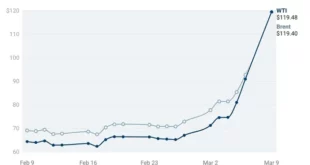
Disrupted energy markets due to continued hostilities are the most immediate economic challenge, with global reverberations, as the Strait of Hormuz is essentially unnavigable and crude oil prices continue to rise.
Europe is highly dependent on energy imports from the Gulf after weaning itself off Russian energy after the full-scale invasion of Ukraine, seeing gas prices rise 60 percent since the onset of Operation Epic Fury.
The increased gas and oil prices have led to widespread concern of an inflation shock and have cast a shadow over any near-term interest rate cuts.
The Gulf states’ relative stability and security in the region have made it the hub for a host of sectors — from aviation to financial —that are now under pressure and will remain so if it is unable to restore stability.
The launch of Operation Epic Fury last weekend and the subsequent Iranian retaliatory strikes across the Middle East have unleashed global economic repercussions. Global energy markets are the most immediately affected, as the Strait of Hormuz has effectively been rendered unnavigable and the energy infrastructure of the Gulf States has been hit, raising oil and gas prices worldwide. Giant shipping and logistics companies that form the backbone of the global economy have halted operations in the region, including Maersk and Mediterranean Shipping Company, ceasing all bookings for worldwide cargo to the Middle East. The conflict is also draining the warring parties’ resources. Nancy Youssef, a journalist at The Atlantic, has reported that the Pentagon estimates the ongoing conflict could cost the U.S. up to $1 billion per day, according to a congressional source. This figure likely does not account for the broader cascading effects of these strikes and how they may impact the U.S. economy in both the short and long term.
Disrupted energy markets as a result of continued hostilities are the most immediate economic issue with global reverberations. According to Bob McNally, former energy advisor to former President George W. Bush, “a prolonged closure of the Strait of Hormuz is a guaranteed global recession.” Before the conflict, around 20 million barrels of oil, approximately 20 percent of the world’s liquid petroleum, passed through the Strait of Hormuz. Aside from shipping companies halting operations, insurance providers have issued “Notice of Cancellation” clauses for war-risk coverage, meaning commercial vessels are legally and financially unable to transit the Persian Gulf. The continued strikes on oil infrastructure in the Gulf States are also further spiking global energy prices.
The impacts of this disruption are global and immediate: for Europe, which is highly dependent on imported liquified natural gas (LNG), prices have already risen 60 percent since the start of the U.S.-Israeli military campaign. Long-term price hikes can spell doom for the European economy and unleash a recession. Europe’s heavy reliance on imports from the Gulf is a result of its strategy since 2022 to wean itself off Russian energy imports. On Wednesday, Russian President Vladimir Putin suggested they halt natural gas supplies to Europe, stating Russia may have better success in emerging markets amid the price surge caused by the Iran crisis and continued EU efforts to become less reliant on Russian energy. The People’s Republic of China (PRC), as well as other Asian countries, including India, Japan, and South Korea, will also be heavily impacted as they extensively import both oil and Liquefied Natural Gas (LNG) from the Persian Gulf.
QatarEnergy, Qatar’s state-owned petroleum company, has declared force majeure due to the recent hostilities, and all gas liquefaction activities in the country have been halted. It is not only the Gulf state’s production capacity that has been hit. Iraq’s production loss has exceeded 2 million barrels per day, with an additional 1.5 million barrels per day threatened over the next few days, according to reporting by the Financial Times.
As Israel and the U.S. continue strikes on key nodes of the Iranian Regime, retaliation may increasingly focus on oil and energy infrastructure to make the war increasingly cost-prohibitive and impactful long-term. Disrupting energy flows is likely, in Tehran’s view, one of the most direct ways it can make the war palpable to ordinary American citizens. On Thursday, the Islamic Revolutionary Guard Corps (IRGC) already announced that it targeted a U.S. tanker in the northern part of the Gulf and that the ship caught fire. Roughly 3,000 ships remain stuck in the Gulf following the closure of the Strait of Hormuz, according to Clarksons Research, a maritime research service.
Stock markets have also reacted to the continuation of hostilities. The increased gas and oil prices have led to widespread concern of a global inflation shock and, in the U.S., have cast a shadow over any near-term interest rate cuts. On Tuesday, Reuters reported that the Dow Jones was down 0.8 percent, and the S&P 500 was down 0.9 percent. However, some financial experts, such as Goldman Sachs’ Chairman and CEO David Solomon, remarked that this reaction was somewhat “benign.” Solomon believes that the market had not yet realized the implications of this war. This may be due, in part, to the rather tumultuous state of global affairs over the last two years, marked by short bursts of conflict that the market often reacted to with immediate volatility, only to stabilize shortly thereafter. Nevertheless, the current conflict may have longer-lasting market implications than events such as the capture of Venezuelan President Nicolás Maduro.
For the Gulf States, particularly, the hostilities may prove especially economically damaging in the long term. As The Soufan Center has previously reported, a key component of the Gulf’s economic strategy has been diversification, hedging against its gas and oil profits economically. One of the most important parts of that strategy in recent years has been its major investments in AI, from infrastructure to research centers, most notably data centers. According to reports, three data centers have already been struck since the start of the conflict, and global AI companies may reconsider their investments in the region after this conflict. This points towards the more significant issue at hand for the Gulf States: its relative stability and security in the region have made it the hub for a host of different sectors that are now all under pressure – from aviation to the financial sector – and will continue to be, if it is unable to restore stability.