 Eurasia Press & News
NOTE: ISW-CTP will not publish morning updates covering the war with Iran on March 14 and 15. ISW-CTP will publish threads on its social media channels in the morning on these days that cover the latest developments in the war and include relevant maps.
CORRECTION: ISW-CTP removed a sentence that incorrectly stated that the K1 base in Iraq hosts US and foreign troops. The Iraqi government assumed control of the base in 2020. ISW-CTP is also updating its assessment that Iranian-backed Iraqi militias conducted the attack on the K1 base upon further reports that a combined force strike targeted PMF positions at the base.
Key Takeaways
 The US-Israeli combined force continued to target Iranian internal security infrastructure on March 13 in order to degrade the regime’s repressive capabilities. Israeli Prime Minister Benjamin Netanyahu stated on March 12 during his first press conference since the war started that Israel is “creating the optimal conditions for toppling the regime.”
The combined force has continued to target Iranian defense industrial sites across Iran. US Defense Secretary Pete Hegseth stated on March 13 that US and Israeli strikes have “functionally defeated” Iran’s ballistic missile production capacity by destroying Iran’s defense companies and production lines across Iran that manufacture missile components.
Iran is selectively allowing some ships to transit through the Strait of Hormuz. ISW-CTP has not observed any Iranian attacks against civilian vessels in the Strait of Hormuz since Iran struck a Chinese-state-owned Liberian-flagged vessel at 10:19 PM ET on March 11. Iran seems to be trying to disrupt commercial shipping with missiles and drones while avoiding the economic and political consequences of mining the Strait completely.
Israeli officials are reportedly discussing the potential expansion of Israeli ground operations in Lebanon. Israeli media reported that Israeli security and defense officials are examining several options, ranging from an expansive ground operation reaching the Litani River to more limited actions in southern Lebanon.
Toplines
The US-Israeli combined force continued to target Iranian internal security infrastructure on March 13 in order to degrade the regime’s repressive capabilities. The combined strikes targeted Law Enforcement Command (LEC) sites, specifically connected to the traffic and economic security police units, in Gharchak, Tehran Province.[1] The Israel Defense Forces (IDF) separately struck Basij checkpoints in Tehran Province on March 12 and 13, including two in northeastern and southeastern Tehran Province.[2] Basij and other Iranian security personnel have dispersed from fixed checkpoints and taken cover in locations, such as highway underpasses and bridges in cities, including Rasht, Gilan Province, and parts of Tehran Province, likely to reduce exposure to drone surveillance and follow-on strikes.[3] The combined force has repeatedly targeted elements of Iran’s internal security apparatus, including the LEC, Basij, and IRGC units, that are responsible for suppressing protests and maintaining domestic control.[4] Israeli Prime Minister Benjamin Netanyahu stated on March 12 during his first press conference since the war started that Israel is “creating the optimal conditions for toppling the regime.”[5] Netanyahu noted that a regime needs to be “topped from the inside” but added that “[Israel] can definitely help” and is helping.[6] The IDF also reported that it targeted IRGC, LEC, and Basij command elements in Tehran during a new wave of strikes on March 13.[7]
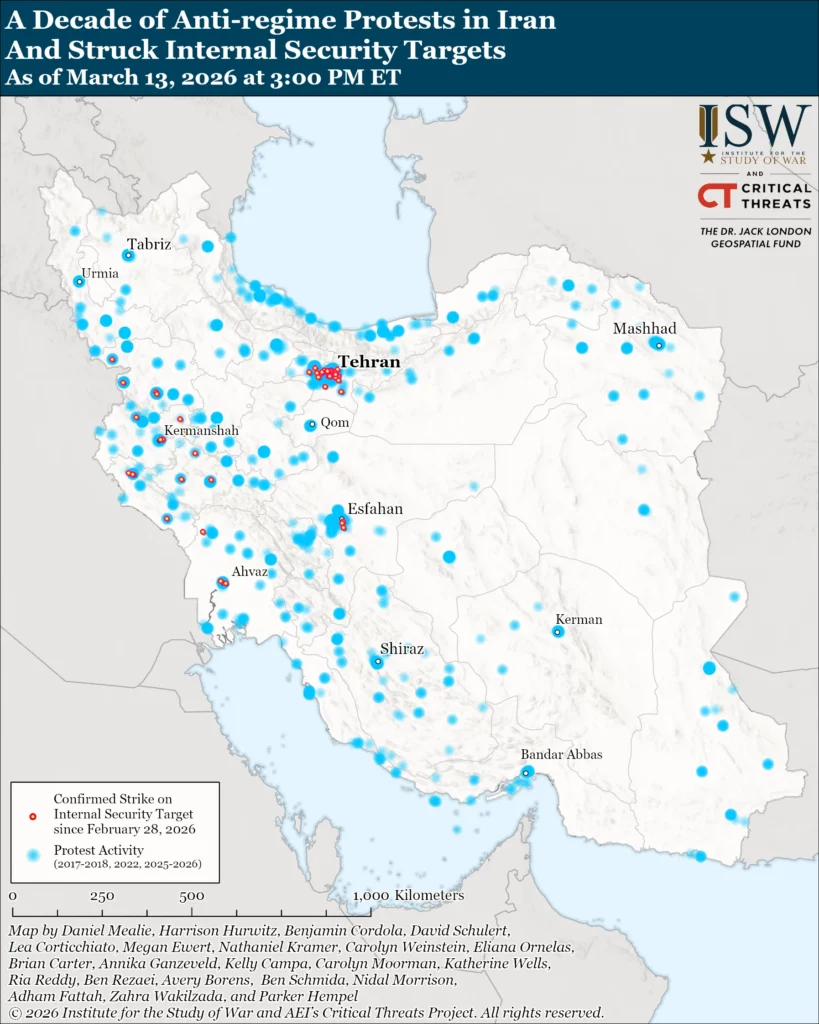
The combined force has severely degraded Iran’s missile and drone capabilities, which has limited Iran’s ability to launch retaliatory attacks in the region. A senior IDF official said that Israel has destroyed 160 to 190 launchers and disabled another 200 launchers.[8] Bloomberg reported on March 12 that Western countries estimate that the combined forces’ strikes have destroyed 80 percent of Iran’s total offensive capability.[9] The senior IDF official noted that Iranian missile crews are reportedly afraid to go out and that there are desertions as well as refusals to follow orders.[10] The official added that Iranian security force casualties are estimated to be at least 10,000.[11] Anti-regime media, citing informed sources, previously reported that the IRGC attempted to mobilize reserve forces earlier this week, but several individuals did not report to military centers.[12]
Iran is selectively allowing some ships to transit through the Strait of Hormuz. Sources with direct knowledge of the matter told Reuters on March 13 that Iran has allowed two Indian-flagged liquefied petroleum gas (LPG) carriers to sail through the Strait.[13] A crude tanker is also reportedly expected to arrive in India on March 14 with Saudi Arabian oil after sailing through the Strait on March 1.[14] The Turkish Transport and Infrastructure Minister separately said that Iran allowed a Turkish-owned ship to traverse the Strait.[15] Fars News reported that it allowed the Turkish ship passage because it was using an Iranian port.[16] Iranian Ambassador to Iraq Mohammad Kazem al Sadegh said on March 13 that Iraqi oil tankers are permitted to pass through the Strait if they provide their identity and destination and certify that they are not owned by a US or Israeli company.[17] United Nations data shows that maritime traffic through the Strait has dropped by 97 percent since the war began.[18]
CTP-ISW has not observed any Iranian attacks against civilian vessels in the Strait of Hormuz since Iran struck a Chinese state-owned Liberian-flagged vessel at 10:19 PM ET on March 11.[19] The United Kingdom Maritime Trade Organization (UKMTO) has reported over 20 maritime incidents in and around the Strait since March 1, however.[20] Iran seems to be trying to disrupt commercial shipping with missiles and drones while avoiding the economic and political consequences of mining the Strait completely. Unspecified US officials told the Wall Street Journal on March 10 that Iran has deployed fewer than 10 naval mines in the Strait so far, which means that Tehran has not yet attempted a large-scale mining effort.[21]
US and Israeli Strike Campaign
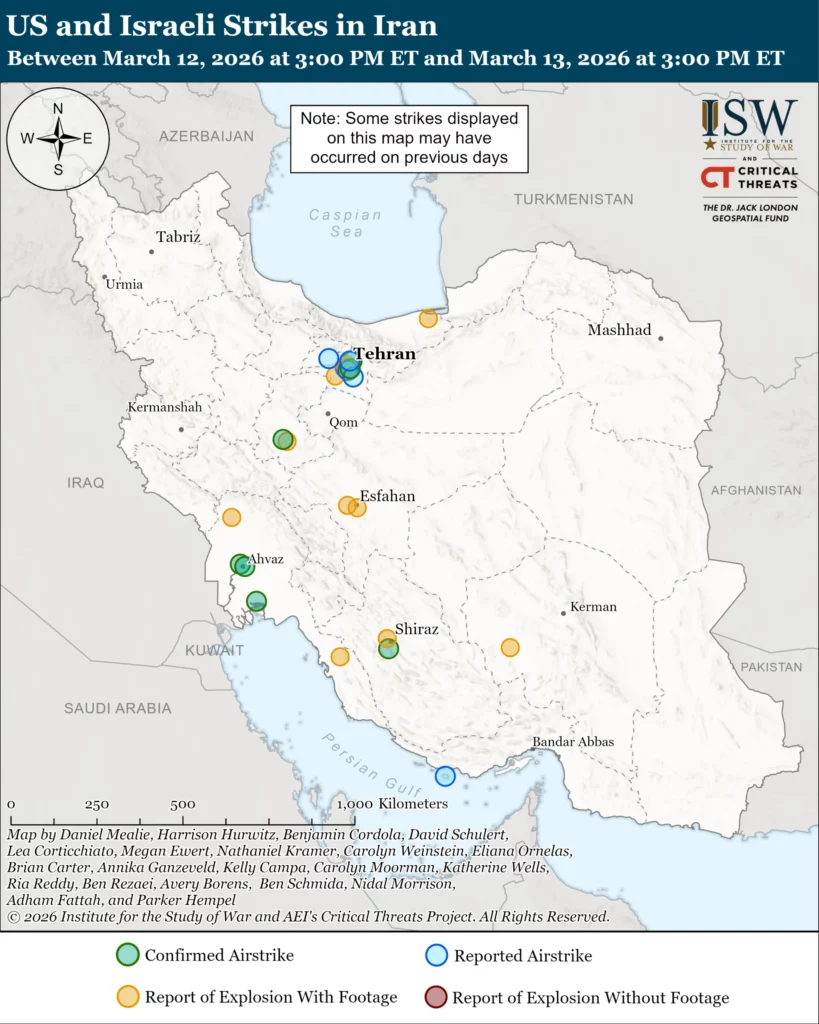
The combined force has continued to target Iranian defense industrial sites across Iran. The combined force struck Shiraz Electronics Industries (SEI) in Shiraz, Fars Province, on March 12.[22] Iran’s industrial zones and defense-industrial sites often contain companies tied to Iran’s defense industrial base and the Ministry of Defense and Armed Forces Logistics (MODAFL).[23] SEI is a MODAFL-affiliated subsidiary of Iran Electronics Industries (IEI) that the United States sanctioned in 2008 for producing military electronics for the Iranian armed forces, including radars, avionics, missile-guidance technology, and other electronic systems.[24] The combined force separately struck the Hajiabad Industrial Zone in Arak, Markazi Province, on March 13.[25] The zone hosts Pegah Aluminum Arak Company, which the United States sanctioned in April 2025 for manufacturing aluminum products for the Iran Centrifuge Technology Company (TESA), a key entity supporting Iran’s uranium enrichment program.[26] US Defense Secretary Pete Hegseth stated on March 13 that US and Israeli strikes have “functionally defeated” Iran’s ballistic missile production capacity by destroying Iran’s defense companies and production lines across Iran that manufacture missile components.[27]
The IDF also targeted Iranian air defense systems in Tehran Province on March 13.[28] The IDF reported that Israeli aircraft dropped 200 munitions against targets across Tehran Province, including air defense systems at one of the first air defense bases that Iran established in Tehran Province.[29] These strikes are consistent with the broader campaign to degrade Iran’s integrated air defense network and expand Israeli freedom of operation over Iranian airspace.[30] US Secretary of Defense Pete Hegseth stated on March 13 that “Iran has no air defenses.”[31]
Iranian Inter-Regime Dynamics
Anti-regime media reported on March 13, citing unspecified sources, that some clerics in Iran have raised concerns about Supreme Leader Mojtaba Khamenei’s physical condition and capacity to govern.[32] Former Supreme Leader Ali Khamenei’s deputy chief of staff for political and security affairs, Ali Asghar Hejazi, and Guardian Council member Alireza Arafi reportedly rank among the clerics who question Khamenei’s health and leadership competence.[33] Hejazi and Arafi have reportedly urged senior Iranian officials to reinstate the Leadership Council. The Iranian constitution states that a Leadership Council — composed of the president, the judiciary chief, and a Guardian Council member — will assume the Supreme Leader’s duties until the Assembly of Experts convenes to select a new leader.[34] The Assembly of Experts previously selected Arafi as the Guardian Council member to serve as the third member of this council after Ali Khamenei died.[35] The March 13 report about concerns regarding Mojtaba Khamenei’s leadership and efforts to reinstate the Leadership Council follows reports that some senior Iranian officials and members of the clerical establishment opposed Mojtaba’s selection as supreme leader before the Assembly of Experts chose him for the position on March 8.[36]
Iranian Retaliation
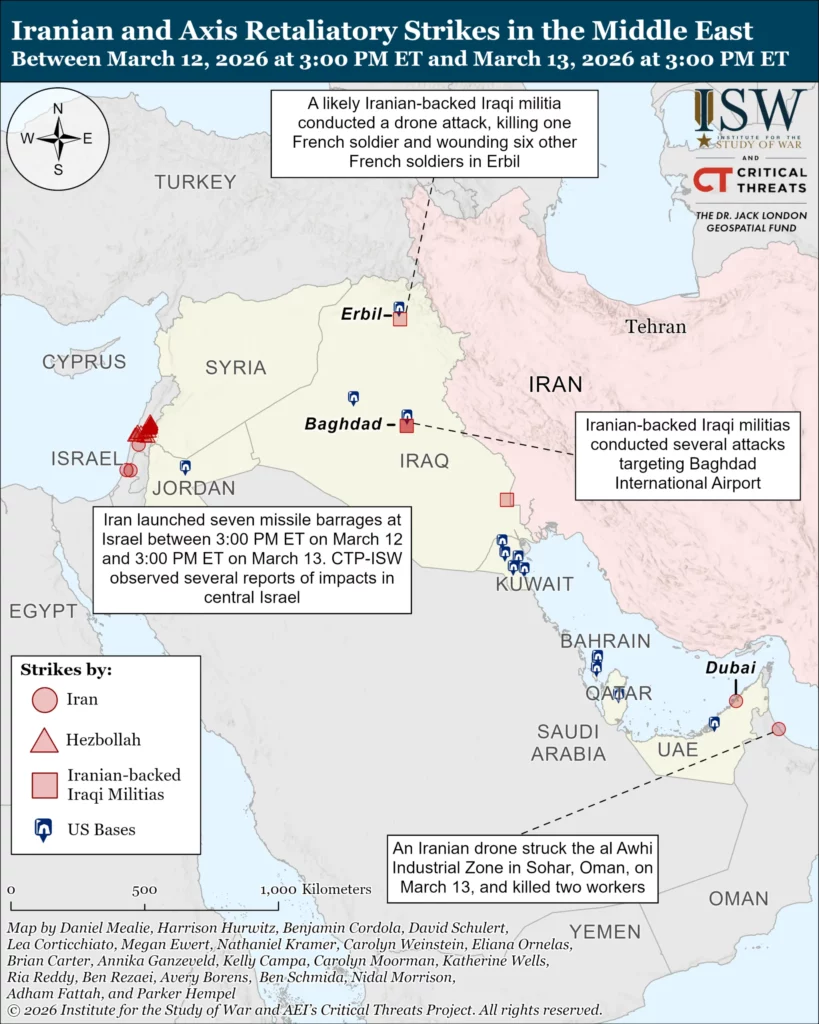
Iran launched seven missile barrages at Israel between 3:00 PM ET on March 12 and 3:00 PM ET on March 13.[37] An Israeli journalist reported on March 13 that suspected Iranian missile fragments or cluster munitions struck a building in Shoham and damaged cars in Rishon Lezion, central Israel.[38] An OSINT account reported on March 13 that several Iranian cluster munitions impacted in Mishmar Hashiva, south of Tel Aviv.[39] IDF-affiliated media reported that there have been 28 impacts on residential buildings and 27 projectiles have fallen in open areas in Israel since the conflict started on February 28.[40]
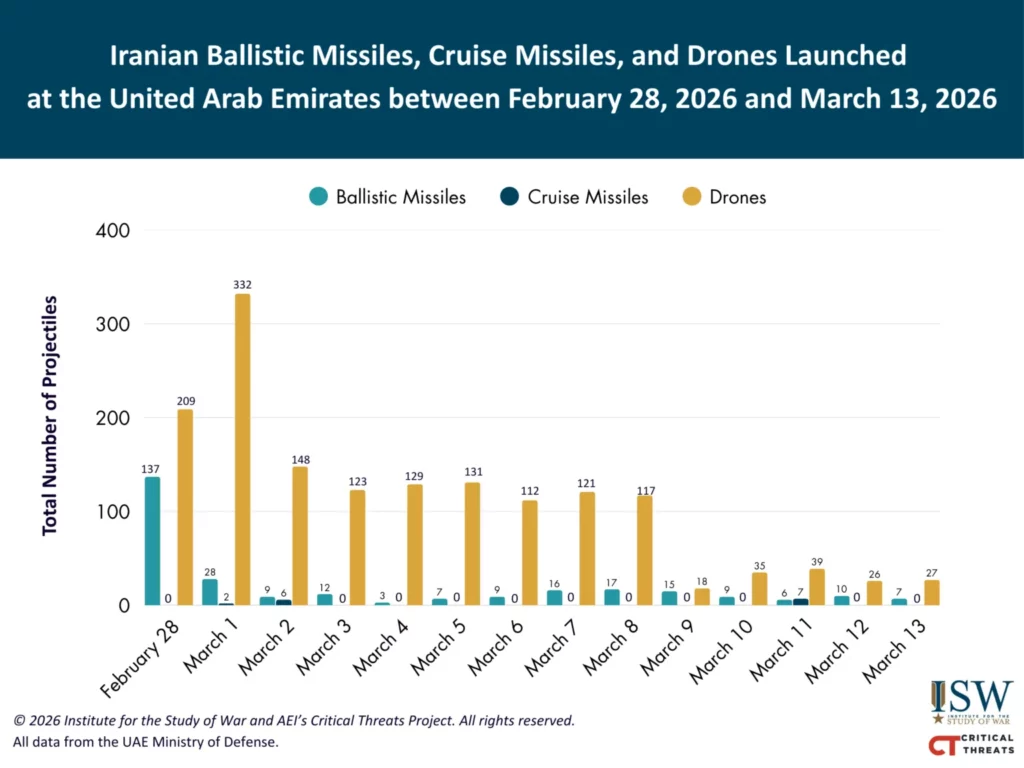
Iran continued to fire at the Gulf states on March 12 and 13, but Gulf air defense systems have largely intercepted Iranian projectiles. Iran has fired roughly 2,000 projectiles at the Gulf since the conflict started on February 28.[41] ISW-CTP only observed one impact in the Gulf states between 3:00 PM ET on March 12 and 3:00 PM ET on March 13. An Iranian drone struck the al Awhi Industrial Zone in Sohar, Oman, on March 13, killing two workers.[42] Saudi Arabia reported that it intercepted 51 Iranian drones on March 13.[43] The Kuwaiti Army reported that it detected one Iranian ballistic missile on March 13, which fell outside ”the threat area.”[44] The Emirati Defense Ministry reported that it intercepted seven Iranian ballistic missiles and 27 Iranian drones on March 13.[45] Iranian drones and missiles targeting the UAE have decreased relative to the peak of attacks since March 8, however (see graphic below). US Secretary of Defense Pete Hegseth stated on March 13 that Iranian missile volume is down 90 percent and one-way attack drone volume is down 95 percent since the start of the war.[46]
Three unspecified US officials told the Wall Street Journal on March 13 that elements of an amphibious ready group, including Japan-based USS Tripoli and its Marine expeditionary unit (MEU), are deploying to the Middle East, following US Central Command (CENTCOM)’s request.[47] The USS Tripoli and its attached marine unit, the 31st MEU, are part of the Tripoli Expeditionary Strike Group, which also includes a guided-missile cruiser and a guided-missile destroyer.[48] The 31 MEU is a combat-ready force able to conduct ”joint, maritime, and amphibious multi-domain operations,” according to the US Navy.[49]
Israeli Campaign Against Hezbollah and Hezbollah Response
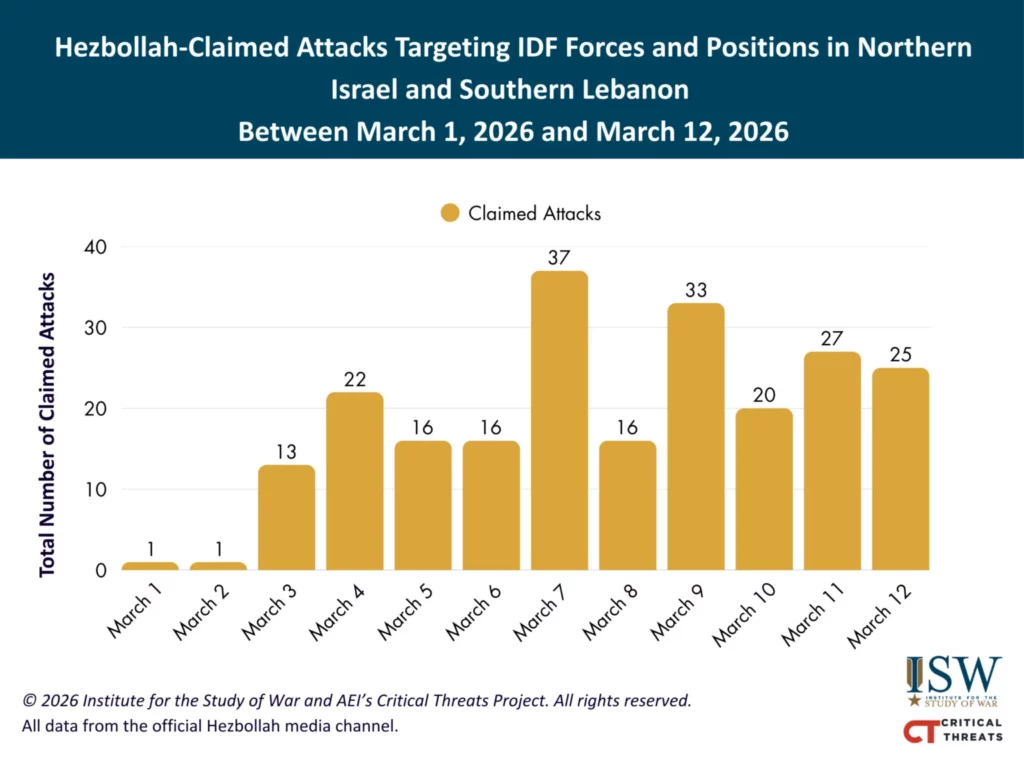
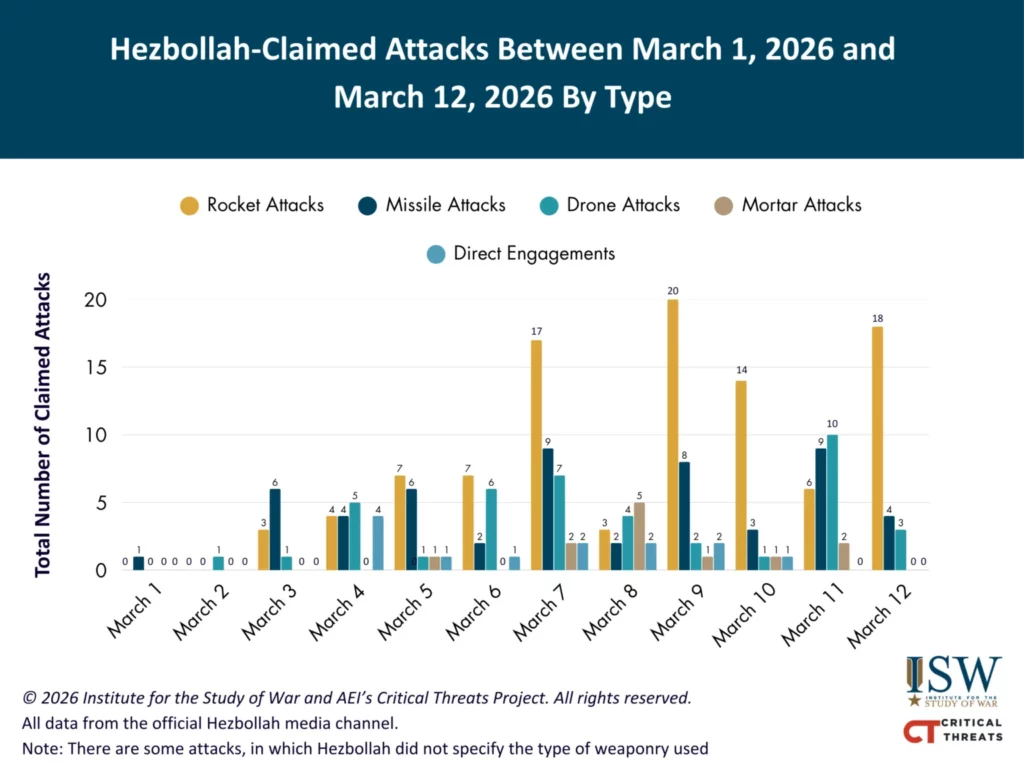
Hezbollah claimed 25 attacks targeting Israeli forces and positions in northern Israel and southern Lebanon between 3:00 PM ET on March 12 and 3:00 PM ET on March 13.[50] Hezbollah claimed several rocket and drone attacks targeting IDF positions and forces along both sides of the Israel-Lebanon border.[51] Hezbollah claimed two separate missile attacks targeting the IDF Meron Air Operations and Control Base at Mount Meron, northern Israel, and the Givaa Drone Base east of Safed, northern Israel.[52] Hezbollah previously targeted both sites on March 3 and 4, respectively.[53] An IRGC social media account reported on March 12 that Hezbollah launched the missile that struck Zarzir, northern Israel, damaging 300 homes and injuring 60 Israeli residents.[54] Israeli media previously reported that an Iranian missile struck Zarzir.[55] Most of Hezbollah’s rockets and missiles come from Iran or are built using Iranian technology.[56]
The rate of Hezbollah attacks has varied since the group joined the war on March 1, as illustrated below. Hezbollah has also employed a variety of weapons in its attacks against Israeli forces and positions in northern Israel and southern Lebanon (see below).
The IDF has continued to conduct airstrikes targeting Hezbollah across Lebanon. The IDF has conducted over 1,100 strikes in Lebanon since the conflict began on February 28.[57] The IDF has struck 190 Radwan Force sites, 200 Hezbollah missile launchers, 35 Hezbollah command centers, and 80 other Hezbollah sites.[58] The IDF has also killed over 380 Hezbollah fighters.[59] The IDF continued its strikes on March 12 and 13, targeting Hezbollah headquarters, fighters, weapons depots, and other infrastructure in Beirut’s southern suburbs, the Bekaa Valley, and southern Lebanon.[60] The IDF struck the Zrariyeh bridge, which spans the Litani River, on March 13.[61] The IDF stated that Hezbollah used the bridge to move its fighters from northern to southern Lebanon to fight against Israeli forces.[62] The IDF added that Hezbollah positioned launchers near the bridge and conducted launches against Israel from there.[63] The IDF also killed Hezbollah Unit 127 operative Murtada Hussein Srour in an airstrike in Beirut on March 13.[64] Unit 127 is Hezbollah’s aerial unit responsible for developing, producing, and launching attack drones.[65] The IDF stated that Srour was a prominent figure and a ”center of knowledge” in weapons manufacturing within Hezbollah.[66]
The IDF has also continued to target Hezbollah organizations that provide financial and social services. The IDF struck several al Qard al Hassan branches, Hezbollah’s main financial arm, across Lebanon on March 13.[67] Hezbollah uses funds transferred via al Qard al Hassan to finance its military operations, pay its fighters, and purchase weapons.[68] The IDF has destroyed 30 al Qard al Hassan sites since the start of the conflict.[69] The IDF reported that al Qard al Hassan has completely stopped its activities due to the IDF’s recent strikes.[70] The IDF also reportedly struck two Islamic Health Authority centers in southern Lebanon on March 13.[71] The Islamic Health Authority is a Hezbollah-controlled organization that provides medical services to most of Lebanon’s Shia population.[72]
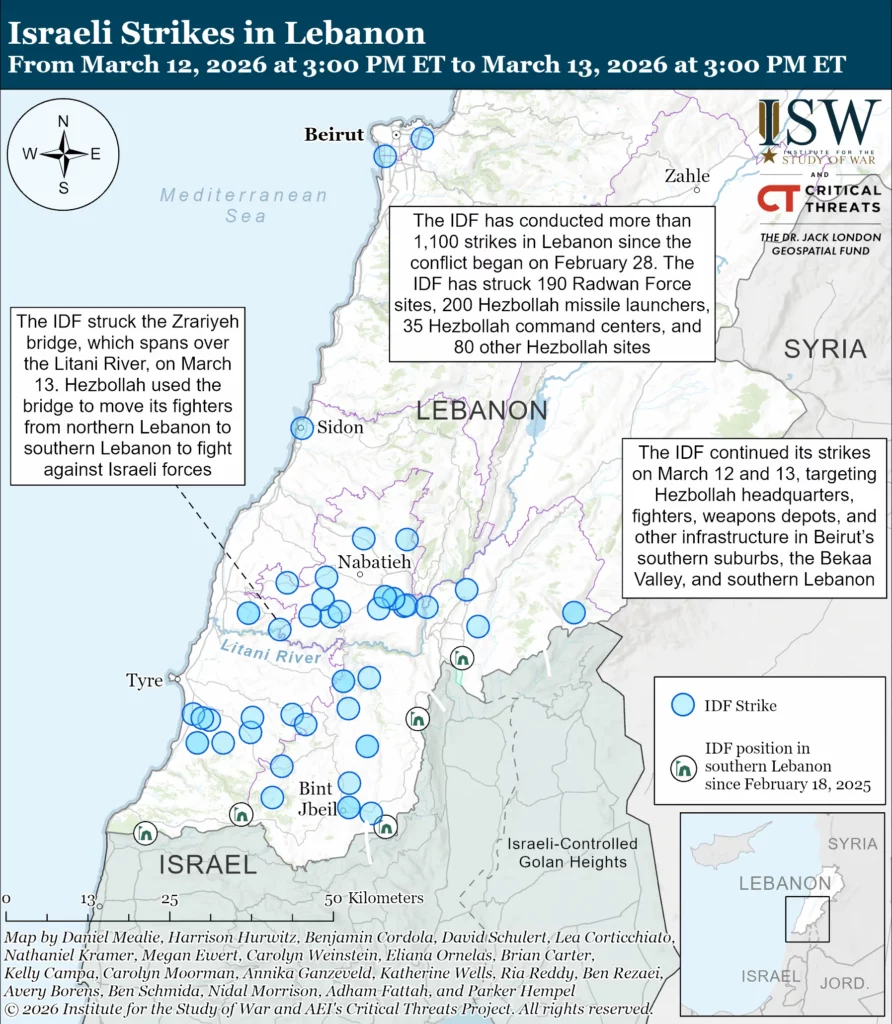
The IDF has continued to conduct ground operations and deploy forces to southern Lebanon since CTP-ISW’s last data cutoff at 3:00 PM ET on March 12. The IDF reported that the IDF 91st Division reconnaissance forces identified several Hezbollah fighters in southern Lebanon and directed an IAF strike on them.[73] Israeli media reported that the IDF 91st and 36th divisions are advancing deeper into southern Lebanon.[74] The IDF reported that the IDF 146th Division destroyed a Hezbollah weapons depot, rocket launch platforms, reconnaissance devices, and buildings in southwestern Lebanon on March 13.[75] The division fired artillery at approximately 400 targets during its operations.[76] The IDF reported on March 13 that IDF Chief of Staff Lieutenant General Eyal Zamir ordered a broad reinforcement of forces in the Northern Command and noted that additional forces, including a division, two brigades, and engineering battalions, will deploy to the northern border.[77] Israeli media reported that the IDF 98th Paratrooper Division will deploy to the Israel-Lebanon border.[78]Israeli officials are reportedly discussing the potential expansion of Israeli ground operations in Lebanon. Senior Israeli officials told Israeli media on March 12 that Israel’s campaign against Hezbollah in Lebanon could continue even if Israel’s campaign against Iran ended soon.[79] Israeli defense officials have reportedly spoken about Israel’s campaign against Hezbollah being months-long rather than several weeks.[80] Israeli media reported that Israeli security and defense officials are examining several options, ranging from an expansive ground operation reaching the Litani River to more limited actions in southern Lebanon.[81] An unspecified Israeli security source also told Israeli media on March 13 that Israel intends to create a seven-to-eight-kilometer buffer zone in southern Lebanon similar to the “yellow line” in the Gaza Strip.[82] The IDF is reportedly working to establish 20 outposts deep inside Lebanese territory as part of this plan.[83]
Other Axis Response
Iranian-backed Iraqi militias are continuing to attack US forces and interests in Iraq. Iranian-backed Iraqi militias are almost certainly responsible for at least three drone attacks targeting sites at the Baghdad International Airport since 3:00 PM ET on March 12.[84] The Iraqi militias have repeatedly claimed attacks since the start of the war targeting the former US Victory base at the airport, although the United States withdrew from the base in 2011.[85] The Baghdad Diplomatic Support Center, which the Iraqi militias have previously attacked, is also co-located at the airport.[86] Footage posted on X on March 13 shows a fire at a power station near the airport following a drone attack.[87] The drone probably crashed before reaching the airport, assuming the militias launched it.
Two drones targeted the radar of an oil field in northern Basra Province on March 12, according to a security source speaking to Iraqi media.[88] One of the drones reportedly crashed into the outer tower of the radar but did not cause any damage.[89] Iraqi media also reported two separate instances of drone impacts in the same oil field on March 10.[90]
Three Iraqi security sources and two sources close to the militias told Reuters on March 12 that the militias have increased the pace of their drone and missile attacks over the last three to four days.[91] CTP-ISW has not yet observed definitive indicators that the militias have launched missiles, although the Islamic Resistance of Iraq, which is a coalition of Iranian-backed Iraqi militias, did use cruise missiles to attack Israel during the Gaza War.[92] Iran also began supplying the Iraqi militias with short-range ballistic missiles in 2018.[93] The Islamic Resistance in Iraq claimed on March 12 that it had conducted 31 drone and missile operations targeting occupation bases in Iraq and the region in the past 24 hours.[94] Likely front group Saraya Awliya al Dam also claimed on March 12 that it conducted 6 operations targeting US bases inside and outside of Iraq, as well as an attack targeting US interests in Kuwait.[95] Kataib Sayyid al Shuhada head Abu Alaa al Walai said on March 13 that the Islamic Resistance’s operations are entering their second phase with unspecified “qualitative objectives” that signal a shift to a “new level of pressure and deterrence.”[96]
Iranian-backed Iraqi militias have continued to target foreign targets in Iraq. A likely militia drone attack on a French base in Erbil, Iraqi Kurdistan, on March 12 killed one French service member and wounded at least six others.[97] Likely front group Kataib Sarqhat al Quds claimed responsibility on March 13 for a drone attack on US-Israeli interests in Erbil but did not provide further attribution.[98] The group admitted to working under the instructions of Harakat Hezbollah al Nujaba on March 5.[99] Kataib Sarqhat al Quds also published a statement earlier on March 13 in which the group threatened French interests due to the reported arrival of French aircraft in the Middle East.[100] French President Emmanuel Macron announced on March 9 that France will send ten additional warships to the Middle East to escort commercial ships through the Strait of Hormuz.[101] The Italian Defense Ministry also reported on March 12 that unidentified drones struck Camp Singara in Erbil overnight on March 11 and 12.[102] Camp Singara is a North Atlantic Treaty Organization (NATO) base that operates under Operation Inherent Resolve.[103] Kataib Sarqhat al Quds released an additional statement on March 13, threatening Iraqis in Ninewa, especially the Counterterrorism Service, to expel US forces from the province.[104] The group claimed that French and Italian forces had begun to withdraw from Iraq, with France suspending its work in the international coalition.[105] An OSINT account also reported on March 10 that unidentified Iraqi militias conducted a drone attack targeting the UAE consulate in Erbil.[106]
The combined force has struck additional Iraqi militia targets since CTP-ISW’s last data cutoff. Geolocated footage posted on X on March 12 shows a US drone purportedly striking a Popular Mobilization Forces (PMF) warehouse in Makhmour, Ninewa Province.[107] Multiple Iranian-backed Iraqi militias control PMF brigades that answer to Iran instead of the Iraqi prime minister.[108] A security source told Iraqi media on March 13 that an airstrike targeted a Kataib Hezbollah headquarters in Fallujah, Anbar Province.[109] Multiple airstrikes also targeted PMF positions near Tikrit, Salah al Din Province.[110] A security source told Iraqi media that the strike hit an Asaib Ahl al Haq headquarters.[111]
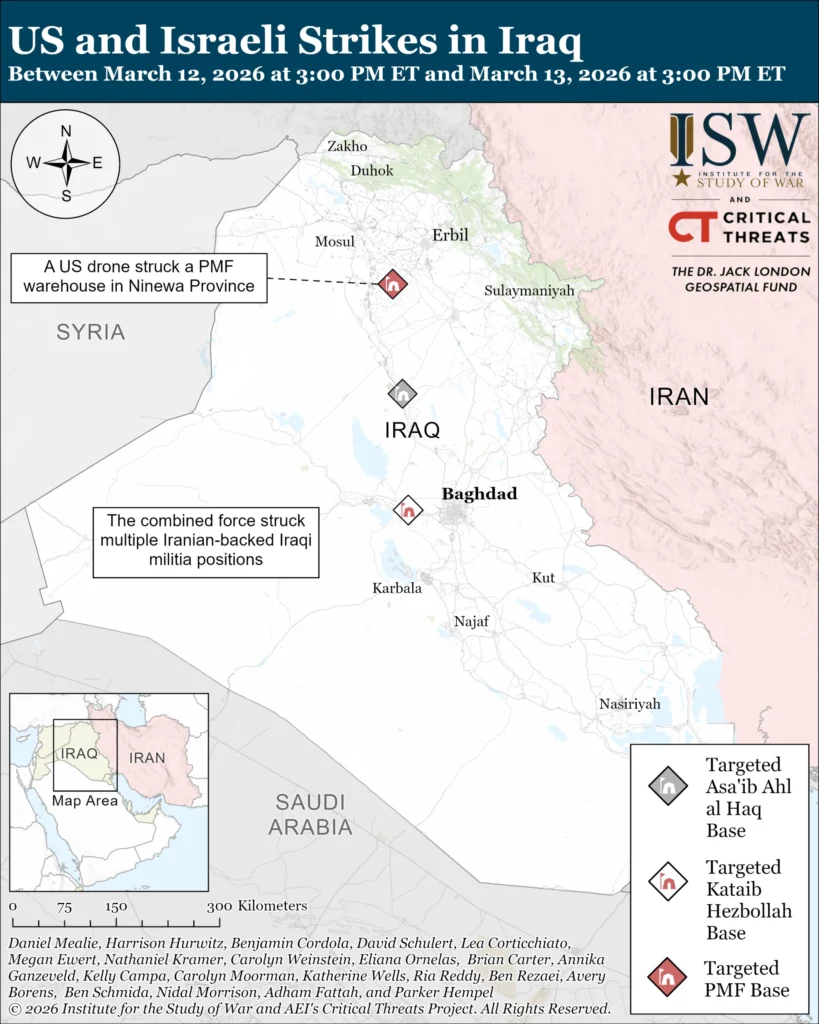
The PMF Anbar Operations Command head reportedly ordered the evacuation of the PMF Anbar Operations Command headquarters in western Anbar Province to avoid combined force strikes.[112] The Anbar Operations Command head is associated with Kataib Hezbollah.[113] The combined force has repeatedly struck Kataib Hezbollah positions since the start of the war.[114] The headquarters facility reportedly hosts about 250 PMF members, according to a security source speaking to Iraqi media, which demonstrates the extent of the concerns about combined force targeting.[115] The Operations Command headquarters have not yet been evacuated as of 3:00 PM ET on March 13. The Anbar Operations Command head’s evacuation order appears to have also caused another PMF Brigade in the area to evacuate its headquarters, however. Another security source separately told Iraqi media that the Badr Organization-affiliated 55th PMF Brigade evacuated its headquarters as a precautionary measure, with all of its personnel and vehicles leaving the area.[116]