 Eurasia Press & News
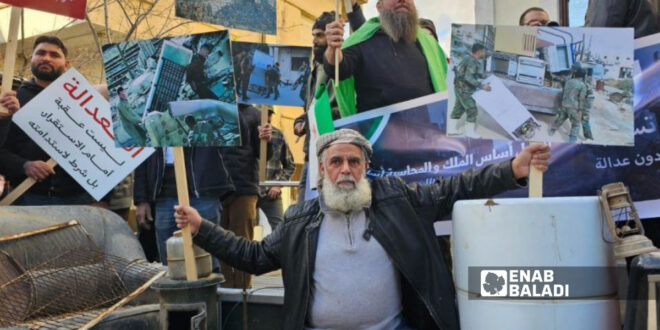
The vigil held by some Syrians in front of the headquarters of the National Committee to Combat Graft in the Mezzeh area of Damascus last January, in protest against the financial settlement with businessman Mohammed Hamsho, who is close to the deposed Assad regime, did not prevent the completion of similar deals with other businessmen who had a prominent role in the Syrian economy during the days of the former regime.
An official source in the National Committee to Combat Graft, Enab Baladi, revealed on February 23, the conclusion of a settlement with the Syrian businessmen Samer al-Fawz and Tarif al-Akhsar, who are close to the deposed Assad regime.
Enab Baladi highlights the file of financial settlements with personalities who were affiliated with the former regime, to see the extent of their legality from a legal point of view, and what cases and legal conditions are, and whether there are similar previous experiences in other countries.
A legal tool with conditions and controls
The director of the Syrian Network for Human Rights, Fadel Abdel Ghani, said that determining any possible settlement requires determining the nature of the allegations addressed to the person concerned accurately. The names raised in these settlements are in the category of “economic facilitators” whose roles have been a structural element in supporting the financial base of an authoritarian regime, suggesting a degree of collusion that goes beyond the usual commercial role.
The legitimacy of the settlement depended on a strict framework that distinguished between acceptable arrangements and convincing impunity, and that the settlement was gaining greater defence when it was built as an economic accountability mechanism that included asset recovery, truth-revealing and cooperation without impeding the investigation or prosecution of serious international crimes.
For his part, the lawyer in the International Criminal Law, Mutasim al-Kilani, told Enab Baladi that financial settlements are not contrary to the law itself, but are a legal tool used in many judicial systems in cases of corruption and economic crimes, especially when they aim to recover public funds, explaining that the settlement, if it is within a clear legal framework and within transparent procedures, is a legitimate procedure, noting that the Syrian mechanisms lack the previous requirements.
He warned that such measures could become inconsistent with the State’s obligations to fight corruption and protect the rights of victims, if it resulted in the elimination of criminal responsibility for serious crimes or the closure of investigations in exchange for financial compensation only.
International human rights law affirmed that serious crimes and grave breaches could not be addressed only by financial settlements, as that might amount to some form of impunity.
Compatibility of settlements with international standards
In an interview with the magazine on March 9, the head of the Graft Committee, Bassel Sweidan, explained that the committee is based on several criteria in its work, including full harmony with international standards, especially Article 20 of the United Nations Convention against Corruption.
Article 20 of the United Nations Convention against Corruption emphasizes the criminalization of “illicit enrichment”, represented by a significant increase in the assets of a public official that he or she cannot reasonably explain in relation to his or her legitimate income.
The principles of transitional justice developed by the United Nations confirm that addressing the legacy of violations must include four main elements: truth, judicial accountability, reparations for victims and institutional reform.
Addressing the legacy of violations must include four key elements: truth-revealing, judicial accountability, reparations for victims, institutional reform, and financial settlements can be part of a broader process of money recovery or economic reform.
Mutasim al-Kilani
Lawyer in International Criminal Law
But financial settlements, according to al-Kilani, should not replace legal accountability, as international experiences show that limiting economic settlements without investigations or prosecutions could undermine transitional justice and weaken confidence in new institutions.
The director of the Syrian Network for Human Rights, Fadel Abdel Ghani, explained that the legitimacy of settlements is fully conditioned by strict restrictions, high transparency, and an explicit exclusion of any coverage that affects international crimes.
The legitimacy of settlements is fully conditioned by strict restrictions, high transparency, and an explicit exclusion of any coverage affecting international crimes.
Fadl Abdul Ghani
Director of the Syrian Network for Human Rights
The above conditions, according to Ghani, require a thorough examination of the nature of the allegations made, the conceptual limits of the “great crime” standard in transitional justice, the conditions that may make settlements defensible, and the red lines that make any arrangement of this kind legally and normatively unacceptable.
Similar international experiences
The head of the Graft Committee, Bassel Sweidan, said in the context of his interview with the magazine that the adoption of the concept of settlements was not an improvisational step, but was based on international studies and experiments extracted from the experiences of other countries, citing some similar examples.
Swedan cited Hong Kong’s experience in establishing the Independent Anti-Corruption Investigation Commission, which combined investigation, prevention and outreach, and the experience of Singapore in the Office of Corruption Practices Investigation, which has broad powers to track wealth inflation associated with public office.
He pointed out that the Syrian committee did not reproduce external models, but tried to invest those experiences and build a national model on the basis of them, commensurate with the specificity of the Syrian stage and its requirements.
The lawyer stressed that the experiences of many countries show that transitional governments often resort to different formulas of economic settlements with elites associated with the former regime.
In Tunisia after the 2011 revolution, the idea of “economic reconciliation,” which was widely criticized for being considered a reintegration of old economic elites without sufficient accountability, was put forward.
In South Africa, after the end of apartheid in the 1990s, the Truth and Reconciliation Commission adopted a different model, with some involved being allowed to confess to their crimes in exchange for a limited amnesty, but serious crimes remained held accountable.
For his part, the director of the Syrian Network, Fadel Abdul Ghani, said that there are transitional experiments that witnessed arrangements for the return of assets and cooperation with economic actors who were linked to the previous era, but these arrangements do not gain legitimacy unless they are conditioned by tight and transparent, and exclude international crimes unequivocally.
The general record of the names put forward for the settlement in Syria shows that they were more economically empowering than direct perpetrators of crimes, opening the way for consideration in principle of conditional arrangements if they meet the conditions for disclosure, asset recovery and verifiable cooperation.
However, according to Abdel Ghani, the legal framework does not accommodate any arrangement that leads to impunity or to the coverage of conduct amounting to international crimes, and therefore remains the boundary between these two categories, which is determined by the nature of the evidence and the extent of its connection to serious crimes.
Settlements limited to non-prosecution of financial
The committee did not, according to an official source in the National Committee to Combat Graft, make any guarantees that the penal prosecution of both the winners and the mute, but only not to prosecute them financially specifically in the cases of graft committed and authorized by them.
He stressed that the nature and details of the settlement concluded with the businessman Tarif Al-Akhras are similar to the details of the settlement with the winning businessman, in terms of confiscating 80% of the property in kind and the movable and immovable property belonging to him.
He pointed out that the issues pursued by the committee also include businesswomen, but the size of their files is relatively small and the size of the files is larger and more complex.
The director of the Syrian Network for Human Rights, Fadel Abdel Ghani, said that the record available to the public about the personalities mentioned in the settlements, shows them as a pivotal economic supporter and pillar of nepotism networks, but this availability does not prove that they have committed international crimes, and this discrimination has a fundamental impact in determining the scope of legitimate accountability.
The economic actors of the Assad regime, according to Ghani, occupy a different position within the transitional justice ladder than those who played direct leadership roles in committing atrocities, and this does not reduce the risk of economic complicity morally, but it illustrates the most effective institutional tools and conditions under which negotiating arrangements can be considered.
For his part, lawyer Al-Mutasim Al-Kilani believes that the impact of settlements on the transitional phase depends heavily on their nature and transparency. If they are part of a clear program to recover looted funds, reform the economy and redistribute resources for the benefit of society, they may contribute to supporting economic stability and providing the necessary resources for reconstruction, provided that they do not interfere in the course of criminal accountability of suspects, and do not grant them any immunities.
Academic literature in the field of transitional justice suggests that ignoring the economic dimension of violations or dealing with them through only limited settlements may weaken the process of democratization and create a sense of injustice among victims and society.