Eurasia Press & News
The assassination of Iran’s Supreme Leader Ali Khamenei represents a pivotal moment in the history of Iran. It opens a complex phase of political transition in light of the U.S.-Israeli war on Iran, mounting internal pressure, and the intensifying competition between the reformists and hardliners. The succession of the Supreme Leader may ultimately be determined either through constitutional mechanisms or through the Interim Leadership Council. Three main scenarios emerge: the continuation of the existing power structure with a new conservative Supreme Leader, a redistribution of authority that reduces the powers of the Supreme Leader in favor of the elected institutions, or a structural change that could affect the Guardianship of the Islamic Jurist principle and nature of the regime, depending on the course of the war and the internal balances.
On February 28, 2026, the United States and Israel carried out a military and intelligence operation in which the Iranian Supreme Leader Ali Khamenei was assassinated after targeting Khatam-al Anbiya Central Headquarters, which houses his office and the institutions affiliated with it. The assassination of the Supreme Leader represents a pivotal event in the history of the Iranian regime, which removed a central figure from the landscape, one who ruled Iran for more than three decades.
However, this may not signal an imminent transformation or a change in the nature of the regime as much as it will start a complex and maybe long process to choose a successor. If the war’s objectives and operations deepen, this will raise several questions about the future of the power structure in Iran and the legal and constitutional frameworks. This is particularly significant given the possibility that the debates about the Guardianship of the Islamic Jurist reemerge, and that competing ideas challenging it may find renewed space to surface—not only outside Iran but within it as well.
Internal Political Context Dynamics
The assassination of the Supreme Leader Ali Khamenei represents a dramatic development in the Iranian landscape, but at the same time, it brings back the question of who will succeed him. This question was raised frequently in recent years in light of the declining health condition of the Supreme Leader Ali Khamenei and his advanced age.
In fact, Khamenei, who was killed at the age of 86, had been keen to prioritize the issue of arranging the political landscape after his death. Even though he did not recommend or designate a specific successor, he worked for years to shape the country’s political and security contexts in a manner consistent with the moment of selecting the new Supreme Leader, in a way that would ensure a smooth transfer of power and consensual loyalty to the incoming leader.
In 2021, one of Khamenei’s closest allies and a prominent successor, Ebrahim Raisi, won the Presidential election. This victory was followed by a series of gains for the conservative and hardline factions. In March 2024, the hardline factions consolidated their control over the Islamic and Assembly of Experts—the body responsible for selecting the third Supreme Leader.
However, that political landscape fractured after the death of Raisi in a helicopter crash on May 20, 2024, and the assumption of office by Masoud Pezeshkian on July 6 after winning the election. It was further shaken by the developments of the war in the Gaza Strip, which extended to the Iranian territories in the first round of fighting between Iran and Israel that lasted for 12 days in June 2025. The repercussions of these events deeply damaged the military capabilities, the defense doctrine, and the religious and revolutionary rhetoric that the regime—led by the Supreme Leader—represents.
Today, Iran stands before its second test to select the third Supreme Leader, in a trajectory that does not seem similar to the selection of Khamenei, who assumed the position as a successor to Khomeini in 1989, after only one day of his death. The current security and political context, however, makes this process far less clear, and the task of identifying a successor is likely to be highly complex.
Who Will Succeed the Supreme Leader
Following the death of Ebrahim Raisi, Ali Khamenei sought to reassure the Iranian people that” they do not have to worry about any disruption in the administration of the State”. Indeed, the country proceeded in accordance with the constitutional provisions governing the vacancy of the presidency under extraordinary circumstances. The country was able to hold presidential elections within fifty days, which reflected its ability to reorganize itself and manage the transfer of power within established constitutional frameworks.
In the event of the death of the Supreme Leader, the constitution organizes the mechanism of his succession, whether under ordinary or extraordinary circumstances. However, the comparison between the two is very limited. Raisi, who ruled Iran for two years, did not possess the stature of Ali Khamenei, who governed the country for thirty-five years.
Moreover, the executive importance of the presidency cannot be compared with the vast power and authority held by the Supreme Leader. While the country experienced the transfer of the presidency office dozens of times, it now enters the current phase without a similar experience in its contemporary history regarding the position of the Supreme Leader. This is particularly significant given the highly sensitive circumstances, as the country is in the midst of a war that could affect the internal power balances and shape the country’s political, security, and social contexts.
From a constitutional perspective, the Supreme Leader is appointed through internal deliberations and a majority decision by the Assembly of Experts, which consists of 88 members. This follows the approval by the Guardian Council of the candidates’ eligibility, who must meet several religious, political, and administrative qualifications.
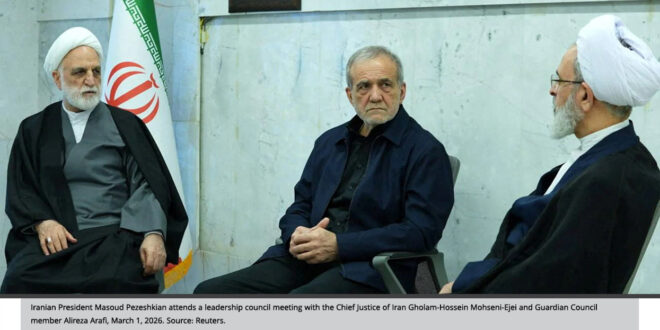
Given the difficulty of completing this process amid the war, especially after the headquarters of the Assembly of Experts were targeted, Iran has moved to treat the situation as emergency. Accordingly, a temporary leadership body was formed in accordance with Article 111 of the Constitution, which regulates how to deal with the vacancy of the Supreme Leader position and sets out arrangements for transferring his powers until a new leader is appointed.
This temporary council consists of the President Masoud Pezeshkian, the Chief Justice of Iran Gholam-Hossein Mohseni-Eje’i, and cleric Alireza Arafi. Reports indicate that Arafi is one of the most prominent candidates to succeed Khamenei. His prospects reportedly increase, especially since he serves as the second Deputy Chairman of the Assembly of Experts and a member of the Guardian Council. These positions grant him presence in the two institutions directly involved in the process of selecting the Supreme Leader. He also heads the administration of the Islamic seminaries (hawzat), which strengthens his standing and influence in both political and religious spheres.
Conversely, the fact that Arafi does not have strong ties with the Islamic Revolutionary Guard Corps (IRGC) may represent a weakness in his profile, an advantage that Mojtaba Khamenei—the son of the former Supreme Leader—appears to possess. Mojtaba is considered one of the potential candidates, yet he faces a significant challenge stemming from the Iranian elite’s rejection of hereditary succession, a principle against which the 1979 Revolution was originally directed.
In addition, the name of Ali Larijani has emerged as a possible contender. Larijani maintains close ties with the former Supreme Leader Ali Khamenei, as he is seen as an advisor and a strategic expert, as the latter relied on him for sensitive and complex diplomatic matters. He was active in the last negotiation round with Washington, and the Supreme Leader’s confidence in him was reflected in his appointment as the Secretary of the Supreme National Security Council.
Reports also have indicated that Khamenei had entrusted him with managing the state affairs in the case of a vacancy in the position of the Supreme Leader. Another name mentioned in this context is Hassan Khomeini, the grandson of the first Supreme Leader.
Nevertheless, the possibility of surprises remains, as the country may select new figures, perhaps from the reformist camp, younger personalities, or maintain the collective leadership form instead of returning to a single-leader model. Such an option remains constitutionally possible, even though it has never been tested in practice. Amid these highly complex and extraordinary conditions, it becomes reasonable to question whether the Supreme Leader and the regime will remain in their current form.
The Changing Iranian Internal Landscape
The absence of the Supreme Leader from the Iranian political landscape comes at a time when the country is witnessing an ongoing war that has already lasted for days and could continue for weeks. This situation follows the outbreak —in late 2025—of a renewed anti-regime popular mobilization that has maintained its continuity and diversity since the “Green Movement” in 2009, through the fuel protest in 2019, and later the Mahsa Amini protests of 2022.
The most important aspect of the absence of the Supreme Leader is not just regarding the narrative that linked his presence to the continuation of the regime, but also his pivotal role as the balancing force among the various factions within the regime, preventing their deep disagreement from undermining the regime’s stability and cohesion.
Accordingly, the sharp contradiction and intense competition between the reformist and hardline currents will not end with Khamenei’s assassination. Rather, they will escalate to higher levels of disagreement over the country’s sovereign and political interests. The leadership temporary council reflects this contradiction, as the ongoing war may, for the moment, hide the extent of divergences in the positions and orientations of the three leaders, as well as the distinct ideological references of each one of them.
The first challenge arising from those contradictions is the difficulty, or maybe the impossibility, of reaching a consensus that the Supreme Leader had previously sought among the various state institutions on a single candidate. The reformists may support the nomination of Hassan Khomeini, while the IRGC may push for the succession of Mojtaba Khamenei. The seminaries (hawzat) and segments of the clerical establishment may favor Alireza Arafi.
Such a division could ignite a powerful struggle within the country’s factions and institutions, as the victor will control the key levers of power and decision-making in Iran for decades to come.
However, the existing disagreement may be limited to the process of selecting the Supreme Leader, but may open the way for a deeper argument regarding the essence of the regime itself and the future of the Guardianship of the Islamic Jurist principle, from which the Supreme Leader derives his authority.
Parallel questions may also arise regarding the nature and position of the Supreme Leader: whether the position should be maintained while abolishing its institution, Khatam al-Anbiya; whether its power remains political or religious or both; and whether its role and authority limits should be refined, or perhaps even abolishing the position altogether.
This debate stems from the fact thatdiputes over authority and power between the two poles of the executive structure (the Supreme Leader and the President) have been persistent and recurring from the era of Hashemi Rafsanjani to that of Masoud Pezeshkian, with the exception of Ebrahim Raisi. Most of the reformist presidents have objected to the Supreme Leader’s encroachment on the institutional authority of the presidency, particularly in matters of foreign policy, as well as to the delegation of parallel regional policies in the Middle East ot the IRGC and Quds Force, which resulted in the outbreak of the ongoing war.
The Changing Landscape of Wartime
The U.S-Israeli military operations that began on February 28, 2026, continue to intensify amid a state of uncertainty and ambiguity regarding their outcomes, objectives, and duration. For now, there is no clear indication that the attacks aim to bring about regime change.
On March 2, U.S. Secretary of State Marco Rubio stated that overthrowing the Iranian regime is not among the objectives of the war; rather, the goal is to reduce the missile and naval capabilities. On the same day, the Secretary of War, Pete Hegseth, reiterated that the war on Iran is not for regime change.
In the early hours of the war, U.S. President Donald Trump and Israeli Prime Minister Benjamin Netanyahu directed their speeches to the Iranian people to seize the opportunity and move against the regime, which indicates that the two countries are not seeking to change the regime through direct military operations.
Although there is no clear evidence, several indicators suggest that the objectives of the military operations may extend beyond attacking Iran’s military capabilities or pressuring it to change its behavior. Even before the war began, senior U.S. officials started using new terminology in their statements regarding Iran. U.S. Secretary of State Marco Rubio, for instance, attributed the difficulty of reaching an agreement to the nature of the Iranian regime, which is dominated by hardline clerics.
The assassination of the Supreme Leader carries significance beyond his positions as the head of the regime, as he embodies religious and spiritual symbolism that extends beyond Iran’s borders. The deepening of the attacks also coincided with strikes targeting the regime’s media and ideological instruments, including the headquarters of the state radio and television broadcaster.
In fact, both the actions of the attacking parties and the Iranian responses will shape the trajectory and the course of the war, as well as its repercussions for the nature of the Iranian regime and internal power balances between its factions–factors that will influence the nature and choice of the next Supreme Leader.
On one hand, the state of war may elevate the levels of national sentiment, enforce the influence and presence of hardline factions, and expand the role of the IRGC and security institutions in the public and political spheres. It may also intensify mobilization and confrontation rhetoric, especially in response to any internal movements opposing the regime.
On the other hand, one of the objectives of the war is to undermine the IRGC and the hardline wing of the Iranian regime. Such developments would strengthen the reformist currents at their expense. For decades, these reformist currents sought to expand their influence over Iranian institutions and may aspire either to the position of the Supreme Leader or to introduce changes to the role itself.
In sum, the resolution of this contradiction remains contingent on the development on the ground. On one hand, the United States seems to push a strategy of speed in its operations, as Trump mentioned that the operations may last for four weeks, during which they are expected to significantly weaken the IRGC and the hardline factions and deprive them of their military instrument. Such an outcome would necessarily strengthen the position of reformist currents and increase their chances of nominating a candidate for the position of the Supreme Leader.
On the other hand, Iran seeks to prolong the war and make it costly for the attacking parties, not only to force an end to the conflict, but also to place the initiators under public and parliamentary scrutiny in both countries. Under such circumstances, the hardline factions will be able to maintain nationalist sentiments during war and in its aftermath.
The Iranian Regime After the Supreme Leader: Possible Scenarios
Given that the path toward the succession of the Supreme Leader remains unclear, along with the course and dynamics of the war. The issue of the Supreme Leader’s succession, the position itself, and its role is likely to unfold across several possible scenarios, as follows:
First Scenario: Maintaining the Structure and the Role of the Executive Authority
The assassination of Ali Khamenei may weaken the regime, but it does not necessarily change it. The Iranian state, with its bureaucracy and its ideological and doctrinal network, is unlikely, if not highly improbable, to be dismantled or significantly damaged through airstrikes, even if they are intense and prolonged. This scenario is reinforced by two main assumptions:
First: If the Assembly of Experts were able—assuming that a number of its members have not been assassinated as claimed by Israel and denied by Iran— to reach a swift decision in selecting the third Supreme Leader. The Council may also prove capable of overcoming the repercussions of the war and the surrounding security threats while maintaining its structure and the safety of its members. In this case, the rise of conservative figures capable of balancing the interests of various state institutions is likely, particularly someone with substantial experience in dialogue with the West, such as Larijani. However, the possibility of assassinating the new Supreme Leader might recreate the state of power vacuum and could further complicate the process of selecting the fourth Supreme Leader.
Second: if the Assembly of Experts delays resolving the issue of succession, the transitional leadership council may remain in place. Under the condition of intensified U.S. strikes and the declining capability and effectiveness of the IRGC in the internal and external policy, the door could be open for the emergence of a reformist third Supreme Leader.
It is possible that the United States, through the assassination of Khamenei, intended to transfer the authority to a second tier of Iranian leadership, within which the third Supreme Leader would emerge more inclined toward engagement and dialogue with the West, and focus on the developmental and reform-oriented issues instead of the ideological ones that have proven ineffective.
Scenario Two: Preserving the Executive Authority Structure While Redistributing Its Roles
It is unlikely that the third Supreme Leader will enjoy the same level of influence and power that Ali Khamenei possessed. internal changes, external transformations, and the failure of Khamenei’s experience—which ultimately culminated in war— may alter the structure of the executive authority and reshape the balance of power between the Supreme Leader and the President. This could reinforce the role of the elected President and transfer the effective decision-making authority to him, while reducing the role of the Supreme Leader to a largely symbolic figure that primarily confers legitimacy.
Implementing this scenario requires reducing the wide powers granted to the Supreme Leader by the constitution and redistributing his roles to the government and the parliament, while limiting his authority to the religious matters. Nevertheless, this scenario remains the most complex, as it would require a wide political consensus within the ruling elite and possibly resort to a popular referendum if constitutional amendments are necessary.
Scenario Three: Changing the Structure of the Executive Authority and the Regime
This scenario represents a last possibility that could emerge from the U.S.-Israeli attacks, or from conditions in which a wave of popular protest is triggered and succeeds in toppling the existing regime, similar to the Operation Ajax model in 1953. Such development could involve the transformation of the entire political, economic, and security system, opening the door to a transitional phase and the emergence of a new republic, which is an unlikely possibility.
The transformation could extend to the structure of the executive authority and the nature of its relationship with other branches of government, while retaining some figures from the current regime and exiting government. At the same time, the position of the Supreme Leader and the principle of the Guardianship of the Islamic Jurist could be abolished. This means that the possible change will not be limited to replacing individuals or redistributing roles, but it will affect the deep structure of the political system and its ideological identity.
The realization of this scenario requires the expansion of the U.S.-Israel strikes to target the members of the Assembly of Experts and possibly members of the Guardian Council, after their headquarters had already been struck. This scenario could be reinforced if the war leads to negotiations between the Iranian government or leadership and the United States that extend beyond the nuclear program to include discussions about the nature and structure of the Iranian regime itself.