 Eurasia Press & News
The Institute for the Study of War (ISW) and The Critical Threats Project (CTP) at the American Enterprise Institute are publishing daily updates to provide analysis on the war with Iran. The updates focus on US and Israeli strikes on Iran and Iran and the Axis of Resistance’s response to the strikes. The updates cover events from the past 24-hour period.
NOTE: ISW-CTP will not publish morning updates covering the war with Iran on March 14 and 15. ISW-CTP will publish threads on its social media channels in the morning on these days that cover the latest developments in the war and include relevant maps.
Key Takeaways
Supreme Leader Mojtaba Khamenei’s reported inner circle is dominated by long-standing hardline Islamic Revolutionary Guards Corps (IRGC) commanders. Their influence will almost certainly drive Iran toward more hardline, anti-Western policies and deepen existing patterns of regime corruption and securitization. All four of these IRGC commanders worked for decades under former Supreme Leader Ali Khamenei. The first generation of Iranian revolutionaries and long-time IRGC leaders thus remain at the top of the Iranian regime‘s hierarchy despite decapitation strikes in recent years.
The Iranian regime has taken steps to further restrict the flow of information out of Iran, which will almost certainly limit ISW-CTP’s ability to observe strikes in Iran. Internet monitor NetBlocks reported on March 16 that the regime has further tightened internet restrictions. A BBC reporter stated on March 15 that the regime has reportedly started to target individuals with Starlink access and reduced the availability of VPNs.
The combined force targeted a likely Iranian drone facility in South Khorasan Province in one of the combined force’s easternmost strikes since the war began. The strike indicates that combined force aircraft can operate deep inside Iranian territory.
Iran has not attacked any vessels in the Strait of Hormuz since March 12. Anti-regime media also published footage on March 12 that shows a US Navy F/A-18 Hornet engaging targets with its auto cannon at extremely low altitude in Chabahar, Sistan and Baluchistan Province, which is on the Iranian coast on the Gulf of Oman. This suggests that US forces have at least local air dominance along certain segments of the coast, which would enable US aircraft to engage drones and anti-ship cruise missiles at low altitudes to protect shipping if ordered to do so.
Toplines
Supreme Leader Mojtaba Khamenei’s reported inner circle is dominated by long-standing hardline Islamic Revolutionary Guards Corps (IRGC) commanders. Their influence will almost certainly drive Iran toward more hardline, anti-Western policies and deepen existing patterns of regime corruption and securitization. The New York Times reported on March 16 that former IRGC Intelligence Organization head Hossein Taeb, de facto IRGC Commander Brigadier General Ahmad Vahidi, former IRGC Commander Major General Mohammad Ali Jafari, and Parliament Speaker and former IRGC Brigadier General Mohammad Bagher Ghalibaf were the main campaigners to get the Assembly of Experts to elect Mojtaba as supreme leader.[1] All four of these IRGC commanders worked for decades under former Supreme Leader Ali Khamenei.[2] The first generation of Iranian revolutionaries and long-time IRGC leaders thus remain at the top of the Iranian regime‘s hierarchy despite decapitation strikes in recent years. The New York Times article cited interviews from five senior Iranian officials, two clerics, two Iranians affiliated with the supreme leader’s office and three IRGC members with knowledge of the selection process.[3] Mojtaba also selected former IRGC commander Major General Mohsen Rezaei as his military adviser on March 16.[4] Mojtaba has had strong ties to the IRGC that date back to when he fought in the Iran-Iraq War in the Habib Ibn Mazahir Battalion within the IRGC 27th Mohammad Rasoul Ollah Division.[5]
Hossein Taeb helped Mojtaba engineer the 2005 presidential election in favor of hardline candidate Mahmoud Ahmadinejad.[6] Taeb later led the Basij‘s suppression of subsequent protests in the 2009 Green Movement as the Basij commander.[7]  The United States sanctioned Taeb in 2010 for his involvement in protest suppression.[8] Taeb went on to serve as head of the IRGC Intelligence Organization, the parallel organization to the Intelligence Ministry, from 2009 to 2022, and then served as adviser to the IRGC Commander.[9] Taeb reportedly pressured all 88 Assembly members to vote for Mojtaba as Supreme Leader, resulting in 59 members ultimately voting in his favor.[10]
Ahmad Vahidi is a long-time hardliner who has held some of the regime’s top security posts, including IRGC Quds Force commander, defense and armed logistics minister, interior minister, and Armed Forces General Staff (AFGS) deputy chief.[11] The United States sanctioned Vahidi for his role in directing Law Enforcement Command during the 2022 Mahsa Amini protests.[12] Vahidi’s abrupt reassignment in December 2025 from AFGS deputy chief to the IRGC deputy commander followed reported clashes with Artesh leaders over post-June 2025 Israel-Iran War air defense priorities.[13]
Ali Jafari similarly has consistently pursued an uncompromising hardline domestic policy, treating reformists and protest movements as “internal enemies” of the regime and deploying IRGC, Basij, and plainclothes units to suppress dissent and intimidate political rivals.[14] The United States also sanctioned Jafari in 2010 for his role in suppressing the 2009 Green Movement protests as IRGC commander.[15] Jafari adopted asymmetrical and extra-territorial warfare that positioned the IRGC to project power beyond Iran’s borders.[16]
Mohammad Bagher Ghalibaf is a veteran IRGC hardliner whose deep ties to senior commanders – dating back to his service as IRGC Air Force chief, Law Enforcement Command (LEC) chief, and in the Iran-Iraq War – have anchored his aggressive approach to domestic security and regime preservation.[17] Ghalibaf reportedly assumed an emergency senior military command after Israeli killed top commanders at the start of the June 2025 Israel-Iran War, an unprecedented move for a sitting civilian parliament speaker that underscored his entrenched influence and the unprecedented damage Iran’s command and control network suffered in June.[18]
Mohsen Rezaei is a senior regime insider and long-standing member of the Supreme Leader-appointed Expediency Discernment Council, whose hardline worldview was shaped by his tenure as IRGC commander from 1981 to 1997 – including through the Iran-Iraq War from 1980 to 1988 – and his continued role advising core strategic polices.[19] Rezaei is also implicated in the 1994 AMIA bombing in Argentina that killed 85 people. He remains the subject of an Interpol Red Notice.[20]
IRGC commanders reportedly view the conflict with the United States and Israel as a unifying national struggle that also reduces pressure on the regime to address Iran’s mounting economic problems. An informed source told anti-regime outlet Iran Wire on March 16 that an IRGC official told President Masoud Pezeshkian that the US and Israeli airstrikes have united the Iranian population behind the regime as the Iran-Iraq War once had, at a meeting where Pezeshkian had asked about the IRGC’s plans for post-war economic recovery.[21] Pezeshkian warned that such thinking amounted to planning for renewed repression rather than genuine post-war recovery or governance, according to the source.[22] The president’s question to IRGC about plans about domestic policy, if accurate, reinforces recent reporting on the command the IRGC holds in current foreign and domestic policy decision-making.[23]
US and Israeli Air Campaign
The Iranian regime has taken steps to further restrict the flow of information out of Iran, which will almost certainly limit ISW-CTP’s ability to observe strikes in Iran.[24] The regime has maintained a nationwide internet shutdown since the war started on February 28.[25] A BBC reporter stated on March 15 that the regime has reportedly started to target individuals with Starlink access and reduced the availability of VPNs.[26] The regime targeted Starlink devices during the Winter 2026 protests to prevent Iranians from circulating videos of protests and the regime’s brutal crackdown.[27] Internet monitor NetBlocks reported on March 16 that the regime has further tightened internet restrictions.[28] NetBlocks founder Alp Toker noted that Iranian state media accounts that usually post frequently on X abruptly stopped posting at 0700 AM ET, which coincided with a collapse in connectivity.[29] Iran’s worsening internet conditions coincide with other regime securitization measures. Residents of Tehran told the BBC that Iranian security forces have established new checkpoints across the city to stop and search individuals.[30] The regime has taken these steps to tighten internal security, at least in part, because it fears potential future unrest.
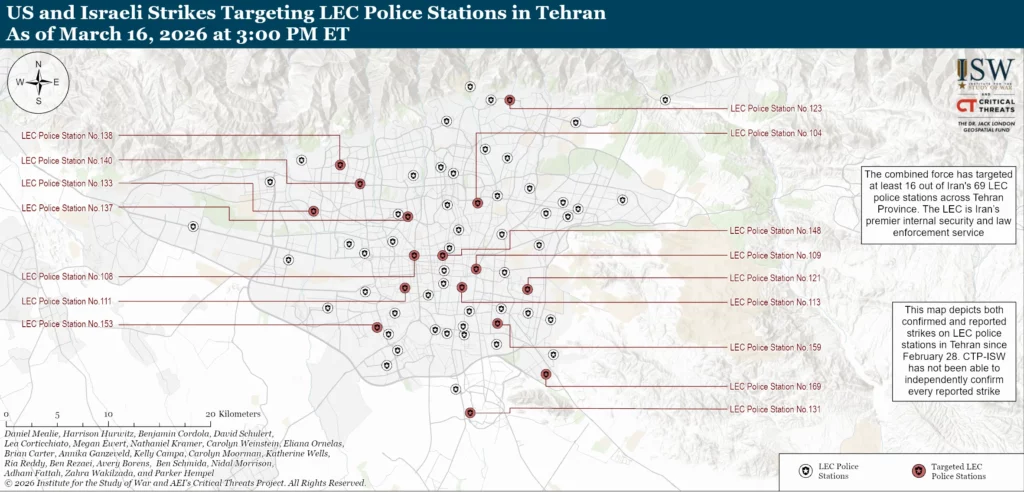
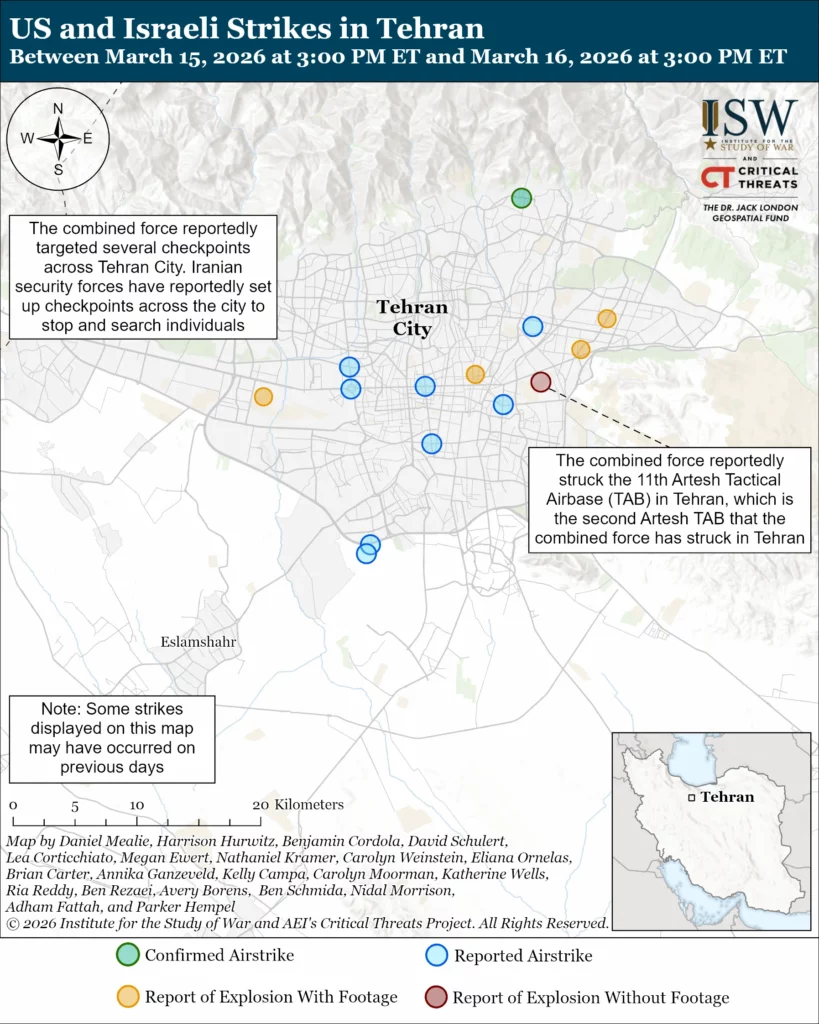
The combined force struck several internal security sites in Tehran. Anti-regime media reported on March 16 that the combined force struck six security force checkpoints across Tehran, including checkpoints in places where large gatherings could occur, such as Enghelab Square.[31] Anti-regime media separately reported on March 16 that the combined force struck a Basij base in northern Tehran.[32] OSINT accounts on X reported on March 16 that the combined force struck several Basij buildings in eastern Tehran.[33] The IDF said on March 16 that it struck an unspecified Iranian intelligence command center in central Tehran.[34] The combined force continued to strike LEC stations in Tehran. Anti-regime media reported on March 16 that the combined force struck the 123rd LEC station in Niavaran District, Tehran.[35] ISW-CTP has recorded combined force strikes against 16 of Tehran’s 69 LEC stations at the time of this writing.[36]
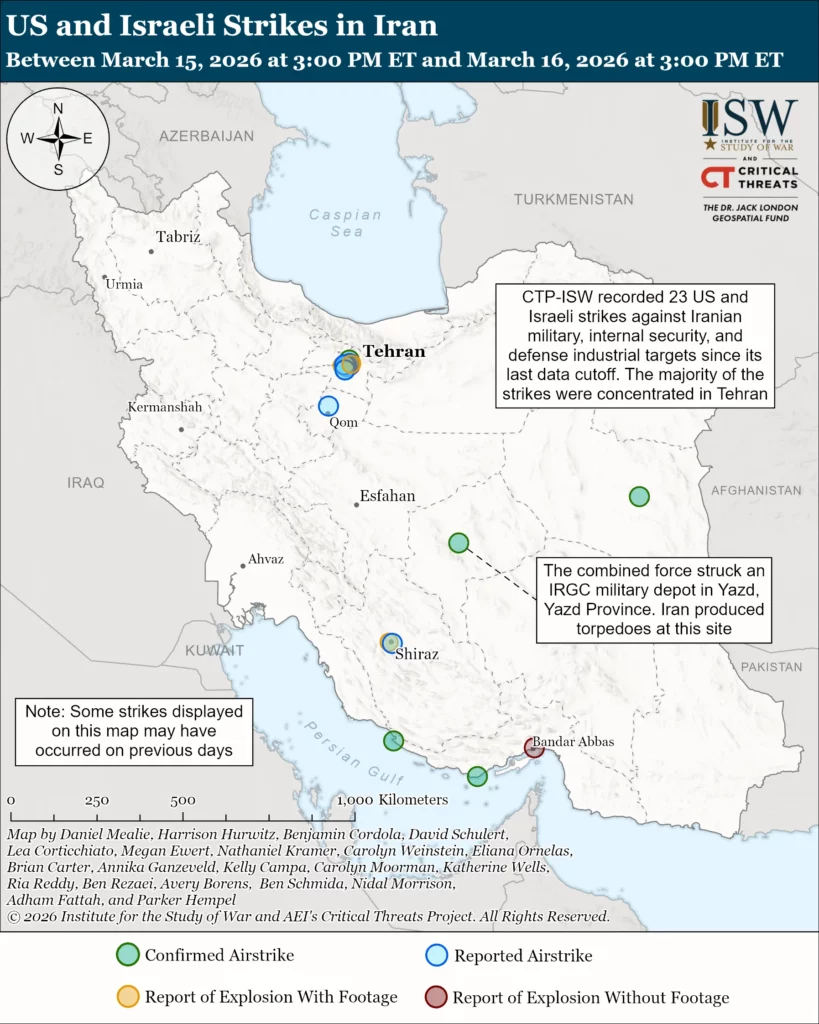
The combined force continued to strike Iranian defense-industrial sites. A BBC journalist reported on March 16 that the combined force struck a military depot site in Yazd, Yazd Province, on March 11, citing images from US Central Command (CENTCOM).[37] US CENTCOM Commander Admiral Brad Cooper stated on March 16 that the military depot in Yazd was associated with “IRGC missile command infrastructure” and used to build ”light and heavyweight torpedoes.”[38] Cooper added that US strikes have shifted from neutralizing immediate missile and drone threats to Iran’s “wider manufacturing apparatus” and defense industrial base.[39]
The combined force targeted a likely Iranian drone facility in South Khorasan Province in one of the combined force’s easternmost strikes since the war began. An Israeli analyst reported on March 15 that the combined force struck two buildings at a likely drone launch site near Bijrand, South Khorasan Province.[40] The drone launch site is within 1.5 kilometers of the IRGC Ground Forces’ 88th Ansar ol Reza Brigade base.[41] The strike aligns with a March 16 statement by US Central Command (CENTCOM) commander Admiral Brad Cooper, who said that US forces are targeting Iran’s military defense industrial base to prevent further threats from Iran.[42] The strike also indicates that combined force aircraft can operate deep inside Iranian territory. The strike occurred more than 800 kilometers inland from the Gulf of Oman and marked the one of the easternmost targets that the combined force has struck since the conflict began on February 28.
The combined force continues to degrade Iran’s air defense network through strikes on air defense sites and air bases across the country. An Israeli OSINT account reported on March 16 that the combined force struck the 11th Artesh Tactical Air Base, also known as Doshan Tappeh Air Base, in eastern Tehran.[43] The base is the second Artesh tactical air base in Tehran that the combined force has targeted since the war began, and, although it is hosting no air traffic, satellite imagery from March 2025 shows air defense systems near the runway. CENTCOM published footage on March 16 of US strikes on multiple Iranian air defense systems in unspecified areas of Iran.[44]
Iran has not attacked any vessels in the Strait of Hormuz since March 12. The Iranian regime appears to be offering safe passage through the Strait of Hormuz to certain oil-carrying vessels. The New York Times, citing unspecified US officials, reported on March 15 that Iran has allowed some tankers transporting oil to China and India to transit the strait.[45] CNN reported that Pakistani oil tankers have similarly been allowed to transit the Strait safely.[46] The New York Times reports follow a March 13 Reuters report that Iran permitted two Indian-flagged liquefied petroleum gas (LPG) carriers to sail through the Strait.[47] Reuters reported on March 16 that daily oil exports from the Middle East have still fallen by at least 60 percent, however.[48] The United Kingdom Maritime Trade Organization has reported over 20 maritime incidents in and around the Strait since March 1.[49] Senior Iranian officials have repeatedly emphasized that the regime continues to intend to disrupt commercial shipping and impose economic costs on the United States and Gulf states as part of a broader Iranian effort to pressure the United States and Israel to end their campaign against Iran.[50]
Anti-regime media also published footage on March 12 that shows a US Navy F/A-18 Hornet engaging targets with its auto cannon at extremely low altitude in Chabahar, Sistan and Baluchistan Province, which is on the Iranian coast on the Gulf of Oman.[51] The combined force jet’s ability to conduct such an attack at low altitude suggests that the combined force has severely suppressed or destroyed local Iranian anti-air capabilities, including anti-aircraft guns, and man-portable air-defense systems (MANPADS) that could presumably return fire on a jet at low altitude.[52] Local air dominance would enable US aircraft operating over the coast to engage drones and anti-ship cruise missiles at low altitudes to protect shipping if ordered to do so.
Iranian Response
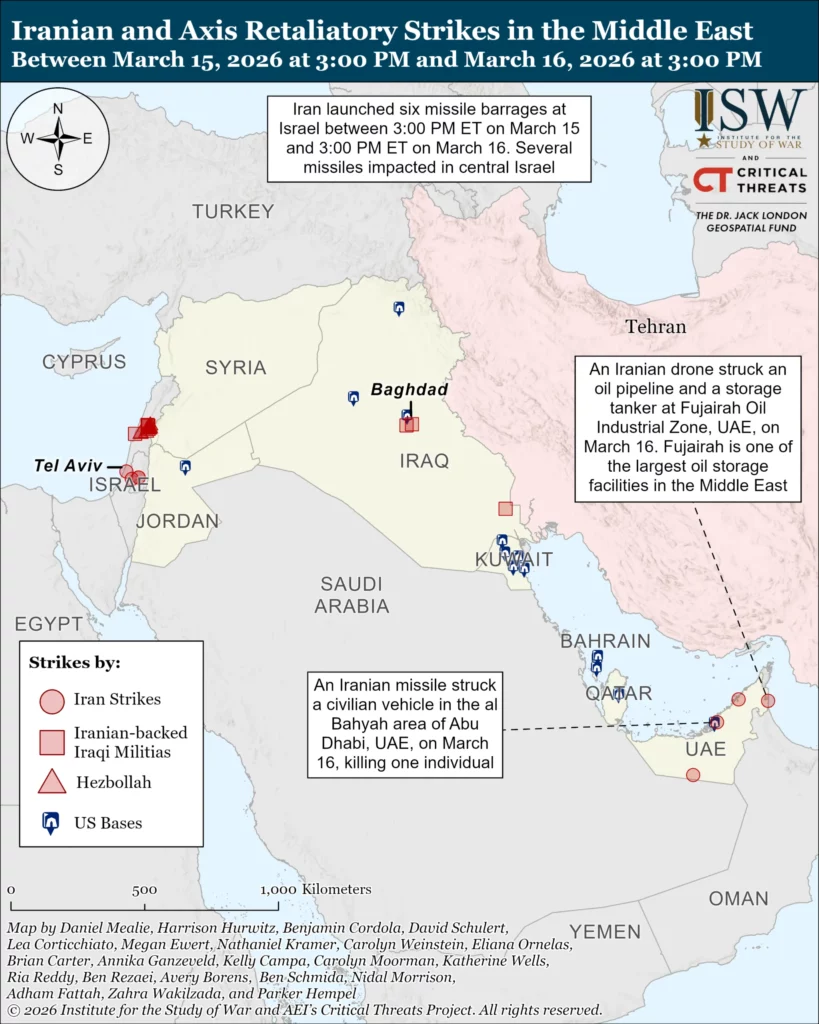
Iran launched six missile barrages at Israel between 3:00 PM ET on March 15 and 3:00 PM ET on March 16.[53] An Israeli journalist reported that suspected cluster munitions or missile fragments impacted at least two sites in central Israel.[54] Israeli media reported an Iranian cluster munition impacted in Rishon Lezion, northern Israel, causing extensive damage.[55] Israeli media reported on March 16 that fragments from Iranian projectiles fell in several areas of Jerusalem and Beit Shemesh, central Israel.[56] An Israeli journalist reported on March 16 that a fragment struck the Boyan Hasidic Synagogue in Jerusalem, central Israel.[57]
Iran continued to fire at the Gulf states on March 15 and 16, but Gulf air defense systems have continued to intercept most Iranian projectiles. CTP-ISW observed four impacts in the Gulf states between 3:00 PM ET on March 15 and 3:00 PM ET on March 16. An Iranian drone struck the Dubai International Airport, United Arab Emirates (UAE), on March 15, causing a fire at a nearby fuel tank.[58] Another Iranian drone struck a storage tanker and an oil pipeline at Fujairah Oil Industrial Zone, UAE, on March 16.[59] Fujairah is one of the largest oil storage facilities in the Middle East and the pipelines that flow to Fujairah enable oil shipments to bypass the Strait of Hormuz.[60] An Iranian missile struck a civilian vehicle in the al Bahyah area of Abu Dhabi, Saudi Arabia, on March 16, killing one individual.[61] An Iranian drone struck the Shah oil field in Abu Dhabi, UAE, on March 16, causing a fire.[62] The Shah field is home to the world’s largest ultra-sour gas operations, which involve using high hydrogen sulfide concentrates to remove impurities so that the gas can be used for electricity production or fuel gas in refineries.[63] Iran has undertaken an effort to impose political pressure on the United States by striking oil infrastructure in the region and oil tankers in the Strait of Hormuz.[64]
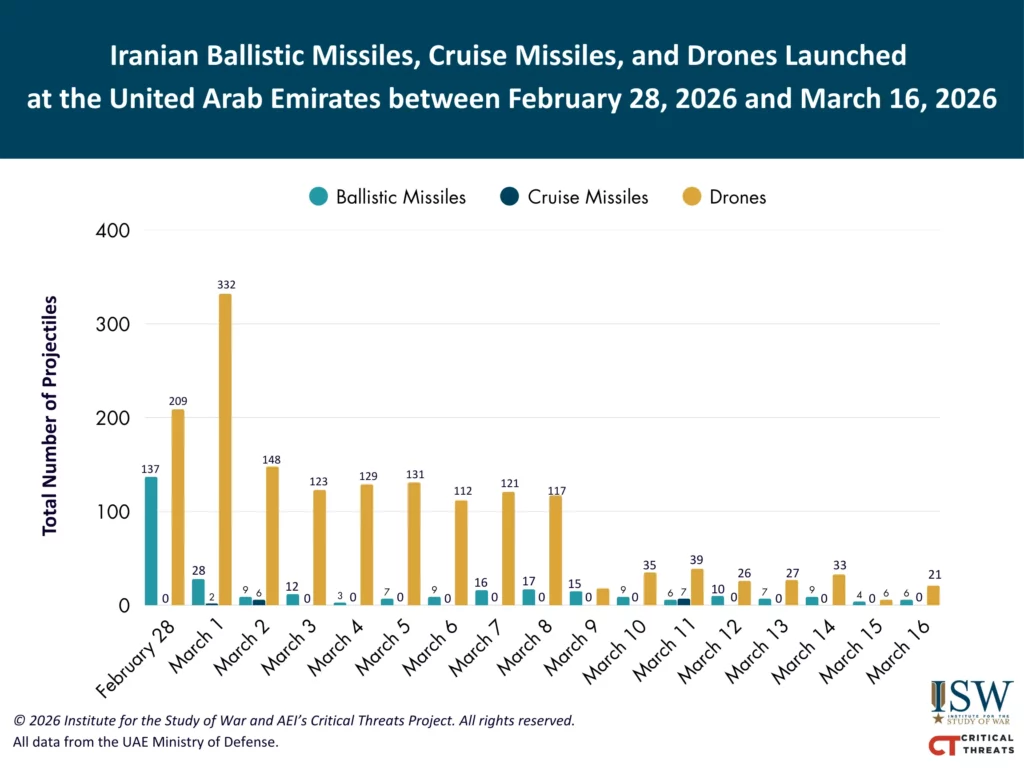
The Gulf states continued to intercept the bulk of Iran’s missile and drone attacks. Bahrain Defense Forces said it detected and intercepted three Iranian drones and four Iranian missiles on March 16 as of 3:00 PM ET.[65] The Kuwaiti Army reported that its air defense system detected four Iranian drones, one of which was intercepted, one fell outside the ”threat zone,” and two fell in the north.[66] The Qatari Defense Ministry reported that it intercepted several Iranian drones and intercepted 13 Iranian ballistic missiles with one missile falling in open areas.[67] Saudi Defense Ministry reported that it detected and intercepted 43 Iranian drones on March 16 as of 3:00 PM ET.[68] The Emirati Defense Ministry reported that it detected and intercepted 21 Iranian drones and six Iranian missiles on March 16.[69] Iranian drone attacks targeting the UAE have relatively increased compared to March 15, as illustrated below.
The combined force has severely degraded Iran’s missile and drone capabilities, which has limited Iran’s ability to launch retaliatory attacks in the region. The IDF reported on March 16 that it has destroyed approximately 70 percent of Iran’s missile launchers since the conflict began on February 28.[70] IDF spokesperson Lieutenant Colonel Nadav Shoshani told reporters on March 16 that the number of Iranian missile launches has decreased significantly.[71] The combined force’s strikes on Iranian missile launchers could be limiting Iran’s ability to retaliate, but there may be other factors that are also limiting Iran’s ability to retaliate. A senior IDF official recently noted that Iranian missile crews are reportedly afraid to go out and that there are desertions as well as refusals to follow orders.[72] The official added that Iranian security force causalities are estimated to be at least 10,000.[73] Anti-regime media, citing informed sources, previously reported that the IRGC attempted to mobilize reserve forces earlier this week, but several individuals did not report to military centers.[74]
Israeli Campaign Against Hezbollah and Hezbollah Response
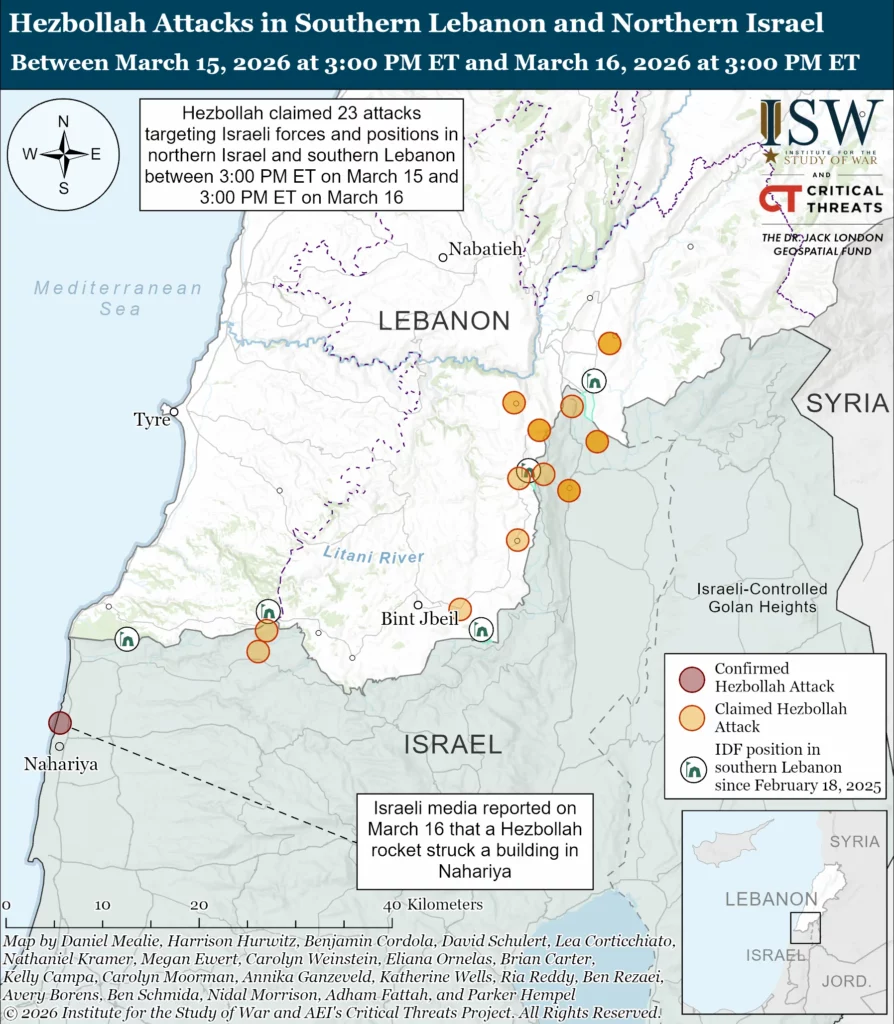
Hezbollah claimed 23 attacks targeting Israeli forces and positions in northern Israel and southern Lebanon between 3:00 PM ET on March 15 and 3:00 PM ET on March 16.[75] Hezbollah claimed several rocket and drone attacks targeting IDF positions and forces along both sides of the Israel-Lebanon border.[76] Hezbollah claimed that it launched a rocket barrage and a “squadron” of drones targeting the town of Nahariya in northern Israel on March 16.[77] Israeli media and an Israeli journalist reported on March 16 that a Hezbollah rocket directly impacted a structure in Nahariya.[78]
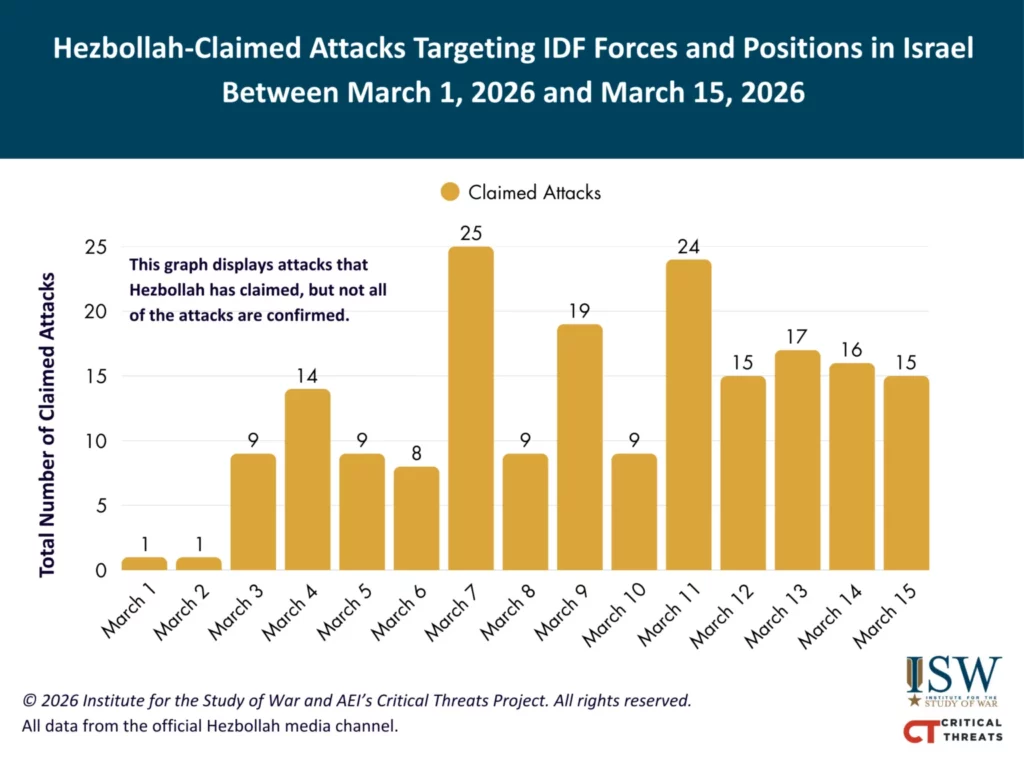
The rate of Hezbollah attacks targeting Israel have varied since the group joined the war on March 1, as illustrated below.
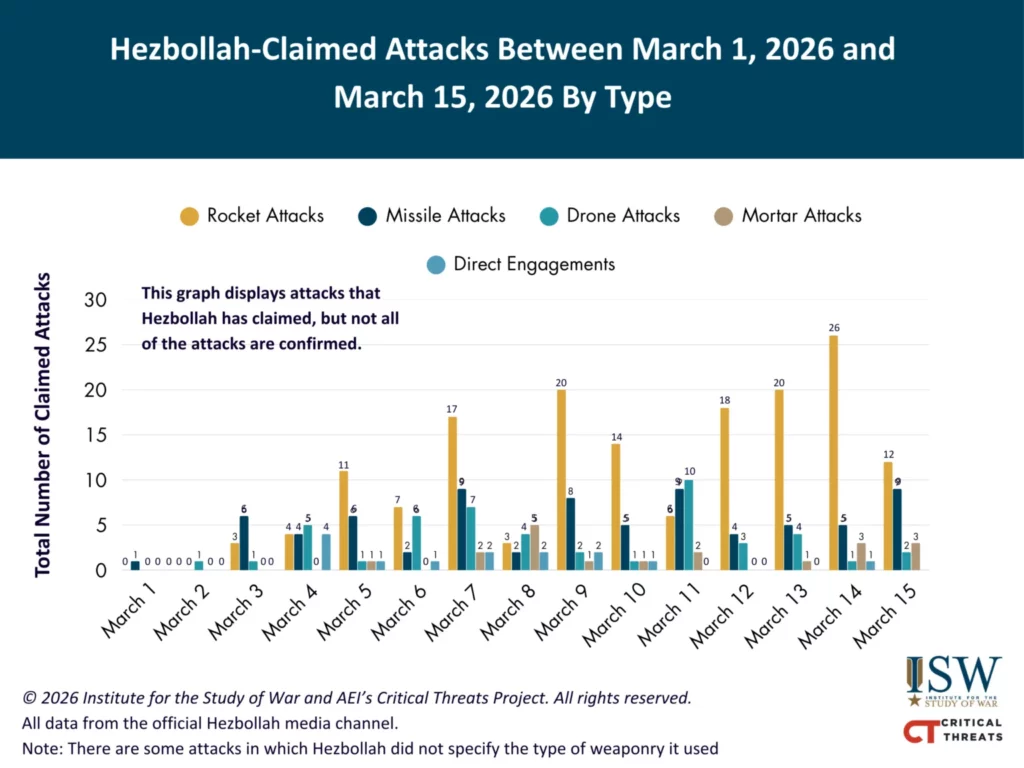
Hezbollah has also employed a variety of weapons in its attacks against Israeli forces and positions in northern Israel and southern Lebanon (see below).
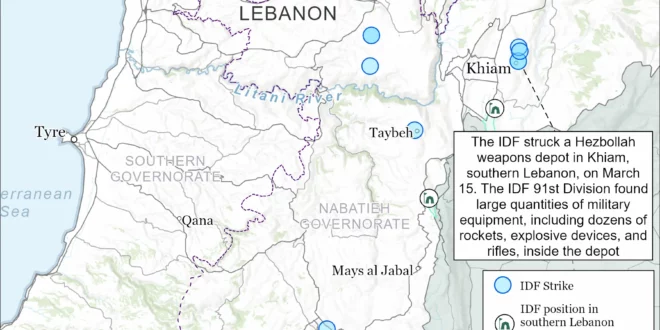
The Israel Defense Forces (IDF) has continued to conduct airstrikes and ground operations targeting Hezbollah in southern Lebanon. The IDF struck a Hezbollah weapons depot in Khiam, southern Lebanon, on March 15.[79] IDF ground forces had previously discovered the depot.[80] The IDF 91st Division previously found large quantities of combat equipment, including dozens of rockets, explosive devices, and rifles, inside the depot.[81] The IDF 401st Armored Brigade (162nd Division) also destroyed a weapons depot and discovered Hezbollah weapons in southern Lebanon on March 16.[82]
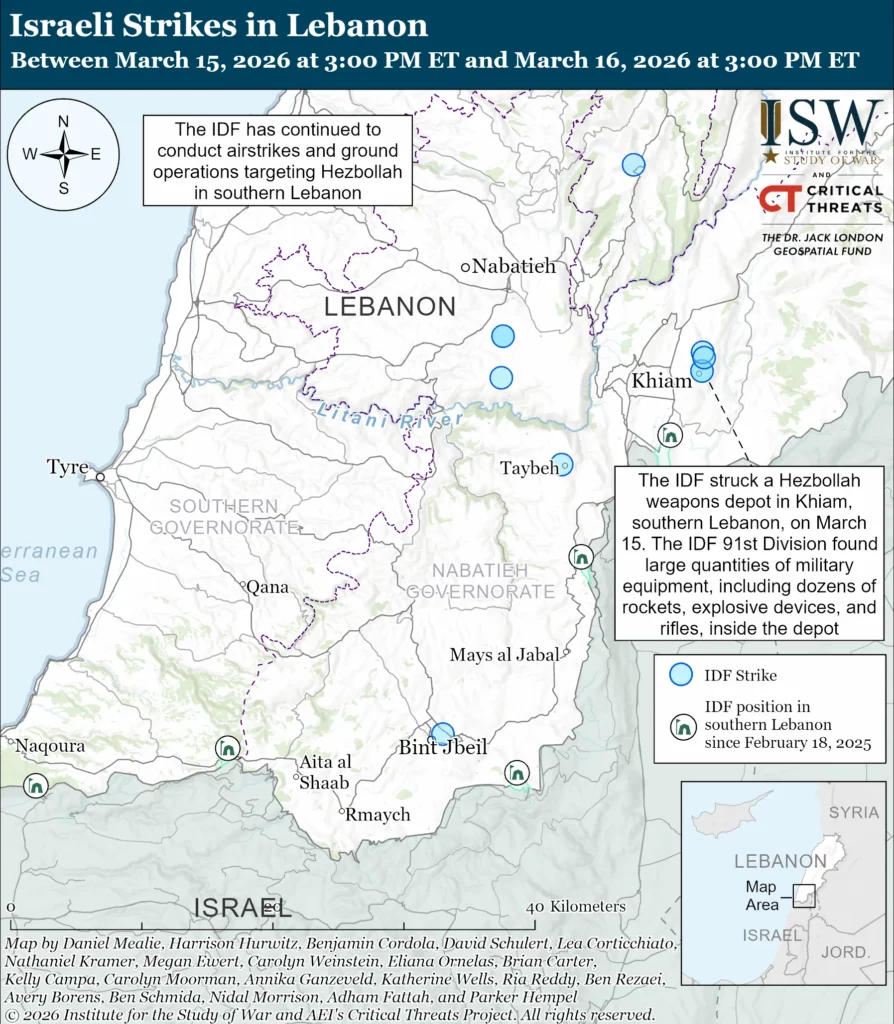
The IDF announced the start of a targeted ground operation in southern Lebanon on March 16.[83] The IDF reported on March 16 that the IDF 91st Division begun a targeted ground operation targeting key locations in southern Lebanon in order to solidify ”the forward defense zone,” destroy Hezbollah infrastructure, and kill Hezbollah fighters.[84] IDF spokesperson Lieutenant Colonel Nadav Shoshani told reporters on March 16 that the IDF was operating in new areas of southern Lebanon and described the Israeli operation as ”limited and targeted.”[85] Israeli Defense Minister Israel Katz stated on March 16 that the operation in Lebanon is meant to resemble the IDF’s operations in the Gaza Strip during Israel’s war against Hamas and noted that the operation will continue until Hezbollah no longer poses a threat.[86]
Axis of Resistance Response
The combined force has likely killed multiple Iranian-backed Iraqi militia commanders, including Kataib Hezbollah security chief Abu Ali al Askari, on March 16.[87] Kataib Hezbollah announced on March 16 that its security commander and spokesperson, Abu Ali al Askari, died but did not provide details.[88] Kataib Hezbollah added that Abu Mujahid al Assaf will replace Askari as the group’s security chief.[89] The Iranian-backed Badr Organization similarly announced on March 16 that one of its commanders, Abu Muntadhar al Muhammadawi, died but did not provide details of his death.[90] CTP-ISW will provide more in-depth analysis on the deaths of both commanders on March 17.
Iranian-backed Iraqi militias continue to attack US forces and interests in Iraq and may be attacking US interests and partner states in the region. The Islamic Resistance in Iraq (IRI) said on March 15 that it carried out 24 operations that targeted “enemy bases” inside Iraq and elsewhere in the region.[91] The IRI‘s claim that it is attacking US facilities “elsewhere in the region,“ if true, would mean that Iran is not conducting all the attacks targeting the Gulf that are currently being attributed to it. The IRI also published two videos of purported rocket and drone attacks on US bases on March 15.[92] Likely militia front group Saraya Awliya al Dam also claimed on March 15 that it launched a barrage of rockets at the former US Victory Base near Baghdad International Airport.[93] Iranian-backed Iraqi militias have repeatedly claimed attacks targeting the former US Victory base since the start of the war.[94] Iranian-backed Iraqi militia Kataib Hezbollah similarly conducted a FPV drone attack on the Victory Base on March 15.[95] No US forces are at Camp Victory. An IRI front group said on March 15 that it launched a drone attack against US interests in northern Iraq, likely referring to US bases in Erbil City.[96] Multiple local sources also reported on March 16 that an Iraqi militia drone likely targeted the US embassy in Baghdad, but Iraqi air defense systems intercepted it.[97] Two likely Iraqi militia drones separately targeted the Majnoon oil field in Basra Province, southern Iraq.[98] One drone struck a communications tower inside the field, while the other hit an office belonging to the US company KBR, according to Iraqi media.[99] A likely Iranian or Iranian-backed militia drone previously struck a power generator at the US-operated Sarsang oil field in Duhok, Iraqi Kurdistan, on March 5, causing a fire and forcing the facility to close temporarily.[100]The combined force has struck additional Iraqi militia targets since CTP-ISW’s last data cutoff. Iraqi media reported on March 16 that a combined force airstrike killed or wounded 20 PMF members of the 18th and 19th PMF brigades in al Qaim, western Anbar Province, along the Iraq-Syria border.[101] The Iranian-backed Badr Organization announced on March 16 that likely combined force airstrikes killed eight of its fighters.[102] An Iraqi source also reported that a combined force strike at the Kataib Hezbollah-controlled facility that now occupies Jurf al Sakhr, Babylon Province, wounded six PMF members.[103] A separate combined force strike wounded three other PMF members near the Badush Dam, north of Mosul, on March 16, according to Iraqi media.[104]