 Eurasia Press & News

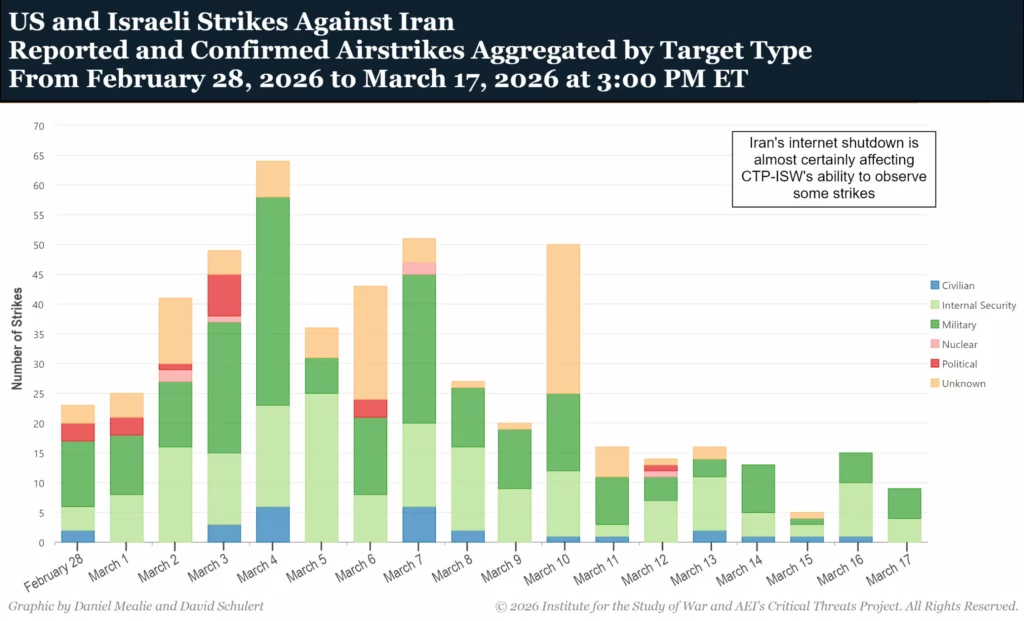
The Institute for the Study of War (ISW) and The Critical Threats Project (CTP) at the American Enterprise Institute are publishing daily updates to provide analysis on the war with Iran. The updates focus on US and Israeli strikes on Iran and Iran and the Axis of Resistance’s response to the strikes. The updates cover events from the past 24-hour period.
NOTE: ISW-CTP will no longer publish morning updates covering the war with Iran. ISW-CTP will instead publish threads on its social media channels in the morning that cover the latest developments in the war and include relevant maps.
Key Takeaways
The United States and Israel are currently attempting to use force to prevent Iran from disrupting shipping in the Strait of Hormuz. A weakened regime that remains in power after this war would be able to disrupt shipping whenever and for however long it pleases with little effort if its current, relatively limited, strike campaign on shipping proves sufficient to cause the US and Israel to surrender.
A failure to demonstrate the will and ability to deny Iran the ability to disrupt traffic will make it enormously harder to deter Iran from future disruptions. Stopping the war in current conditions would thus represent a major strategic challenge that the United States or Israel would need to contend with in future rounds of conflict with a regime that will continue to be a committed adversary.
The Israel Defense Forces (IDF) confirmed that it struck the Islamic Revolutionary Guards Corps (IRGC) Navy headquarters in Tehran on March 16. It stated that commanders used the headquarters to direct IRGC Navy forces and plan operations against Israel and other regional countries.
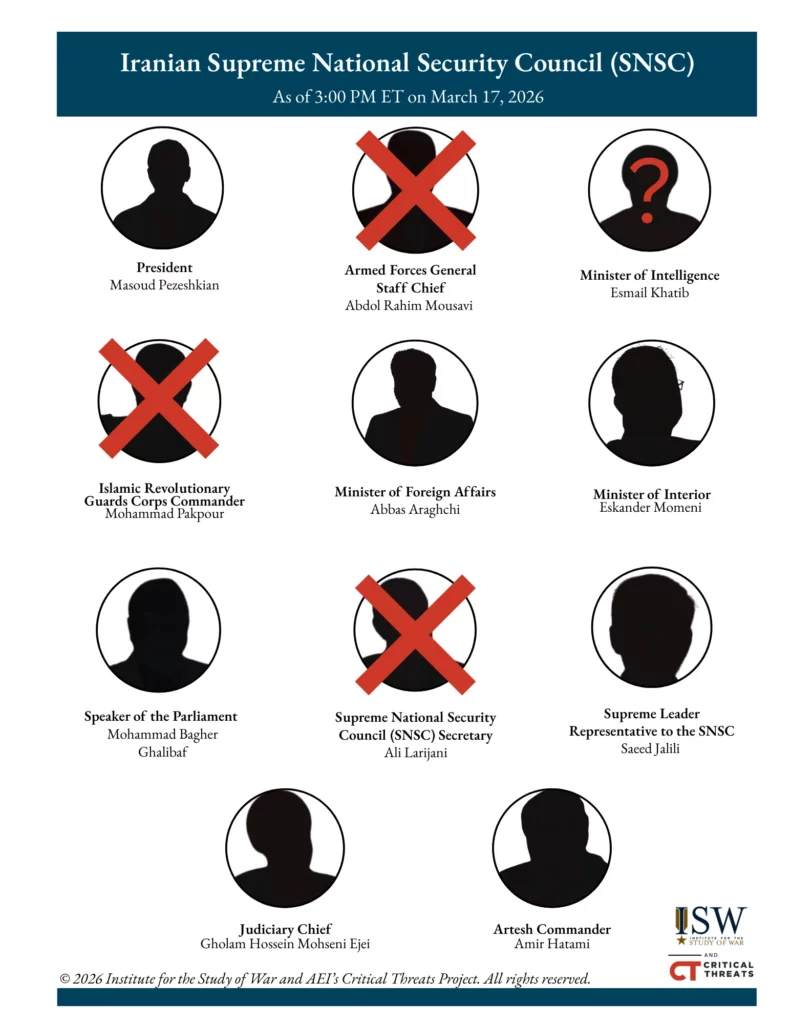
The IDF confirmed that it killed Supreme National Security Council (SNSC) Ali Larijani, who was a long-time regime insider and had held many senior posts, in airstrikes in Tehran overnight on March 16 and 17. Larijani’s death likely weakens a key faction in competition with the Supreme Leader Mojtaba Khamenei-IRGC nexus, but it will not end the ongoing competition.
A long-time observer of drone operations in Ukraine suggested on March 17 that the drone footage posted by likely Iranian-backed Iraqi militia front group Saraya Awliya al Dam is consistent with a fiber optic first-person view (FPV) drone. The Iranian proxy group’s decision to advertise its possession of such a weapon would be an explicit threat aimed at the United States.
Toplines
The United States and Israel are currently attempting to use force to prevent Iran from disrupting shipping in the Strait of Hormuz. Such an operation will also demonstrate that the regime cannot hold the strait hostage in the future to secure strategic victories at relatively limited cost. A “very senior Israeli political source” enumerated a series of war aims to Israeli Channel 12 that included preventing Iran from disrupting shipping in the Strait of Hormuz and denying Iran’s ability to do so in the future.[1] Accomplishing this objective would demonstrate that Israel and the United States have the ability to prevent Iran from trying again in the future. The US objectives are consistent with the Israeli objectives regarding the Strait of Hormuz. US Central Command (CENTCOM) commander Admiral Brad Cooper said on March 11, for example, that the United States aims to degrade Iran’s ability to interrupt shipping in the Strait and “end their ability to project power and harass shipping in the Strait of Hormuz.”[2]
A weakened regime that remains in power after this war would be able to disrupt shipping whenever and for however long it pleases with little effort if its current, relatively limited, strike campaign on shipping proves sufficient to cause the US and Israel to surrender. A failure to demonstrate the will and ability to deny Iran the ability to disrupt traffic will make it enormously harder to deter Iran from future disruptions. Stopping the war in current conditions would thus represent a major strategic challenge that the United States or Israel would need to contend with in future rounds of conflict with a regime that will continue to be a committed adversary. Iranian Parliament Speaker and former military official Mohammed Bagher Ghalibaf, for example, said that the strait will never return to its pre-war state.[3] Ghalibaf is presumably suggesting that Iran will continue to use the Strait of Hormuz and threats against it to coerce its adversaries and deter future military action. Ending Iran’s ability to disrupt shipping would demonstrate to Tehran that the United States and its partners can and will stop Iran by force if needed. It remains unclear whether military action will stop Iran from threatening the Strait. But ending the war without taking all feasible action to destroy Iran’s ability to disrupt traffic would communicate Iran that it can use threats to the strait to defeat its adversaries, including the United States, in any future conflict.
The list of objectives also included “creating conditions for regime change.” It does not follow that “conditions for regime change” will create regime change.[4] The conditions for regime change may or may not exist after the war, but executing regime change would require a sufficiently strong, large, and organized force to topple the regime nationwide and then take control nationwide in order to avoid chaos or a large-scale indigenous movement to overthrow the regime. It is premature to forecast the likelihood of such an uprising, as the air campaign is not complete, and people are very unlikely to rise against the regime in the midst of an active air campaign.
The Israel Defense Forces (IDF) confirmed that it struck the Islamic Revolutionary Guards Corps (IRGC) Navy headquarters in Tehran on March 16.[5] It stated that commanders used the headquarters to direct IRGC Navy forces and plan operations against Israel and other regional countries. The IRGC Navy is primarily responsible for the Persian Gulf and the Strait of Hormuz.[6] Iranian leaders have historically viewed the IRGC Navy as their main tool to disrupt commercial traffic near Iran’s coast and around the Strait of Hormuz. IRGC Navy Commander Alireza Tangsiri implicitly threatened on March 1 to attack any vessels that transit the strait without permission from Iran.[7] The United Kingdom Maritime Trade Organization has reported more than 20 maritime incidents in and around the strait since March 1.[8] The IRGC Navy also transports military equipment and other resources to Iranian proxy groups.[9]
NOTE: A version of the following text will also appear in the Institute for the Study of War’s March 17 Russian Offensive Campaign Assessment:
Russia continues to expand its intelligence sharing and military cooperation with Iran to facilitate Iranian strikes on US and Israeli forces in the Middle East. The Wall Street Journal (WSJ) reported on March 17, citing sources familiar with the matter, that Russia has been providing Iran with satellite imagery and drone technology and advice to support Iran’s strike campaign against Israeli and the US forces.[10] Anonymous sources familiar with the matter, including a senior European intelligence officer, told the WSJ that Russia provided Iran with modified Shahed drone components meant to improve communication, navigation, and targeting, and specific advice for conducting drone strikes, including at what altitude and how many drones Iran should launch. A senior European intelligence officer and a Middle Eastern diplomat reported that Russia provided Iran with satellite imagery, which another official said came from satellites the Russian Aerospace Forces (VKS) manage, to assist recent Iranian strikes on US forces in the Middle East and US allies in the region. ISW continues to assess that Russia sees aiding Iran’s strike campaign as an opportunity to weaken the US, as Russia has self-defined the US as one of its primary geopolitical adversaries.[11]
The IDF conducted a strike in Tehran killing Ali Larijani. Larijani has long been a major figure in the Iranian ruling establishment as a member of the powerful Larijani family and key player in the inner circle of recently killed Supreme Leader Ali Khamenei.[12] He has held numerous key posts over decades, including parliament speaker and most recently Supreme National Security Council (SNSC) secretary. The SNSC is the seniormost foreign and defense policy decision-making body. In that capacity, Larijani has overseen Iranian strategy in the current war and the brutal crackdown that killed 30,000 protesters in January 2026.[13] The New York Times reported in February 2026 that Larijani had “effectively been running the country” by that time.[14]
Larijani was a relative pragmatist, occasionally supporting more restrained behaviors compared to the more uncompromising hardliners. Larijani supported the Joint Comprehensive Plan of Action championed by moderate President Hassan Rouhani, for instance. Nevertheless, Larijani was a long-time regime operative who had long endorsed and helped implement some of the regime’s most aggressive and authoritarian policies.
Larijani’s death likely weakens a key faction in the intra-regime competition with the Supreme Leader Mojtaba Khamenei-IRGC nexus but will not end the ongoing competition. The New York Times reported on March 17 that Larijani had been lobbying the Assembly of Experts, the body responsible for selecting the supreme leader, to change their vote in favor of a more moderate choice.[15] Anti-regime media reported on March 6 that Larijani had wanted his brother, Sadegh Amoli Larijani, to become the next Supreme Leader.[16] Anti-regime media reported in September 2025 that Ali Larijani was maneuvering to secure his influence in the regime after Khamenei dies.[17]
Competition within the regime over its future trajectory will continue despite Larijani’s death. Key factions continue to disagree over succession and governance after the combined force killed Ali Khamenei. Anti-regime media, citing unspecified sources, reported on March 13 that some clerics in Iran have raised concerns about Mojtaba’s physical condition and capacity to govern, for example.[18] Larijani’s death is also unlikely to be the last casualty from among Iran’s top leaders as decapitation strikes continue. Each loss will alter the nature of the competition and the power of the various factions. Mojtaba will likely face several immediate challenges even after the war and after the decapitation strikes stop or slow. These challenges will include establishing his legitimacy and attempting to unite and gain the support of various regime factions.[19]
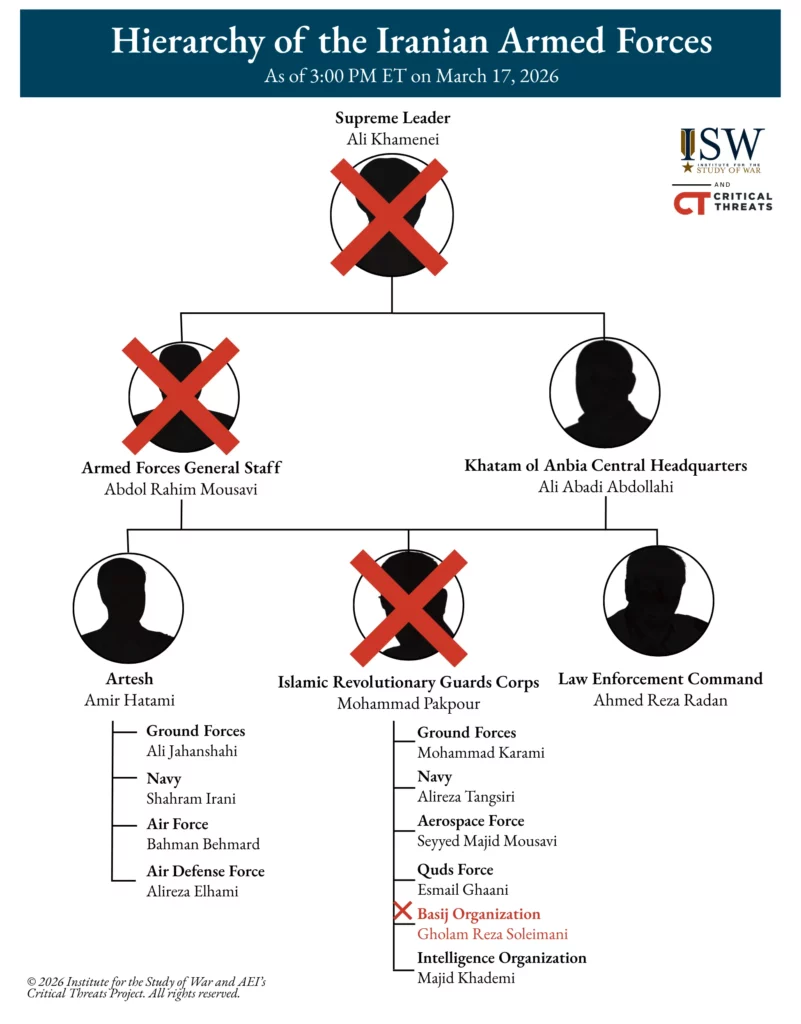
The IDF also killed Basij Organization Commander Brigadier General Gholamreza Soleimani and his deputy Ghassem Ghoureishi during strikes on a “makeshift headquarters” in Tehran where, according to anti-regime media, they were reportedly coordinating protest suppression efforts.[20] The strike occurred overnight on March 16 and 17. Sources told anti-regime media that senior Basij commanders held a meeting that night to discuss plans to counter potential protests during the Iranian Chaharshanbe Suri holiday on March 17.[21] The report added that the Israeli strikes overnight killed around 300 Basij commanders and field officers.[22] Israeli strikes targeting senior Basij commanders are part of a broader US-Israeli effort to degrade repressive institutions in Iran. The Basij is a paramilitary organization that the Iranian armed forces use to recruit, indoctrinate, organize, and control regime loyalists.[23] The Basij focuses largely on producing and disseminating propaganda, social policing, suppressing domestic dissent, and conducting civil defense activities. The Basij maintains elite units that receive advanced military and “ideological-political” training and function as a manpower reserve for the IRGC Ground Forces. The IRGC Ground Forces incorporates these Basij units into its ranks, especially during times of war or domestic crisis. The Basij also cooperates extensively with the IRGC Intelligence Organization to monitor the Iranian population. Israeli airstrikes overnight killed the following individuals, among others:
· Gholamreza Soleimani. Former Supreme Leader Ali Khamenei appointed Soleimani as Basij Organization commander following the 2019 protests as part of a broader reshuffling of internal security leadership.[24] The United States sanctioned Soleimani in January 2020 for the Basij’s involvement in recruiting and sending child soldiers to fight in regional conflicts.[25] Soleimani previously commanded IRGC Ground Forces units and has an extensive history of repression.[26]
· Ghassem Ghoureishi. Former IRGC Commander Hossein Salami appointed Ghoureishi in 2021 during the same reshuffling period of internal security officials.[27] He previously served as the coordination deputy to the supreme leader’s representative to the IRGC.[28] The European Union sanctioned Ghoureishi on March 16 for his role in protest suppression and human rights violations.[29]
A long-time observer of drone operations suggested on March 17 that the drone footage posted by a likely Iranian-backed Iraqi militia front group, Saraya Awliya al Dam, is consistent with a fiber optic first-person view (FPV) drone.[30] The Iranian proxy group’s decision to advertise its possession of such a weapon would be an explicit threat aimed at the United States. Saraya Awliya al Dam claimed that it launched a reconnaissance drone inside the perimeter of the US Embassy in Baghdad and posted the drone’s video footage.[31] Fiber optic FPV drones are immune to jamming and can be used for intelligence, surveillance, and reconnaissance, or outfitted with strike capabilities to conduct precise targeting.[32] Russia and Ukraine have extensively used FPV drones in the Russia-Ukraine War.[33] Iran possesses FPV drones and could share this technology with its partners in Iraq.[34] Russia has also recently shared drone tactics with Iran, but disseminating these tactics to Iraqi groups from Iran would take time, especially during a war. An Iraq analyst reported on March 17 that Saraya Awliya al Dam is a front group for Kataib Sayyid al Shuhada.[35] CTP-ISW continues to assess that Iranian-backed Iraqi militias are using front groups to conduct attacks to obfuscate responsibility. Kataib Sayyid al Shuhada is a US-designated terrorist organization and conducted attacks targeting US forces in Iraq and Syria under the Islamic Resistance in Iraq coalition during the Gaza War.[36]
A US official and source with knowledge told Axios on March 16 that Iranian Foreign Affairs Minister Abbas Araghchi and US envoy Steve Witkoff have reactivated a direct communications channel in recent days.[37] The US official claimed that Araghchi reached out to Witkoff to find ways to end the war, adding that the US side “is not talking to Iran.”[38] Araghchi denied on March 16 having any contact with Witkoff since the war started on February 28.[39]
US and Israeli Air Campaign
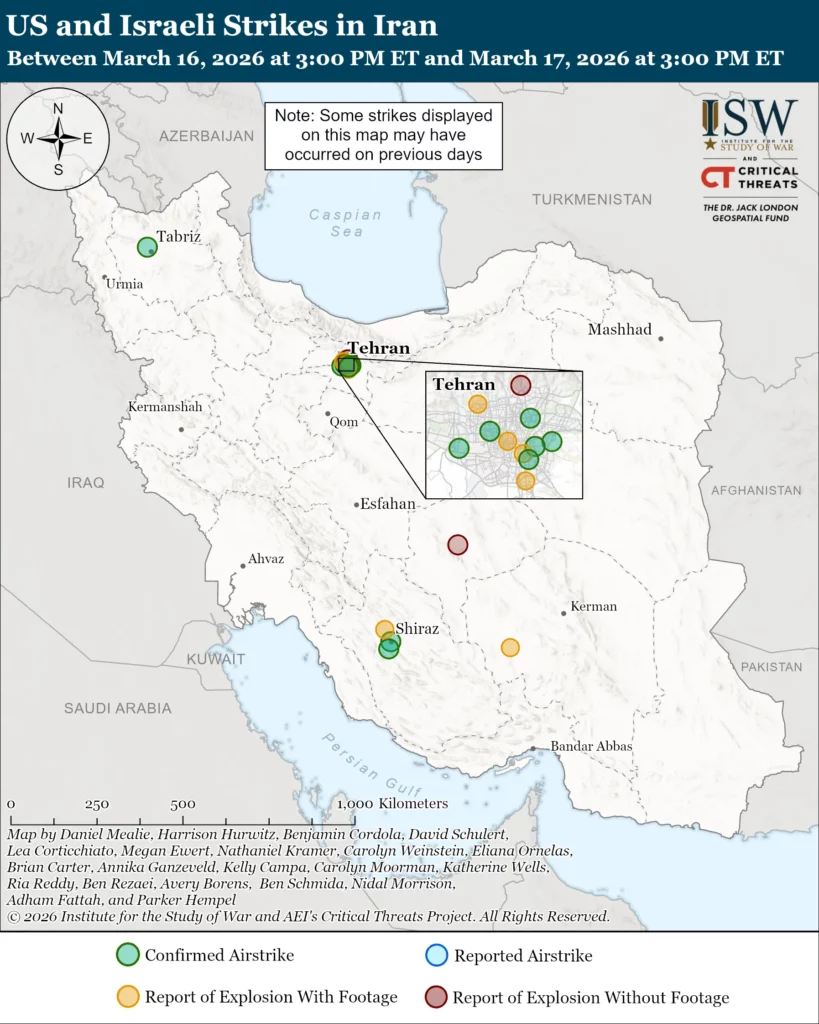
The combined force has continued to strike Iranian ballistic missile infrastructure to degrade Iran’s missile capabilities. The IDF said on March 17 that it struck a ballistic missile and storage site located in underground facilities at an IRGC drone and missile base south of Shiraz, Fars Province.[40] The combined force has struck this missile base several times since the war began on February 28, based on satellite imagery of the site, including likely strikes on March 2 and March 6.[41] The combined force likely struck the facility with ground-penetrating munitions based on satellite imagery from March 7.[42] The IDF previously struck the base during the 12-Day War after Iran launched missiles at Israel from the site.[43] The facility also includes underground silos for drone launches, according to an Israeli think tank.[44] The combined force likely struck the Imam Hussein Strategic Missile base located south of Yazd City on March 17.[45] An OSINT account geolocated photographs of reported strikes published by anti-regime media on March 17 to the Imam Hussein Strategic Missile base in Yazd.[46] The combined force has similarly struck this facility multiple times on March 1 and March 6, according to satellite imagery from an Israeli analyst.[47] The Imam Hussein Strategic Missile Base previously stored long-range Khorramshahr ballistic missiles in underground tunnels and used the site to launch approximately 60 ballistic missiles at Israel during the 12-Day War, according to an Israeli military correspondent.[48] These included ballistic missiles with cluster munition warheads, which Iran has launched toward Israel several times since the war began on February 28, and previously used them during the 12-Day War.[49] Repeated strikes on these facilities suggest a continued effort to degrade Iran’s ability to store, launch, and sustain ballistic missile operations.
The combined force has continued to degrade Iranian air capabilities in order to maintain air superiority over parts of Iran. An Israeli analyst published satellite imagery on March 17 that shows that the combined force struck the 7th Artesh Air Force Tactical Airbase in Shiraz, Fars Province.[50] The combined force struck two C-130 transport aircraft, an Ilyushin Il-76 transport aircraft, and ten nearby hangars.[51] US CENTCOM previously published a video of strikes on similar aircraft types in Iran on March 11.[52] Iran reportedly maintained a fleet of around 28 C-130’s prior to the war, which it acquired from the United States before the 1979 Islamic Revolution.[53] This is likely the fourth strike on the 7th Artesh Air Force Tactical Airbase, which is co-located with the Shiraz International Airport. The combined force previously struck the Airbase on March 1 and March 6.[54] CENTCOM also released footage on March 17 showing strikes on multiple Iranian air defense systems in unspecified locations.[55]
The combined force continued to strike Iranian defense industrial sites. Anti-regime media reported on March 16 that the combined force struck an ammunition depot in Sirjan, Kerman Province.[56] US CENTCOM Commander Admiral Brad Cooper stated on March 16 that US forces struck a drone production facility in Tehran on March 11.[57] Cooper added that the US efforts have begun to focus more on Iran’s defense industrial sites and “wider manufacturing apparatus.”[58] The IDF stated on March 17 that it struck an unspecified regime defense site in Tabriz, East Azerbaijan Province, which commercially available satellite imagery showed to be a missile production site.[59]
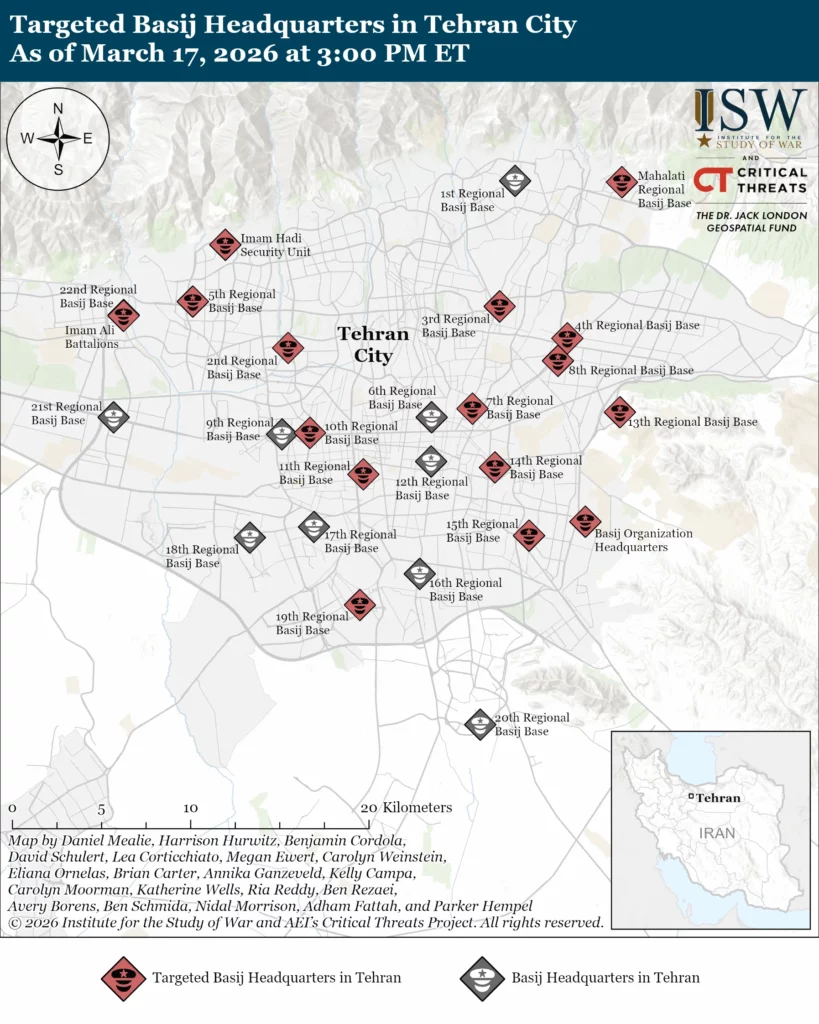
The combined force struck a number of internal security targets. The IDF stated on March 17 that the combined force struck multiple Basij checkpoints and bases across Tehran, including a Basij base in Kamraniyeh District.[60] Anti-regime media reported that these strikes killed around 300 Basij commanders and field officials on March 17.[61] The IDF also struck the Imam Hadi security unit, which consists of Basij and IRGC forces, and one of Tehran’s most important units for enforcing internal security under the IRGC Ground Forces Mohammad Rasoul Ollah Corps.[62] The Imam Hadi unit is reportedly stationed at a football stadium, which is a tactic the regime uses for protective cover or in times of emergency.[63] Anti-regime and regime media reported on March 17 that the combined force struck the IRGC Quds Force Imam Ali unit, which is one of the regime units responsible for training proxy militias.[64] It has open-air shooting ranges, underground ammunition depots, and residences for security units.[65] The IDF also announced on March 17 that it struck the Fars LEC Provincial headquarters.[66]
Iranian Retaliation
Iran launched nine missile barrages at Israel between 3:00 PM ET on March 16 and 3:00 pm ET on March 17.[67] Israeli media reported on March 17 that an Iranian cluster munition impacted in Rishon Lezion and at least six other sites in central Israel.[68] Iranian missile fragments also hit a train station in Holon.[69]
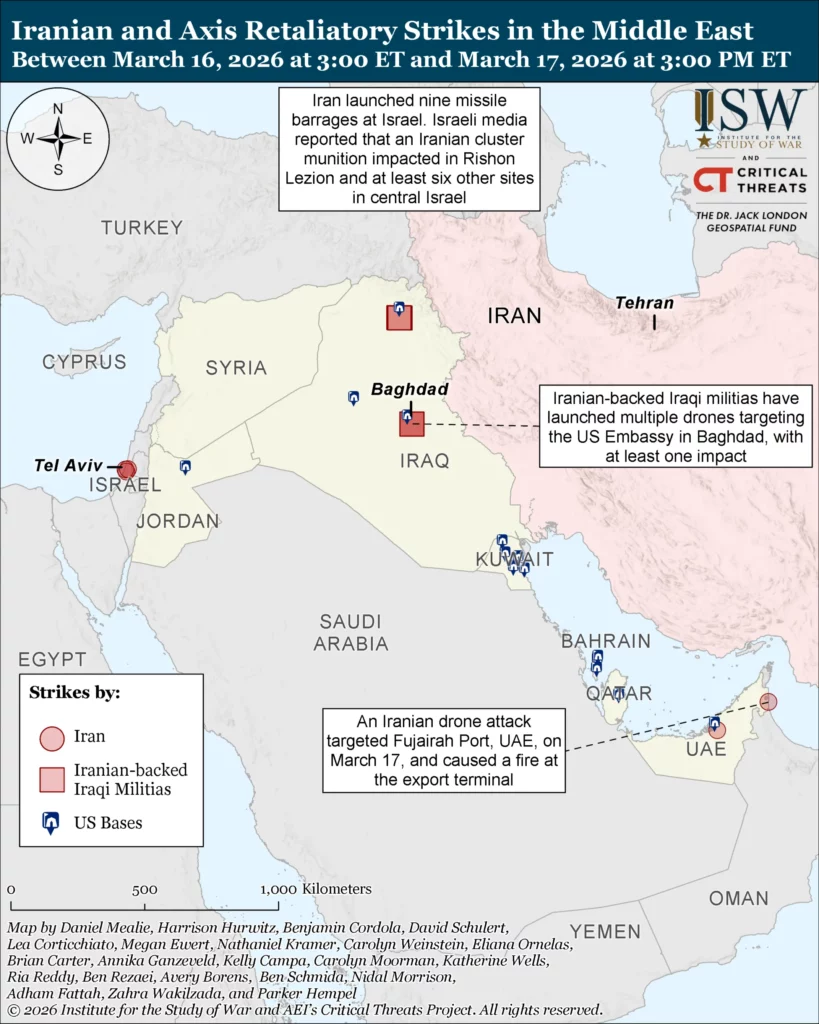
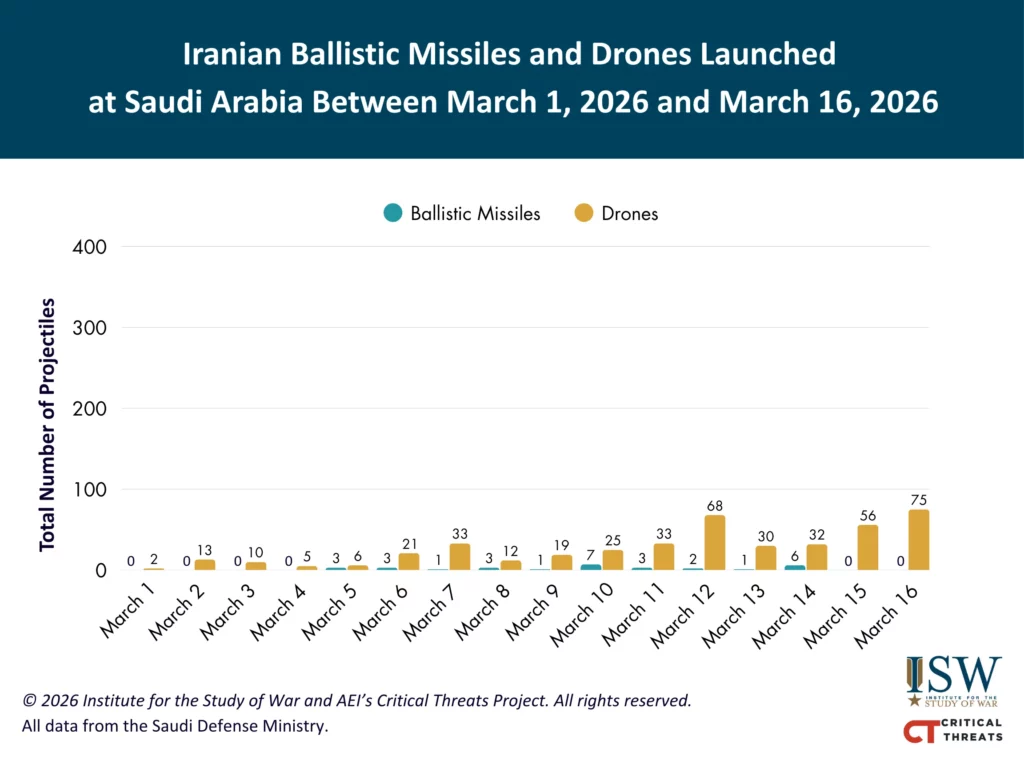
Iran continued to conduct drone and missile attacks against the Gulf states on March 16 and 17, but Gulf air defense systems have continued to intercept most Iranian projectiles. The Saudi Defense Ministry reported that it intercepted 35 Iranian drones and one ballistic missile on March 17 as of 3:00 PM ET.[70] The Kuwaiti Defense Ministry said that it intercepted 13 Iranian drones and two ballistic missiles.[71] The Qatari Defense Ministry reported that it intercepted several Iranian drones and 15 Iranian ballistic missiles, with one missile landing in an uninhabited area.[72] The Bahrain Defense Forces also intercepted two Iranian drones.[73]
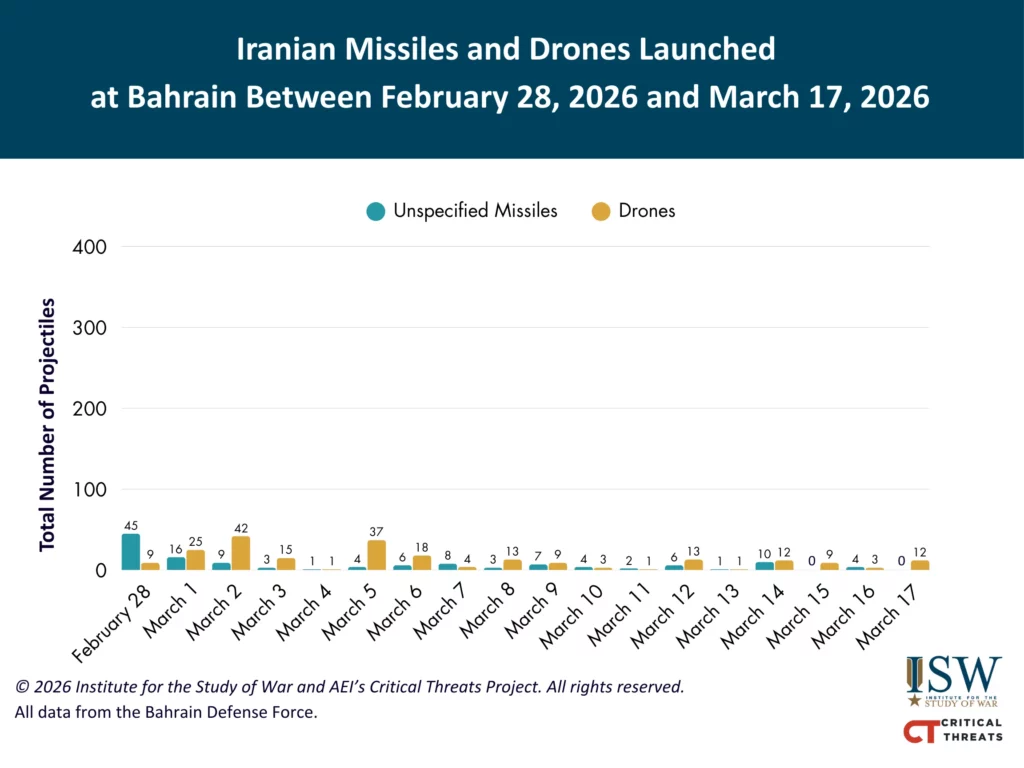
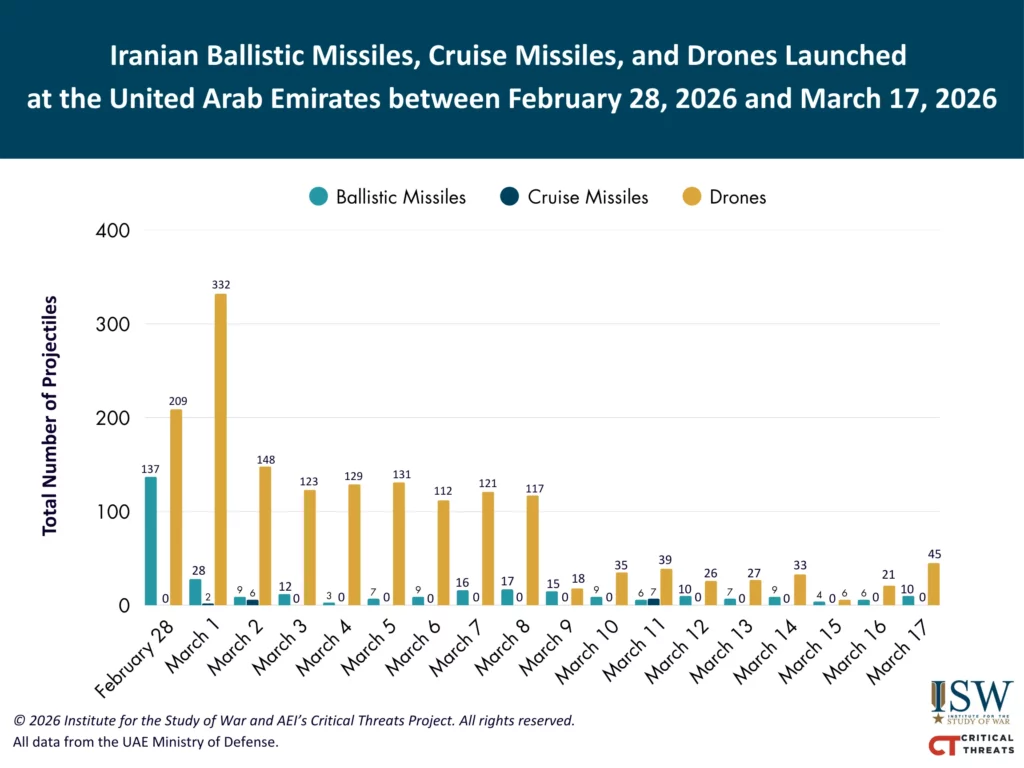
The Emirati Defense Ministry reported that it detected and intercepted 45 Iranian drones and 10 Iranian ballistic missiles on March 17.[74] An Iranian drone attack targeted Fujairah Port, UAE, on March 17, and caused a fire at the export terminal.[75] Unspecified industry sources told Western media on March 17 that the port suspended oil loadings.[76] Emirati authorities also reported on March 17 that debris from a missile interception killed one Pakistani national in Bani Yas, Abu Dhabi.[77]
Israeli Campaign Against Hezbollah and Hezbollah Response
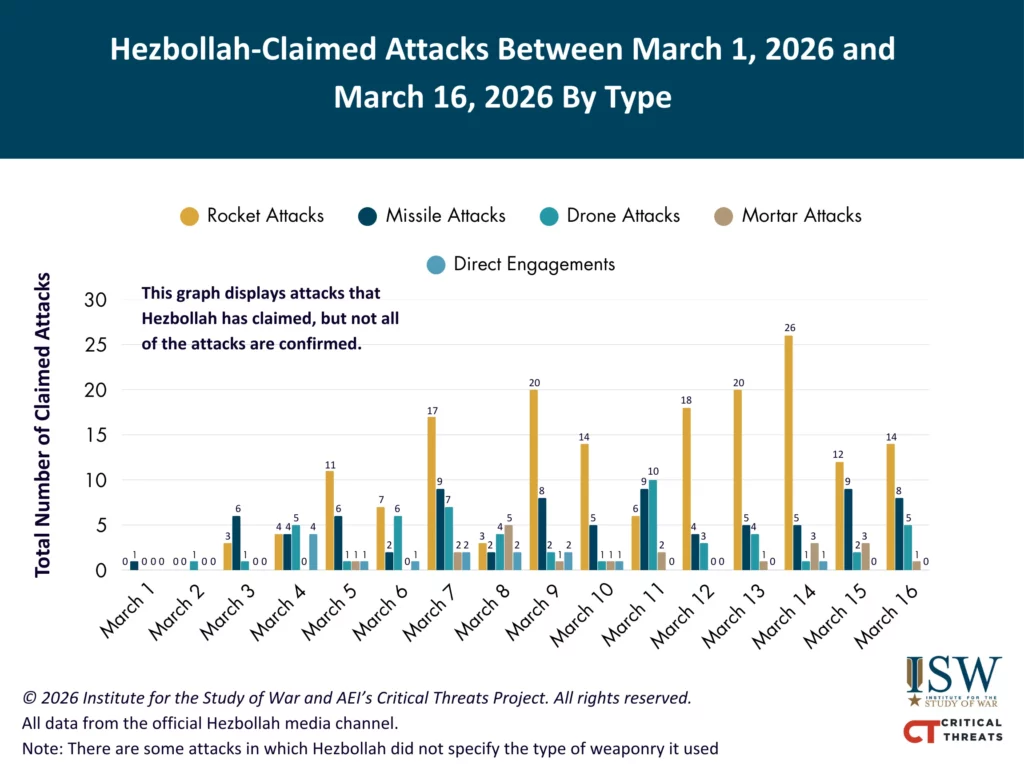
Hezbollah claimed 19 attacks targeting Israeli forces and positions in northern Israel and southern Lebanon between 3:00 PM ET on March 16 and 3:00 PM ET on March 17.[78] Hezbollah claimed several rocket and drone attacks targeting IDF positions and forces along both sides of the Israel-Lebanon border.[79] Hezbollah claimed four anti-tank guided missile attacks targeting Israeli Merkava tanks in southern Lebanon.[80] Hezbollah claimed two separate drone attacks targeting the radar sites and control rooms at the Ramat David Airbase in northern Israel and the IDF Katsavia barracks in the Israeli-controlled Golan Heights.[81] The size of Hezbollah’s rocket barrages appears to be decreasing. Hezbollah launched a barrage of rockets on March 16, which contained approximately 40 rockets.[82] Hezbollah has launched about 100 rockets per day, with its largest rocket barrage containing 200 rockets.[83] The IDF warned on March 17 that Hezbollah is planning to launch a large overnight rocket attack and has taken precautionary measures.[84]
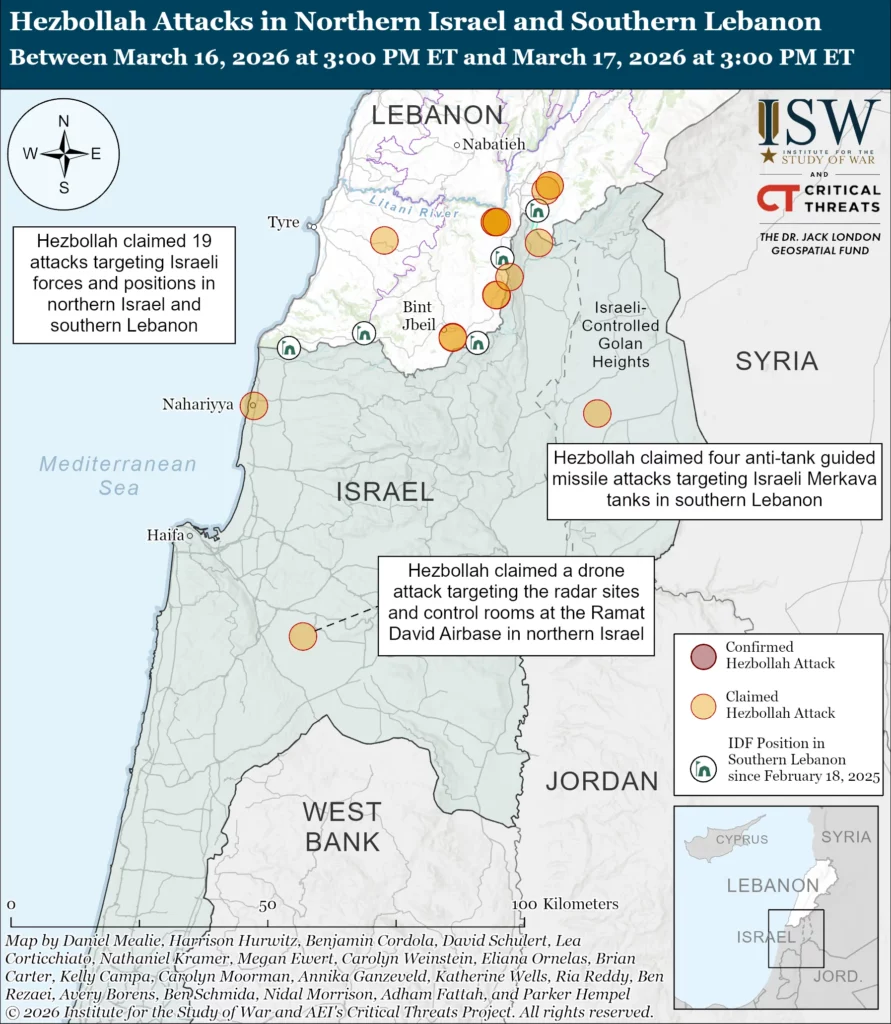
The rate of Hezbollah attacks targeting Israel has varied since the group joined the war on March 1, as illustrated below.
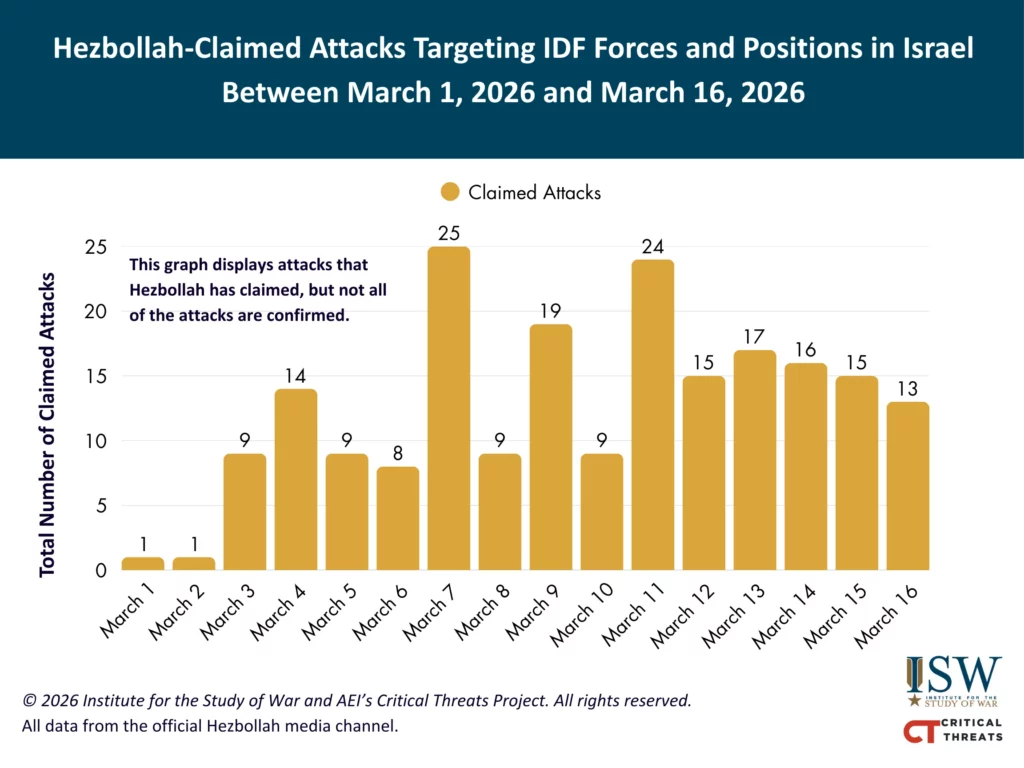
Hezbollah has also employed a variety of weapons in its attacks against Israeli forces and positions in northern Israel and southern Lebanon (see below).
Hezbollah Secretary General Naim Qassem commended Hezbollah fighters on March 17.[85] Qassem applauded Hezbollah fighters in their “confrontation with the Israeli-American aggression.”[86] Qassem noted that the ”available solution” is to stop Israeli operations, an Israeli withdrawal from Lebanese territory, the release of Lebanese prisoners held in Israel, and the commencement of reconstruction in Lebanon.[87] Qassem’s stated solution mirrors Hezbollah’s long-standing demands that the group stated must be met before the group discusses its weapons.[88]
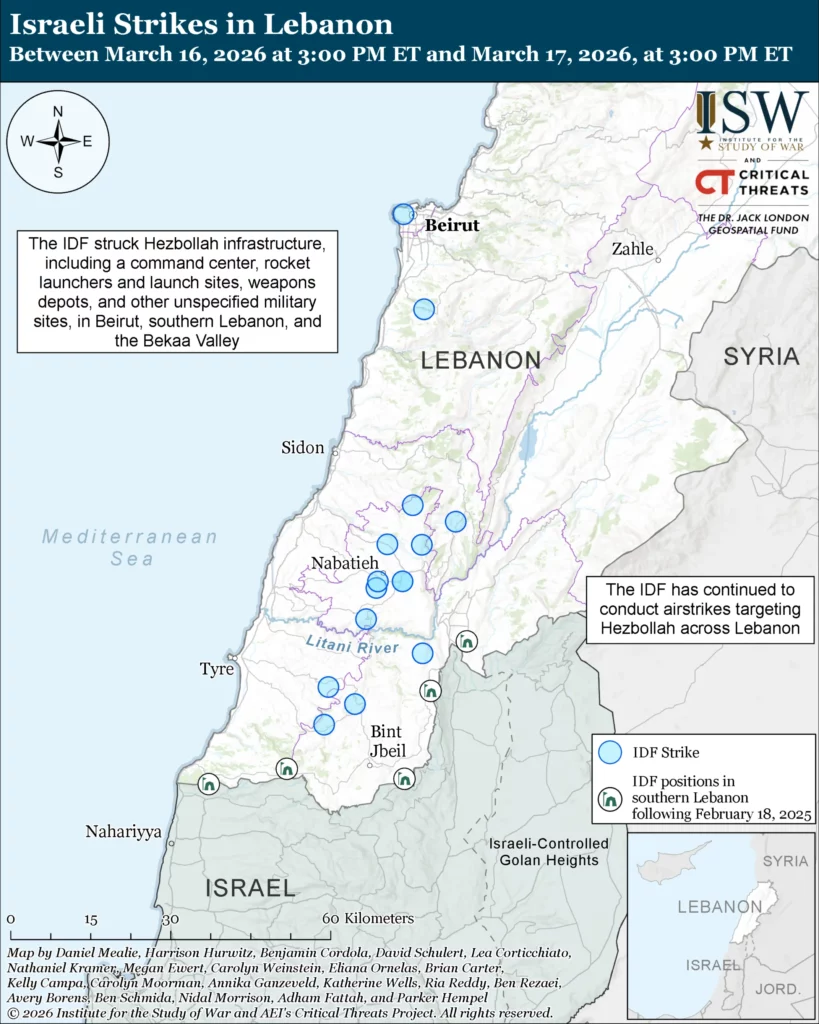
The IDF has continued to conduct airstrikes and ground operations targeting Hezbollah in southern Lebanon. The IDF struck Hezbollah infrastructure, including a command center, rocket launchers and launch sites, weapons depots, and other unspecified military sites, in Beirut, southern Lebanon, and the Bekaa Valley.[89] The IDF also killed several Hezbollah fighters in southern Lebanon.[90] The IDF 36th Division continued to conduct ”focused ground activity” in southern Lebanon on March 17.[91] IDF Chief of Staff Major General Eyal Zamir stated on March 17 that the IDF continues to mobilize forces and expand its ground operation in Lebanon.[92] The IDF also continued to issue evacuation warnings for Lebanese residents in Beirut’s southern suburbs and southern Lebanon.[93]
US Special Envoy Tom Barrack rejected reports that the United States is encouraging Syria to send forces into Lebanon to disarm Hezbollah.[94] Barrack called the reports “false and inaccurate.”[95]
Kuwaiti authorities arrested a 16-member Hezbollah cell and seized various weapons in Kuwait on March 16.[96] The cell comprised 14 Kuwaiti citizens and two Lebanese nationals.[97] Kuwaiti authorities seized weapons and equipment, including firearms, encrypted communication devices, drones, maps, cash, and Hezbollah flags.[98] Hezbollah stated on March 17, in which it declared that it has no cells, individuals, or networks in Kuwait.[99]
Other Axis Of Resistance Response
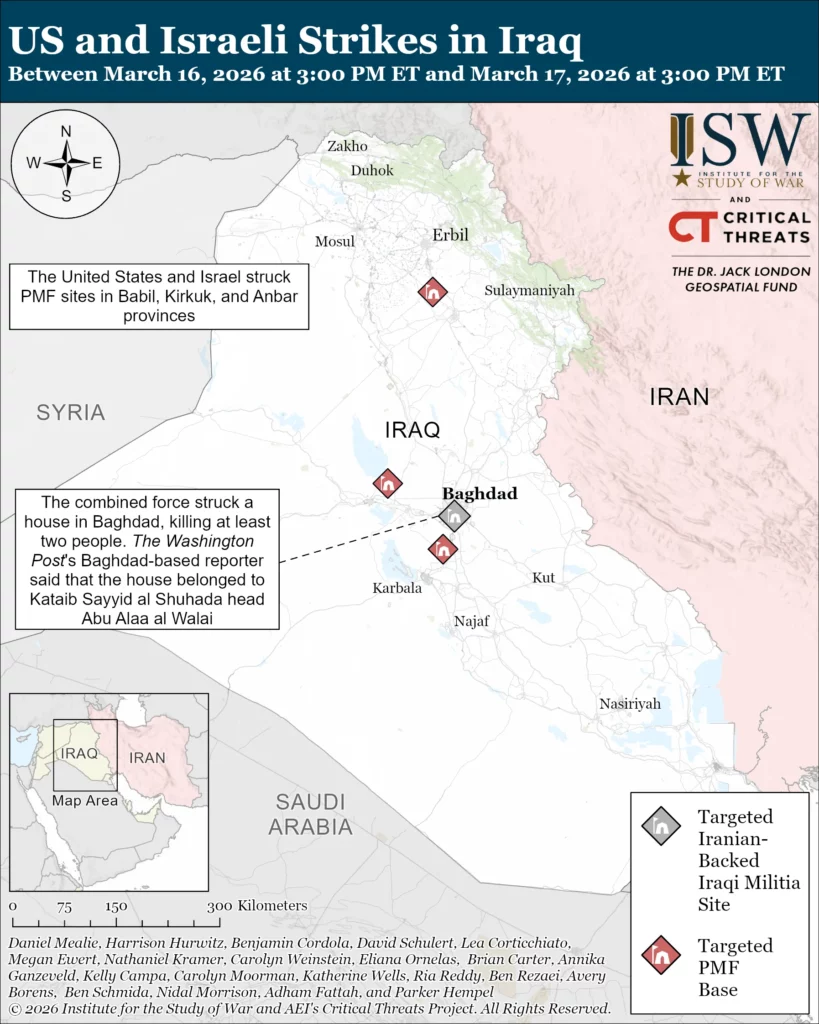
US and Israeli combined force strikes continue to target Iranian-backed Iraqi militia positions, including those affiliated with Kataib Hezbollah. The combined force conducted multiple strikes targeting Kataib Hezbollah’s Jurf al Sakhr stronghold since 3:00 PM ET on March 16.[100] Kataib Hezbollah is an Iranian proxy that is closely ideologically bound to the regime, and the combined force has conducted multiple strikes targeting the group during the war.[101] The combined force also struck multiple sites in Baghdad on March 13, reportedly targeting Kataib Hezbollah head Abu Hussein al Hamidawi.[102] Kataib Hezbollah announced the death of its security chief and spokesperson Abu Ali al Askari on March 16 and said that Abu Mujahid al Assaf will replace Askari as the group’s next security chief.[103] Askari was a senior commander in Kataib Hezbollah.[104] Askari’s death will likely impose operational constraints and potentially command and control disruptions on Kataib Hezbollah.
An airstrike on a house in Baghdad’s Jadriya neighborhood on March 16 killed at least two people.[105] The Washington Post’s Iraq reporter said the house belongs to Kataib Sayyid al Shuhada’s head, Abu Alaa al Walai.[106] A security source told Iraqi media that the combined force strike in Baghdad targeted an Iranian advisor for Iraqi economic affairs and an IRGC official responsible for Iraq.[107]
Other combined force airstrikes targeted PMF positions in Baghdad, Anbar, and Kirkuk provinces. Airstrikes targeted the headquarters of the 12th PMF Brigade of the Popular Mobilization Forces (PMF), which is affiliated with Iranian partner militia Harakat Hezbollah al Nujaba, in the Nabai area, north of Baghdad, injuring three PMF members.[108] A security source told Iraqi media on March 17 that a strike targeted the headquarters of the 65th PMF Brigade, injuring the commander of the brigade’s Tribal Mobilization Forces-affiliated 2nd regiment.[109] The Tribal Mobilization Forces are usually Sunni-dominated components of PMF brigades.[110] CTP-ISW is unable to certify the affiliation of the 65th PMF brigade. A security source separately told Iraqi media that a drone strike targeted a 40th PMF Brigade site in Kirkuk Province.[111] The 40th PMF brigade is affiliated with Kataib al Imam Ali.[112]
Iranian-backed Iraqi militias continued to launch drone attacks targeting US forces and interests in Iraq. Iranian-backed Iraqi militias have launched multiple drones targeting the US Embassy in Baghdad since 3:00 PM ET on March 16, with at least one impact.[113] Geolocated footage shows a Shahed drone striking near the entrance of the US Embassy in Baghdad.[114] Iranian-backed Iraqi militias operating under the Islamic Resistance in Iraq launched Shahed drones targeting Israel and US bases in Iraq and Syria during the Gaza War.[115] Other footage shows the embassy’s air defense system intercepting another drone.[116] Iraqi media reported additional instances on March 16 of the embassy’s air defenses intercepting both drones and rockets, and an Iraq-focused OSINT analyst reported that the embassy’s air defenses intercepted another drone on March 17.[117] Iranian-backed Iraqi militias almost certainly launched a drone attack that struck the Royal Tulip al Rasheed Hotel in Baghdad’s Green Zone.[118] The Ministry of Interior said that a projectile fell on the hotel’s roof but did not cause any human casualties or material damage.[119] Iraqi media reported on March 17 that more than 10 drones targeted the US Consulate in Erbil and the Erbil International Airport.[120] CTP-ISW did not observe any impacts at these sites. The US base near Erbil city is co-located with the airport.[121] The Islamic Resistance of Iraq claimed on March 17 that it had conducted 21 attacks with dozens of missiles and drones against “occupation” bases in Iraq and the region in the past 24 hours.[122] CTP-ISW has not yet observed proof of the militias firing missiles in this war.
Likely Iranian-backed Iraqi militia Saraya Awliya al Dam claimed it fired drones at Victory Base, which is a former US facility at Baghdad International Airport.[123] Iraqi militias have repeatedly claimed attacks since the start of the war targeting the former US Victory base at the airport, although the United States withdrew from the base in 2011.[124]