 Eurasia Press & News
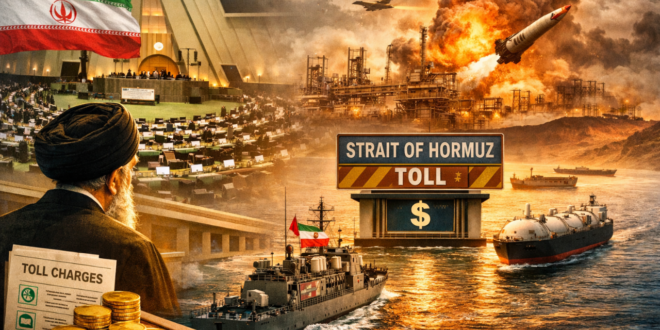
Iran plans Hormuz transit fees amid war tensions, signalling a major shift from military conflict to economic control over global trade routes.
The global attention around the world has largely focused on military developments as tensions escalate following Israel’s strikes on Iranian-linked facilities near the South Pars gas field. The world is assessing how the geopolitical situation will pan out in the coming days amid the ongoing Middle East crisis. However, a potentially more consequential shift is unfolding away from the battlefield, inside Iran’s legislative corridors.
Tehran is reportedly exploring a strategy that could rewrite the global trade dynamics by putting a toll on one of the world’s most critical maritime waterways.
While main headlines remain dominated by the Israel-Iran-US conflict, Iran’s parliament is reportedly working on a proposal that goes far beyond conventional warfare. Instead of relying solely on military threats, lawmakers are considering a system to impose transit charges on ships passing through the Strait of Hormuz, a waterway through which roughly one-fifth of the world’s oil and liquefied natural gas flows, according to a report from The Strait Times.
According to reports, the proposed legislation would require countries using the strait for shipping, energy transport, and food supply routes to pay tolls and taxes.
Iran’s ‘New Regime’ For Global Shipping
Statements from senior Iranian officials further strengthened this new approach of the country. An adviser to Iran’s supreme leader indicated that “a new regime for the Strait of Hormuz” could be introduced once the current conflict with Israel and the US subsides. This framework would allow Tehran to impose restrictions on nations that have sanctioned it.
“By using the strategic position of the Strait of Hormuz, we can sanction (the West) and prevent their ships from passing through this waterway,” Mohammad Mokhber said Thursday, according to Mehr news agency.
Such remarks suggest that Iran is looking to institutionalise its influence over the strait, not merely as a defensive measure but as a long-term geopolitical tool to generate revenue.
The Economics of Control Over The Free Ocean
The proposal gives global shipping companies a clear and simple choice. On one side, ships can keep using the usual security methods, like relying on naval escorts, but this comes with higher risks and expensive insurance. On the other side, they could pay a fee to Iran, which might allow them to pass more safely and with less uncertainty.
This idea changes the situation from just a military conflict into a financial decision. By using its important location, Iran seems to be trying a strategy where controlling shipping routes helps it gain money and political influence.
A Turning Point for Global Trade Routes?
This kind of policy could have a big impact. If it actually happens, it might change the long-standing rules about how ships move freely in international waters. The idea of charging money to pass through an important water route like the Strait of Hormuz raises concerns about whether navigation will remain free and how power is shared in global trade.
With increasing global tensions and changing alliances, what happens around the Strait of Hormuz is becoming very important for markets, energy supply, and relationships between countries. It’s still unclear if this idea will become reality, but it shows a growing trend: using money and economic pressure can be just as powerful as using military force in shaping global events.