 Eurasia Press & News
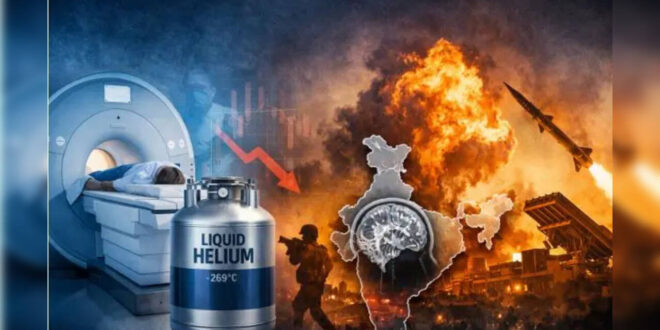
The Iran-Israel war has triggered a global helium shortage, raising concerns over MRI services in India. Helium is essential for cooling MRI magnets, and supply disruptions in Qatar may increase scan costs and delays. While no immediate crisis exists, experts warn that prolonged shortages could strain diagnostics, highlighting the healthcare sector’s dependence on stable helium supply chains.
MRI Services at Risk? Iran–Israel War Triggers Helium Shortage (Pic: AI generated)
A lesser-known, yet highly critical fallout of the ongoing Iran-Israel war is now threatening to disrupt a major part of India’s healthcare sector – the MRI services, cancer detection, and neurological diagnosis. According to news reports, a global helium shortage, linked to disruptions in the Middle East, could potentially strain MRI supply chains, spiking costlier scans and delays in diagnostics. Even though there is no immediate cause for panic, experts warn that if the conflict continues, the impact on medical diagnostics could soon become significant.
Qatar accounts for almost one-third of global helium output, making any disruption there significant for MRI services across the world. News reports say Qatar shut off liquified helium plants in the Laffan facility after recent Iranian strikes against the region’s energy-producing infrastructure and later declared force majeure, which means it is not able to supply contracted customers due to circumstances beyond its control.
Why is helium important for MRI scans?
Helium plays an extremely important role in magnetic resonance imaging (MRI). While it is used to cool the superconducting magnets inside MRI machines to extremely low temperatures, allowing them to function properly, without the gas, MRI scanners simply cannot operate.
Most MRI machines require large quantities of liquid helium – often more than 1,500 litres – to maintain these ultra-cold conditions. This makes the healthcare sector heavily dependent on a stable global helium supply.
How is helium used in MRI machines?
To understand how the risk is playing, it is best to break down how helium works inside an MRI:
Cooling superconducting magnets
MRI machines completely rely on powerful magnets made of superconducting materials. These only work when cooled to about -269°C, near absolute zero. Liquid helium is the only substance capable of maintaining such low temperatures efficiently.
Maintaining magnetic field stability
The ultra-cold environment allows the magnets to carry electric current without resistance, creating a stable and strong magnetic field essential for high-quality imaging.
Preventing machine failure
If helium levels drop, the magnet warms up – a process known as “quench”, which can shut down the MRI machine and require expensive repairs.
Closed-loop systems
Modern MRI scanners try to recycle helium, but they still need periodic refilling, especially in high-usage hospitals. In short, helium is not just a component but is the backbone that keeps MRI technology functional.
Apart from the MRI machines, helium is also essential for manufacturing semiconductors, including the cutting-edge chips used for artificial intelligence models produced in Asian fabrication plants.
MRI machines require large quantities of liquid helium, more than 1,500 litres – to maintain these ultra-cold conditions
How has the war triggered a shortage?
The current crisis stems from disruptions in natural gas production and supply chains across the Middle East, particularly in Qatar. Due to attacks and shutdowns of key gas facilities, a significant portion of global helium output has been disrupted.
Additionally, shipping bottlenecks in the Strait of Hormuz have further complicated global distribution. This has already led to rising helium prices and reduced availability. According to the international players, even though an extreme shortage has not hit yet, because helium containers that would have been filled when the conflict erupted in February would still have taken several weeks to arrive in Asia.
“Nobody’s run out of helium yet. But it’s a few weeks out when the shortage really hits,” Phil Kornbluth, president of US-based Kornbluth Helium Consulting, was quoted by Fortune.
“Despite multiple attempts, no viable alternative has matched helium’s efficiency in maintaining the ultra-low temperatures required for MRI operations. This makes the current situation particularly concerning for the healthcare sector. MRI systems are indispensable, with over 90 per cent of their usage dedicated to diagnostics especially in neurological (28 per cent), musculoskeletal (23.2 per cent), and oncology (16.6 per cent) cases,” Haresh Calcuttawala, CEO and CO-Founder of Trezix, told Times Now Health.
Impact on MRI services in India
India relies heavily on imported helium and is now beginning to feel the pressure. The shortage is tightening supply chains and increasing operational costs for hospitals and diagnostic centres. According to news reports, if the situation persists, patients may face higher MRI scan costs, longer wait times, and even delays in diagnosis and treatment.
For now, healthcare providers are managing with existing reserves, so there is no immediate disruption. However, experts warn that prolonged shortages could strain the system. According to the Economic Times, many diagnostic labs are now accelerating a shift towards alternatives, with companies developing helium-free MRI systems. Siemens Healthcare has recently introduced helium-free machines using drycool technology, reducing dependence on the gas and limiting service disruptions.
While global inventories and improved helium recycling technologies are helping cushion the impact for now, helium does remain a finite and irreplaceable resource for MRI technology on a larger scale. Prolonged disruptions could go beyond pricing issues and start affecting access to essential diagnostic services.