 Eurasia Press & News
Key Takeaways
Senior officials in Tehran have signaled that they seek to use the Strait of Hormuz and energy flows around it as points of leverage that Iran can use after the war to extract concessions and secure strategic aims.  They have also signaled that they will not accept a ceasefire or halt disruptions to international shipping in the Strait of Hormuz unless the United States and Israel cease all attacks on Iran.
Iran has continued attacks on shipping amid discussions in Tehran about Iran’s leverage over the strait. Iran attacked the Panamanian-flagged AQUA 1 oil tanker, leased by Qatari state-owned energy firm, 17 nautical miles northwest of Ras Laffan, Qatar.
These statements indicate that Iran could continue to use its proven ability to disrupt shipping in the strait after the war ends to deter the United States and its partners or compel them to avoid actions that would have negative impacts on Iran.
The IDF stated on April 1 that it struck “approximately 15 weapons production sites,” including a Ministry of Defense and Armed Forces Logistics (MODAFL) complex for advanced missile production.
The IDF struck a pharmaceutical research and development company that supplied the Iranian regime with materials, such as fentanyl, that can be used for chemical weapons.
The IDF killed IRGC Quds Force Lebanon Corps Engineering Head responsible for advancing underground projects in Lebanon and Syria for Hezbollah and the Assad regime and he managed dozens of underground facilities in Lebanon used to store advanced weapons.
Iran launched five missile salvoes, including a 10-missile salvo, which was among the largest missile salvoes targeting Israel since the beginning of the war. It remains unclear if this was a one-off large salvo or will become part of a trend.
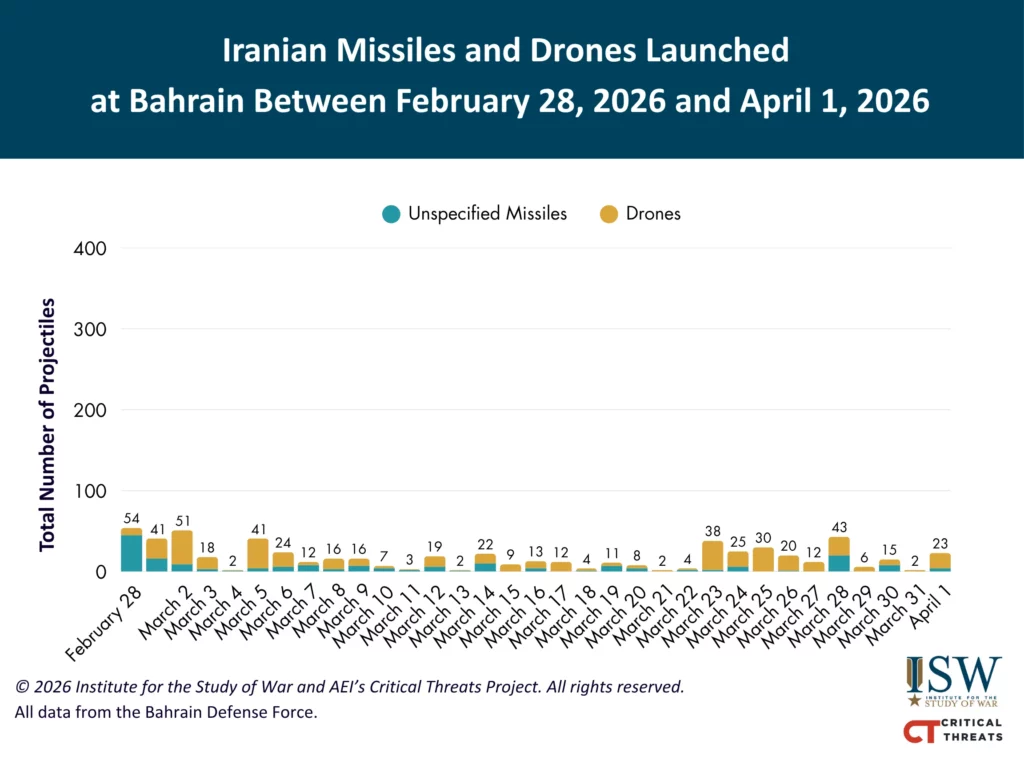
Iran launched 19 drones and four ballistic missiles targeting Bahrain on April 1. One or more of these targeted a company in Bahrain. This follows the IRGC’s threat on March 31 that it would target US‑linked information, communications, artificial intelligence, and advanced technology firms in retaliation for US and Israeli attacks.
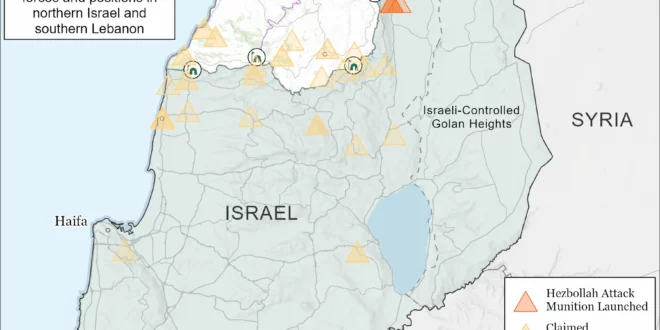
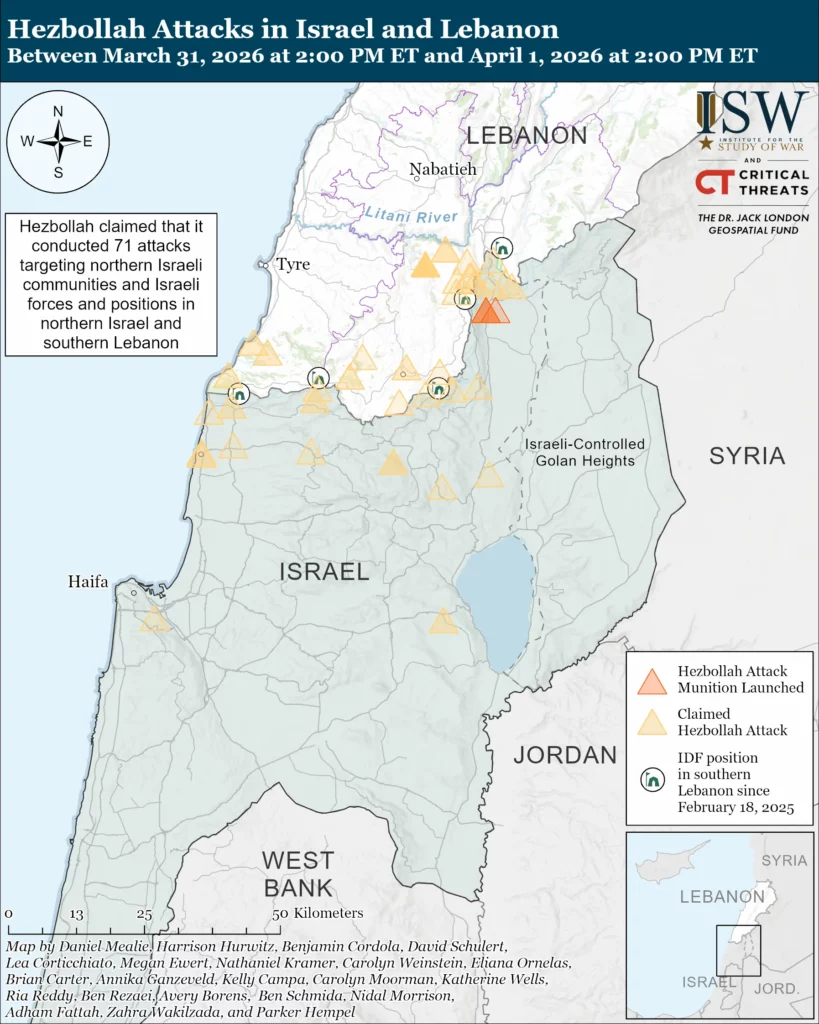
Hezbollah claimed that it conducted 71 attacks targeting northern Israeli communities and Israeli forces and positions in northern Israel and southern Lebanon between 2:00 PM ET on March 31 and 2:00 PM ET on April 1.
The Houthis launched an unspecified number of ballistic missiles targeting southern Israel on April 1. This attack marks the fourth time that the Houthis have attacked Israel since entering the conflict on March 28. The Houthis claimed that it coordinated the ballistic missile attack on Israel with Hezbollah and Iran.
Toplines
Senior officials in Tehran have signaled that they seek to use the Strait of Hormuz and energy flows around it as points of leverage that Iran can use after the war to extract concessions and secure strategic aims. Multiple Iranian officials and institutions, including Iranian parliament speaker and key regime leader Mohammad Bagher Ghalibaf, several IRGC-linked media platforms, and an analyst close to Iranian security institutions, all highlighted the strait’s value as leverage and Iran’s ability to use its leverage over shipping through the strait to “ensure” the regime’s survival now and in the future.[1] Some of the officials discussing the value of the Hormuz are not decisionmakers, but their statements reflect a broader discussion in Tehran about how to achieve short- and long-term military and strategic aims. The analyst close to the regime stated on April 1 that Iran can remove the ability of the United States and Israel to threaten it if it maintains its “legal-security dominance” over the strait even after the war ends.[2]
These statements indicate that Iran could continue to use its proven ability to disrupt shipping in the strait after the war ends to deter the United States and its partners or compel them to avoid actions that would have negative impacts on Iran. Iran would not need to continue attacks indefinitely to retain the ability to deter and coerce the United States and its partners using the leverage Tehran has over the straits. Iran now has a proven ability to disrupt the global economy by shutting down the Strait, and it could threaten to disrupt shipping in the future for any reason and at any time. Iran may be especially incentivized to leverage its control around the strait if it concludes that such actions are an effective means of coercing the United States and its partners.
Iran has continued attacks on shipping amid discussions in Tehran about Iran’s leverage over the strait. Iran attacked the Panamanian-flagged AQUA 1 oil tanker, leased by Qatari state-owned energy firm, 17 nautical miles northwest of Ras Laffan, Qatar.[3] The tanker’s hull sustained damage.[4] This is the second Iranian attack on a civilian vessel in two consecutive days.[5] Such attacks are one of the ways that Iran can impede shipping around the strait.
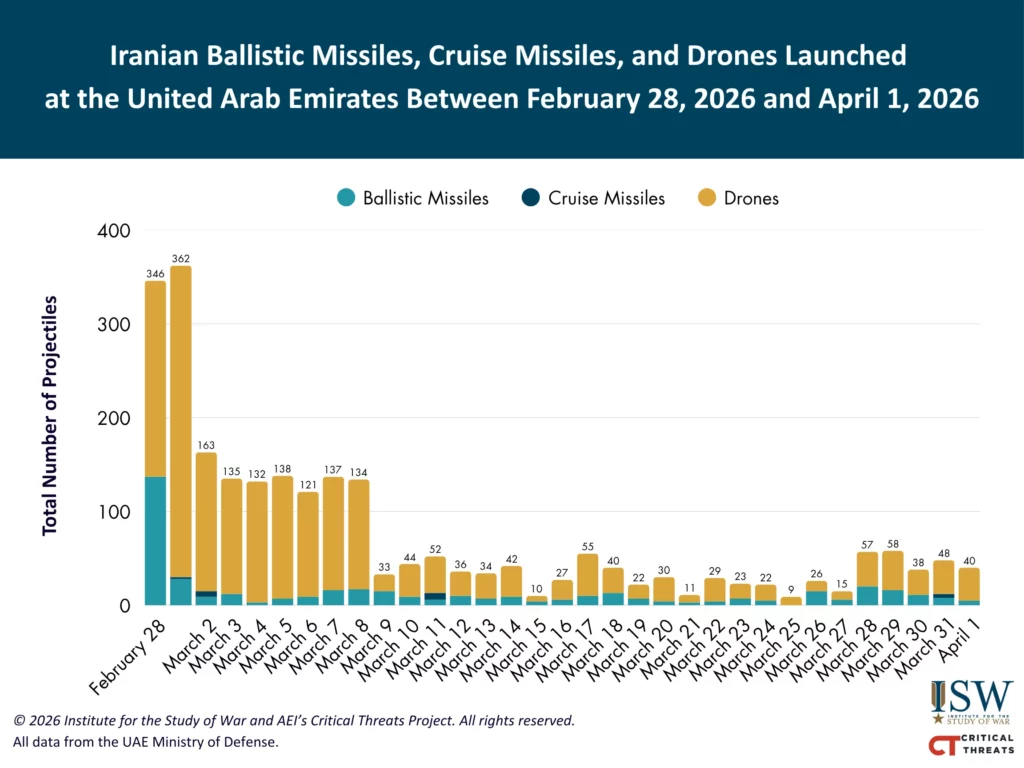
The UAE, among other Gulf countries, appears to support more aggressive action to reopen the Strait of Hormuz. Emirati leaders almost certainly view Iran’s efforts to control the strait, combined with sustained Iranian missile and drone strikes against the UAE, as a direct threat to the UAE’s security. The United Nations Security Council is expected to vote on April 2 on a resolution that would authorize the use of “all necessary means” to protect shipping in and around the strait.[6] Unspecified Arab officials told the Wall Street Journal that the UAE has lobbied in favor of this resolution.[7] The resolution comes amid reports that the UAE may be willing to deploy assets to secure international shipping in the strait.[8] The UAE almost certainly views Iranian efforts to assert sovereignty over the strait as a direct threat to its economic security. Iran has significantly disrupted shipping in the strait, which serves as a critical maritime chokepoint for the UAE and other Gulf states, since the war began. Senior UAE official Anwar Gargash stated on March 17 that the UAE’s “main concentration is…the Iranian threat on [the UAE’s] security.”[9] He emphasized that the strait is an international waterway and that states that rely on it share a responsibility to ensure the free flow of trade. The strait is critical to the UAE’s oil exports, liquefied natural gas trade, and food imports. Gargash also warned that Gulf states cannot accept a future defined by persistent Iranian missile and nuclear threats.[10] Iran has launched more missiles and drones at the UAE than at any other country since the war began, including Israel.[11] Iran retaining the ability to disrupt international shipping and resume missile and drone attacks on Gulf countries at any time poses a direct threat to the UAE and other Gulf countries.
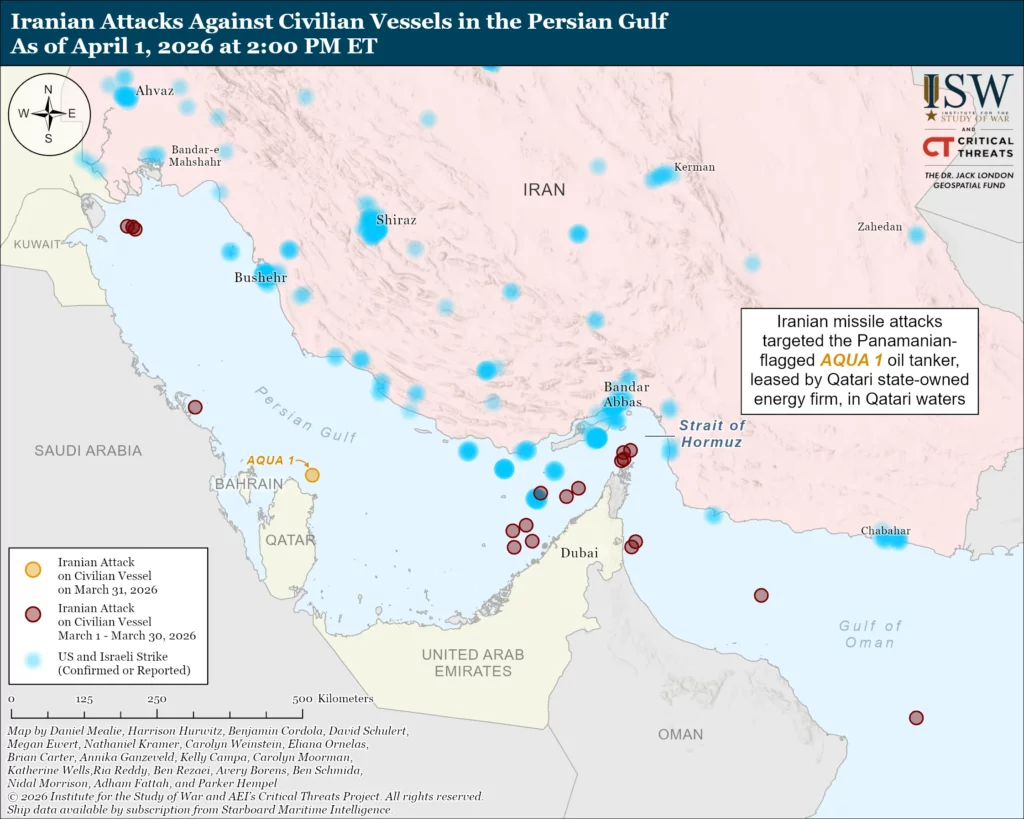
Iranian officials have signaled that they will not accept a ceasefire or halt disruptions to international shipping in the Strait of Hormuz unless the United States and Israel cease all attacks on Iran. This position is inconsistent with the stated US position on a ceasefire. US President Donald Trump stated on April 1 that Iran’s “new regime president” has requested a ceasefire and emphasized that the United States will only consider one when the Strait of Hormuz is “open, free, and clear.”[12] Iranian Foreign Affairs Ministry spokesperson Esmail Baghaei rejected Trump’s claim as “false and baseless.”[13] Iranian officials have repeatedly stated that they seek a permanent end to the war that guarantees the United States and Israel will cease all attacks on Iran.[14] Iran views the period between the Israeli strikes in June 2025 and the current conflict as a ”pause” in one war. The demands for a ”permanent end” are akin to a guarantee that the United States and Israel will not attack Iran in the future as well. Iranian officials have stated that Iran will not grant the United States access to the Strait of Hormuz to secure a ceasefire, even after the war ends.[15]
US and Israeli Air Campaign
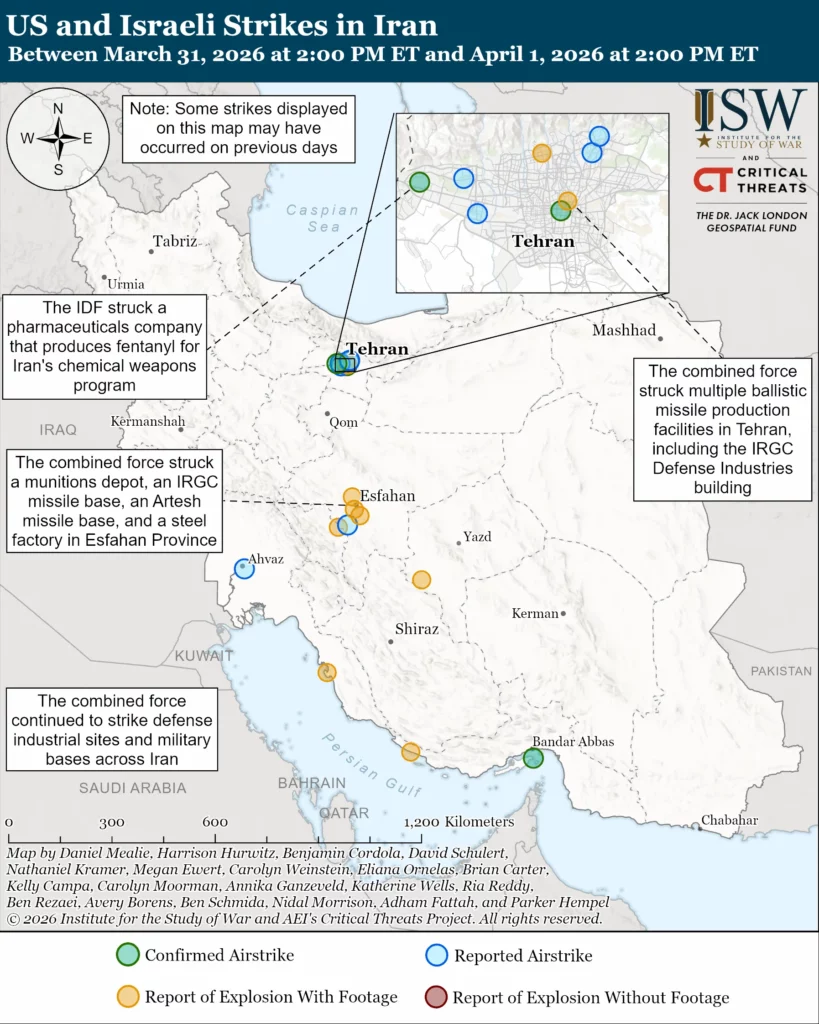
The combined force continued to strike military bases and missile launch sites across Iran. Anti-regime media reported on March 31 that the combined force struck the Artesh Ground Forces 55th Airborne Brigade headquarters in Shiraz, Fars Province.[16] Commercially available satellite imagery from March 17 confirms that the combined force struck an Artesh 840th Missile Group barracks in Aran and Bidgol, Esfahan Province.[17] Iran had plans to build five new missile bases for the 840th Missile Group before the 12-Day War.[18] OSINT accounts on X reported on April 1 that the combined force struck a missile base and munitions depot near the Baharestan Mountains in Esfahan Province.[19] The 15th Khordad Missile base is near the Baharestan Mountains.[20] The IDF also posted footage showing strikes targeting air defenses in Tehran on March 31. One strike targeted the old Iranian stock exchange building in Tehran.[21]
The combined force continued to strike Iran’s defense industrial sites. The IDF stated on April 1 that it struck “approximately 15 weapons production sites,” including a Ministry of Defense and Armed Forces Logistics (MODAFL) complex.[22] The complex contained infrastructure for the development of advanced ballistic missiles.[23] MODAFL is responsible for the research and development of Iran’s missile and nuclear weapons programs and is sanctioned by the United States.[24] An OSINT account on X reported on March 31 that the combined force struck an IRGC Defense Industries building in Tehran.[25] The combined force also struck three major Iranian steel factories on March 31: Sefid Dasht industrial zone in Boroujen, Charmahal and Bakhtiari Province, the Khuzestan Steel Company in Ahvaz, Khuzestan Province, and the Mobarakeh Steel Company in Mobarakeh, Esfahan Province.[26] The IDF previously struck the Mobarakeh Steel Company and Khuzestan Steel Company on March 27.[27] Strikes on Iran’s steel factories hurt both its military and economy by degrading its ability to build ballistic missiles and reducing one of Iran’s most important exports.[28]
The IDF struck a research and development facility, Tofigh Daru, in Tehran Province on March 31.[29] The IDF stated that Tofigh Daru supplied chemical materials to the Iranian regime and functioned as a central supplier of fentanyl-based compounds to the Organization of Defensive Innovation and Research (SPND) organization.[30] The SPND is a research and development entity subordinate to Iran’s Ministry of Defense and Armed Forces Logistics (MODAFL) that is responsible for advanced military-related research.[31] The United States sanctioned the SPND in August 2014 for engaging in or attempting to engage in activities that have materially contributed to, or posed a risk of materially contributing to, the proliferation of weapons of mass destruction or their means of delivery.[32] Iran has conducted long-term research on pharmaceutical-based agents, particularly fentanyl and medetomidine, and has explored how to synthesize, aerosolize, and deliver these compounds through munitions such as grenades, anti-riot rounds, and potentially drones.[33] Iranian state media previously reported in November 2020 that Tofigh Daru produced the raw materials used in the domestic manufacture of remifentanil, which has potential dual-use applications as a pharmaceutical-based incapacitating agent.[34] The Iranian regime previously used chemical or toxic gas to attack schoolgirls across multiple provinces following the Mahsa Amini Movement in 2020, which affected thousands of students and caused symptoms including respiratory distress and dizziness.[35]
The combined force has continued decapitation strikes targeting senior Iranian officials. The IDF confirmed on April 1 that it killed IRGC Quds Force Lebanon Corps Engineering Head Mehdi Vafaei in Mahallat, Markazi Province.[36] Vafaei was responsible for advancing underground projects in Lebanon and Syria for Hezbollah and the Assad regime and he managed dozens of underground facilities in Lebanon used to store advanced weapons.[37] The IRGC separately confirmed on March 31 that an Israeli airstrike killed an adviser to the Armed Forces General Staff chief in Tehran Province.[38] The United States sanctioned Eshaghi in February 2025 for his role in an international network that facilitated illicit oil sales to China, which generated hundreds of millions of dollars for Iran’s armed forces and supported the Axis of Resistance.[39] The combined force also reportedly killed Mohammad Sadeghi, who was an engineering officer under the IRGC Aerospace Force al Ghadir Missile Command.[40] Sadeghi reportedly was responsible for constructing underground tunnels and missile infrastructure.[41]
Iranian Response
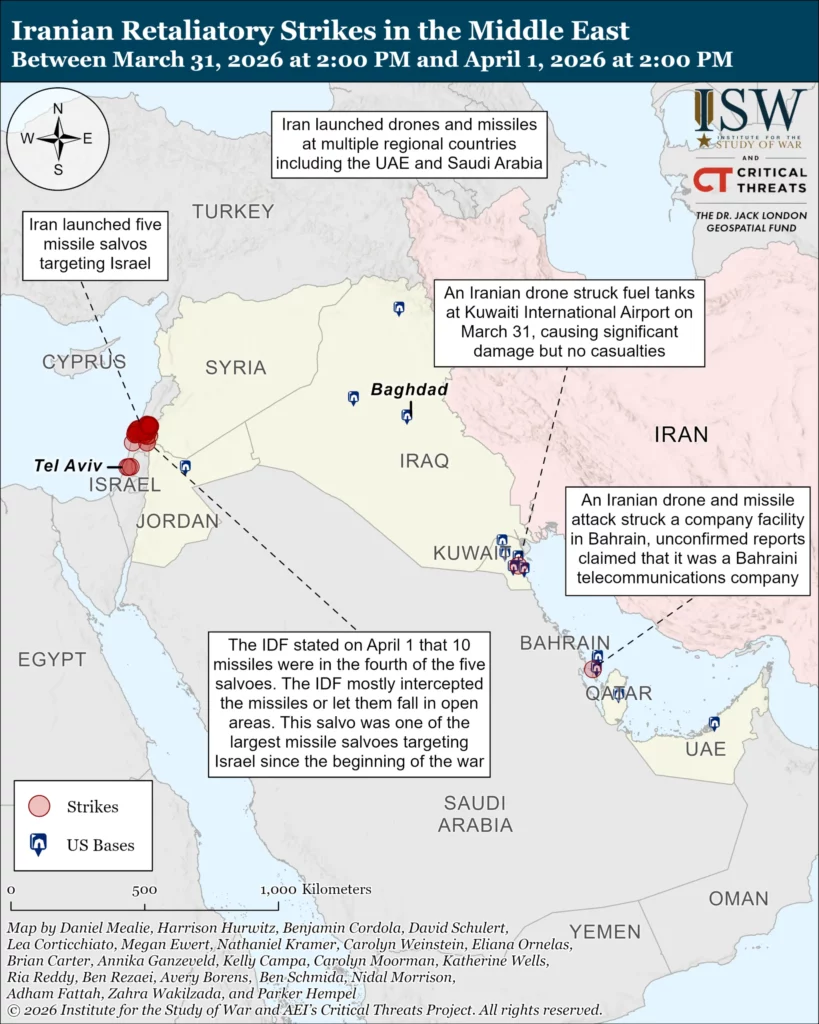
Iran has launched five missile salvos at Israel since CTP-ISW’s last data cutoff at 2:00 PM ET on March 31.[42] The IDF stated on April 1 that 10 missiles were included in the fourth of the five salvos, most of which were intercepted or allowed to fall in open areas.[43] This salvo was among the largest missile salvoes targeting Israel since the beginning of the war, according to an Israeli war correspondent.[44] It remains unclear if this was a one-off large salvo or will become part of a trend.[45] The fifth salvo reportedly involved only a “small number” of missiles, and three other salvos had only one missile.[46] The IDF reported that cluster munitions fell in three sites in central Israel, including Bnei Barak, injuring at least 10 civilians, on April 1.[47] Iranian media also claimed that at least one of its missile salvoes targeting Israel on April 1 was coordinated with Hezbollah and Houthis.[48]
Iran continues to conduct drone and missile attacks against the Gulf states. The Bahrain Defense Forces reported on April 1 that it intercepted 19 drones and four ballistic missiles.[49] The Bahraini Interior Ministry reported that one of these Iranian attacks struck an unspecified company building but caused no casualties.[50] Unconfirmed reports circulating on social media suggested that the targeted building was the Bahrain Telecommunication Company (Batelco) headquarters in Hamala, Bahrain, but the Bahraini Interior Ministry only said that one attack struck an unspecified company building.[51] The incident follows an IRGC threat on March 31 that it would target US‑linked information, communications, artificial intelligence, and advanced technology firms in retaliation for US and Israeli attacks.[52] Iran has previously targeted data centers in the Gulf states, including an Amazon Web Services data center in the UAE.[53]
The Emirati Defense Ministry reported that it intercepted 35 drones and five ballistic missiles on April 1.[54]
The United Kingdom’s Royal Air Force (RAF) separately reported it intercepted 10 Iranian drones in unspecified locations in the Middle East.[55] UK aircraft have operated defensively over Cyprus, Jordan, Bahrain, and the UAE.[56]
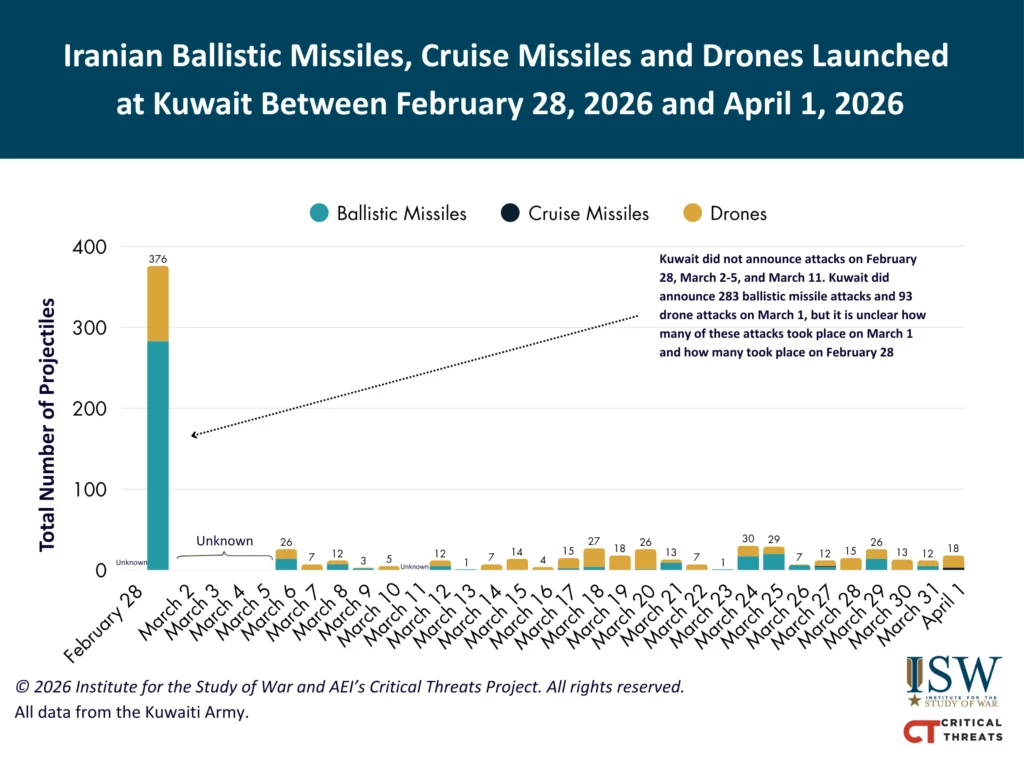
The Kuwaiti Armed Forces also reported that it detected three Iranian cruise missiles and 15 drones in Kuwaiti airspace on April 1.[57] Kuwait media also reported that an Iranian drone struck fuel tanks at the Kuwait International Airport on March 31, causing significant damage but no casualties.[58]
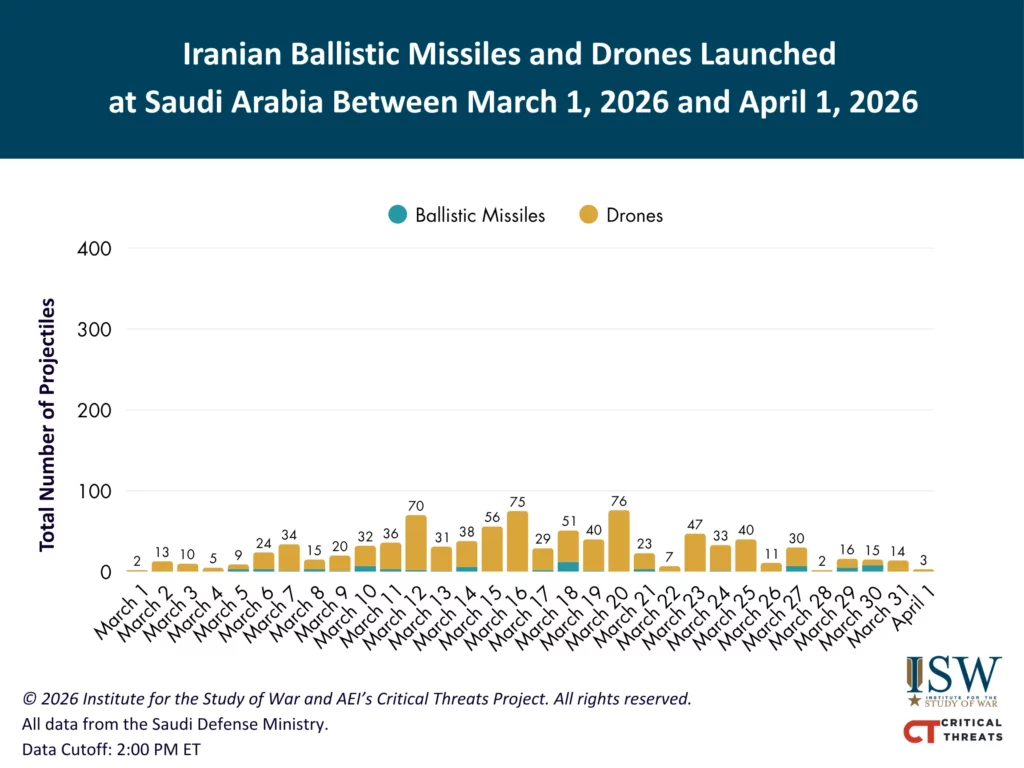
The Saudi Defense Ministry separately reported that it intercepted and destroyed three drones on April 1.[59]
The Qatari Defense Ministry also confirmed that Iran launched three cruise missiles at Qatar and successfully intercepted two missiles, and one struck a tanker used by Qatari state-owned energy company, QatarEnergy (see topline section).[60]
Israeli Campaign Against Hezbollah and Hezbollah Response
Hezbollah claimed that it conducted 71 attacks targeting northern Israeli communities and Israeli forces and positions in northern Israel and southern Lebanon between 2:00 PM ET on March 31 and 2:00 PM ET on April 1.[61] The IDF confirmed on April 1 that Hezbollah shot down an IAF drone over southern Lebanon with a surface-to-air missile overnight between March 31 and April 1.[62]
Hezbollah may have conducted two first-person view (FPV) drone strikes against IDF positions in southern Lebanon on April 1.[63] Hezbollah has not posted footage of either attack. The term Hezbollah used to refer to the two April 1 strikes is the same one the group used to describe previous FPV drone attacks.[64] Hezbollah previously conducted four FPV drone strikes against IDF armored vehicles in southern Lebanon on March 31 and posted footage of the attacks.[65] Hezbollah has also used the same term in 2024 to describe a drone attack in 2024, however, two years before the group’s first confirmed FPV drone attack in March 2026.[66]
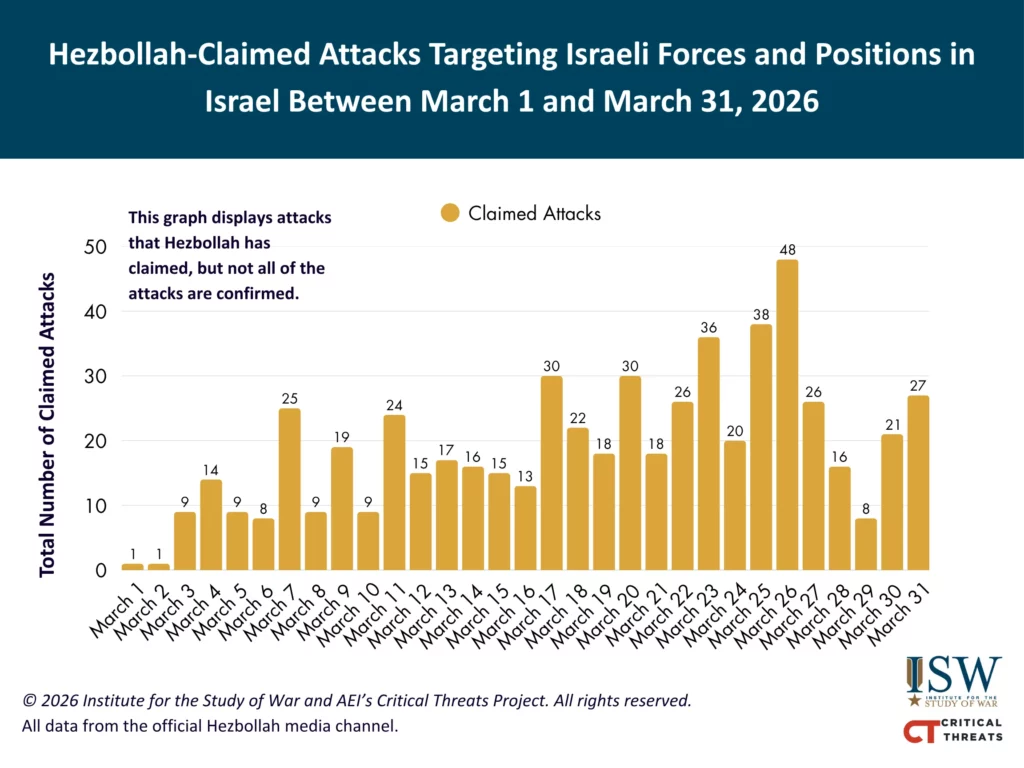
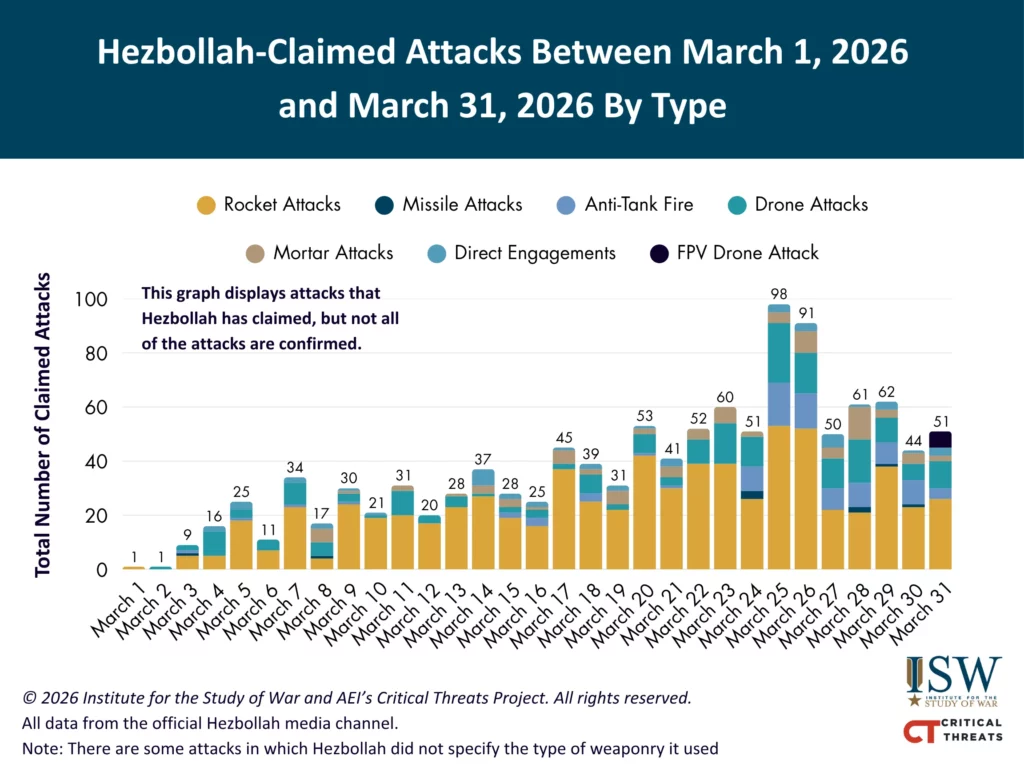
The IDF has continued to strike Hezbollah sites and personnel throughout Lebanon. The IDF said it killed Hezbollah Southern Front commander Yusuf Ismail Hashem in a strike on Beirut on April 1.[67] The IDF said that Hashem replaced Ali Karaki as Southern Front commander after IDF strikes killed Karaki in September 2024.[68] The IDF stated that Hashem was responsible for directing Hezbollah’s ground combat against the IDF in southern Lebanon and rocket attacks on Israel.[69] The IDF also reportedly killed three Hezbollah-affiliated Amal Movement members in strikes on southern Lebanon on March 31.[70]
The IDF also continued to target Hezbollah organizations that provide financial services. The IDF struck Hezbollah-linked currency exchanges “Boa Chance” and “Trade Point International” in Beirut on April 1.[71] The IDF said the sites laundered money and transferred funds to Hezbollah.[72] The US Treasury Department sanctioned Trade Point International and its owner in 2016 for providing financial services to Hezbollah.[73] The IDF has struck several Hezbollah organizations that are part of the group’s social and financial service network in Lebanon since the start of the conflict.[74] This network is essential to Hezbollah’s efforts to maintain the support of its Shia base.[75]
The IDF continued to conduct ground operations in southern Lebanon on April 1. The IDF 8th Armored Brigade (Res.) (91st Division) began ground operations on April 1 to destroy Hezbollah infrastructure, including observation posts and weapons depots, in southern Lebanon.[76]
Other Axis of Resistance Response
The Houthis launched ballistic missiles targeting southern Israel on April 1.[77] The IDF detected ballistic missiles in southern Israel and Israeli air defenses intercepted all the missiles, according to an Israeli military correspondent.[78] The Houthis claimed that it coordinated the ballistic missile attack on Israel with Hezbollah and Iran.[79] Iranian media similarly claimed Iran coordinated its attacks on Israel with Hezbollah and the Houthis.[80] This attack marks the fourth time that the Houthis have attacked Israel since entering the conflict on March 28.[81]
The US-Israeli combined force continued to strike Iranian-backed Iraqi militia targets to prevent Iranian-backed militia attacks against US interests and Israel. The combined force conducted two airstrikes on April 1 targeting the 53rd Popular Mobilization Forces (PMF) Brigade headquarters in Tal Afar, Ninewa Province.[82] The first strike did not cause casualties, but the second strike, approximately an hour later, killed the commander of the 53rd Brigade’s commando regiment, three other PMF members, and wounded others.[83] The Badr Organization mourned the commander of the 53rd Brigade’s death.[84] The 53rd PMF Brigade is affiliated with the Badr Organization.[85]
Iranian-backed Iraqi militias continued to target Baghdad International Airport on March 31 and April 1. Iraqi air defenses at the Baghdad airport intercepted a likely Iranian-backed militia drone that targeted the airport on March 31.[86] A likely Iranian-backed militia drone later struck the diplomatic support center at the Baghdad International Airport on March 31 but did not cause casualties, according to Iraqi media.[87] A likely Iranian-backed militia drone also struck near the logistics support headquarters at the Baghdad International Airport on April 1 but did not cause casualties, according to Iraqi media.[88] Iranian-backed Iraqi militia have continuously targeted the Baghdad International Airport and its co-located facilities, including the former US military base Camp Victory and the Iraqi Mohammad Alaa Airbase, since the war began.[89]
Iranian-backed Iraqi militias likely targeted US forces in Syria on March 31 and April 1. Multiple sources reported that US air defenses at the Qasrak Base in Hasakah Province intercepted at least five drones launched from Iraq that targeted the base on March 31.[90] A Syrian source reported that likely Iranian-backed Iraqi militias launched more drones that targeted the base on April 1, but the source did not indicate whether US air defenses intercepted the drones.[91] Likely Iranian-backed Iraqi militias previously targeted Qasrak Base with drones on March 28.[92]
Iranian-backed Iraqi militias likely targeted UK-owned energy infrastructure in northern Iraq on April 1.[93] Three drones struck a storage warehouse owned by the Castrol Oil Company near Erbil City on April 1, while nearby Iraqi air defenses intercepted a fourth drone.[94] The drone strikes started a fire that severely damaged the warehouse but did not cause casualties.[95]
Iranian-backed Iraqi militias and militia front groups continue to claim attacks against US targets in Iraq and the Middle East. The Islamic Resistance in Iraq, a coalition of Iranian-backed Iraqi militias, claimed on March 31 that it conducted 23 drone attacks against “enemy” bases in Iraq and the region.[96] Likely front group Saraya Awliya al Dam claimed it carried out five attacks against US bases in the region.[97]
Iranian Internal Security
The IRGC appears to have further consolidated control over Iran’s political system by sidelining the Iranian president, Masoud Pezeshkian’s government and restricting access to Supreme Leader Mojtaba Khamenei. Anti-regime media reported on March 31 that growing friction between Iranian President Masoud Pezeshkian and the IRGC has pushed Pezeshkian into a “complete political deadlock.”[98] The IRGC reportedly blocked Pezeshkian’s decisions, with IRGC Commander Major General Ahmad Vahidi pressuring him and preventing the selection of a new intelligence minister.[99] Vahidi reportedly insisted that all sensitive positions must be selected and managed directly by the IRGC during the war.[100] Anti-regime media also reported on March 31 that a “military council” composed of senior IRGC officers has assumed control over the regime’s core decision-making apparatus and established a security perimeter around Supreme Leader Mojtaba Khamenei.[101] The ”military council” reportedly prevented government reports from reaching him and ignored Pezeshkian’s repeated requests for a meeting with Mojtaba.[102]
Anti-regime media separately reported on March 31 that an “unprecedented crisis” is emerging within the inner circle of Mojtaba, with some close associates reportedly seeking to remove former Iranian Supreme Leader Ali Khamenei’s Deputy Chief of Staff for Political and Security Affairs, Ali Asghar Hejazi, from the Supreme Leader’s office.[103] The report added that this effort stems from Hejazi’s opposition to Mojtaba’s succession, including warnings that Mojtaba lacks leadership qualifications and that hereditary succession is incompatible with the “Islamic Republic.”[104] Hejazi reportedly also warned that Mojtaba’s selection would effectively hand full control of the state to the IRGC and permanently sideline administrative institutions.[105]
These reports are consistent with earlier reports that the IRGC has expanded its influence over regime decision-making following Mojtaba Khamenei’s selection as supreme leader.[106] Senior Iranian sources told Reuters on March 10 that the IRGC “forced through” Mojtaba’s appointment to ensure alignment with hardline policies and overpowered opposing political and clerical figures.[107] Mojtaba’s inner circle is dominated by long-standing IRGC commanders, including Ahmad Vahidi, Mohammad Bagher Ghalibaf, and Mohammad Ali Jafari, who played key roles in securing his selection and shaping regime decision-making.[108] CTP-ISW previously assessed on March 21 that the IRGC has increasingly filled a leadership vacuum caused by decapitation strikes and Mojtaba’s apparent inability to govern, consolidating control over political, military, and internal security institutions.[109]
The Iranian regime has continued its nationwide counterintelligence and internal security operations. The regime conducted mass arrests and disrupted alleged espionage and militant networks across multiple provinces between March 30 and April 1.[110] Iranian authorities reported over 1,000 arrests in March alone, including individuals for espionage, filming sensitive sites, and supporting adversary-linked networks.[111] The United Nations Human Rights Office reported on April 1 that approximately 2,345 individuals have been arrested in Iran since the start of the war on charges related to national security, including terrorism, dissent, alleged espionage, and “cooperation with the enemy.”[112]
The regime has also expanded public securitization measures, including the deployment of security personnel and equipment across civilian infrastructure and the integration of society into internal defense efforts. Reporting indicates that Iranian forces have operated in at least 70 civilian locations, including schools, hospitals, and mosques.[113] The Basij and affiliated organizations have also increased recruitment and mobilization efforts, including volunteer registration campaigns and, in some cases, the use of minors in checkpoint and patrol roles.[114] Iranian authorities have also reinforced legal deterrence by warning that individuals accused of espionage or collaboration with hostile actors may face execution and asset seizure.[115]