 Eurasia Press & News
The Russian Ministry of Defense (MoD) claimed that Russian forces seized the entirety of Luhansk Oblast for the third time over the course of Russia’s full-scale invasion, even though Russian forces have controlled most of Luhansk Oblast since October 2022. The Russian MoD claimed on April 1 that Russian forces seized all of Luhansk Oblast.[1] ISW has observed evidence to assess that Russian forces control 99.84 percent of Luhansk Oblast as of April 1 but have not seized Nadiya and Novoyehorivka (both east of Borova). Russian officials have repeatedly claimed that Russian forces control all of Luhansk Oblast throughout the war. Then-Russian Defense Minister Sergei Shoigu claimed in July 2022 that Russian forces seized the oblast, and Luhansk People’s Republic (LNR) Head Leonid Pasechnik made the same claim again in June 2025.[2] Russian President Vladimir Putin later claimed in October 2025 that Ukrainian forces only maintained positions in 0.13 percent of Luhansk Oblast.[3] Russian forces have controlled most of Luhansk Oblast since Fall 2022, when the frontline in this area settled following the Ukrainian Kharkiv counteroffensive. Kremlin claims in 2025 and 2026 about seizing the oblast are aggrandizing miniscule changes on the front in Luhansk Oblast in order to create the false impression that Russian forces are rapidly advancing on various sectors of the battlefield.
The Kremlin’s aggrandized claims about the seizure of Luhansk Oblast are part of a wider coordinated information campaign that aims to create a false sense of urgency to force Ukraine to cede unoccupied parts of Donetsk Oblast. The Russian MoD’s claim about Luhansk Oblast is part of the Kremlin’s ongoing cognitive warfare effort aimed at portraying Ukrainian defenses as on the verge of collapse to drive the United States and Ukraine’s other partners into forcing Ukraine to unnecessarily cede territory that Russian forces are very unlikely to seize militarily in the medium term, if at all.[4] Ukrainian President Volodymyr Zelensky stated on March 31 that Russia is demanding that Ukrainian forces withdraw from the remainder of Donetsk Oblast within two months (by late May 2026) and implied that the Kremlin is trying to create a perception that Russia will imminently take Donbas and will make new, harsher demands if Ukraine does not withdraw from Donetsk Oblast on the Kremlin-dictated timeline.[5] Kremlin Spokesperson Dmitry Peskov answered a question on April 1 about the alleged two-month deadline, claiming that Zelensky must make this decision “today” but ideally should have made it “yesterday.”[6] Russian State Duma Defense Committee Member Andrei Kolesnik claimed that Zelensky should have withdrawn from Donetsk Oblast “the day before yesterday.”[7] State Duma International Affairs Committee First Deputy Head Alexei Chepa claimed that Russia’s new terms in the future could include demands that Ukraine also withdraw from Zaporizhia and Kherson oblasts and cede Odesa, Mykolaiv, Dnipro, and Kharkiv cities.[8] Kremlin threats that Russian forces are going to “inevitably” seize Donetsk Oblast militarily or even seize territory outside of the five regions that Russia has illegally annexed are not new. Russian officials have routinely called Odesa and Kharkiv cities “Russian” cities, for example.[9] The Kremlin has been making these demands for years but is likely amplifying them now as US-Ukrainian-Russian negotiations have stalled due to the ongoing war in the Middle East.
Russian claims that Russian forces will be able to seize the rest of Donetsk Oblast easily — let alone make large-scale advances to seize major cities in other oblasts far from the frontline — are absurd and do not correspond with the current battlefield realities. The current battlefield realities and recent Ukrainian advances show that significant Russian battlefield gains are not inevitable, particularly against the large and well-fortified cities of Ukraine’s Fortress Belt in Donetsk Oblast. The Russian military command has previously set ambitious deadlines for the seizure of Ukraine’s Fortress Belt, and Russian forces have repeatedly failed to meet these goals.[10] Ukrainian successes in 2026 have likely further disrupted Russia’s preparations for its spring-summer offensive against the Fortress Belt, with Ukrainian President Volodymyr Zelensky noting on April 1 that Russian forces were unable to achieve their goals in Donetsk Oblast and had to again postpone their deadlines.[11] Russian forces have also been unable to take advantage of their yearslong control over a majority of Luhansk Oblast to launch a successful offensive against Slovyansk or Izyum from the east of northeast. Russian advances have actually slowed since the start of 2026, with Ukrainian forces having shown their ability to contest the initiative for a protracted period and successfully counterattacking in various parts of the frontline.[12]
Russian forces conducted another prolonged strike series against Ukraine with a total of 700 drones launched in two waves on the night of March 31 to April 1 and during the day on April 1. Russian forces launched a total of 700 drones against Ukraine between 1800 March 31 and 1800 April 1 local time.[13] The Ukrainian Air Force reported that Russian forces launched 339 Shahed-type, Gerbera-type, Italmas-type, and other drones, of which about 200 were Shaheds, from the directions of Bryansk, Kursk, and Oryol cities; Millerovo, Rostov Oblast; Primorsko-Akhtarsk, Krasnodar Krai; occupied Hvardiiske, Crimea; and occupied Donetsk City on the night of March 31 to April 1.[14] The Ukrainian Air Force reported that Ukrainian forces downed 298 drones, that 20 drones hit 11 locations, and that drone debris fell at five locations. Ukrainian officials reported that Russian forces struck energy, industrial, and civilian infrastructure in Volyn, Chernihiv, Dnipropetrovsk, Zhytomyr, Poltava, Odesa, Kharkiv, Ivano-Frankivsk, Ternopil, Zakarpattia, and Khmelnytskyi oblasts.[15]
The Ukrainian Air Force reported that Russian forces also launched 361 Shahed-type, Gerbera-type, and other drones — of which about 250 were Shaheds — between 0800 and 1800 April 1 local time.[16] The Ukrainian Air Force reported that Ukrainian forces downed 345 of the drones. The Ukrainian Air Force reported that most of the drones flew into Ukraine from the southeast and headed westward, resulting in 14 hits. Cherkasy Oblast Military Administration Head Ihor Taburets reported that the Russian drones killed four people in an open area in Cherkasy Oblast during an air raid alert, and the Cherkasy Oblast Prosecutor’s Office added that the locals died on the afternoon of April 1 after approaching a crashed drone, the warhead of which subsequently detonated.[17]
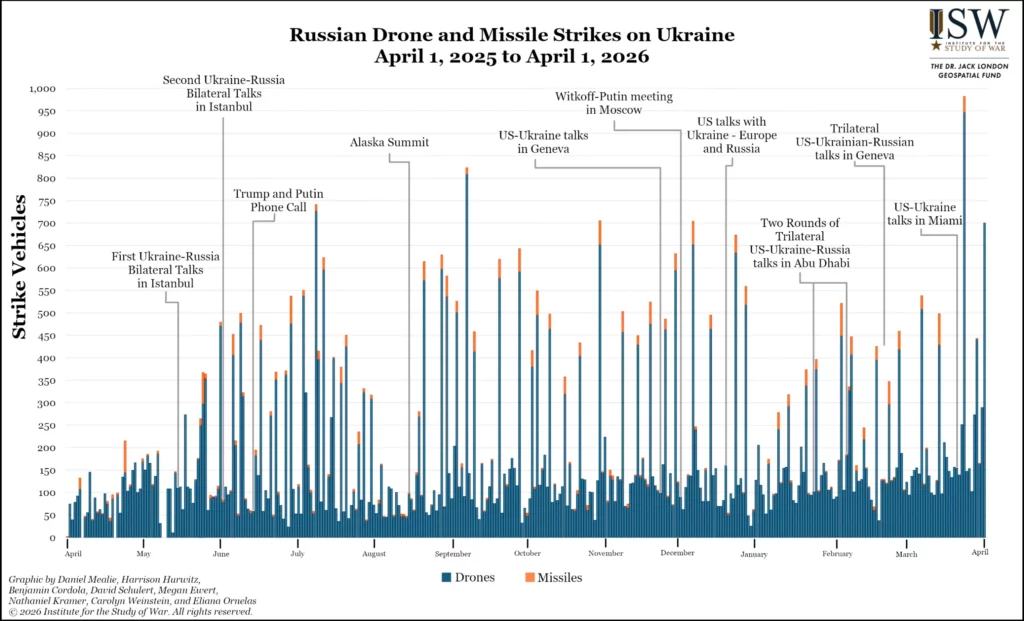
Russia’s new tactic of coupling a large nighttime strike with an equally large daytime strike will likely cause increased civilian harm. Russian forces launched their largest strike series against Ukraine in the war thus far on March 23 to 24, launching nearly 1,000 drones and missiles in a prolonged strike series that spanned the night and following day.[18] This new Russian tactic allows Russia to threaten more areas of Ukraine for longer periods of time and disproportionately affect civilian areas.[19] Russia has in the past launched 700 or more projectiles in one overnight strike series but may now be choosing to spread these hundreds of projectiles over longer time periods in order to maximize civilian damage and disruption.[20] Russia may aim for the daytime strike series to more heavily target civilians and civilian infrastructure including public and open-space areas, especially as warmer weather arrives and more Ukrainians are likely outside. Ukrainians have largely become used to daily overnight strikes but are likely less accustomed to large-scale daytime strikes and may not respond to air raids or seek shelter as they do during nighttime strikes. Russia’s continued use of these tactics may desensitize Ukrainians to the daytime strikes such that civilian damage and harm increases. The large-scale daytime strikes may alternatively push Ukrainians to seek shelter more often, resulting in significant disruptions in daily life and the Ukrainian economy.
Russia’s new tactic of prolonged nighttime and daytime strikes reflects aspects of the way Iran is currently launching drone and missile salvos at Israel and the Gulf. Iran has recently been spreading out its small missile salvos targeting Israel throughout the day, presumably increasing the number of times per day that Israeli civilians must seek shelter.[21] ISW-CTP assesses that this Iranian tactic may aim to maximize the effects of Iran’s limited capacity to launch large missile salvos against Israel and to impose psychological effects on Israeli civilians by consistently forcing them to take shelter and keeping the country under constant alert.[22] The Israel Defense Forces (IDF) similarly noted on April 1 that Iran is spreading out its individual missile launches to try to disrupt the Israeli home front.[23]
ISW has observed reports of seven Ukrainian drones crashing in Baltic and Finnish territory since March 23, possibly as a result of Russian electronic warfare (EW) efforts. ISW has observed reports of one drone falling in Lithuania on March 23; two drones falling in Latvia and Estonia on March 25; two drones falling in Finland on March 29; one drone falling in Estonia on March 31; and one falling in southeastern Finland on April 1.[24] Ukrainian Ministry of Foreign Affairs (MFA) Spokesperson Heorhii Tykhyi responded on March 30 to reports that several Ukrainian drones violated Finnish airspace on March 29, stating that the drones likely deviated from their flight paths due to Russian EW interference.[25] Ukrainian Foreign Minister Andriy Sybiha stated on April 1 that Ukrainian intelligence assesses that Russian forces are deliberately directing drones toward the Baltic states for informational and propaganda effects.[26]
Russian exports of non-energy resources are benefiting from the ongoing war in the Middle East. Bloomberg reported on April 1 that prices for aluminum are reaching four-year highs and that American and European buyers are asking Russian aluminum company United Co. Rusal International PJSC about its spare capacity.[27] Bloomberg noted that the shutdown of the Strait of Hormuz is cutting off fertilizer flows, which may benefit Russian fertilizer exports. The Kremlin has limited Russian fertilizer exports to prioritize domestic supplies, but Russia can still export fertilizers within a 18.7-million-ton quota. Bloomberg also noted, citing analysis from grain market research firm SovEcon, that Russian wheat exporters may benefit from supply risks resulting from the war in the Middle East. Russian grain exporters operating in occupied Ukraine may especially benefit from the situation in the Middle East as Russia has been expanding port infrastructure to export stolen Ukrainian grain, including from occupied Mariupol.[28]
Bloomberg reported that several European governments assessed that Russia could receive an additional $40 billion in oil export revenue if the price of Urals crude remains high to the end of 2026 but that the boost would be under $10 billion if the war in the Middle East ends quickly, the Strait of Hormuz reopens, and oil prices return to their pre-war levels.[29] ISW continues to assess that elevated Russian revenues from oil and other commodities may enable the Kremlin to continue to finance its war against Ukraine in the medium term.[30]
The Kremlin is reportedly turning to university students as part of its forced covert mobilization efforts. A source close to a rector at an unspecified Moscow City university told Russian opposition source Faridaily that Russian Minister of Science and Higher Education Valery Falkov told rectors at Russia’s largest universities in early 2026 that at least two percent of the student body must sign contracts with the Russian Ministry of Defense (MoD).[31] Faridaily estimated that 2.2 million men were enrolled in Russian universities in 2025 and that the new quota could potentially generate 44,000 new soldiers.[32] Faridaily noted that a total of 76,000 young men will have to sign MoD contracts should Russian authorities set a similar quote for technical schools. Russian opposition source Vazhnye Istorii reported on March 5 that official documents from November 2025 published on the websites of colleges in Khabarovsk Krai, Volgograd Oblast, and St. Petersburg and show that the Russian MoD plans to recruit 78,000 personnel for the Russian Unmanned Systems Forces (USF) by the end of 2026.[33] The documents show that the Russian MoD aims to recruit 58,000 of the USF forces from students, graduates of drone control courses, former military personnel from aviation units, and female citizens with appropriate training. The Russian MoD’s quotas for universities come as Ryazan Oblast is now requiring that its medium to large businesses select two to five employees to sign MoD contracts.[34]
The Kremlin is likely turning to these forced covert mobilization efforts as Russia’s high battlefield losses are starting to outpace its conventional voluntary recruitment rates. Russia’s current force generation mechanism, which relies on high financial incentives to recruit voluntary sign-ups, continues to show signs of strain. Ukrainian USF Commander Major Robert “Magyar” Brovdi stated that Russia’s recruitment rate in March 2026 was below its loss rate on the battlefield for the fourth month in a row (since December 2025).[35] The Russian recruitment rate fell below its casualty rate for the first time since 2022 in January 2026. The Russian MoD appears to be struggling to find new force generation mechanisms and is target new pools such as enterprise workers and students.[36]
The European Union (EU) will transfer €1.4 billion in proceeds from frozen Russian assets to aid Ukraine. European Commission President Ursula von der Leyen stated on April 1 that the EU will transfer €1.4 billion (roughly $1.6 billion) from interest on frozen Russian assets held in European depositories to Ukraine.[37] Von der Leyen stated that the EU will provide 95 percent of the funds to the Ukraine Loan Cooperation Facility and five percent to the European Peace Facility.
Key Takeaways
The Russian Ministry of Defense (MoD) claimed that Russian forces seized the entirety of Luhansk Oblast for the third time over the course of Russia’s full-scale invasion, even though Russian forces have controlled most of Luhansk Oblast since October 2022.
The Kremlin’s aggrandized claims about the seizure of Luhansk Oblast are part of a wider coordinated information campaign that aims to create a false sense of urgency to force Ukraine to cede unoccupied parts of Donetsk Oblast.
Russian forces conducted another prolonged strike series against Ukraine with a total of 700 drones launched in two waves on the night of March 31 to April 1 and during the day on April 1.
Russia’s new tactic of prolonged nighttime and daytime strikes reflects aspects of the way Iran is currently launching drone and missile salvos at Israel and the Gulf.
ISW has observed reports of seven Ukrainian drones crashing in Baltic and Finnish territory since March 23, possibly as a result of Russian electronic warfare (EW) efforts.
Russian exports of non-energy resources are benefiting from the ongoing war in the Middle East.
The Kremlin is reportedly turning to university students as part of its forced covert mobilization efforts.
The European Union (EU) will transfer €1.4 billion in proceeds from frozen Russian assets to aid Ukraine.
Ukrainian forces recently advanced in the Pokrovsk and Hulyaipole directions.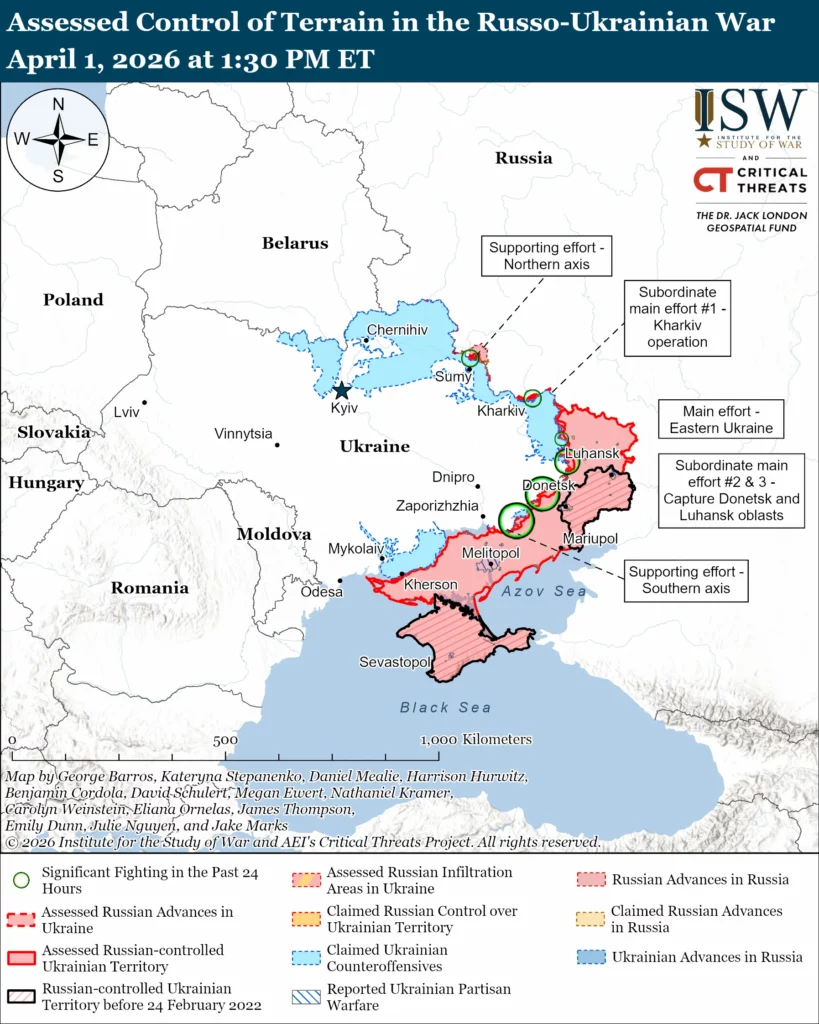
We do not report in detail on Russian war crimes because these activities are well-covered in Western media and do not directly affect the military operations we are assessing and forecasting. We will continue to evaluate and report on the effects of these criminal activities on the Ukrainian military and the Ukrainian population and specifically on combat in Ukrainian urban areas. We utterly condemn Russian violations of the laws of armed conflict and the Geneva Conventions and crimes against humanity even though we do not describe them in these reports.
Ukrainian Operations in the Russian Federation
Ukrainian forces continued their long-range strike campaign against Russian defense industrial infrastructure on the night of March 30 to April 1. The Ukrainian General Staff reported on April 1 that Ukrainian forces struck the “Strela” Joint Stock Company in Bryansk Oblast, which produces cruise missiles for the Russian military.[38]
Ukraine’s more than week-long strike campaign on Russian Baltic Sea ports has likely resulted in lasting damage to oil Russia’s Baltic oil infrastructure National Aeronautics and Space Administration Fire Information for Resource Management System (NASA FIRMS) data shows heat anomalies on April 1 at the oil terminals at the ports of Ust-Luga and Primorsk, both in Leningrad Oblast, following over a week of Ukrainian strikes on Russian Baltic Sea port oil infrastructure.[39] Planet Labs satellite imagery captured on April 1 shows damage to several storage tanks at the oil terminal at the Ust-Luga port and grey smoke emanating from oil tanks in the port of Primorsk. A spokesperson for the Ukrainian Unmanned Systems Forces (USF) reported on March 31 that Ukrainian strikes on key bottlenecks in Russian oil infrastructure can disrupt the larger network of Russian oil infrastructure and impede Russian oil refining and exports.[40]
Russian Supporting Effort: Northern Axis
Russian objective: Create defensible buffer zones in Sumy Oblast along the international border
Russian forces continued offensive operations in northern Sumy Oblast on April 1 but did not make confirmed advances.
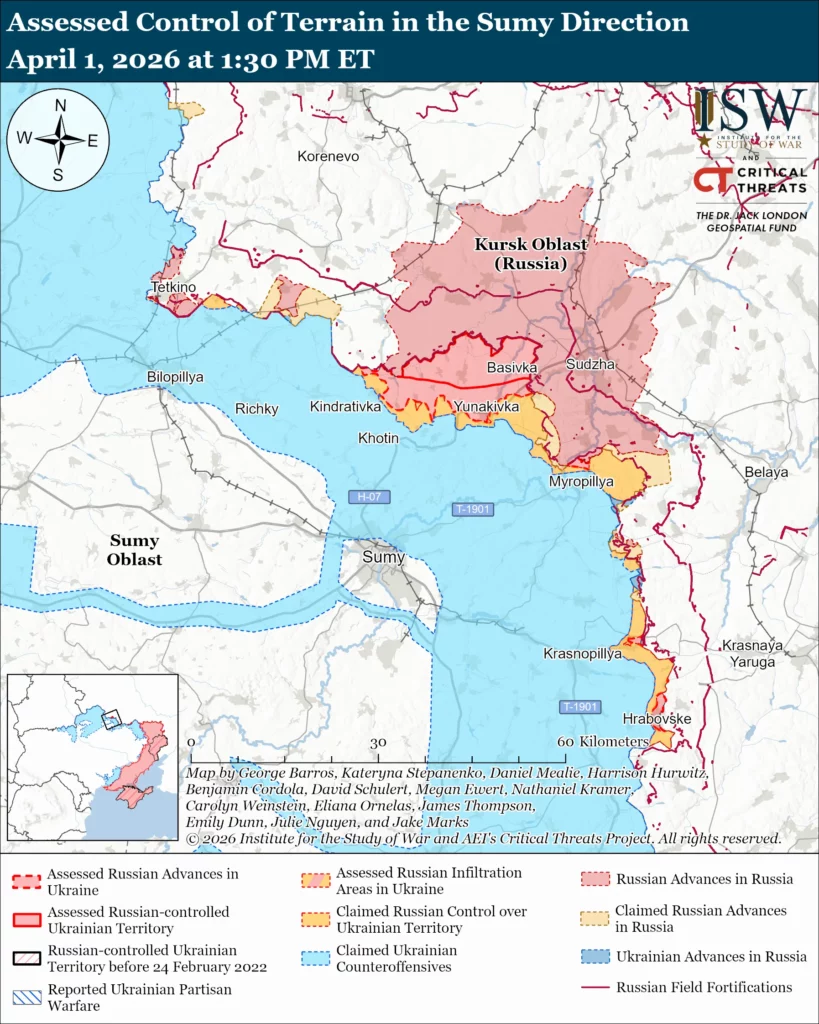
Unconfirmed claims: Russian milbloggers claimed that Russian forces advanced northwest of Sopych (northwest of Sumy City); south of Varachyne and Mala Korchakivka (both north of Sumy City); and east of Myropillya (northeast of Sumy City).[41]
Russian forces attacked in Sumy Oblast, including north of Sumy City near Mala Korchakivka and southeast of Sumy City near Novodmytrivka, on March 31 or April 1.[42] A Russian milblogger claimed that Ukrainian forces counterattacked toward Mala Korchakivka.[43]
A source reporting on the Northern Grouping of Forces claimed that the Russian military command is redeploying Russian airborne (VDV) units to the Kherson direction from Sumy Oblast. A source reporting on the Northern Grouping of Forces claimed on April 1 that the Russian military command plans to redeploy elements of the Russian 51st and 119th VDV regiments (both of the 106th VDV Division) from Sumy Oblast to Kherson Oblast by mid-April[44]The milblogger claimed that the Russian command will redeploy elements of the 80th brigade, possibly referring to the 80th Separate Arctic Motorized Rifle Brigade (14th Army Corps [AC], Leningrad Military District [LMD]), and the 9th regiment, possibly referring to the 9th Motorized Rifle Regiment (18th Motorized Rifle Division, 11th AC, LMD) to the Sumy direction to replace the 51st and 119th VDV regiments. ISW most recently observed reports of the 80th Separate Arctic Motorized Rifle Brigade operating in Kherson Oblast on March 15 and the 9th Motorized Rifle Regiment operating near Shevchenko and Vodyanske (north of Pokrovsk) on March 21[45][46] The purported movement of 106th VDV Division elements to the Kherson direction may be an indicator of a troop rotation, as the 106th VDV Division has taken heavy losses in Sumy Oblast and likely needs to rest and reconstitute on a less active part of the front.[47]
Order of Battle: Drone operators of the Russian Rubikon Center for Advanced Unmanned Technologies are reportedly operating in the Sumy direction.[48]
Russian Main Effort: Eastern Ukraine
Russian Subordinate Main Effort #1 – Kharkiv Oblast
Russian objective: Push Ukrainian forces back from the international border to create a defensible buffer zone with Belgorod Oblast and approach to within tube artillery range of Kharkiv City
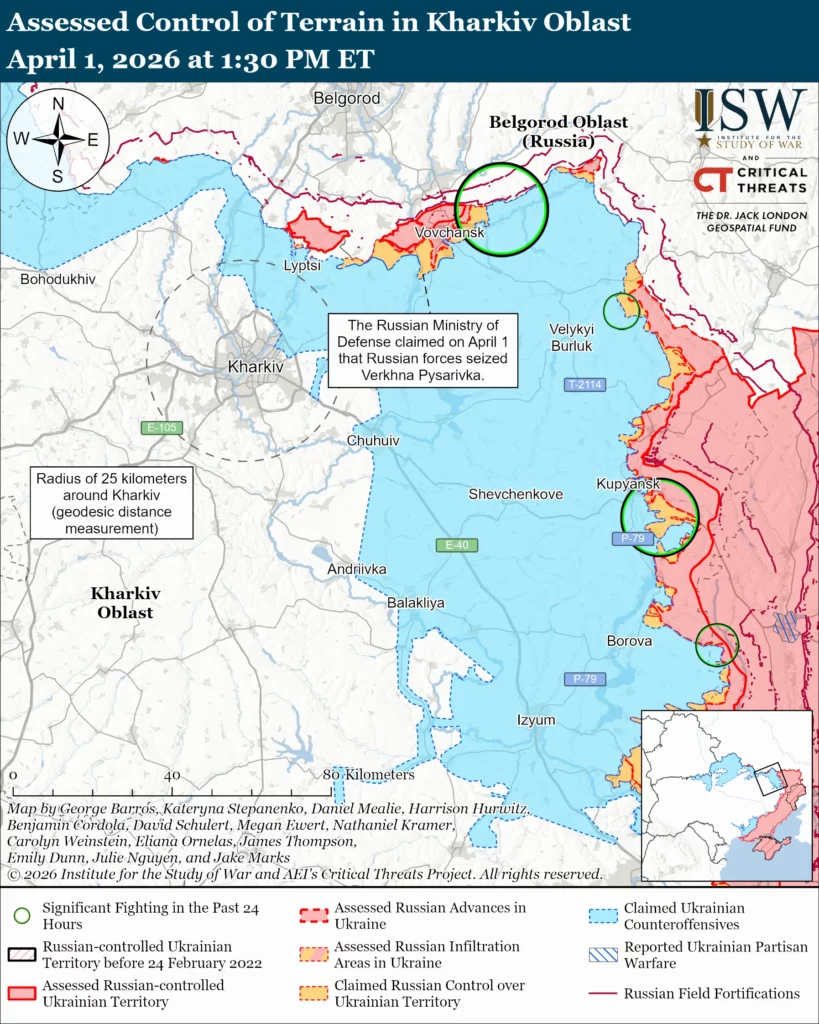
Russian forces continue offensive operations in northern Kharkiv Oblast on April 1 but did not make confirmed advances.
Unconfirmed claims: The Russian Ministry of Defense (MoD) claimed that elements of the Russian 82nd Motorized Rifle Regiment (69th Motorized Rifle Division, 6th Combined Arms Army [CAA], Leningrad Military District [LMD]) seized Verkhnya Pysarivka (northeast of Kharkiv City).[49] A Russian milblogger claimed that Russian forces advanced north of Bochkove (northeast of Kharkiv City).[50]
Russian forces attacked northeast of Kharkiv City near Vovchanski Khutory, Izbytske, Starytsya, Okhrimivka and toward Verkhnya Pysarivka on March 31 and April 1.[51]
Order of Battle: Drone operators and other elements of the Russian Chechen Akhmat Spetsnaz Vakha Battalion (204th Akhmat Spetsnaz Regiment), the 45th Spetsnaz Brigade of the Russian Airborne Forces (VDV), and the 245th Motorized Rifle Regiment (47th Tank Division, 1st Guards Tank Army [GTA], Moscow Military District [MMD]) are reportedly striking Ukrainian forces in the Kharkiv direction.[52]
Russian forces continued offensive operations in the Velykyi Burluk direction on April 1 but did not make confirmed advances.
Unconfirmed claims: A Russian milblogger claimed that Russian forces advanced west of Shevyakivka (northeast of Velykyi Burluk).[53]
Russian sources claimed that Russian forces attacked southeast of Velykyi Burluk near Dvorichanske on March 31 and April 1.[54]
Russian Subordinate Main Effort #2 – Oskil River
Russian objective: Cross the Oskil River in Kharkiv Oblast and push westward into eastern Kharkiv Oblast and northern Donetsk Oblast
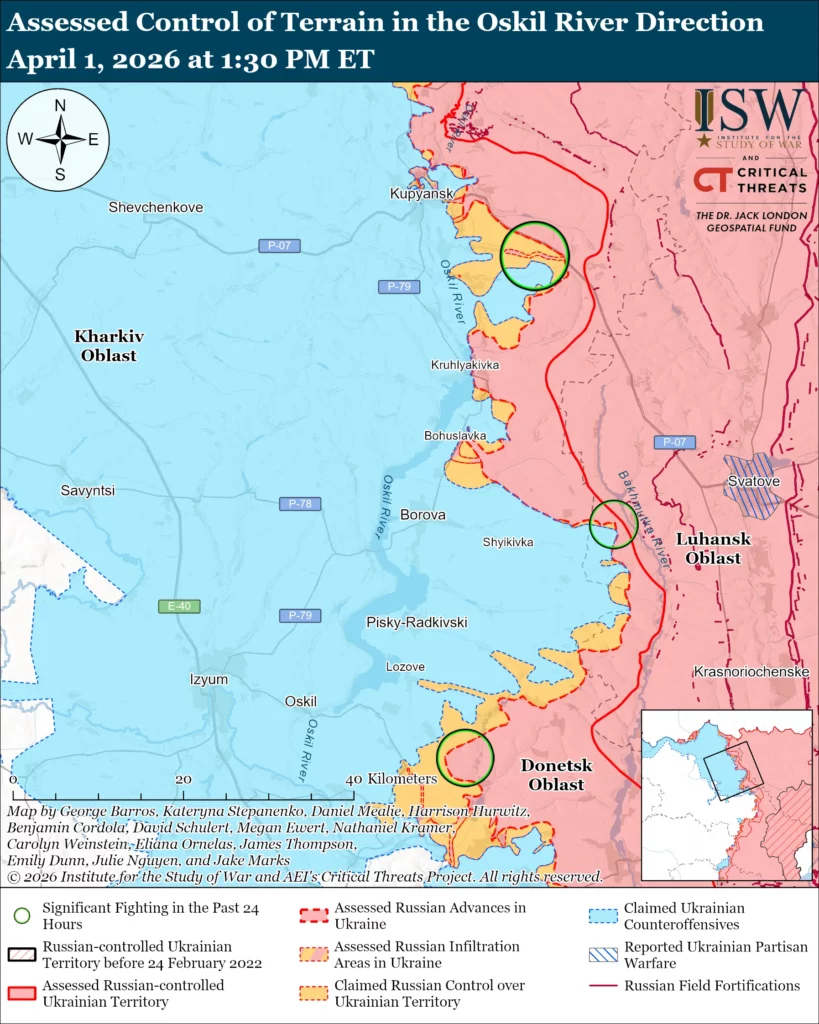
Ukrainian forces either maintained positions or recently advanced in the Kupyansk direction.
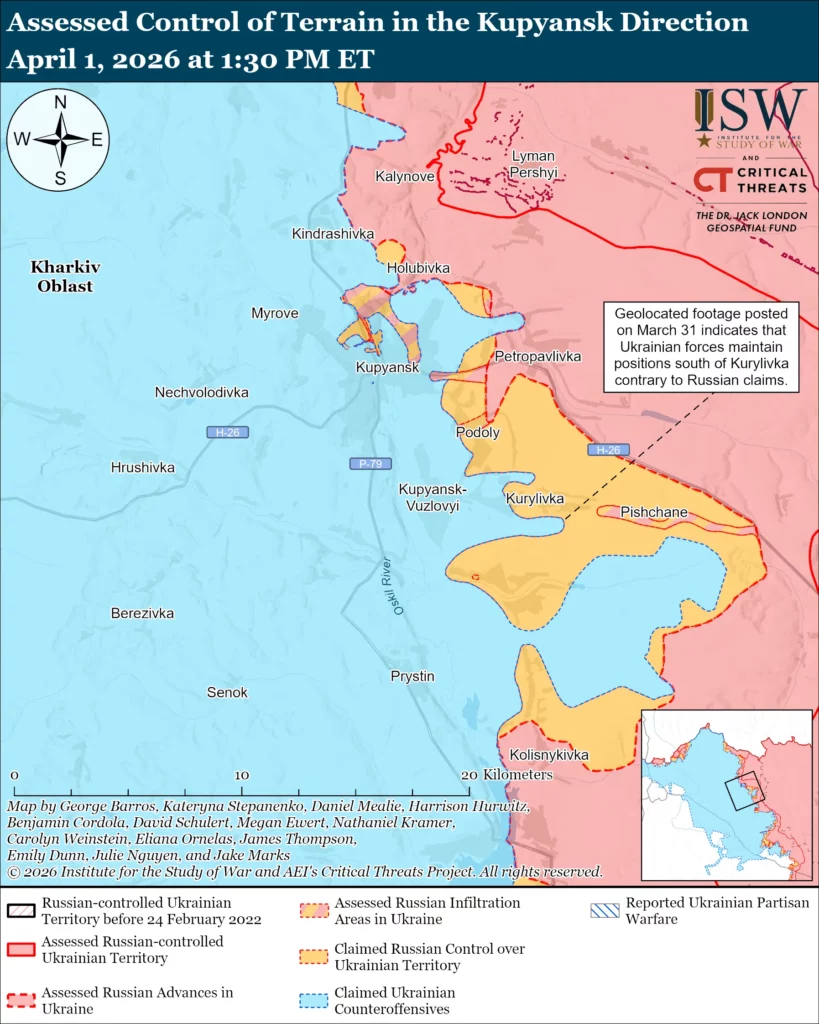
Refinement of areas under Russian claims: Geolocated footage published on March 31 shows that Ukrainian forces are operating south of Kurylivka – an area where Russian sources previously claimed that Russian forces maintained positions.[55]
Russian forces attacked near and within Kupyansk itself; northeast of Kupyansk near Krasne Pershe; south of Kupyansk near Kupyansk-Vuzlovyi; and southeast of Kupyansk near Novoosynove, Pishchane, Kivsharivka and Kurylivka on March 31 and April 1.[56]
Order of Battle: First-person drone (FPV) drone operators of the Russian 153rd Tank Regiment (47th Tank Division, 1st Guards Tank Army [GTA], Moscow Military District [MMD]) are reportedly striking Ukrainian positions in Kurylivka.[57] Elements of the 121st Motorized Rifle Regiment (68th Motorized Rifle Division, 6th Combined Arms Army [CAA], Leningrad Military District [LMD]) are reportedly operating in Kupyansk.[58]
Russian forces continued offensive operations north of Borova near Novoplatonivka and northeast of Borova near Nova Kruhlyakivka on March 31 and April 1 but did not advance.[59]
Russian Subordinate Main Effort #3 – Donetsk Oblast
Russian objective: Capture the entirety of Donetsk Oblast, the claimed territory of Russia’s proxies in Donbas, and advance into Dnipropetrovsk Oblast
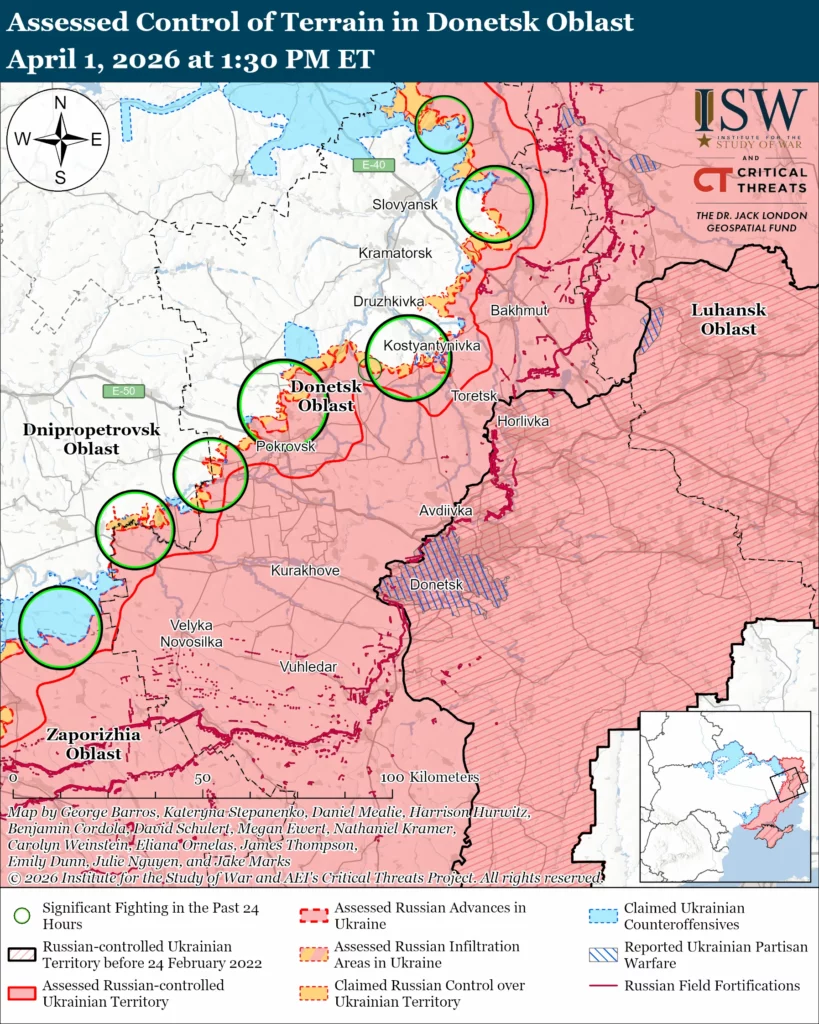
Ukrainian forces recently advanced in the Slovyansk direction.
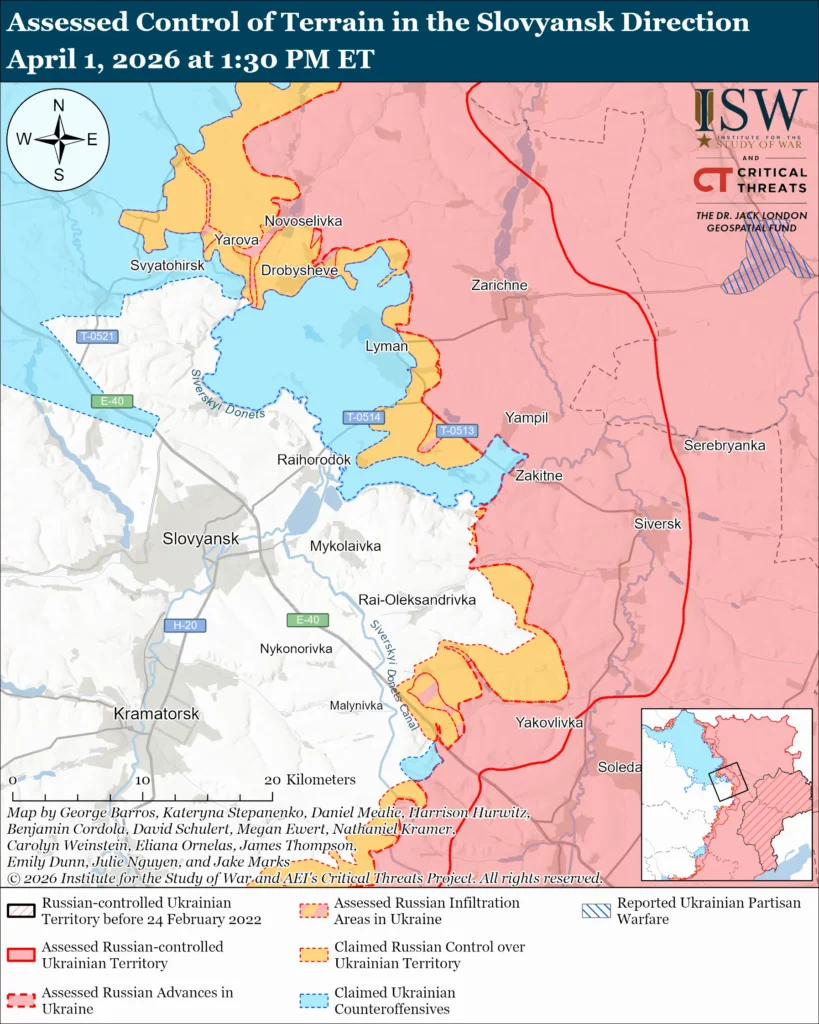
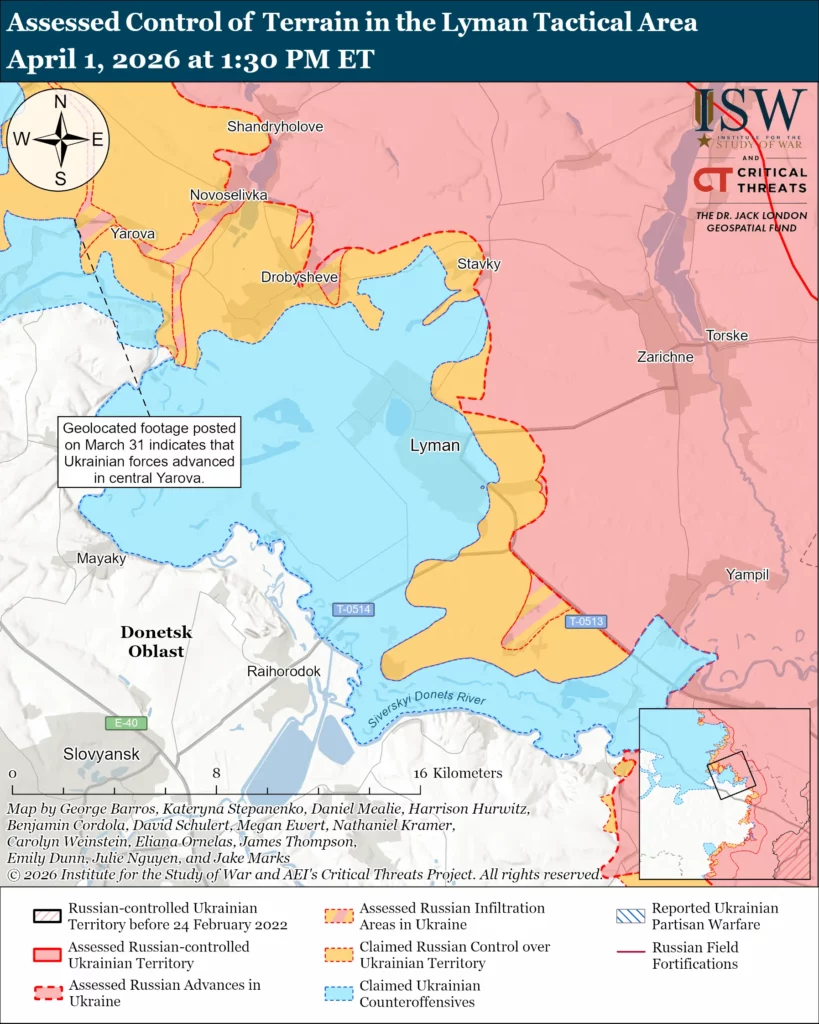
Assessed Ukrainian counteroffensives: Geolocated footage published on March 31 indicates that Ukrainian forces recently advanced in Yarova (northwest of Lyman).[60]
Assessed Russian infiltrations: The geolocated footage published on March 31 shows Ukrainian forces striking a Russian position in Yarova and then clearing the position after ISW assesses was a Russian infiltration mission that did not change control of terrain or the forward edge of the battle area (FEBA) at this time.[61]
Unconfirmed claims: A Russian milblogger claimed that Russian forces advanced in the fields south of Kryva Luka (east of Slovyansk).[62]
Russian forces attacked near Lyman itself; northwest of Lyman near Drobysheve and toward Svyatohirsk; east of Slovyansk near Zakitne, Kryva Luka, Platonivka, Riznykivka, Kalenyky, and toward Rai-Oleksandrivka; and southeast of Slovyansk near Fedorivka Druha and Lypivka on March 31 and April 1.[63]
Russian forces conducted a platoon-sized motorized assault in the Slovyansk direction on March 31. A Ukrainian brigade operating in the Slovyansk direction reported on April 1 that Russian forces attacked with 16 total motorcycles, comprised of several separate groups of three to four motorcycles each carrying two to three servicemembers [64] The brigade reported that Russian forces tried to exploit a large area of open terrain to break through Ukrainian defenses, but that Ukrainian forces repelled the assault and eliminated all 16 motorcycles and 32 Russian servicemembers. The Ukrainian brigade reported that this assault was the largest motorcycle assault Russian forces have conducted in this direction since the start of 2026.
Order of Battle: Drone operators of the Russian Chechen 204th Akhmat Spetsnaz Regiment are striking Ukrainian forces in Yampil (southeast of Lyman).[65] Assault elements of the 85th Separate Motorized Rifle Brigade (3rd Combined Arms Army [CAA], formerly 2nd Luhansk People’s Republic Army Corps [LNR AC], Southern Military District [SMD]) are reportedly operating in the Rai-Oleksandrivka direction.[66] Drone operators of Rubikon Center for Advanced Unmanned Technologies are reportedly operating in the Lyman direction.[67]
Russian forces recently infiltrated in Kostyantynivka.
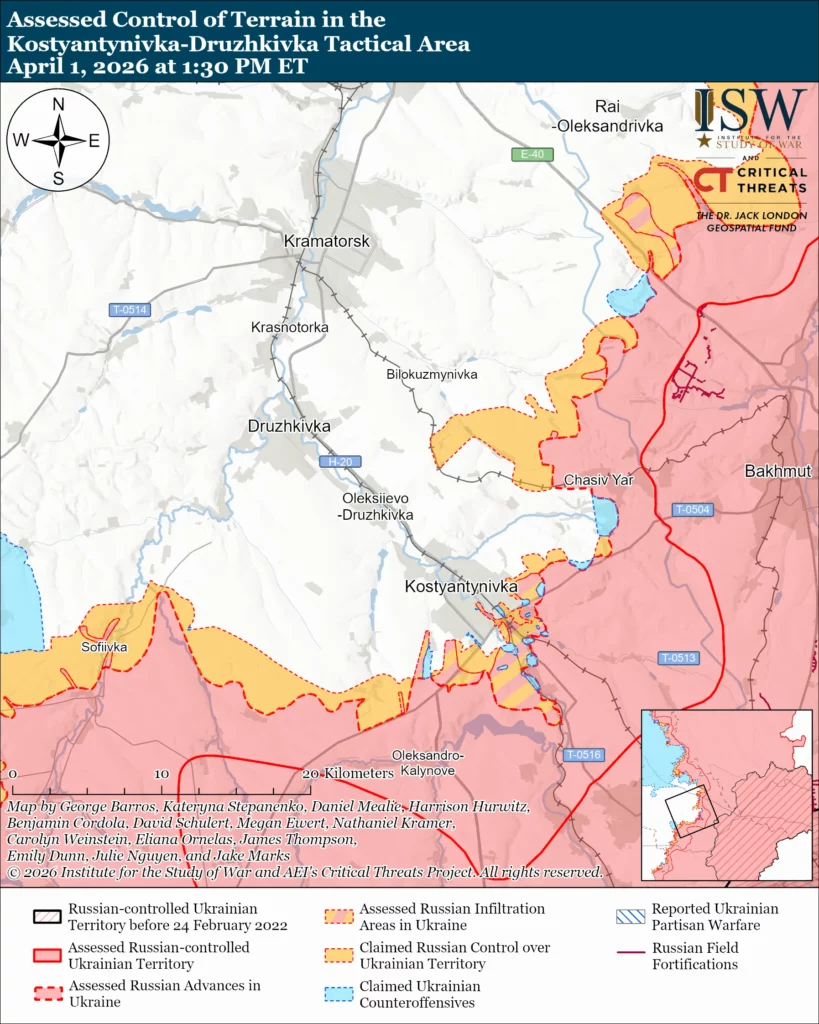
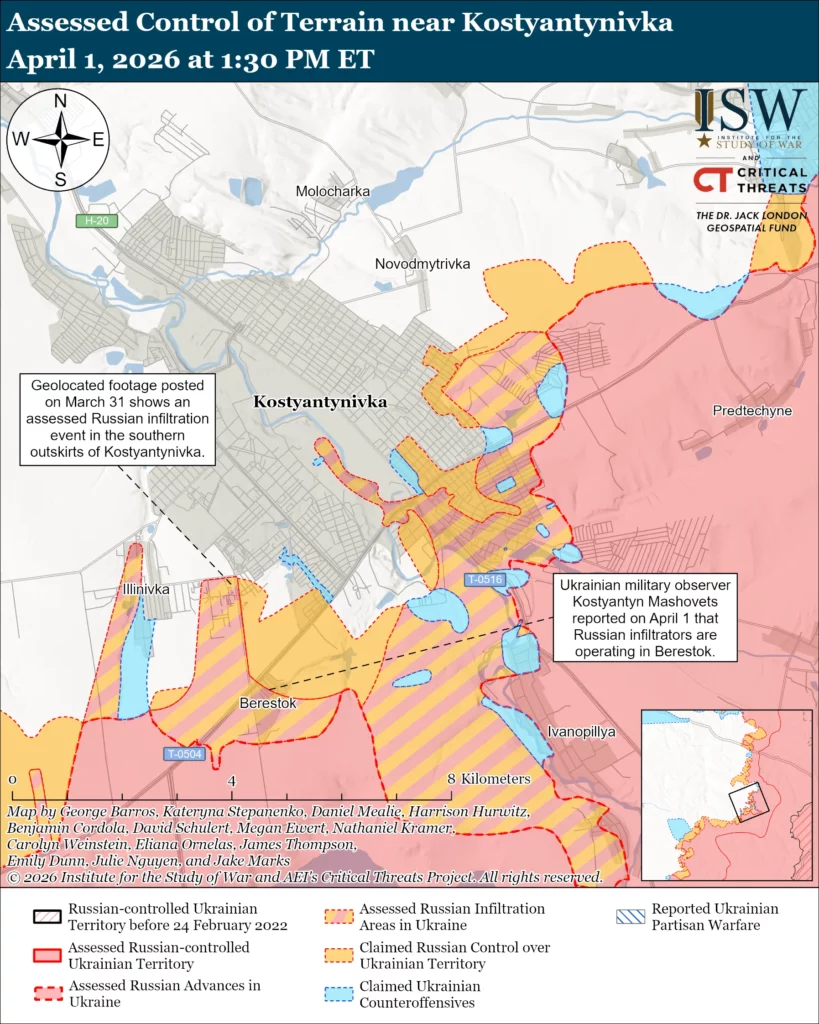
Assessed Russian infiltrations: Geolocated footage published on March 31 shows Ukrainian forces striking a Russian position in southeastern Kostyantynivka after what ISW assesses was a Russian infiltration mission that did not change the control of terrain or the FEBA.[68] Ukrainian military observer Kostyantyn Mashovets reported on April 1 that Russian forces advanced into Berestok.[69]
Russian forces attacked near Kostyantynivka itself; south of Kostyantynivka near Ivanopillya, Illinivka, and Pleshchiivka; southwest of Kostyantynivka near Stepanivka and Yablunivka; south of Druzhkivka near Rusyn Yar and toward Mykolaipillya; and southwest of Druzhkivka near Novopavlivka and Sofiivka on March 31 and April 1.[70]
Mashovets reported that the Russian military command continues attempts to envelop Ukrainian defenses in Kostyantynivka from the east and south as part of a broader plan to cover the entire agglomeration of Kostyantynivka-Druzhkivka from the east and southwest.[71] Mashovets stated that Russian forces will likely conduct mass infiltrations on Kostyantynivka’s perimeter using small and ultra small infantry groups to envelop the town, but that Russian forces will first need to amass a sufficient number of assault infantry to conduct these types of infiltrations.[72] Mashovets assessed that Russian forces may increase offensive activity near Chasiv Yar and toward Sofiivka-Raiske, so that Russian forces con concentrate on bypassing Kostyantynivka and converge on Druzhkivka, instead of conducting a bloody frontal assault on Kostyantynivka.[73] Mashovets assessed that Russian forces current offensive capabilities do not correspond with the scope of their planned offensive.
Order of Battle: Elements of the Russian 1307th and 1008th motorized rifle regiments (both of the 6th Motorized Rifle Division,3rd AC, under operational control of the Southern Grouping of Forces) and of the Rubikon Center for Advanced Unmanned Technologies are striking Ukrainian forces in Kostyantynivka.[74] Drone operators of the 238th Artillery Brigade (8th CAA, SMD) are striking Ukrainian forces in Mykolaipillya.[75] Elements of the 255th Motorized Rifle Regiment (20th Motorized Rifle Division, 8th CAA) reportedly continue to operate in the Kostyantynivka direction.[76]
Russian forces continue offensive operations east of Dobropillya near Nove Shakhove and Vilne on March 31 and April 1 but did not advance.[77]
Order of Battle: Elements of the Russian 35th Separate Motorized Rifle Brigade (41st CAA, Central Military District [CMD]), the 102nd Motorized Rifle Regiment (150th Motorized Rifle Division, 8th CAA, SMD), and the 61st Separate Naval Infantry Brigade (Northern Fleet) are reportedly operating in the Dobropillya direction.[78] Drone operators of the Rubikon Center for Advanced Unmanned Technologies and of the Smuglyanka Detachment are reportedly conducting reconnaissance operations near Novohryshyne (southwest of Dobropillya).[79]
Ukrainian forces recently advanced in the Pokrovsk direction.
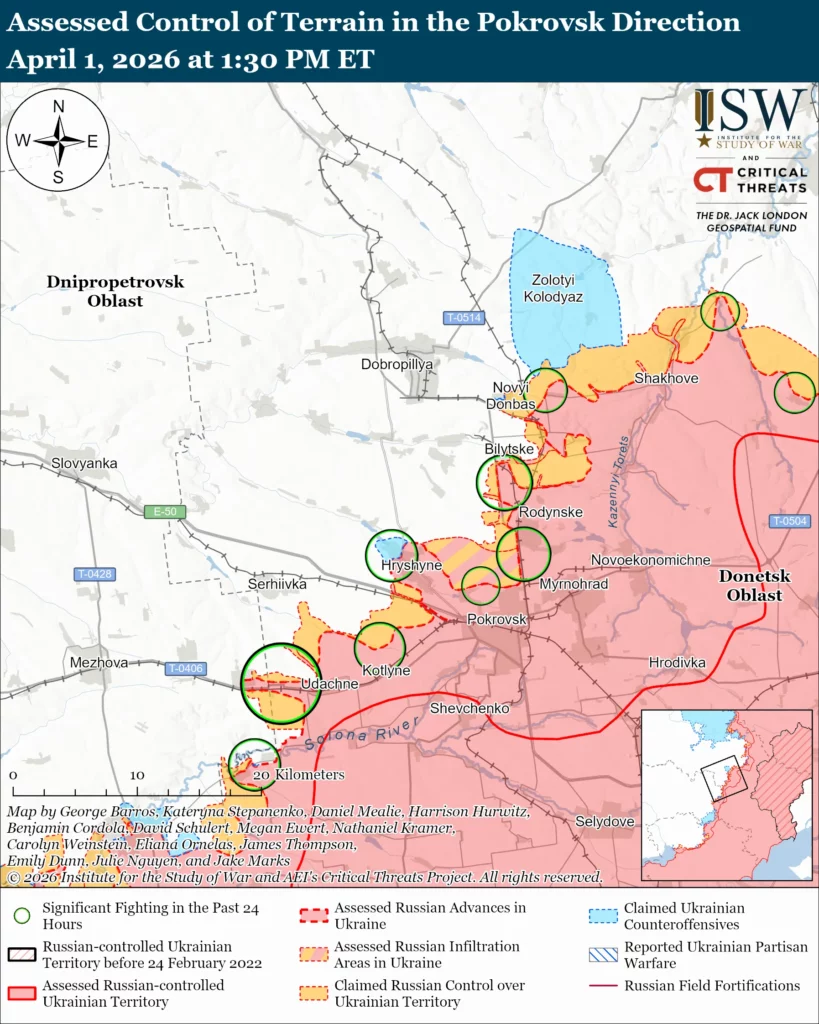
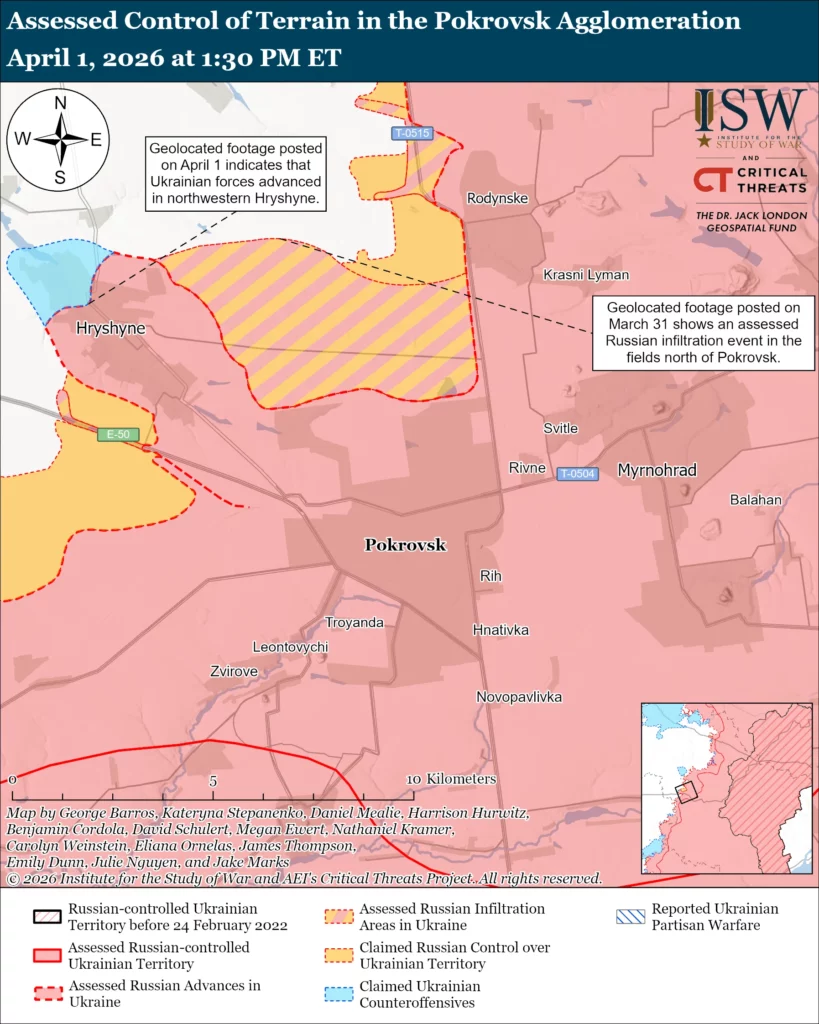
Assessed Ukrainian advances: Geolocated footage published on April 1 indicates that Ukrainian forces advanced in northwestern Hryshyne (northwest of Pokrovsk).[80]
Assessed Russian infiltrations: Geolocated footage published on March 31 shows Ukrainian forces striking a Russian position north of Pokrovsk after what ISW assesses was a Russian infiltration mission that did not change the control of terrain or the FEBA.[81]
Russian forces attacked near Pokrovsk itself; northwest of Pokrovsk near Hryshyne and toward Novooleksandrivka; north of Pokrovsk near Bilytske and Rodynske; east of Pokrovsk near Myrnohrad; and southwest of Pokrovsk near Kotlyne, Molodetske, Novopidhorodne, and Udachne on March 31 and April 1.[82] Russian milbloggers claimed that Ukrainian forces counterattacked near Pokrovsk, Hryshyne and Rodynske.[83]
Ukrainian Commander-in-Chief General Oleksandr Syrskyi stated on April 1 that the Pokrovsk direction is the most active direction across the theater and that Ukrainian forces have stopped simultaneous Russian attacks against several settlements in the Pokrovsk direction.[84] Syrskyi reported that Ukrainian forces destroyed Russian forces near Hryshyne and that Ukrainian forces struck Russian forces near Myrnohrad.
Order of Battle: Mashovets stated that the Russian military command has had to send a significant part of its 120th Naval Infantry Division (Baltic Fleet) (newly formed from the 336th Naval Infantry Brigade) to stabilize the Novooleksandrivka direction (northwest of Pokrovsk).[85] Elements of the 35th Motorized Rifle Brigade (41st CAA, Central Military District [CMD]) are reportedly operating in Hryshyne.[86] Drone operators of the Smuglyanka Detachment and the Rubikon Center for Advanced Unmanned Technologies are reportedly conducting reconnaissance operations near Mezhova (southwest of Pokrovsk).[87]
Russian forces continued offensive operations in the Novopavlivka direction, including northeast of Novopavlivka near Novomykolaivka and Muravka, southeast of Novopavlivka near Horikhove, and southwest of Novopavlivka near Filiya, on March 31 and April 1 but did not advance.[88]
Russian forces continued offensive operations in the Oleksandrivka direction on April 1 but did not make confirmed advances.
Assessed Russian infiltrations: Geolocated footage published on April 1 shows a Russian servicemember raising a flag in Boikove (southwest of Oleksandrivka) during what ISW assesses was a Russian infiltration mission that did not change control of terrain or the forward edge of battle area (FEBA).[89] ISW continues to assess that Russian flag raising tactics are part of a cognitive warfare effort to make aggrandized claims of Russian advances and to spread the false narrative that Ukrainian defenses are collapsing across the theater.[90]
Unconfirmed claims: The Russian Ministry of Defense (MoD) claimed that the Russian 64th Separate Motorized Rifle Brigade (35th CAA, Eastern Military District [EMD]) seized Boikove.[91]
Russian forces attacked northeast of Oleksandrivka near Zelenyi Hai; southeast of Oleksandrivka near Pryvillya, Oleksandrohrad and Novohryhorivka; and southwest of Oleksandrivka toward Nove Zaporizhzhia on March 31 and April 1.[92] A Russian milblogger claimed Ukrainian forces counterattacked toward Hai (southeast of Oleksandrivka).[93]
The spokesperson of a Ukrainian brigade operating in the Oleksandrivka direction reported that Russian forces are attempting to contain Ukrainian advances through localized counterattacks with small assault groups, reinforcing forward positions with units redeployed from other directions.[94]
Ukrainian forces continued strikes against frontline Russian military assets in the Oleksandrivka direction. The Ukrainian General Staff reported that Ukrainian forces struck a Russian personnel concentration near Sosnivka (southeast of Oleksandrivka).[95]
Order of Battle: FPV drone operators of the Russian 14th Spetsnaz Brigade (Russian General Staff’s Main Directorate [GRU]) are reportedly intercepting Ukrainian drones in Dnipropetrovsk Oblast.[96]
Russian Supporting Effort: Southern Axis
Russian objective: Maintain frontline positions, secure rear areas against Ukrainian strikes, and advance within tube artillery range of Zaporizhzhia City
Ukrainian forces recently advanced in the Hulyaipole direction.
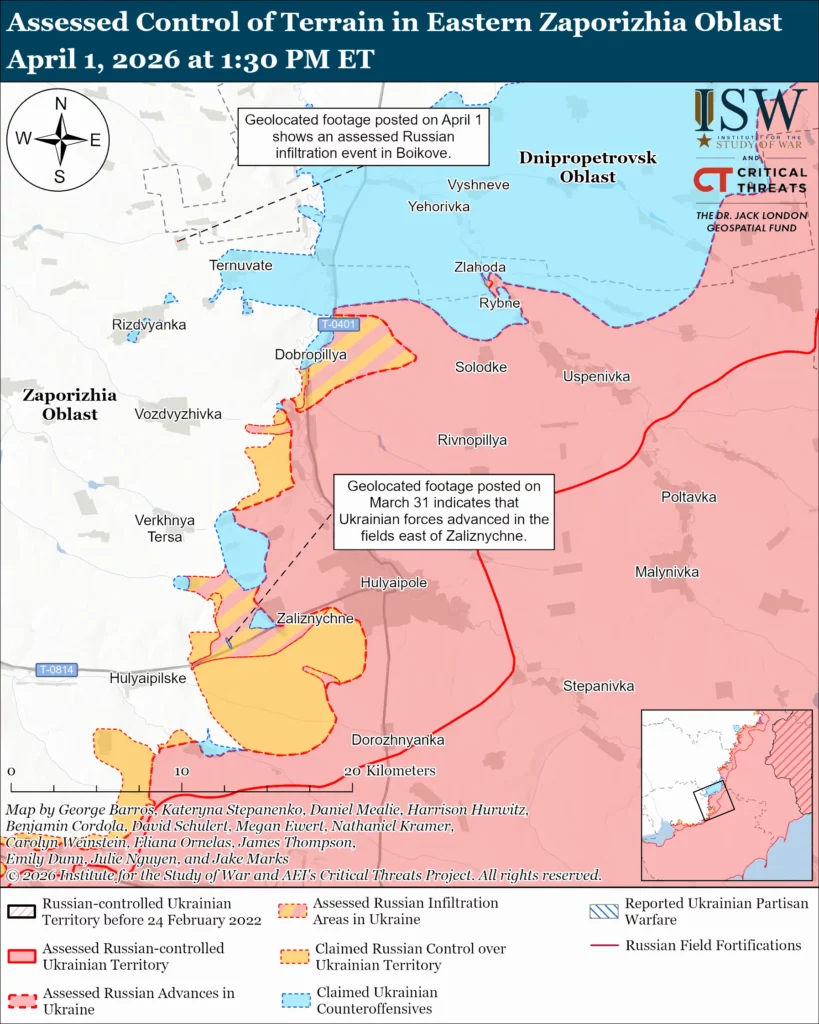
Assessed Ukrainian advances: Geolocated footage published March 31 indicates Ukrainian forces recently advanced north of the T-0814 highway east of Zaliznychne (west of Hulyaipole).[97]
Russian forces attacked near Hulyaipole itself; northwest of Hulyaipole near Olenokostyantynivka, Svyatopetrivka, and Tsvitkove and toward Verkhnya Tersa and Vozdvyzhivka; north of Hulyaipole near Varvarivka and toward Dobropillya; northeast of Hulyaipole near Rivnopillya; southwest of Hulyaipole near Myrne and toward Hulyaipilske; and west of Hulyaipole near Zaliznychne and Hirke and toward Charivne on March 31 and April 1.[98]
A Ukrainian regiment operating in the Hulyaipole direction reported that Russian military command continues to deploy motorcyclists in high-risk assault attempts through the Ukrainian kill zone.[99]
Ukrainian forces continued strikes against frontline Russian military assets in the Hulyaipole direction. The Ukrainian General Staff reported on April 1 that Ukrainian forces struck a Russian drone control point in Zaliznychne and a Russian command and observation post near Uspenivka (northeast of Hulyaipole).[100]
Order of Battle: Drone operators of the Russian 11th Air Force and Air Defense Army (Russian Aerospace Forces [VKS] and Eastern Military District [EMD]) are reportedly striking Ukrainian forces near Rivne (northwest of Hulyaipole).[101]
Russian forces recently infiltrated in western Zaporizhia Oblast.
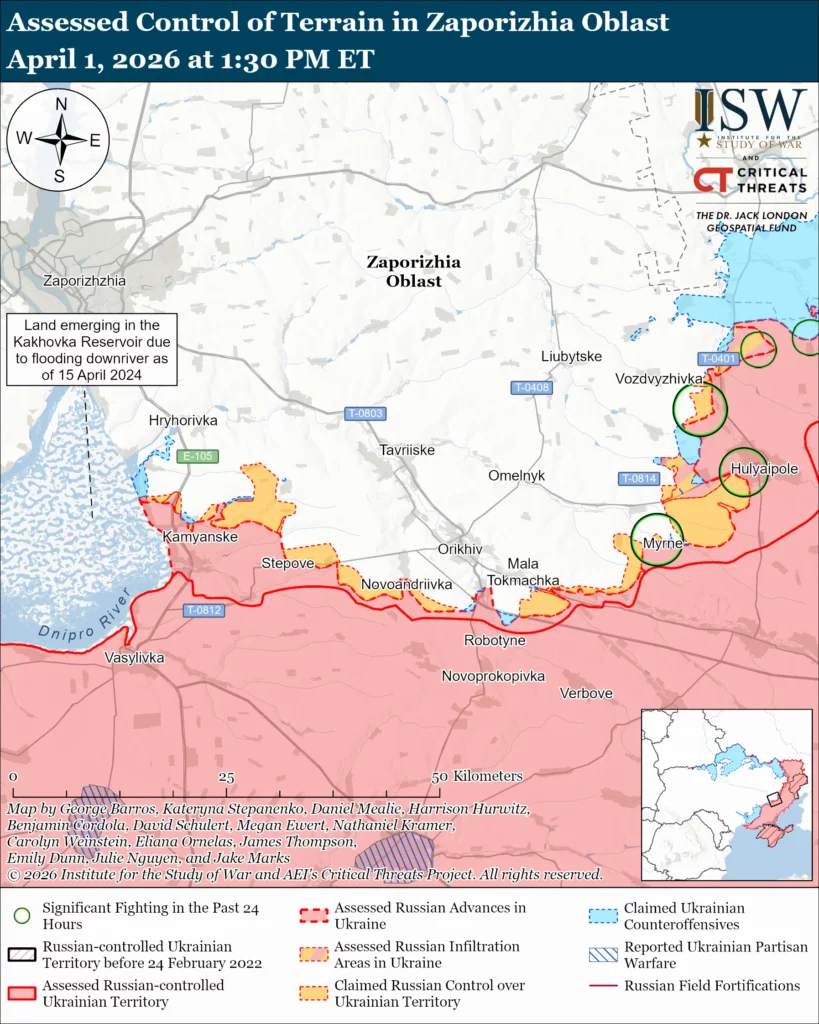
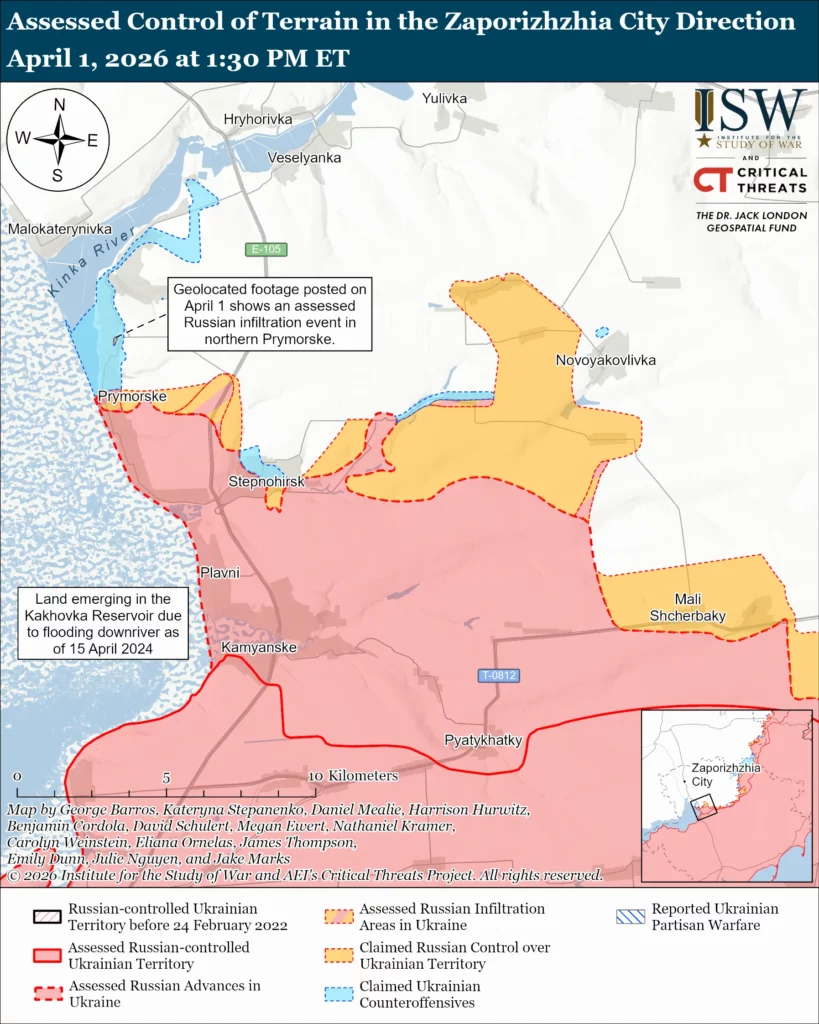
Assessed Russian infiltrations: Geolocated footage published on April 1 shows Ukrainian forces striking a Russian position in central Prymorske (northwest of Orikhiv) after what ISW assesses was a Russian infiltration mission that did not change control of terrain or the forward edge of the battle area (FEBA).[102] ISW assesses that the Russian infiltrators operating in central Prymorske likely infiltrated on a prior date.
Russian milbloggers claimed that Russian forces attacked southeast of Orikhiv near Novodanylivka and Mala Tokmachka; west of Orikhiv near Mali Shcherbaky; and northwest of Orikhiv near Prymorske, Pavlivka and Stepnohirsk on March 31 and April 1.[103]
The head of intelligence of a Ukrainian brigade operating in western Zaporizhia Oblast reported that Russian forces are attempting to infiltrate behind Ukrainian lines to disrupt Ukrainian logistics in the Orikhiv direction.[104] The officer reported that Russian forces are trying to move drone, FPV, and mortar crews as close to the frontline as possible to strike deeper into the Ukrainian rear. The officer reported that Russian forces continue to struggle with logistics and equipment losses and are using Molniya drones to resupply forward positions.
Order of Battle: Drone elements of the Russian Chechen 270th Akhmat-Kavkaz Motorized Rifle Regiment (42nd Motorized Rifle Division, 58th Combined Arms Army [CAA], Southern Military District [SMD]) are reportedly striking Ukrainian positions and equipment in the Zaporizhzhia direction.[105]
Ukrainian forces continued their short- to mid-range strike campaign against military assets in occupied Zaporizhia Oblast. The Ukrainian General Staff reported on April 1 that Ukrainian forces struck a Russian drone control point near Dolynka (southwest of Orikhiv roughly eight kilometers from the frontline) and a material and technical equipment warehouse near occupied Yakymivka (roughly 115 kilometers from the frontline).[106]
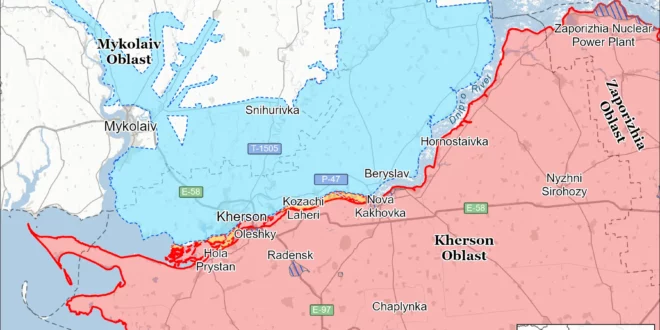
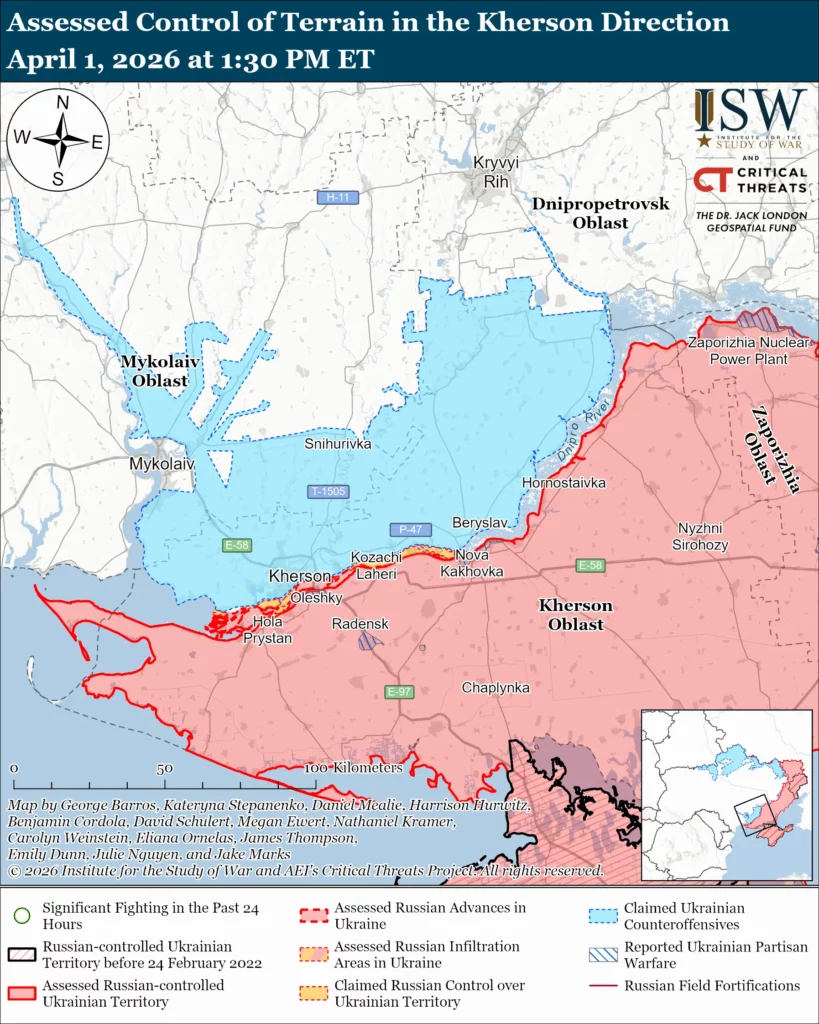
Russian forces continued offensive operations in Kherson Oblast, including northeast of Kherson City toward the Antonivskyi Bridge and southwest of Kherson City near Bilohrydyi Island on March 31 and April 1 but did not advance.[107]
Russian Air, Missile, and Drone Campaign
Russian Objective: Target Ukrainian military and civilian infrastructure in the rear and on the front line
See topline for more information on Russian long-range strikes on Ukraine.
The Ukrainian Ministry of Defense (MoD) reported on April 1 that Ukrainian air defenses shot down 89.9 percent of Russian missiles and drones in March 2026. The Ukrainian MoD reported that 5,935 Russian drones and missiles failed to reach their targets in March and that the figures illustrate the growing effectiveness of Ukrainian air defense systems.[108]
Significant Activity in Belarus
Russian efforts to increase its military presence in Belarus and further integrate Belarus into Russian-favorable frameworks
Russia and Belarus continue to cohere administrative and production systems as part of Russian efforts to de-facto annex Belarus. State Secretary of the Union State Sergei Glazyev, a former Russian economic official, claimed on April 1 that Russia and Belarus are preparing to launch the first “Union State Goods” products, which will place a quality mark on machine tools, electronics, buses, and cars.[109]
Note: ISW does not receive any classified material from any source, uses only publicly available information, and draws extensively on Russian, Ukrainian, and Western reporting and social media as well as commercially available satellite imagery and other geospatial data as the basis for these reports. References to all sources used are provided in the endnotes of each update.