Eurasia Press & News
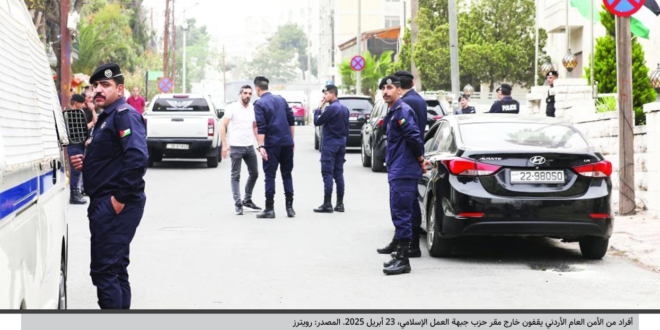
The paper reads into the Jordanian government’s decision to ban the group on April 23, 2025, in response to growing security concerns after the discovery of associated cells planning to threaten Jordanian national security. The paper presents three possible paths beyond the ban: either the ban on the group only, its extension to the Islamic Action Front (IAF), or the complete uprooting of the two entities, highlighting the legal and security challenges associated with each track.
The relationship between the state and the banned group has entered a new turn, after the Jordanian government announced the banning of the group on April 23, 2025, and the prohibition of all its activities, affiliation to it or promote its ideas, which was followed by measures to surround its headquarters and confiscate its documents, and activate the committee to confiscate its property. This came in a practical implementation of a previous resolution that considered the group dissolved and illegal in July 2020. These measures come after the General Intelligence Directorate revealed on April 15, 2025, cells associated intellectually and organizationally with the group that were planning and preparing to target Jordanian national security. This is an incident that renewed concerns about the group’s activities, orientations and agenda, especially in light of the turmoil surrounding Jordan and the region. In fact, the government’s actions came in response to security developments, but it closed a long-standing path from the group’s internal movements and a network of external dealings and relations, through which it sought to tamper with the local equation and exploit Jordan’s geographical location in the region.
Read the ban decision
The ban is considered an activation of a judicial decision issued by the Court of Cassation in 2020, after it was found that the group is not in line with the licensing conditions of charities stipulated in the Jordanian Associations Law amended in 2014. In 2021, a committee tasked with dissolving the group, inventorying its assets and confiscating its property was formed, a committee that recently directed the government to speed up its work. During that period, the State gave the banned group an opportunity to correct its legal status and return to the charitable and advocacy aspects of its work. The activation of this latest decision was the result of a security rather than a political approach.
The ban came days after law enforcement announced the arrest of “chaotic cells” that were working to manufacture and use weapons to harm Jordan’s national security and turn the 16 people involved in it into the State Security Court. Although Jordan has witnessed previous attempts to target its security and stability throughout its history, these attempts have highlighted some of the emerging threats and the broader range of risks associated with the banned group, including unprecedented developments, including: its non-linkage in the course of the war in the Gaza Strip, where law enforcement forces have been following the activities of cells since 2021, a year that the government stressed its importance. In addition to the involvement of those involved in groups that were carrying out separate tasks from each other, represented in four main issues, including the attempt to manufacture weapons inside Jordan, the possession of automatic weapons and high explosives smuggled from abroad, with the concealment of a missile equipped for use, in addition to the existence of a project to manufacture drones with the help of external parties. In addition to the issue of recruiting and training elements inside and outside the Kingdom, specifically in Lebanon.
In fact, the “Chills of Chaos” incident, as it is called in the media, revealed the duality of the group’s work between public activity and hidden work, both intellectually and organizationally. In particular, previous incidents confirmed this duality, including the failure of the security services to try to smuggle Iranian weapons through Syria, announced in May 2024, sent to a cell belonging to the banned group, and has links with Hamas in order to carry out acts of sabotage. In addition to the shooting by two of its members in the southern Dead Sea on October 18, 2024, an incident that required logistical support, observers were aggravated the suspicions of a broader organizational role behind it. The two perpetrators followed a standard practice among members of armed or terrorist Islamic organizations, both used and recited the commandments in a video, in addition to their ability to bypass heavily protected borders, possess weapons, master their use and injure two Israeli soldiers. All of this coincided with the security services dealing with other similar incidents, including the case of South Marka explosives, which was seized on June 19, 2024, followed by the discovery of another site for the storage of explosives in the Abu Alanda area on June 24. In a separate incident, on September 8, 2024, a Jordanian truck driver carried out a shooting at the Allenby crossing, which appears to have links to the “Salafi-jihadist” ideology. His operation was blessed by the banned group at the time.
Ban decision: Transnational Community Context
The decision came a day after Hamas demanded the release of “cells of chaos” elements, in a statement widely seen as interference in Jordan’s internal and security affairs. The relationship between the outlawed group and Hamas, whose offices in Jordan were closed in 1999 as a result of illegal activities and practices, including its attempt to establish an illegal organization and seize weapons in the possession of individuals associated with it, has been brought back to the forefront. It is clear that this relationship has returned to pose a security threat to Jordan, as evidenced by the positions of the banned group during the war, and its tactical rhetoric, which prompted several times for direct confrontations between its members and the public security services, in addition to the joint coordination between them for the movement and protests in the Jordanian street.
In general, Hamas’s rhetoric against Jordan has become remarkable, both with the attempts of its leaders, such as Mohammed al-Deif, Khaled Meshaal, and Abu Obeida, to influence the Jordanian street, and their inflammatory calls for Jordanian citizens to engage in the “Flood of Al-Aqsa” as Hamas calls the war. On March 29, 2024, the head of Hamas abroad, Khaled Meshaal, delivered a video address during an event held by the banned group, in which he called on Jordanians to take to the streets by millions. The military spokesman of Hamas, Abu Obeida, sent political and military messages to the Jordanian street, including describing the country as a “Jordanian front” in several speeches, and considering the Jordanian mass arena “the most important squares.” The movement bet on the banned group in translating its speech on the ground, which was able to direct the protests from “spontaneous” to “inflammatory.” Hamas’s rhetoric dominated the protesters’ chants, before crossing the “red lines” of harming the state leadership and security institutions, vandalizing public property and contacting public security men. It has reached an unprecedented level with the availability of information about “external contacts” – apparently sourced from Iran – pushing the Jordanian street to escalate against the state and the political system in the wake of the protests in the Rabiya region in March 2024, and the increasing activity of foreign accounts on social media platforms, calling for participation in those protests. This prompted the General Security to issue a statement on March 31, 2024, confirming the occurrence of abuses, and attempts to attack the General Security men in some vigils and gatherings
In general, the banned group has tried to show an independent workspace outside the state and its control limits. On the one hand, it continued to call on the public to go to the western border and the Jordan Valley, the last of which was on April 11, 2025, despite the Interior Ministry’s assertion that this has not been allowed since October 13, 2023. In the early hours of the shooting incident south of the Dead Sea, it was quick to announce the affiliation of its perpetrators to the group, before denying its connection, and then blessing it, without waiting for information or the statement of the competent authorities, which preferred to follow up on these developments before issuing its statement.
More broadly, it has become noticeable that the banned group does not believe in the thought of the homeland, in contrast to its transnational ideology and geography, especially with the intersection and overlap between its movements and the strategy of the Iranian “unity of the squares”, which tried since the first day of the war to drag Jordanian geography into the conflict. The threats surrounding the country have been exacerbated by the increase in attempts to smuggle drugs, weapons and explosives from southern Syria to Jordan, in addition to the threat posed by flying objects (ballistic missiles and drones) launched by the Houthis from their positions of control in Yemen, or Iraqi armed factions, over Jordanian airspace, a number of which fell in Jordanian territory. In addition to the equally important threat of anti-Jordan rhetoric, she was accused of opening up its territory to supply the Israeli military with Israeli weapons and aircraft to refuel by air, and then accused of participating in a land bridge transporting goods from UAE ports to Jordan to Israel. In addition to accusing parties from the so-called axis of resistance Jordan of confronting attempts to smuggle weapons to Palestinian factions in the West Bank, and then accused of countering the Iranian strike, which Tehran violated the sovereignty of the Kingdom’s skies to protect Israel. Iran has tried to support its rhetoric with field action, including the gathering of hundreds of PMF and peace companies at the Trebil border crossing between Jordan and Iraq to call for the opening of a road towards the Jordanian-Israeli border. On April 1, 2024, the security official of the Iraqi Hezbollah Brigades, Abu Ali al-Askari, issued a statement saying that “the Islamic Resistance in Iraq has prepared its equipment to equip the brothers of the Islamic resistance in Jordan to meet the need of 12,000 fighters,” and Iran’s threats in April 2024 that “Jordan will be the next target” if it participates in the work of repelling Iranian strikes.
It seems that the banned group has reacted to these movements, although its interaction did not reach the point of direct involvement in the war, as in the case of the “Islamic Group” in Lebanon, but it was no less important than it, whether through its involvement in the smuggling, possession and storage of money and weapons inside Jordan, or the provision of political and media support and the mobilization of the street against the state, and then the implementation of “individual operations” on October 18, 2024, to the “cells of chaos” that participated parties in Lebanon, perhaps from Hamas or the Islamic Group in their training and funding.
What about after the ban?
The charting of the paths of the next step or phase depends mainly on the security investigations and the suspicious activities of the security services of the banned group, and the extent to which the Islamic Action Front party is linked to it. The banned group quickly destroyed large quantities of documents at its headquarters on the night of the announcement of the “cells of chaos.” However, the paths of the next stage are almost limited to three: the cessation of the ban within the framework of the banned group, or the extension of the ban towards its political arm, the “party” if it is proven to be involved, or the circle expands towards the uprooting of both. The evolution of these tracks poses a series of problems and challenges.
The suspension of the ban at the group, and the fact that the Labour Front Party remains licensed and effective, would create new dynamics in the form of their relationship. The party is aware that the banned group is its main backer, and has a major role in its electoral campaigns and the selection of its candidates, which is a reflection of the size of the banned group in the street, especially since the number of party members does not exceed 1230 members. Thus, the party finds itself in front of limited options, the first of which is to distance itself from the current developments, and to separate its real and total link from the banned group, and this option is a sound legal procedure and an assessment of the party’s course and reputation, but this entails weakening the size and strength of the party, as it will lose the traditional electoral rules of the banned group, and its ability to mobilize and mobilize, and even fund its electoral campaigns, and other roles that the banned group was playing.
But there is a possibility that the party will circumvent the ban, by silently absorbing sympathizers, supporters and members of the banned group who are not involved in security issues within its ranks, whether by officially joining the party, or by opening alternative channels of communication with them from the banned group. In both cases, this can be monitored by tracking the level of inflation of the number of members of the party over time, or the changes it will make to its leadership structure, to include personalities with popular associations, especially among the youth groups. However, the party’s going towards this option entails challenges and repercussions, foremost of which is that the party will turn into the intellectual incubator that produced the previous security incidents, maintain the network of foreign relations of the banned group, and perhaps replace the banned group in the licensed party. This will implicate the party and push it to confront the force of law.
The second track, which is the extension of the ban to include the party if it is proven that it is involved – a possibility that exists with the involvement of three of its members in the “cells of chaos” – this means that the Jordanian political arena is facing a radical transformation, not only in terms of the fate of the House of Representatives and the future of the government, but also in the entire political reform process, which is a warning that has already been mentioned in our reading of the twentieth parliamentary scene and the prospects for political modernization. In addition to the continuous negative impact of regional security conditions on the paths of modernization and reform historically, the representation of the party and its participation in the path of modernization raises questions about the feasibility of completing that path, or going towards alternative options to manage the political arena in the future.
On the other hand, the lines between the trends of Islamic currents in general are absent, specifically what is considered conservative, moderate, or inclined towards liberalism, and many of the active Islamic parties have been formed in the Jordanian arena through a series of historical defections from the banned group, and the fears of this approach lie in two issues: the first is the departure of members of the banned group and the party to establish licensed political parties, associations or civil society institutions, and the second by trying to affiliate with the licensed Islamic political parties, and that affiliation may be for the purpose of political participation and correcting the situation or with the aim of penetrating those parties silently.
The third track related to the expansion of the circle towards the eradication of both completely, it seems more complex, while this path is considered the maximum option to resolve the issue of the banned group and its presence in the street, so that it extends to various intellectual, cultural, educational, educational, social, media and political levels, but the eradication is surrounded by several problems, including the need for a clear legal ground, especially since the banned group penetrated through 80 years of its life in the Jordanian social fabric. Therefore, the promulgation of a special law on eradication would regulate that issue, in parallel with the avoidance of excesses and the preservation of the political arena active and effective. But that does not mean that the legal approach is sufficient in this path, as it turns out that the hardline currents of the banned group have already tended to work in the shadows, acquire weapons and plan to use them against the state. In fact, the group’s statements abroad indicated, as stated by the call of the Change Movement, which is affiliated with the group’s branch in Egypt, the banned group in Jordan to confront and carry weapons in the face of the state, and this means that the choice of all members of the banned group and its members to abide by the law and instructions issued by the state is questionable, and they are likely to intensify the secret work practiced by the group’s branches abroad, especially in Egypt in the 1950s and 1960s, and then after the revolution of July 30, 2013, as well as in Syria in the 1980s and Algeria in the 1990s. This means that the security and intelligence approach will remain active and effective against the remnants of the banned militant group and their level of communication and dependence on the agenda of the branches of the international organization and the regional countries concerned with their survival and the permanence of their activity.
Finally, the state’s actions against the banned group came after the state exhausted all peaceful solutions and acted in accordance with the law, after a series of positions and escalatory moves of the “prohibited group” that it placed within the framework of direct threats against Jordanian national security, which is a red line that cannot be tolerated or allowed to be crossed. Especially since her moves were consistent with the anti-country and anti-country positions, which Iran is the main source.