 Eurasia Press & News
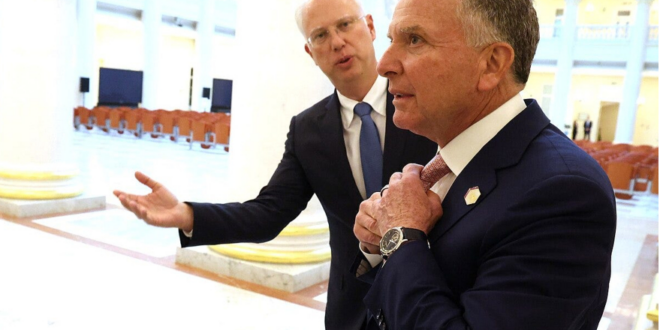
On November 20, some American media outlets, citing an anonymous source, leaked a 28-point plan to end the war in Ukraine, passing it off as an American peace plan, supposedly formulated as a result of lengthy US negotiations with the Russian and Ukrainian sides. In reality, the document represented proposals from the Kremlin, which had not been negotiated with the US State Department, much less with Ukraine. Wiretaps published by Bloomberg confirm that Russian negotiator Kirill Dmitriev agreed with US Special Representative Steve Witkoff to pass these proposals off as an American plan. Many of the controversial terms of this plan were contained in a document that sources had discussed with The Insider several months earlier.
The 28-point plan to end the war in Ukraine, allegedly drafted by American negotiators with the participation of Kirill Dmitriev, head of the Russian Direct Investment Fund (RDIF) and a Kremlin negotiator, is in fact essentially a reworked version of a Russian document. A source close to the Russian government showed this document to The Insider several months ago.
According to Axios and the Wall Street Journal, the American plan, which is clearly biased in favor of Moscow, has sparked an international crisis amid concerns that the Trump administration is pushing a pro-Russian agenda and attempting to coerce Ukraine into capitulation. The document is said to be the product of a month-long collaboration between three figures: US Special Envoy Steve Witkoff, Trump’s son-in-law Jared Kushner, and Dmitriev himself.
The 28-point plan has fueled concerns that the Trump administration is pushing a pro-Russian agenda.
Several key provisions of the plan, leaked to the American press on November 18, were actually borrowed from an earlier draft written by Dmitriev shortly after Trump returned to the White House in late January 2025, including:
de facto recognition by the United States of the Russian-occupied Crimea, LPR and DPR (which is seen as a concession on the part of Moscow compared to the more binding de jure recognition of these territories);
freezing of the territorial status along the current line of contact in the Zaporizhzhia and Kherson regions;
a phased process of lifting sanctions against Russia;
Ukraine’s accession to the European Union;
unconditional refusal to admit Ukraine to NATO;
a ban on the presence of Western peacekeepers or NATO contingents in Ukraine;
a scheme in which the US profits from frozen Russian assets held by the EU while investing in post-war Ukraine, as well as an invitation for the US to invest in Russia.
The most striking similarity concerns the last point:
“$100 billion in frozen Russian assets are being channeled into U.S.-led reconstruction and investment in Ukraine,” the 28-point plan states. “The U.S. will receive 50% of the profits from this endeavor. Europe will contribute $100 billion to increase the investment available for Ukraine’s reconstruction. Frozen European funds are being unfrozen.”
“Oligarchs will still be able to profit from their investments in Ukraine,” explained a Russian source who showed The Insider the first version of the document. In other words, the assets won’t be lost, but simply redirected to future business projects to enrich billionaires close to Putin.
The Russian concept also contained two “baits” aimed directly at the Trump administration, known for its no-nonsense approach. Both proposals were quite remarkable, but only one of them made it into the plan leaked to the American media.
The first was that the US would be able to invest in Russia’s post-war economy, which is expected to be “starved for cash and in need of investment” due to its full transition to war footing following a full-scale invasion in February 2022. This, the source explained, would open “a new… era for US investment in Russia, similar to the 1990s.”
The 28-point plan reflects this proposal as follows: “The remainder of the frozen Russian funds will be channeled into a separate U.S.-Russian investment structure, which will implement joint projects in specific areas. This fund will aim to strengthen relations and expand shared interests to create a powerful incentive to prevent future conflicts.”
The second proposal, revealed in the original plan, is completely absent from the Whitkoff-Kushner-Dmitriev version. A source for The Insider summarized it this way: “We would be willing to trade China for the US,” adding that Russian elites are “infuriated by China’s growing role in the civilian economy—it’s exploiting the gaps left by the departure of Western investors.” Given the well-known great-power rivalry between Washington and Beijing, the proposal involved creating a coalition of opponents of the rising Asian superpower, characterized by the source as “a kind of new Christian coalition.”
Russian elites are “infuriated by China’s growing role in the civilian economy,” a source told The Insider.
This was apparently intended to capitalize on a popular argument in MAGA circles for abandoning support for Ukraine: that the US should focus its military and diplomatic efforts on countering China’s rise as a global superpower. This provision was likely removed because Russia was unwilling to even hint at ever breaking with its most important strategic ally.
Since January, when Trump returned to the White House promising to end the war “in twenty-four hours,” the diplomatic process has been marked by unpredictable twists and turns.
The Wall Street Journal reported on November 24 that Witkoff and Kushner allegedly wrote the first draft “while returning from a Middle East trip, flush with the success of the Israel-Hamas deal,” and that they worked out the details with Dmitriev, who flew to Miami in October to meet with both Americans. “Most” of the plan was written by Witkoff and Kushner, the publication claimed, citing “a person familiar with the drafting process.”
In reality, even if Witkoff and Kushner added anything to the document, it wasn’t much, as it contains specific language that almost word for word repeats an earlier text—one written solely by Dmitriev shortly after Trump’s second inauguration. The purpose of that original document, according to the source who described it, was to present the incoming US president with a “grand bargain” enshrining Russia’s maximalist demands.
The Kremlin often refers to them as addressing the “root causes” of the war—namely, the revision of the American-led security architecture in Europe, which emerged after the Cold War and has been in place for the past 34 years. The “packaging” of this deal was intended to play on the Trump administration’s well-known predilections and its penchant for “you get what I get, I get what you get,” even when the subject of the bargain is something that belongs neither to Russia nor to the United States.
The Russian “peace deal” was designed to play on the Trump administration’s well-known predilections and its penchant for “quid pro quo” deals.
These features were on full display in an October 14 phone call between Whitkoff and senior Russian diplomat Yuri Ushakov, a transcript of which was leaked to Bloomberg on the afternoon of November 25.
In that conversation, which took place two weeks after the announcement of the Trump-brokered Gaza peace plan, Witkoff coached Ushakov on the approach Putin should take in his conversation with his American counterpart.
“I would call and just reiterate that you congratulate the president on his achievement, that you’ve supported him, that you respect the fact that he’s a man of peace, and that you’re, well, you’re just really glad that this happened,” Witkoff says, adding that the coming days are the perfect time for the Kremlin to deliver such a message. “Zelenskyy is coming to the White House on Friday [October 17],” Witkoff continues. “I’ll be at that meeting because that’s what they want me to do, but I think, if possible, your boss should be called before that Friday meeting.”
“What I think would be terrific,” Witkoff added, “is that maybe he’d say to President Trump, ‘You know, Steve and Yuri discussed a very similar 20-point peace plan, and that could be something that we think could potentially move the needle, and we’re open to that kind of conversation—to exploring what it takes to get a peace deal.'”
On October 16, at Russia’s request, Trump and Putin held a phone call that lasted over two hours. Trump’s meeting with his Ukrainian counterpart the following day was reportedly tense. A week later, Trump sent Whitkoff to Miami for a personal meeting with Dmitriev.
On October 29, according to another transcript published by Bloomberg, Dmitriev and Ushakov spoke on the phone in Russian and discussed how firmly Moscow should insist on its demands in any peace proposal.
Dmitriev : No, look. I think we’ll just draft this paper as if it were our position, and I’ll just informally convey that this is all informal. And let them do it as if it were theirs. I don’t think they’ll take our version exactly, but at least something as close as possible.
Ushakov : Well, that’s the thing, they might not take it, but they’ll say it was agreed upon with us. That’s what I’m afraid of.
Dmitriev : No, no, no. That’s for sure, I’m right there with you, I’ll say it exactly as you say it.
Ushakov : They can change it later, and that’s all. Well, there is such a danger. There is. Oh well, never mind. We’ll see.
Just as politically inexperienced as Whitkoff, Dmitriev made his career thanks to his wife’s closeness to Putin’s daughter, Katerina Tikhonova. “Kirill wasn’t exactly a shining example, but he readily took credit for others’ accomplishments and used big names and connections to advance himself,” a source close to Dmitriev told The Insider. “Given his background, he shouldn’t have received security clearance or negotiating authority, but now he’s ‘in the family,’ and exceptions are being made for him—just like in the Trump White House.”
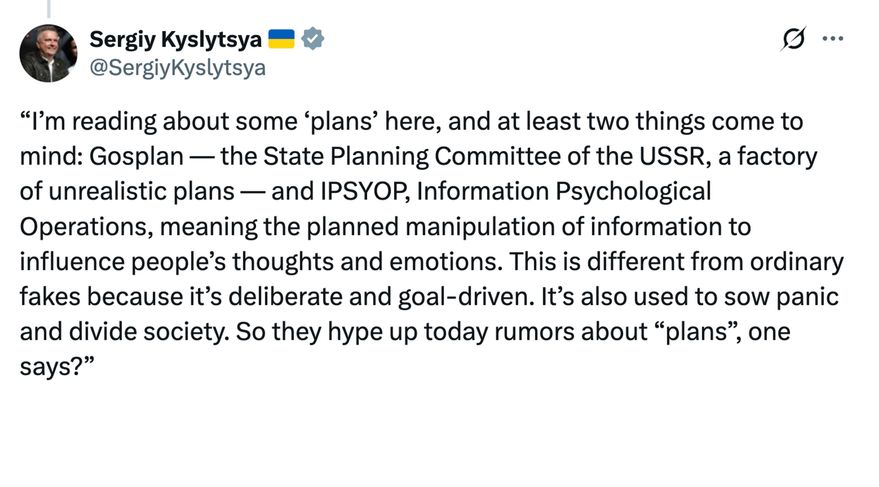
Unsurprisingly, when the fruits of Dmitriev’s labors became public, Kyiv’s reaction was less than enthusiastic. Ukrainian Deputy Foreign Minister Serhiy Kyslytsya tweeted in response to Axios’s initial article that the circulating rumors of a 28-point “peace deal” reminded him of Soviet “active measures”—”the planned manipulation of information to influence people’s thoughts and emotions… to sow panic and divide society.”
Ukraine’s deputy foreign minister wrote on Twitter that rumors of a 28-point “peace deal” are reminiscent of the Soviet “active measures.”
On his way to Geneva to discuss the framework agreement with a nervous Ukrainian delegation (and a group of surprised Europeans), US Secretary of State Marco Rubio called several senators, including Mike Rounds (R-South Dakota) and Angus King (Independent-Maine), who were attending the Halifax Security Forum. Rubio reportedly told them that the plan was not an approved US protocol, but simply a “Russian wish list.” The senators held a live press conference, recounting Rubio’s comments.
After these statements caused an uproar, Rubio backtracked, tweeting that it was, after all, “the American plan.” However, two sources familiar with the details of the conversation told The Insider that the senators’ version was correct. (Neither of them retracted their initial account of Rubio’s words.)
On the first day of negotiations in Switzerland, Rubio attempted to downplay the plan’s official status, calling it a “living document” and “a foundation built from proposals from all interested parties.” This rhetoric was echoed by Trump, who told reporters at the White House that the concept was not his “final offer” to Kyiv.
During consultations with the Ukrainian and European delegations, the 28 points were subsequently reduced to 19, with some of the most pro-Russian provisions reportedly removed. As part of the revised concept, the issues of territorial concessions and NATO membership were left for future discussion between Trump and Zelenskyy.
Kislitsa told the Financial Times on November 24 that the revised 19-point plan his delegation helped craft in Geneva was a significant improvement over Dmitriev’s version. “Very little remains of the original version,” he said.