Eurasia Press & News
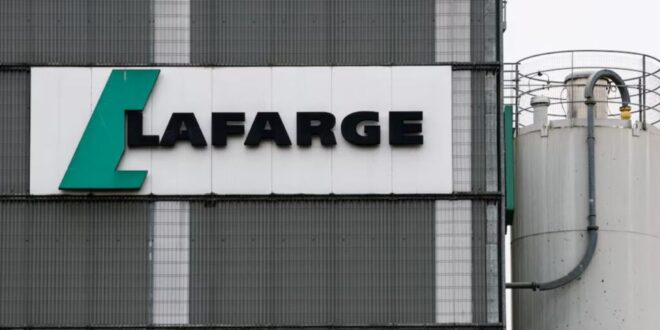
France’s National Anti-Terrorism Prosecutor’s Office in Paris has requested that the court impose a 1.125 million euro fine on the cement company Lafarge and sentence eight of its former senior executives to prison terms of up to eight years.
The toughest prison sentence requested by prosecutors concerned Syrian intermediary Firas Tlass, who did not attend the trial and is wanted under an international arrest warrant, France 24 reported on Tuesday, December 16.
Lafarge is suspected of paying money to groups designated as “terrorist” in Syria until 2014, including the Islamic State group and the al-Nusra Front, which was then affiliated with al-Qaeda, to keep its cement plant running.
Prosecutors also requested a six-year prison sentence, with a suspended committal order, against the group’s former CEO, Bruno Lafont, along with a 225,000 euro fine and a 10-year ban on holding any commercial or industrial position, or managing a company.
As for Lafarge as a legal entity, prosecutors also asked for the partial confiscation of assets worth up to 30 million euros.
France’s customs intelligence and investigations service, for its part, requested a joint customs fine of 4.570 million euros against the company and four defendants, for committing the offense of “failure to comply with international financial sanctions.”
Trial over alleged payments in 2013 and 2014
Company officials are on trial in Paris on charges of terrorism financing, over payments made in 2013 and 2014, through its Syrian subsidiary Lafarge Cement Syria (LCS), to the Islamic State group and the al-Nusra Front, at a time when other foreign companies shut down and left Syria.
The company also paid intermediaries to protect its cement plant in al-Jalabiya (northern Syria, Aleppo countryside) during the war years.
The trial of Lafarge began on November 4, 2025, according to Radio Monte Carlo at the time.
The French broadcaster said the company’s former CEO, Bruno Lafont, five former officials in its operational or security chain, and two Syrian intermediaries, one of whom is wanted under an international arrest warrant, are being tried alongside the company, which was acquired by Switzerland’s Holcim group in 2015, before the Paris Criminal Court.
The Lafarge case
Judicial proceedings in Paris began in 2017, following media reports and lawsuits filed in 2016, one by France’s Economy Ministry for violating the financial embargo on Syria, and another by associations and 11 former employees of the company’s Syrian branch for terrorism financing.
On a parallel track, the new group formed after Holcim’s 2015 acquisition of Lafarge launched an internal investigation and has consistently denied any connection to events that preceded the merger.
Two years later, an investigation entrusted to the US law firm Baker McKenzie and France’s Darrois concluded that there had been “violations of Lafarge’s business conduct rules.”
In October 2022, Lafarge admitted in the United States to paying around 6 million dollars to the Islamic State group and the al-Nusra Front, and agreed to pay a 778 million dollar fine.
Former CEO Bruno Lafont said he was not aware of payments being made to jihadist groups.
According to Lafont’s defense team, this guilty plea, which French investigating judges partly rely on, “constitutes a blatant attack on the presumption of innocence,” and was aimed at preserving the economic interests of a major group.
Lafont’s lawyers said the trial would help “clarify” many “dark aspects of the case,” including the role of French intelligence services.
Investigating judges argued that although information was exchanged between Lafarge security officials and intelligence services about the situation around the factory, this “does not in any way prove that the French state approved Lafarge’s practices of financing terrorist entities in Syria.”
A total of 241 civil parties joined the case. Anna Kiefer of the anti-financial crime NGO Sherpa said that, “more than ten years after the events,” Syrian employees would finally be able to testify about what they endured, whether at checkpoints, through kidnappings, or under the constant threats that loomed over their lives.
Lafarge could face a fine of up to 1.125 billion euros if convicted of terrorism financing. If convicted of violating the financial embargo on Syria, the fine would be much higher.
Another aspect of the case remains under investigation, as the group is also facing accusations of complicity in crimes against humanity in Syria and Iraq.
Who is Firas Tlass?
Firas Tlass is the head of the Syrian Promise Movement and the Syrian National Party. He holds a bachelor’s degree in economics from the University of Damascus (1984). He is the eldest son of former Syrian Defense Minister Mustafa Tlass, and the brother of Assad-era defector Brigadier General Manaf Tlass.
Tlass entered the business world and became one of Syria’s wealthiest businessmen. He founded several commercial and investment companies, including Palmyra Real Estate Development and the Mas Economic Group, which were involved in the coffee bean trade, metal production, and canned food production.
He owns a large number of food and real estate companies, in addition to partnerships with several foreign companies, including the French cement producer Lafarge. He was also known for monopolizing the sugar trade in Syria before the 2011 uprising.
Firas Tlass left Syria for France with his father, Mustafa Tlass, in March 2012, and later moved between France, the UAE, and Egypt.
On June 26, 2012, he announced support for Bashar al-Assad’s resignation, saying he had provided relief support to the al-Farouq Brigade in Homs, one of the Syrian opposition factions at the time, which operated under the leadership of his relative Abdul Razzaq Tlass, one of the officers who defected from the Assad regime.
Tlass was among the founders of the Syrian Promise Movement on April 11, 2014, which aimed to work in areas outside regime control.
On February 7, 2021, he established a new party under the name the Syrian National Party, which he said would operate from inside Syria, with its priority being “the welfare of the Syrian citizen and securing their economic needs.”