 Eurasia Press & News
Toplines
The Iranian regime views the protests as a proto-revolution that it must crush completely and immediately. Some Iranians are resisting the regime, in some cases violently, which reinforces the regime’s view that the protests retain the potential to transform into a revolution. The regime will likely succeed in quelling this resistance if it can retain the loyalty of security forces and prevent those who are resisting the regime from acquiring the wherewithal to challenge the regime’s ability and willingness to sustain its crackdown. The regime has abandoned any effort it made in the beginning of this protest movement to distinguish between legitimate economic protests and illegitimate anti-regime protests. Iranian media and officials, including those who expressed sympathy for protesters in the beginning of this protest movement, are categorically describing protesters as “terrorists.”[1] Iranian Justice Minister Amir Hossein Rahimi stated on January 14 that any protester who has participated in protests after January 8—which is when the rate and scope of the protests expanded dramatically—is guilty of taking part in an “internal war.”[2] Rahimi’s statement highlights how the regime has stopped showing any tolerance toward protests, as it did to an extent in the beginning of the protest movement, and views any protest as a serious threat to the regime.
The extent and extremity of the regime’s use of violence to quell the protests further demonstrate that the regime views the protests as a proto-revolution. Reports from eyewitnesses and protesters in Iran describe an unprecedented degree of regime brutality toward protesters. Iranians told BBC Persian on January 11 that the scale of deaths and injuries in the current protest movement is “unprecedented and incomparable” to previous protest waves.[3] Amnesty International reported on January 14 that regime security forces have committed “unlawful killings…on an unprecedented scale.”[4] Western media outlets have reported protester death toll estimates between 2,000 and 20,000.[5] These numbers surpass the approximately 1,500 protesters who were killed in 2019 and approximately 550 protesters who were killed during the 2022-2023 Mahsa Amini movement.[6] A US-based human rights organization also estimated that the regime has arrested over 10,000 individuals in the current wave of protests thus far.[7] The regime previously arrested around 7,000 individuals in the 2019 protests and 20,000 individuals during the Mahsa Amini movement. The regime arrested 20,000 individuals over a roughly three-month period, whereas the regime has arrested 10,000 individuals in the past two and a half weeks.
CTP-ISW recorded zero protests on January 14, but the regime is sustaining repressive measures that impose a significant cost on the regime. This suggests that the regime does not perceive that the threat from protests has subsided. The regime is maintaining security force mobilizations, which risks exhausting and burning out these forces. Security forces are patrolling streets in towns and cities across Iran to prevent Iranians from holding demonstrations.[8] Sources in Chalus, Mazandaran Province, for example, told a BBC Persian reporter on January 11 that “security forces with machine guns have been stationed in all streets.”[9] The widespread deployment of security patrols is likely contributing to the decrease in recorded protest activity because these patrols are likely deterring some Iranians from participating in protests. The sustained mobilization of security forces increases the risk that the regime will burn out these forces, potentially diminishing their willingness and ability to continue to suppress protesters. Iranian reformist media previously reported in September 2022—days after the Mahsa Amini movement began—that then-Law Enforcement Commander Hossein Ashtari discussed security forces’ exhaustion and bandwidth constraints with senior military and intelligence officials.[10] Security forces will likely experience similar exhaustion if the regime continues to mobilize them for a long period of time.
The regime has also suggested that it will sustain its nationwide internet shutdown for at least another week. Internet shutdowns have a detrimental effect on the Iranian economy, and a sustained shutdown will likely exacerbate the poor economic conditions that triggered this protest movement. Islamic Revolutionary Guards Corps (IRGC)-affiliated media reported on January 14 that “relevant institutions” will decide in the “next week or two” whether to grant greater internet access to the population.[11] Iranian officials have frequently acknowledged that internet shutdowns prevent Iranians from being able to conduct business and therefore have a negative impact on the Iranian economy.[12] NetBlocks estimates that internet shutdowns cost Iran over $1.5 million per hour.[13] A resident in Tehran separately told anti-regime media on January 14 that most shops in Tehran remain closed.[14] The closure of businesses would likely compound the negative impact that the internet shutdown is having on the Iranian economy. The current protest movement was initiated by merchants and shopkeepers in Tehran in late December 2025 in response to Iran’s deteriorating economic conditions.[15]
Some Iranians are resisting the regime’s efforts to contain protests, which further indicates that the regime has not regained control over the security situation. A Europe-based outlet that appears to have sources in Iran reported on January 13 that some Iranians in Shiraz, Fars Province, are fighting back against security forces using knives and machetes.[16] The outlet reported that security forces have struggled to contain crowds by using tear gas and batons and have resorted to using military weapons.[17] The outlet added that communities are “self-organizing” and assisting individuals who are resisting the regime, such as by providing them with safe houses, to sustain protest activity.[18] Resisting security forces that are armed with military weapons is inherently more dangerous than participating in peaceful protests, which demonstrates the commitment of those who are resisting security forces to fight the regime. IRGC-affiliated media reported an increase in security personnel deaths in Fars Province between January 11 and 12, which could corroborate this report of resistance in Shiraz.[19] Shiraz was previously a hotspot for unrest during the 2019 protests.[20] Western and anti-regime media separately reported on January 12 and 14, respectively, that protests continue to take place in Esfahan and eastern Tehran, which highlights how Iranians are continuing to resist security forces in areas outside of Shiraz.[21]
The regime will likely succeed in quelling this resistance if it can retain the loyalty of security forces and prevent those who are resisting security forces from successfully challenging the regime’s ability and willingness to sustain its crackdown. The regime has not indicated any intention to stop using lethal force and brutality to quell the current unrest. The most likely way for protesters to be successful would be through the defection of security forces because protesters are unlikely to degrade the regime’s ability to sustain its crackdown. Security forces are the basis of the regime’s stability, and the loss of security forces’ willingness to suppress unrest could pose an existential threat to the regime. CTP-ISW has not observed reports of defections, although the IRGC Intelligence Organization stated on January 9 that it is “dealing with possible acts of abandonment.”[22] This statement suggests that some Iranian security forces may have already defected or that the regime is very concerned about this possibility.
Iranian regime officials have leaked various protester death counts to Western media. The leak of high protester death counts by some regime officials indicates that these officials may be disaffected by the regime’s brutal crackdown on the protests. Two Iranian officials told the New York Times and Reuters on January 13 that 3,000 and 2,000 people have been killed in the protests, respectively.[23] Both officials claimed that “terrorists” caused the deaths, and the official speaking to the New York Times emphasized that the number of deaths included “hundreds” of security officers.[24] These claims suggest that these officials support the regime’s violent crackdown and seek to emphasize the role of “terrorists” in the current unrest to justify the crackdown. A source close to the Supreme National Security Council (SNSC), two sources in the Iranian presidential office, and several IRGC sources contrastingly told anti-regime media that the protester death count is “at least” 12,000.[25] The leak of such a high protester death count by regime officials suggests that some members of the regime may oppose the regime’s brutal crackdown on the protests. These leaks come amid reports that there are divisions among Iranian security forces over how to respond to the protests.[26]
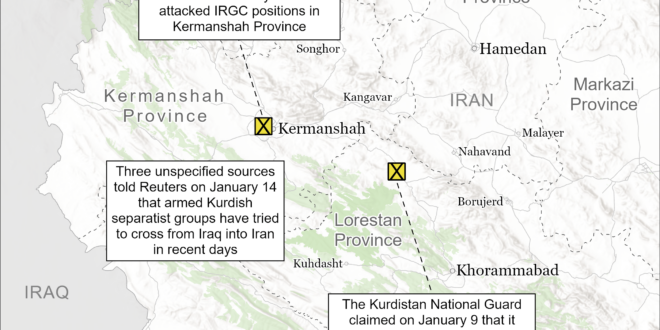
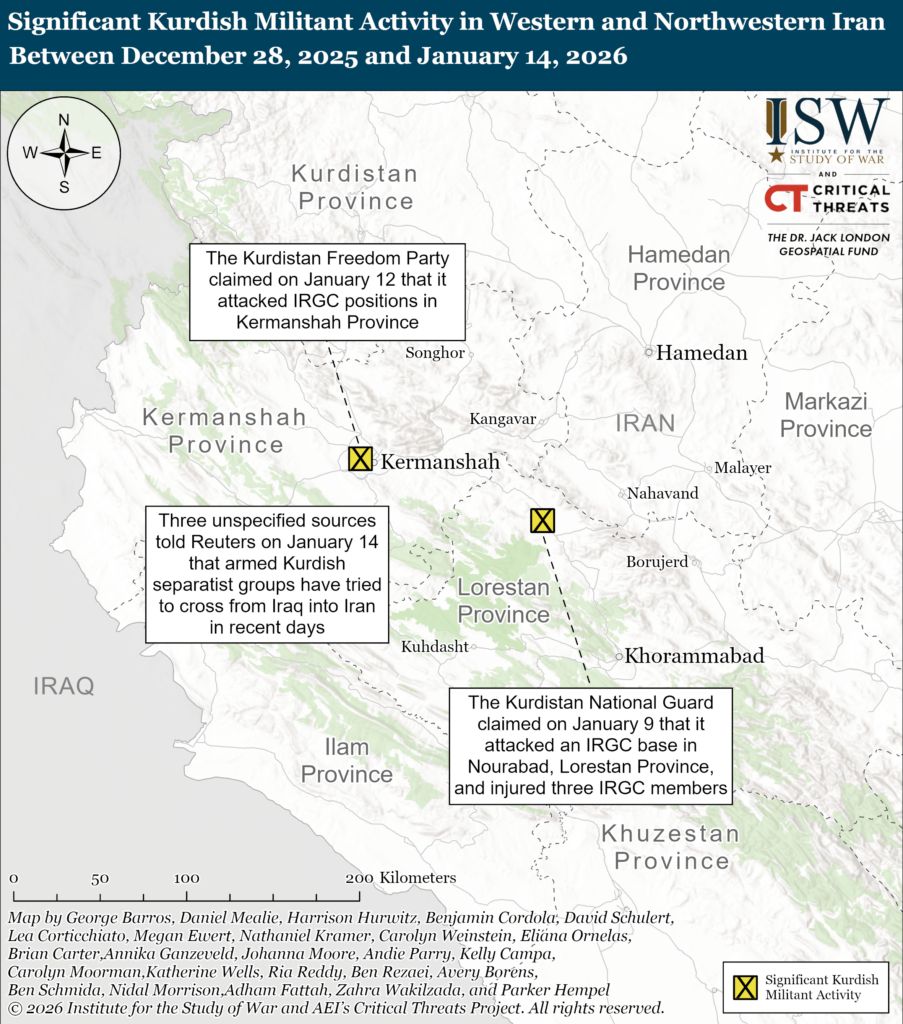
The Iranian regime’s concern about cross-border Kurdish militant activity will likely cause the regime to divert resources to address this threat, which would stretch the bandwidth of Iranian security forces that are suppressing protests. The regime is currently attempting to simultaneously defend against Kurdish militant activity and suppress protests in Iran’s border provinces, particularly in Ilam, Kermanshah, and West Azerbaijan provinces.[27] Turkey’s intelligence service warned the IRGC that armed Kurdish separatist groups were attempting to cross from Iraq into Iran “in recent days,” according to three unspecified sources familiar with the matter speaking to Reuters on January 14.[28] The Reuters report follows several attacks by Kurdish anti-regime groups against Iranian military sites in recent days. The Kurdistan National Guard announced on January 9 that it attacked an IRGC base in Nourabad, Lorestan Province, and injured three IRGC members.[29] The Kurdistan Freedom Party (PAK) separately claimed responsibility for an attack on IRGC positions in Kermanshah Province on January 12 that killed an unspecified number of IRGC personnel.[30] The uptick in Kurdish militant activity in western and northwestern Iran in recent days will likely force the regime to divert personnel and resources to confront this issue that it would have otherwise used to quell protests.
The regime’s confrontation with Kurdish militant groups in western and northwestern Iran comes as the regime has simultaneously sought to suppress intense protest activity in these areas.[31] The regime has only deployed IRGC Ground Forces units to suppress protests in western and northwestern Iran, which suggests that the intensity of protests in these areas have challenged the Law Enforcement Command and Basij’s ability to contain them.[32] The regime has deployed the 29th Nabi Akram Division to suppress protests in Kermanshah and has threatened to deploy units that operate under the Hamzeh Seyyed ol Shohada Operational Base to suppress protests in northwestern Iran, for example.[33] A Kurdish human rights organization reported on January 9 that security forces in Eslamabad-e Gharb, Kermanshah Province, sought reinforcements but could not receive reinforcements due to a shortage of forces.[34] The bandwidth constraints that security forces are reportedly facing in western Iran are exacerbated by Kurdish militant attacks and the regime may not be able to simultaneously confront both issues effectively. The regime previously not only threatened escalation but also shelled anti-regime Kurdish militant positions in the Iraqi Kurdistan Region (IKR) during the Mahsa Amini movement, but Iranian security forces have notably neither threatened to do so nor done so during the current protest movement.[35] The lack of kinetic action against Kurdish militant groups suggests that security forces may be facing bandwidth constraints as they try to confront the Kurdish militancy issue and protest activity simultaneously.
Iran has continued to coordinate with Turkey and Iraq in an effort to contain cross-border Kurdish militant activity. Iranian Foreign Affairs Minister Abbas Araghchi discussed the recent protests in Iran, and likely cross-border Kurdish militant activity, in a phone call with Turkish Foreign Minister Hakan Fidan on January 14.[36] Iranian SNSC Secretary Ali Larijani separately discussed the implementation of the March 2023 Iran-Iraq security agreement in a phone call with Iraqi National Security Adviser Qassem al Araji on January 14.[37] The March 2023 agreement requires Iraqi authorities to disarm and relocate Kurdish anti-regime groups away from the Iran-Iraq border.[38]
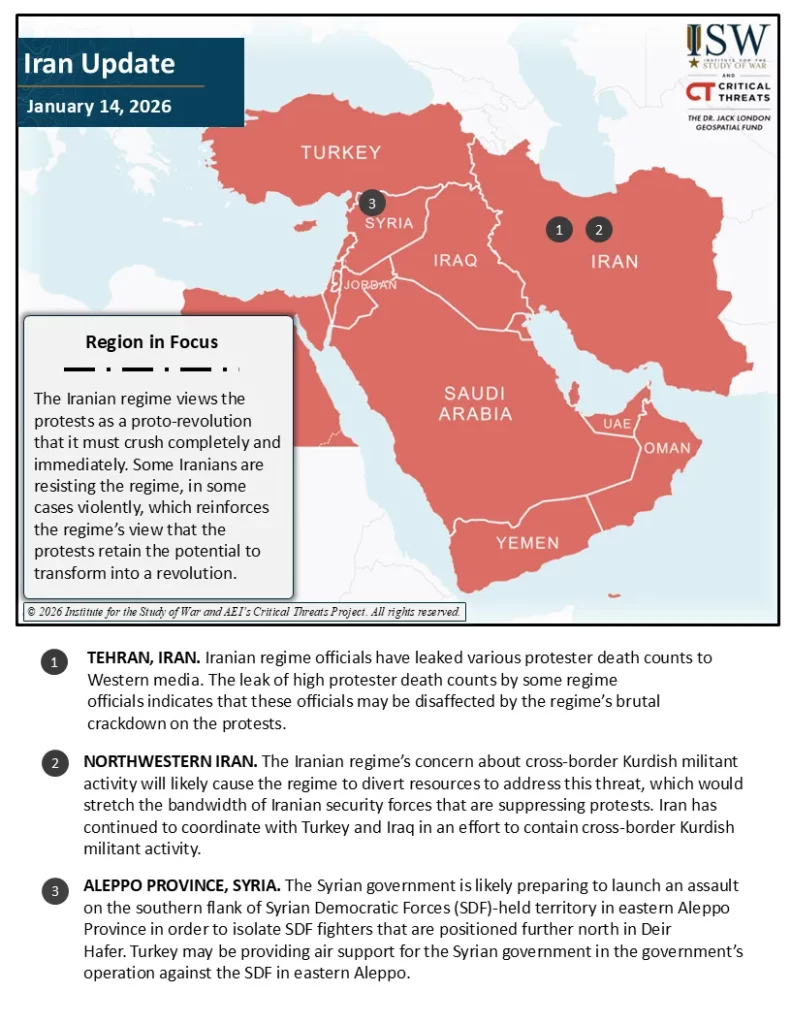
The Syrian government is likely preparing to launch an assault on the southern flank of Syrian Democratic Forces (SDF)-held territory in eastern Aleppo Province in order to isolate SDF fighters that are positioned further north in Deir Hafer. The Syrian Ministry of Defense (MoD) began a limited offensive operation against the SDF in a salient east of Aleppo City and west of the Euphrates River on January 13.[39] The Syrian government’s stated objective is to secure the majority of the SDF-controlled salient, which includes Deir Hafer and territory along the western bank of Lake Assad.[40] The government said that it intends to prevent further SDF reinforcements to the area and deny the SDF’s ability to launch drone attacks targeting government territory.[41]
Several indicators suggest that the Syrian army is preparing for a possible assault on Maskanah, which is an SDF-held city located between Deir Hafer and the rest of SDF-controlled territory, in order to isolate Deir Hafer from SDF supply lines and reinforcements. The Syrian MoD declared on January 14 that it will open a humanitarian corridor for eight hours on January 15 to allow civilians to safely evacuate Maskanah and Deir Hafer and travel to government-controlled territory.[42] The MoD has sent more Syrian army reinforcements to the Deir Hafer frontlines since January 13, including reportedly deploying the coastal Syria-based 50th Division, which is led by likely former HTS commander Brigadier General Mahmoud Hamdi.[43] The Syrian government closed the desert road that connects Maskanah to government-held territory to the west, which indicates that military forces may be traveling in the area.[44] A northern Syria-based source reported on January 13 that “large” Syrian army reinforcements arrived on Maskanah’s outskirts.[45] The Syrian army has continued to shell SDF positions in Deir Hafer since January 13, and the SDF said that MoD forces attempted to infiltrate the SDF-controlled village of Zubaida, south of Deir Hafer, on January 13.[46] One objective of the MoD’s operations around Deir Hafer may be to fix SDF forces around Deir Hafer to them from reinforcing the SDF’s southern flank.

Turkey may be providing air support for the Syrian government in the government’s operation against the SDF in eastern Aleppo. The SDF alleged that Turkish Bayraktar drones struck Maskanah in addition to an SDF position in al Buasi, north of Tabqa, Raqqa Province, on January 13.[47] Turkey provided significant air support to the Syrian National Army factions that engaged the SDF along the western bank of the Euphrates River in the months between the Assad regime’s collapse and the Syrian government-SDF ceasefire in April 2025.[48] The Turkish Defense Ministry said on January 8 that the Turkish army is “ready to provide the necessary support” to the Syrian government in a conflict with the SDF.[49] Turkish involvement in the MoD’s operations could signal that the MoD seeks to expand operations against the SDF further into SDF-controlled territory. The Syrian government would probably need significant Turkish support to conduct any large-scale operations into northern and eastern Syria. CTP-ISW noted on January 13 that the Syrian government’s operation in Deir Hafer does not appear at this time to be part of a larger-scale countrywide military campaign against the SDF, however.[50]
The United States is attempting to de-escalate tensions among the involved parties. US Central Command (CENTCOM) Commander Admiral Brad Cooper called on all parties to “exercise maximum restraint” and “return to the negotiating table in good faith” on January 13.[51] US Special Envoy to Syria and Ambassador to Turkey Tom Barrack held a “productive and candid” conversation with Turkish Foreign Minister Hakan Fidan in Ankara on January 14.[52] Barrack, who recently appeared to have played a role in encouraging Turkey to show restraint toward the SDF during a December 16 visit to Ankara, almost certainly discussed the eastern Aleppo operation with Fidan, given both men’s involvement in the Syrian government’s negotiations with the SDF.[53]
Key Takeaways
Iranian Threat Perception: The Iranian regime views the protests as a proto-revolution that it must crush completely and immediately. Some Iranians are resisting the regime, in some cases violently, which reinforces the regime’s view that the protests retain the potential to transform into a revolution. The regime will likely succeed in quelling this resistance if it can retain the loyalty of security forces and prevent those who are resisting the regime from acquiring the wherewithal to challenge the regime’s ability and willingness to sustain its crackdown.
Deaths of Protesters in Iran: Iranian regime officials have leaked various protester death counts to Western media. The leak of high protester death counts by some regime officials indicates that these officials may be disaffected by the regime’s brutal crackdown on the protests.
Anti-Regime Kurdish Militant Group Activity: The Iranian regime’s concern about cross-border Kurdish militant activity will likely cause the regime to divert resources to address this threat, which would stretch the bandwidth of Iranian security forces that are suppressing protests. Iran has continued to coordinate with Turkey and Iraq in an effort to contain cross-border Kurdish militant activity.
Syrian Military Operations in Aleppo Province: The Syrian government is likely preparing to launch an assault on the southern flank of Syrian Democratic Forces (SDF)-held territory in eastern Aleppo Province in order to isolate SDF fighters that are positioned further north in Deir Hafer. Turkey may be providing air support for the Syrian government in the government’s operation against the SDF in eastern Aleppo.
Iran
See topline section.
Iraq
Nothing significant to report.
Syria
See topline section.
Arabian Peninsula
CTP-ISW has temporarily suspended its coverage of Yemen beginning on January 9 to prioritize coverage of the protests in Iran.
Palestinian Territories & Lebanon
Hezbollah will only respond to a US or Israeli attack on Iran if it poses an “existential” threat to the Iranian regime, according to a Lebanese source close to Hezbollah speaking to Reuters on January 14.[54] Reuters reported that unspecified diplomats have sought guarantees from Hezbollah over the past week that it will not get involved militarily if the United States or Israel attack Iran.[55] Hezbollah reportedly said that it “has no plans to act” unless a US or Israeli attack were to pose an existential threat to the Iranian regime.[56] It is unclear how Hezbollah defines an existential threat or its threshold for involvement. Hezbollah was previously unwilling and likely unable to defend Iran or retaliate against US or Israeli targets during the Israel-Iran War in June 2025, despite previously serving as one of Iran’s primary deterrents against Israel and the United States.[57] Lebanese, Saudi, and Israeli media have widely circulated the Reuters report, but CTP-ISW has not been able to locate the original report at the time of this writing.[58] Lebanese media reported on January 5 that US officials called on the Lebanese government to prevent Hezbollah from supporting Iran in future conflicts to avoid Israel expanding its operations against Hezbollah in Lebanon.[59] Hezbollah released a statement on January 13 that expressed support for the Iranian regime but notably did not offer Iran military support or threaten to retaliate against the United States or its allies if they attack Iran.[60]