 Eurasia Press & News
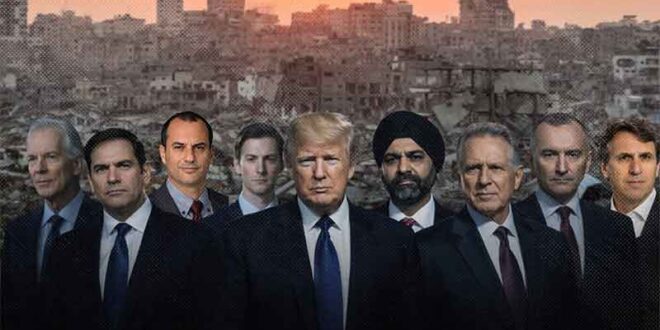
US President Donald Trump has named former UK Prime Minister Tony Blair and US Secretary of State Marco Rubio as members of his so-called “Board of Peace”, a body which he says will oversee the governance and reconstruction of Gaza after two years of Israeli genocide.
With Trump serving as chair, the Founding Executive Board will oversee the work of a committee of technocrats tasked with the temporary governance of Gaza and its reconstruction. It will also include US special envoy Steve Witkoff, World Bank President Ajay Banga, and the president’s son-in-law Jared Kushner.
There will also be a separate “Gaza Executive Board” – responsible for overseeing all on-the-ground work of yet another administrative group, the National Committee for the Administration of Gaza (NCAG).
Meanwhile, the Board of Peace is expected to sit above these two executive bodies and comprise a number of world leaders.
Here is everything you need to know about Trump’s “Board of Peace” members:
Tony Blair
Blair is known for his role in the 2003 US-led invasion and occupation of Iraq.
After leaving office, Blair’s consultancy organisation, the Tony Blair Institute (TBI), has drawn widespread criticism for advising a raft of autocratic governments including Egypt, the UAE, and Saudi Arabia.
TBI has also received money from a financial fraudster linked with illegal Israeli settlements and an American Islamophobic network.
Blair also serves as an honorary patron of the UK branch of Israel’s Jewish National Fund (JNF), which has faced heavy criticism for its activities – including donating £1m ($1.3m) to what it described as “Israel’s largest militia” and erasing Palestine from its official maps.
TBI was more recently linked to a widely condemned plan which proposed the ethnic cleansing of Gaza, involving a sweeping postwar redevelopment of the besieged Strip.
The project includes turning the devastated enclave into a “Trump Riviera,” with infrastructure named after Gulf monarchs and was created by Israeli businessmen with support from Boston Consulting Group (BCG).
He described Trump’s plans for Gaza as the “best chance of ending two years of war, misery and suffering”.
Conceding that Blair’s inclusion on the executive board is controversial, Trump said in October: “I’ve always liked Tony, but I want to find out that he’s an acceptable choice to everybody.”
A map on TBI’s website includes the occupied West Bank, Gaza, and the Golan Heights as part of Israel, reinforcing concerns over the organization’s alignment.
He will serve on the Gaza Executive Board.
Jarad Kushner
Former Middle East advisor and Donald Trump’s son-in-law Jared Kushner was one of the main architects of Trump’s Abraham Accords, and he formed an especially close friendship with Saudi Arabia’s Crown Prince Mohammed bin Salman.
He floated a plan dubbed “The Deal of the Century”, which called for Israel to annex 30 percent of the West Bank and a Palestinian pseudo-state to be created with no military. The plan tried to entice the Palestinian Authority by offering $50bn in economic aid. It was rejected.
When Trump left the White House, Kushner launched Affinity Partners, a private equity fund that blended Kushner’s taste for exotic properties, adventure and geopolitics. Saudi Arabia is Affinity Partners’ main backer, with its sovereign wealth fund giving Kushner $2bn dollars.
With the Gulf money, Affinity Partners has invested in two Israeli companies: Phoenix Holdings, an insurance company, and the car leasing division of Shlomo Holdings, whose parent company, Shmeltzer Holdings, is part owner of Israel Shipyards, the only domestic shipbuilder for the Israeli navy.
When Kushner began his White House role, the little experience he had in the Middle East was based on religious Zionism through his synagogue. Kushner was raised in an Orthodox Jewish household, and Trump’s daughter Ivanka converted to Judaism after marrying him.
The 44-year-old hails from a family of Jewish New Jersey real estate developers known for their cut-throat ways. The Kushner family is especially close with ICC-wanted Israeli Prime Minister Benjamin Netanyahu. So close in fact that Netanyahu once slept in Jared Kushner’s bedroom at the family house in New Jersey decades ago when he was visiting the US, the New York Times reported previously.
When Trump called for the US to take over the Gaza Strip and turn it into a Middle East Riviera with the Palestinians forcibly displaced, many Arab officials in the region and analysts saw Kushner’s hand at work.
In February 2024, Kushner gave a talk at Harvard where he advocated for the forced displacement of Palestinians and highlighted the destroyed enclave’s real estate potential.
“Gaza’s waterfront property, it could be very valuable,” he said. “It’s a little bit of an unfortunate situation there, but I think from Israel’s perspective, I would do my best to move the people out and then clean it up.”
Steve Witkoff
Steve Witkoff, a New York real estate developer and investor, was a relatively unknown political newcomer in Trump’s team who emerged as a key figure in the Gaza ceasefire negotiations.
After the first deal was announced in January and later violated by Israel, Trump said Witkoff would continue “to work closely with Israel and our Allies to make sure Gaza NEVER again becomes a terrorist safe haven”.
Witkoff, who is Jewish himself, has been a friend of Trump for four decades. Now, he’s Trump’s Middle East envoy.
Witkoff has consistently blamed Palestinians for Israel’s assault on Gaza and claimed that humanitarian aid is reaching starving Palestinians despite Israel’s blockade. “There is hardship and shortage, but no starvation,” he once said, at a time when Israel was using starvation as a weapon of war against Palestinians.
Marco Rubio
As US Secretary of State, Marco Rubio is central to the Trump administration’s approach to foreign policy.
Before Trump’s return to office, Rubio had spoken out against a ceasefire in Gaza, saying that he wanted Israel “to destroy every element of Hamas they can get their hands on”.
In October, he said the Gaza security force must include nations Israel is “comfortable with” and that the UN agency for Palestinian refugees (Unrwa) can have no future in the running of Gaza.
Rubio has long been known as a strong opponent of the BDS movement and pro-Palestine activism, and for cracking down on anti-genocide, pro-Palestinian protests.
Ajay Banga
Ajay Banga, president of the World Bank, has advised a number of senior US politicians, including President Barack Obama, during his career.
Born in India in 1959, Banga became a US citizen in 2007, and later served as the CEO of Mastercard for more than a decade.
Former US President Joe Biden nominated him to lead the World Bank in 2023.
In 2024, he warned that a significant widening of Israel’s assault on Gaza could lead to major impacts on the global economy, calling the steep loss of civilian lives “unconscionable.”
Banga said war damage from Israeli strikes on Gaza was at that time probably in the $14-20 billion range, and destruction from Israel’s bombing of southern Lebanon added to that regional total.
Marc Rowan
Marc Rowan, an American billionaire investor and co-founder of Apollo Global Management, is among the most prominent financial figures on the board. He is currently serves as Apollo’s chief executive officer and is widely regarded as one of the firm’s principal strategists.
Apollo Global Management is one of the world’s largest alternative investment firms. Rowan’s personal wealth is estimated at approximately $8.2 billion, based on Forbes’ 2026 rankings. He has also been active in philanthropic initiatives and is known for supporting organizations focused on combating antisemitism.
Observers say Rowan is likely to play a central role in designing complex financial structures aimed at attracting private global capital to Gaza, shifting reconstruction from emergency relief toward long-term investment.
Yakir Gabay
Israeli businessman Yakir Gabay, who also holds Cypriot citizenship, is another key figure named to the board. Gabay is a major player in European real estate and is expected to focus on housing solutions and investment models for Gaza’s massive displacement crisis.
Gabay owns approximately 15 percent of Aroundtown, Europe’s largest commercial real estate company by assets under management. The firm’s portfolio is valued at around $30 billion and spans Germany, the Netherlands, and the United Kingdom, according to Forbes.
Gabay began his career at Israel’s Securities Authority before moving into the private sector, later serving as chief executive of the underwriting arm of Bank Leumi. He entered the real estate market in the early 2000s, capitalizing on depressed property prices in Berlin before expanding across major European cities.
Gabay also comes from a family with deep institutional ties in Israel. His father, Meir Gabay, served as director-general of Israel’s Ministry of Justice and as civil service commissioner. His mother, Yemima Gabay, held a senior position in the public prosecution and headed the pardons department at Israel’s Ministry of Justice.
Robert Gabriel
Robert Gabriel, a US national security adviser, will be the final member of the “founding executive board”.
Gabriel has worked with Trump since his 2016 presidential campaign, shortly after which, according to PBS, he became a special assistant to Stephen Miller, another of Trump’s key current advisers.
Nickolay Mladenov
The 53-year-old former Bulgarian foreign minister and defence minister is the most critical figure in the newly launched phase two of the ceasefire.
While not on the Executive Board, Mladenov has been confirmed as the director-general of the United States-proposed “Board of Peace”. His mandate is to oversee the transition to a new technocratic administration.
For five years from 2015-2020, Mladenov served as the United Nations’ top envoy to the region.
Now, he is tasked with supervising the new “technocratic committee”, which will manage daily life for two million war-battered Palestinians who have lost homes and now displaced after two years of Israeli genocide and ongoing violations of ceasefire.
The “Board of Peace” signals a new governance architecture for post-genocide Gaza, one that shifts management from local frameworks to an internationally led structure with clear political, security, and economic mandates.