 Eurasia Press & News
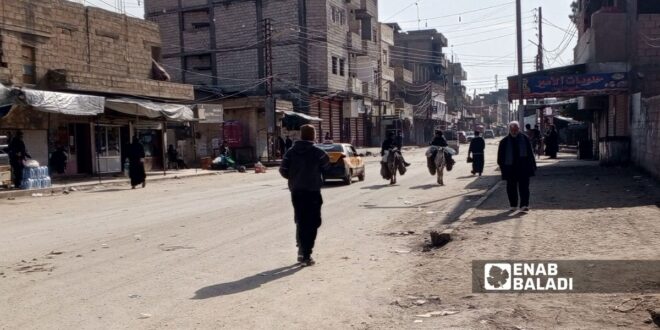
The city of Hasaka and its surroundings turned into a kind of “closed military zone”, where the SDF tightened its control over all entrances and exits, amid the almost complete absence of safe corridors for civilians wishing to flee the escalation.
This field tightening comes in conjunction with a cautious calm on the fronts between the Syrian Democratic Forces (SDF) and the Syrian government since dawn on Thursday, January 29, after a night of mutual targeting of the countryside of the province.
The Paths of Death
The “safe corridors” crisis is at the forefront of the humanitarian landscape in Hasakah, where exit options from the city are limited and risky.
According to field sources, Enab Baladi said that the road adopted by the Syrian government forces towards the area of “Tel Baroud” as a corridor for the exit of civilians, is no longer valid for actual use, after it became directly monitored by snipers and elements of the “SDF”, turning it into a “trap” that threatens the safety of transitors.
This field siege extended to all axes, as the “Tel Aswad” road east of Hasaka was completely closed, and the vital “Hasaka-Tel Barak” road, which starts from the town of “Safya” north of the city center, was cut.
These successive closures have isolated the city from its countryside, forcing dozens of families to resort to “smuggling routes” and dangerous exit, amid the spread of snipers targeting any suspicious movement, exacerbating human suffering and making the displacement an unsafe adventure.
On the ground: the calm of the fronts and the activity of the international coalition
On the military front, Enab Baladi’s correspondents have recorded a halt in direct combat operations on the main lines of contact since the early hours of dawn.
Yesterday evening, there was a wide escalation, as the two sides exchanged shelling in the countryside of Tel Tamr, Ras al-Ain and the Jabal Abdul Aziz area, which are hot contact points that witness continuous friction between the SDF and the Syrian government forces.
In the air, the noise of the international coalition warplanes, which continued its intensive overflight of the city, has not subsided.
This air activity covers complex air security operations aimed at moving ISIS prisoners from detention centers in Hasakah towards Iraqi territory, in a precautionary step to secure these detainees away from areas of direct conflict.
A security grip. Liquidation and arrests provoke resentment
Internally, areas under the control of the SDF are living in a state of popular tension as a result of continued human rights violations. Local circles were buzzing with the news that the body of the young man, Saleh Abdul Samad al-Humoud, was found lying in the village of Tal Fars, north of al-Hasakah, days after his arrest.
Al-Hamoud, a soldier who defected from the ranks of the SDF about three weeks ago, was physically liquidated after the raid on his house, in an incident that the people considered a clear message of intimidation to anyone who tries to defect or oppose the security policies of the SDF.
In another incident that reflects the restrictions on freedoms, the security forces of the SDF arrested the teacher Suleiman Alyan, a displaced person from the city of Ras al-Ain, while he was in the city of Al-Hasakah.
The arrest came against the backdrop of searching his mobile phone and finding a picture of the Syrian flag, a procedure that has recently been repeated as part of the tight security checks imposed by the SDF on civilians at checkpoints.
Foreign fighters and the legalization of presence
On the other hand, the SDF-affiliated media acknowledged the killing of the fighter Ahmed Omar, an Iraqi national from the province of Kirkuk, who was killed during the recent clashes in Hasaka.
This official announcement renews the controversy over the use of non-Syrian fighters by the SDF, and the presence of elements belonging to the PKK within its ranks, a charge that the SDF leadership has long officially denied, but the funerals of foreign fighters confirm this cross-border involvement in the Syrian conflict.
The Tragedy of “Arisha” and the Rehabilitation of the Energy Sector
Humanitarianly, the situation is getting worse in the “Arisha” camp south of Hasakah, as winter storms intensify, thousands of displaced people suffer from lack of heating, lack of food and lack of medical care.
Dilapidated tents can no longer withstand rain, in light of international silence and a decline in relief aid to informal and organized camps in the region.
Economically, the Syrian government is trying to repair what was destroyed by the war in the energy sector, as the Ministry of Energy announced the rehabilitation of two electricity-generating violence in the strategic “Gibsa field.”
This measure allowed the resumption of oil and gas pumping towards refineries in Homs and Baniyas, which could contribute to improving the energy reality in areas controlled by the Syrian government, despite the security challenges facing the long supply lines between eastern and western Syria.